
Why Your AC Can't Keep Up During Santa Ana Winds (And What to Do About It)
Updated on May 12, 2026
You know the morning. You step outside to grab the mail and the air hits you like someone opened an oven door. The sky is that eerie, crystal-clear blue with not a cloud anywhere. Your neighbor's palm trees are bent sideways. And inside, even though your AC has been running since 6 AM, it's 79 degrees and climbing. You set it to 72 last night. The system sounds fine. The vents are blowing. But it's just... not keeping up.
Welcome to Santa Ana wind season in Orange County.
Every year, we get flooded with calls during these events. Homeowners in Yorba Linda, Anaheim Hills, Brea, Fullerton, Villa Park are all convinced something broke. And sometimes something has. But most of the time? Their air conditioner is doing exactly what it's supposed to do. It's just fighting conditions that no standard residential system was designed to beat.
After 15 years of providing AC repairs across Orange County, we've learned that the most helpful thing we can do during Santa Ana wind season is help homeowners understand what's actually happening, what they can fix themselves, and when they genuinely need us to show up. That's what this guide is for.
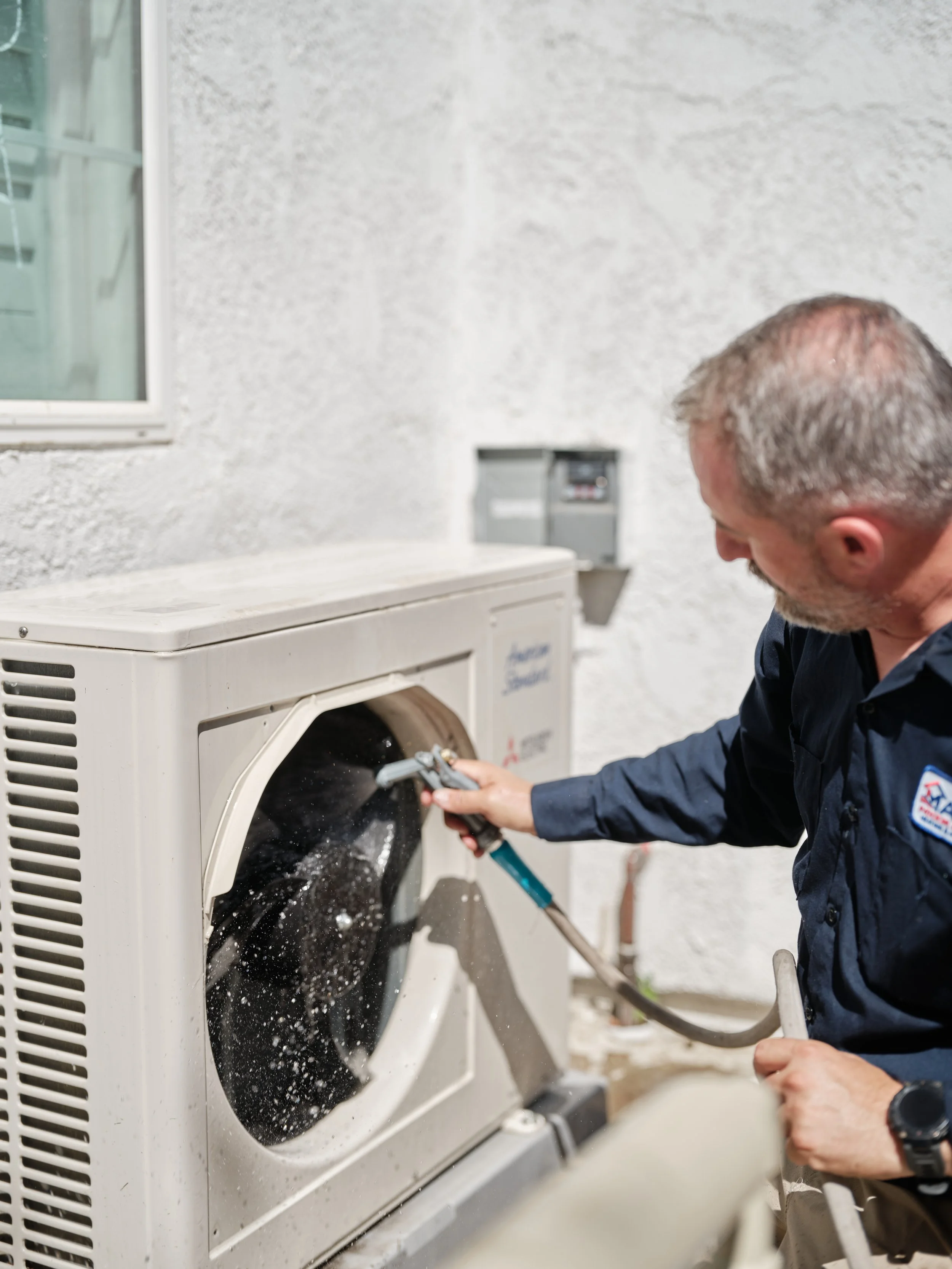
Santa Ana winds leave your condenser coils coated in desert dust. A professional cleaning restores cooling capacity fast. Schedule your maintenance with J Martin: (714) 462-4686.
What Makes Santa Ana Winds So Brutal on Your AC
Santa Ana winds aren't just "hot weather." They're a completely different animal, and understanding what they actually are explains a lot about why your air conditioner can't handle them.
These winds start hundreds of miles away in the Great Basin, the high desert region covering most of Nevada and parts of Utah. When a high-pressure system builds over that area, it pushes dry, cold air westward toward the coast. As that air mass descends through mountain passes like the Cajon Pass and San Gorgonio Pass, it compresses. And when air compresses, it heats up fast. Atmospheric scientists at UCLA have documented that dry air warms at roughly 5°F for every 1,000 feet it drops in elevation. So air that started out cold in the desert arrives in Orange County scorching hot and bone dry.
How dry? During Santa Ana events, relative humidity regularly drops into single digits. To put that number in context, the Sahara Desert typically sits around 20 to 25% humidity. During a Santa Ana event, your backyard in Anaheim is literally drier than the Sahara.
The temperatures are equally extreme. Inland areas like Yorba Linda and Anaheim Hills regularly hit the mid-90s to low 100s during Santa Ana events, and this can happen in any month from September through May. It's not just a summer problem. In early February 2026, a Santa Ana event pushed temperatures above 90°F across parts of Orange County — roughly 20 degrees above normal for the time of year. The National Weather Service recorded wind gusts between 50 and 60 mph in the foothills, with sustained advisory-level winds throughout the region.
Research published in Climate Dynamics found that 10 to 25 Santa Ana events hit Southern California each year, averaging three days each. The longest on record lasted 14 days straight in November 1957. That means your AC system faces multiple multi-day extreme heat events annually that have nothing to do with normal summer conditions.
Here's what makes this uniquely punishing for your air conditioner: it's not just the heat. It's the heat plus the extreme dryness plus the sustained high winds all hitting at the same time. Each one alone would stress your system. Together, they create a scenario most residential AC units simply weren't engineered to overcome.
Why Your Air Conditioner Falls Behind
Your AC system was sized based on something HVAC engineers call the "design temperature." In Orange County, most residential systems are designed to handle outdoor temperatures around 95 to 100°F while maintaining roughly 75°F indoors. That's a 20 to 25 degree temperature differential. When Santa Ana winds push outdoor temps past 100°F and drive hot air directly into your home's structure, you're asking your system to do more than it was built for.
Think of it like a car. Your AC is a Honda Civic that's perfectly capable of cruising at 70 on the freeway. During a Santa Ana event, you're asking it to do 110 uphill. It's not broken. It's just reached its limit.
Here's what's actually happening to each part of your system during a Santa Ana event.
Your Outdoor Unit Is Getting Battered
The condenser, that big box sitting outside your house, works by releasing the heat it pulled from inside your home into the outdoor air. It does this by blowing outdoor air across coils filled with hot refrigerant. The bigger the temperature difference between the refrigerant and the outdoor air, the more efficiently this works.
During a Santa Ana event, the outdoor air is way hotter than your system was designed for. That shrinks the temperature differential, which means your condenser can't shed heat as efficiently. It has to run harder and longer to achieve the same cooling. At 95°F, your system might cool your home comfortably. At 105°F, it's falling behind even though nothing mechanical has changed. This guide provides more detail on what to check when your AC is running but not cooling.
The wind makes it worse. You'd think strong wind would help cool the condenser, but Santa Ana winds are hot winds — often hotter than the surrounding ambient air. They blast your condenser with air that's above the temperature it was designed to handle. And they carry enormous amounts of dust, sand, dirt, and debris from the desert. After even one Santa Ana event, your condenser coils can be coated in a layer of grime that reduces heat transfer and chokes airflow through the fins.
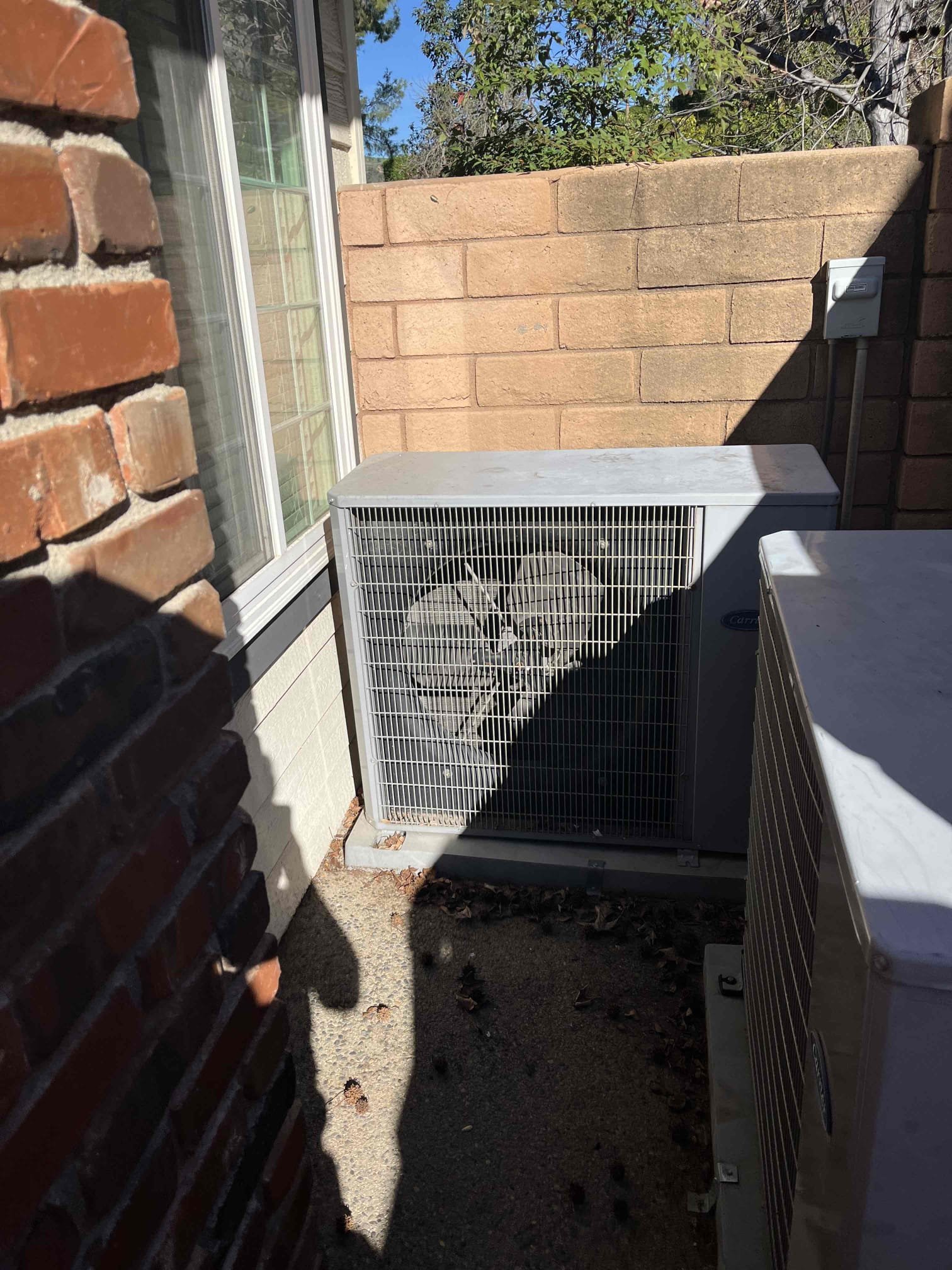
Santa Ana winds carry enormous amounts of dust, leaves, and debris straight into your outdoor unit. When your condenser is tucked between walls like this, there's nowhere for that debris to go. Clear a two-foot perimeter around your unit before the next wind event. Need a professional cleaning? Call J Martin: (714) 462-4686.
Your Home Is Leaking Heat Like a Sieve
Santa Ana winds don't just affect your outdoor unit. They attack your home's ability to stay cool from every direction. Hot, gusty wind pushes through every gap, crack, and weak point in your home's envelope, around old windows, under doors, through gaps in weatherstripping, around plumbing penetrations and electrical outlets, through recessed lighting in the ceiling.
A lot of Orange County homes were built in the 1960s through 1990s. Their original sealing has degraded significantly. If your house feels drafty during a Santa Ana event, that "draft" is 100+ degree desert air forcing its way inside. Your AC system then has to cool all of that infiltrated air on top of the heat already radiating through your walls, windows, and roof.
This is why attic insulation matters so much. During a Santa Ana event, attic temperatures can exceed 150°F. If your insulation is thin, old, or compressed, that extreme heat radiates straight down into your living spaces. Your AC is fighting heat from above, heat from the sides, and hot air being forced through every crack in the building.
The effect is especially brutal in two-story homes. Heat rises. During a Santa Ana event, the combination of a superheated attic, inadequate insulation, and hot wind blasting the upper level can make second-floor bedrooms 8 to 15 degrees warmer than the ground floor, even with the AC running nonstop. If this sounds like your house, we wrote a whole separate guide on why upstairs rooms get so hot in Orange County two-story homes and how to fix it.
The Dry Air Messes With Your Perception
Here's something most people don't think about. Your thermostat measures temperature. It doesn't measure comfort. During normal conditions in Orange County, indoor humidity is around 40 to 55%. During a Santa Ana event, indoor humidity can plummet to 15 to 20% or lower because the dry air infiltrating your home overwhelms your normal moisture levels.
Extremely dry air actually feels cooler on your skin because sweat evaporates faster. So your house might be 78°F and you feel "okay" until you don't. At that point, you crank the thermostat lower and lower, demanding more from a system that's already maxed out. Meanwhile, that dry air is affecting your health too, cracking skin, irritating sinuses, drying out nasal passages, and making everyone in the house feel worse.
Is Your AC Broken, or Is It Just the Winds?
This is the million-dollar question, and it's the first thing we help homeowners figure out on service calls during Santa Ana events. Here's how to tell.
Signs Your System Is Working Fine (Just Overwhelmed)
If your AC is running steadily and the air from your vents feels cold, but your house is a few degrees warmer than the thermostat setting, your system is probably working correctly. It's just hit its capacity limit. This is normal during extreme conditions.
Here's a quick test. Grab a kitchen thermometer or a cheap infrared thermometer from a hardware store. Measure the temperature of the air at your supply vent (where cold air comes out), then measure the air at your return vent (where warm air gets sucked in). You should see a 15 to 20 degree difference. If you're getting that split, your system is doing its job. The outdoor conditions are simply more than it can overcome.
A system running continuously during a 105°F Santa Ana event that's maintaining 78°F when you want 72°F is performing well. It's not broken. It's doing the best physics will allow.
Signs Something Is Actually Wrong
Some problems are real regardless of the weather. These need professional attention.
No cold air at all. If the air from your vents feels room temperature or warm, something has failed, a dead compressor, a refrigerant leak, or an electrical problem. This won't improve when the wind stops.
Short cycling. If your system turns on, runs for two to five minutes, shuts off, then starts again a few minutes later, that's called short cycling. It means something is wrong with your system's ability to complete a cooling cycle. We wrote a detailed breakdown of every cause of AC short cycling and what to do about it that's worth reading if this is happening.
New, unusual noises. Your AC working hard sounds like steady humming and consistent fan operation. Mechanical failure sounds like grinding, screeching, banging, or high-pitched squealing. If you're hearing sounds your AC has never made before, shut it down and call for service. Mechanical noises get worse with every minute of operation.
Ice on refrigerant lines. This seems impossible when it's 100°F outside, but ice forming on your lines or evaporator coil during hot weather means you likely have a refrigerant leak or severely restricted airflow. Both are problems that will destroy your compressor if you keep running the system.
Tripped breaker. An AC that keeps tripping the circuit breaker is drawing too much current. This could be a failing compressor, a bad capacitor, or an electrical fault. Don't just keep resetting the breaker. That's how electrical problems become electrical fires.
What You Can Do Right Now (No Tools, No Tech Required)
These are the things you can do today, during a Santa Ana event, with zero cost or minimal investment. Don't underestimate them. Combined, they can make the difference between a house that's uncomfortably warm and a house that's unbearable.
Change Your Air Filter
This is the single most impactful thing you can do, and it takes about two minutes. A dirty filter restricts airflow, forces your system to work harder, and reduces cooling capacity. During normal conditions, a moderately dirty filter costs you maybe 5 to 10% of your system's efficiency. During a Santa Ana event, when your system is already at its limits, that same dirty filter can be the tipping point between keeping up and falling behind.
Standard one-inch fiberglass filters should be changed monthly during heavy use. Higher-quality pleated filters (MERV 8 to MERV 13) should be checked monthly and replaced every 60 to 90 days. During Santa Ana season, check it more often as the dust and debris these winds carry will clog your filter faster than normal.
A filter costs $5 to $20. A compressor that failed from overheating due to restricted airflow costs $1,500 to $3,000.
Close Blinds on Sun-Facing Windows
Santa Ana winds blow away the marine layer, leaving crystal-clear skies and intense direct sunlight. Solar heat gain through windows is one of the biggest contributors to your cooling load. Closing blinds or drapes on east-, south-, and west-facing windows can reduce solar heat gain by 33 to 45% according to the U.S. Department of Energy. Blackout or thermal-lined curtains can cut it by up to 60%. That's a massive reduction in how hard your AC has to work, and it costs you nothing.
Seal the Obvious Air Leaks
Walk through your house during a Santa Ana event and feel for drafts around windows, doors, and wall penetrations. When 40 mph hot wind is blowing, it finds every gap your home has. Temporary fixes work: draft stoppers under doors, rolled towels on windowsills, even painter's tape on badly leaking window frames as a stopgap. For something more permanent, a tube of caulk and a roll of weatherstripping cost under $15 at Home Depot. Pay special attention to sliding glass doors. They're notorious for air leakage in older Orange County homes.
Rinse Your Outdoor Unit After the Wind Stops
Once the Santa Ana event subsides, take a regular garden hose and gently rinse your condenser unit from top to bottom, spraying from inside out to push debris away from the coils. Don't use a pressure washer as high pressure bends the delicate aluminum fins and makes things worse. Clear a two-foot perimeter around the unit of any debris, leaves, or anything blocking airflow. Takes 10 minutes. Costs nothing. Makes a real difference.
Raise Your Thermostat (Yes, Really)
Nobody wants to hear this, but it's the most effective thing you can do for your system. Every degree you raise your thermostat reduces your AC's workload by roughly 3%. Setting it to 76 or 78 instead of 72 during a Santa Ana event keeps your system from running nonstop, reduces compressor wear, and saves real money on your electric bill.
Continuous operation during a three-day Santa Ana event can add $50 to $100 to your electricity bill. Southern California Edison rates for higher-tier usage run $0.25 to $0.40 per kWh, and marathon AC sessions push you into those expensive upper tiers fast.
Use Ceiling Fans
Ceiling fans don't cool the air, but they create a wind chill effect that makes the room feel 3 to 4 degrees cooler on your skin. That means you can set your thermostat higher while feeling the same comfort level, which gives your AC breathing room. Make sure fans are spinning counterclockwise (pushing air down) during warm months.
Minimize Indoor Heat Sources
During a Santa Ana event, every heat source inside your home adds to your AC's workload. Grill outside instead of using the oven. Run the dishwasher and dryer at night when temps drop. Switch incandescent bulbs to LEDs (incandescents produce 75% more heat). Avoid running multiple TVs, computers, and game consoles simultaneously in the same room. These seem like small things, but combined they measurably reduce the heat your AC has to remove.
When to Actually Call a Professional
Not every Santa Ana wind problem requires a service call. But some situations absolutely need professional help, and waiting makes them worse.
Every year we get flooded with calls during Santa Ana events. Homeowners in Yorba Linda, Anaheim Hills, Brea, and Fullerton all convinced something broke. Sometimes it has. But most of the time, their AC just needs maintenance it didn't get before wind season started. Call J Martin before the next event: (714) 462-4686.
Call if the air from your vents isn't cold. No temperature difference between supply and return air means your compressor has failed, your refrigerant has leaked out, or there's a major electrical problem. Running the system in this state causes additional damage.
Call if your system keeps tripping the breaker. An AC that repeatedly trips its breaker is drawing dangerous amounts of current. This is an electrical fault, a failing compressor, or a motor problem. Resetting the breaker and hoping is how small problems become house fires.
Call if you see ice forming during hot weather. Ice on refrigerant lines when it's 100°F outside means a refrigerant leak or critical airflow restriction. Both will kill your compressor if you keep running it.
Call if your system hasn't been serviced in over a year. If your AC went into Santa Ana season with low refrigerant, dirty coils, a weak capacitor, or an aging contactor, the extreme conditions will expose every weakness. Annual maintenance costs $100 to $200 and routinely prevents $500 to $2,000 emergency repairs. The best time to do it is before the heat arrives. The second-best time is now.
If you're in Orange County and not sure whether your system needs service, here's why families across Yorba Linda and beyond trust us to give them a straight answer.
Long-Term Fixes That Make Santa Ana Events Manageable
If you're tired of your house turning into an oven every time the winds blow, there are upgrades that provide lasting relief. Some are surprisingly affordable. All of them pay for themselves over time.
Upgrade Your Attic Insulation
This is the single best investment for year-round comfort in Orange County. Most homes in our area were built to the insulation standards of their era — a 1980s home might have R-19 attic insulation, while current California Title 24 code requires R-38 or higher.
Upgrading from R-19 to R-38 can reduce cooling costs by 15 to 25%. During Santa Ana events, the impact is even more dramatic because you're slowing the rate at which your attic's extreme heat (140 to 160°F during a Santa Ana) radiates into your living space. Blown-in cellulose or fiberglass insulation typically runs $1,500 to $3,500 for a standard Orange County home. Most homeowners see a full return on investment within three to five years through energy savings alone. We covered this topic in detail in our guide on how attic insulation affects your HVAC efficiency.
Seal and Insulate Your Ductwork
If your ducts run through the attic (and in most Orange County homes, they do), leaky or poorly insulated ducts are a massive energy drain — especially during Santa Ana events. The Department of Energy estimates that typical homes lose 20 to 30% of cooled air through duct leaks and poor insulation before it ever reaches the living space. When your attic is 150°F, those losses are even worse.
Professional duct sealing and insulation typically costs $1,500 to $4,000. For many homes, this single improvement delivers the most noticeable comfort difference, especially in rooms far from the air handler that always seem hotter than everywhere else.
Add a Ductless Mini-Split for Problem Rooms
Some rooms just can't be adequately cooled by your central system during extreme heat — bonus rooms, converted garages, second-floor master bedrooms, home additions. Rather than oversizing your central system (which creates its own problems), a ductless mini-split delivers targeted, efficient cooling exactly where you need it.
Modern mini-splits from manufacturers like Mitsubishi use inverter technology that ramps up and down based on demand, making them exceptionally efficient. A single-zone mini-split typically costs $3,000 to $5,500 installed in Orange County and can transform an unusable room during Santa Ana events into the most comfortable space in your house. As a Mitsubishi Diamond Dealer, we install these throughout the area and can assess whether a mini-split makes sense for your situation.
Know When Replacement Makes More Sense Than Repair
If your system is over 15 years old, uses R-22 refrigerant (phased out — now running $150 to $300 per pound), needs frequent repairs, or has never adequately cooled your home during hot weather, Santa Ana season is often the wake-up call that replacement is the smarter long-term move. Modern systems are 30 to 50% more efficient than equipment manufactured 15 years ago.
We recently wrote a detailed guide on the R-410A refrigerant phase-out and what it means for Orange County homeowners. If your system uses R-410A and you're wondering about timing, that post covers the facts without the scare tactics some contractors use.
A complete AC replacement in Orange County typically runs $7,000 to $15,000 depending on system size, efficiency rating, and ductwork needs. Spread that over 15 to 20 years of reliable, efficient operation plus the energy savings, and the math is more favorable than most homeowners expect.
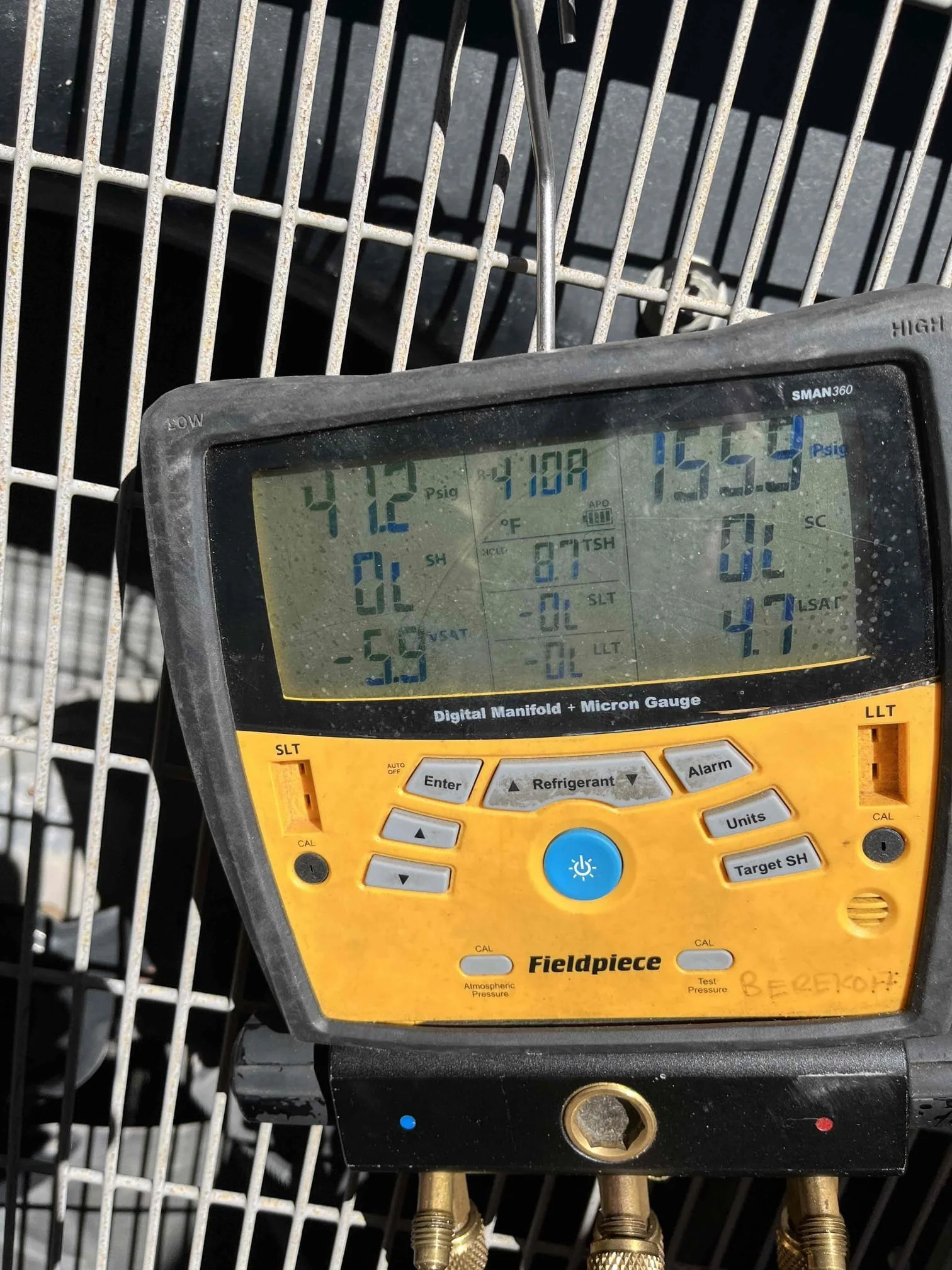
A refrigerant recharge for R-410A systems runs $200 to $600 depending on how much is needed. But here's what matters: if your system needs refrigerant, there's a leak that should be found and fixed, or the refrigerant will just leak out again. That's why our technicians use digital manifold gauges to get exact pressure and temperature readings before recommending anything.
What Common Santa Ana AC Repairs Cost in Orange County (2026)
Knowing what repairs typically cost helps you evaluate quotes and decide whether repair or replacement makes sense. Here's what we see most frequently after Santa Ana events.
Condenser coil cleaning to remove dust and debris buildup: $150 to $350 (often included in a maintenance visit). Capacitor replacement, one of the most common failures during extended extreme heat because continuous operation stresses these components: $150 to $400 including parts and labor. Refrigerant recharge for R-410A systems: $200 to $600 depending on how much is needed. Keep in mind, if your system needs refrigerant, there's a leak that should be found and fixed, or the refrigerant will just leak out again.
Compressor replacement, the most expensive common repair: $1,500 to $3,000 for parts and labor. If your system is over 10 years old and the compressor fails, replacing the entire outdoor unit or full system is usually more cost-effective than the compressor alone. Blower motor replacement: $400 to $800. Contactor replacement: $150 to $350. Both of these electrical components take extra punishment during multi-day heat events because they're running continuously for 72 hours straight.
Protect Your Indoor Air Quality Too
Temperature gets all the attention during Santa Ana events, but the air quality impact is just as real. These winds carry desert dust, pollen, fine particulates, and when fires are burning, smoke that significantly degrades your indoor air. Your HVAC filter is the first line of defense, but standard fiberglass filters only capture a fraction of the fine stuff Santa Ana winds deliver.
If anyone in your household deals with allergies, asthma, or respiratory issues, consider stepping up to a MERV 11 or MERV 13 filter during Santa Ana season. These capture a much higher percentage of fine particles. Just confirm your system can handle the increased airflow resistance, a filter that's too restrictive creates the same problems as a clogged one. Ask during your next maintenance visit. We wrote a broader guide on improving indoor air quality that covers the full range of options from simple filter upgrades to whole-home purification systems.
The extremely low humidity during Santa Ana events also takes a toll beyond comfort. Dry air irritates nasal passages and throats, cracks skin, increases static electricity, and can damage wood floors and furniture. A whole-home humidifier can maintain indoor humidity at a comfortable 35 to 45% even when outdoor levels drop to single digits.
Myths That Cost Orange County Homeowners Money
A few persistent myths about AC performance during extreme heat lead to bad decisions and wasted money. Let's clear them up.
"Setting my thermostat lower cools the house faster." It doesn't. Your AC produces cool air at the same rate regardless of the thermostat setting. Setting it to 65°F when you want 75°F doesn't make the system blow colder air. It just makes it run until it hits that temperature — which during a Santa Ana event means it runs forever, never reaches the setpoint, and you've just worn out your equipment faster with nothing to show for it.
"I should turn the AC off when I leave, then crank it when I get home." During normal weather, this strategy saves modest energy. During a Santa Ana event, it's a disaster. Your home heats up dramatically while you're gone, and your system has to remove all that accumulated heat when you return. It's far more efficient to raise the thermostat 5 to 7 degrees while you're away than to let your house become a 95-degree oven and then ask your AC to recover.
"Closing vents in unused rooms helps my AC keep up." This one actually makes things worse. Closing vents increases pressure in your ductwork, reduces total airflow across the evaporator coil, and can cause the coil to freeze. It also creates pressure imbalances that pull more hot outside air into your home through gaps and cracks. During a Santa Ana event, the last thing you need is reduced airflow. We covered this in depth in our post about the truth behind closing vents to save money.
Preparing Before the Next Santa Ana Event
The best time to deal with Santa Ana wind stress on your AC is before it happens. Here's what we recommend.
Schedule your annual maintenance in early fall, before the first Santa Ana event of the season. A comprehensive tune-up includes checking refrigerant levels (low refrigerant is the number one reason for poor cooling), cleaning condenser and evaporator coils, testing capacitors and contactors, verifying thermostat calibration, and inspecting ductwork. Systems that receive annual maintenance typically last 15 to 20 years. Neglected systems often fail at 10 to 12.
Stock up on air filters. Buy three or four at once so you're never stuck with a clogged filter during a multi-day heat event. Keep one as a spare near your air handler so changing it is a two-minute task instead of a trip to the store.
Walk your home's perimeter and check for obvious sealing problems around windows and doors. Feel for drafts. Replace worn weatherstripping. Caulk gaps. These take an afternoon and cost under $50 in materials.
Clear the area around your outdoor condenser. Trim back landscaping so there's at least two feet of clearance on all sides. Remove any stored items, hoses, or debris that block airflow.
If you know your home has problem areas, rooms that are always hot, an attic with thin insulation, and old ductwork, address those before the season starts. Emergency HVAC service during a Santa Ana event means longer wait times, higher urgency, and less time to make smart decisions.
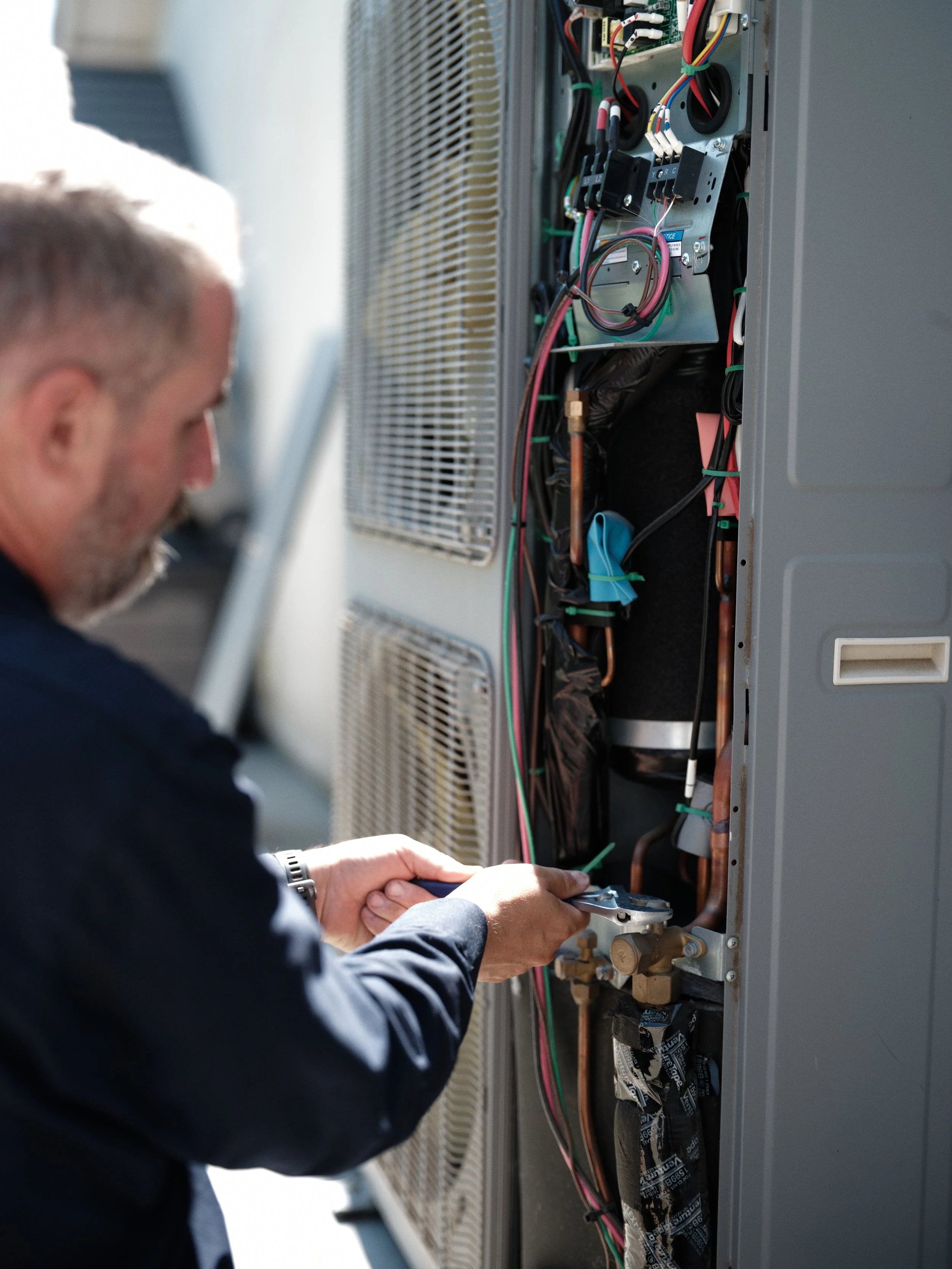
If your AC went into Santa Ana season with a weak capacitor, an aging contactor, or a loose wiring connection, extreme conditions will expose every weakness. Most homeowners never see the inside of their outdoor unit, and that's fine. That's our job. Annual maintenance costs $100 to $200 and routinely prevents $500 to $2,000 emergency repairs.
The Honest Bottom Line
Santa Ana winds are a fact of life in Orange County, and they will continue to push residential air conditioning systems to their limits every year. The good news: most of what you can do to prepare and cope is straightforward, affordable, and within your control. Change your filter. Seal your air leaks. Clean your condenser. Set realistic thermostat expectations during extreme heat. Invest in annual maintenance.
If your system is genuinely struggling, underperforming, or showing signs of mechanical failure, don't wait for the next event to expose the problem. Deal with it now, when HVAC companies aren't drowning in emergency calls and you have time to make calm, informed decisions instead of panicked ones.
At J Martin Indoor Air Quality, we've spent 15 years providing AC repairs to Orange County families so they stay comfortable through every Santa Ana season. We're family-owned. Our technicians aren't paid on commission, which means the person in your home is focused on solving your actual problem, not selling you equipment you don't need. If you're worried about your system heading into the next wind event, or if you just want a maintenance visit to make sure everything's solid, give us a call at 714-462-4686. We'll give you a straight answer about what your system needs and what it doesn't.
J Martin Indoor Air Quality | (714) 462-4686 | Services
Sources: UCLA Department of Atmospheric and Oceanic Sciences, Santa Ana Winds FAQ; National Weather Service, Mountain and Valley Winds; Climate Dynamics journal, "Hot and cold flavors of southern California's Santa Ana winds" (NOAA); U.S. Department of Energy, energy-saving guidelines; FOX 11 Los Angeles, February 2026 Santa Ana wind event coverage.