
Gas Furnace vs. Heat Pump in Orange County: Which Saves More in 2026?
Updated on May 19, 2026
Your gas furnace is dying in the middle of February, and you're staring at two very different quotes from your HVAC contractor. One replaces your existing setup with a new gas furnace and AC combo. The other swaps the whole thing for a heat pump. The price tags look similar enough, but the guy across the street swears his heat pump cut his energy bills in half, and your coworker says gas is still cheaper in Southern California.
So who's right?
This is the single most common question we get at J Martin Indoor Air Quality, and the honest answer is more nuanced than either camp wants to admit. The math has shifted dramatically heading into 2026, and what was true even two years ago no longer holds up. Federal tax credits have expired. SoCalGas rates have climbed over 40% in just twelve months. SCE restructured its billing. And California's building codes are pushing hard toward electrification.
We've installed over 5,000 systems including heat pumps across Anaheim, Yorba Linda, Brea, Fullerton, and the rest of Orange County since 2003. We install both gas furnaces and heat pumps every single week. We don't earn commissions, and we don't push one system over the other because it pays us more. What follows is the real math, the real costs, and the real answer for Orange County homeowners in 2026.
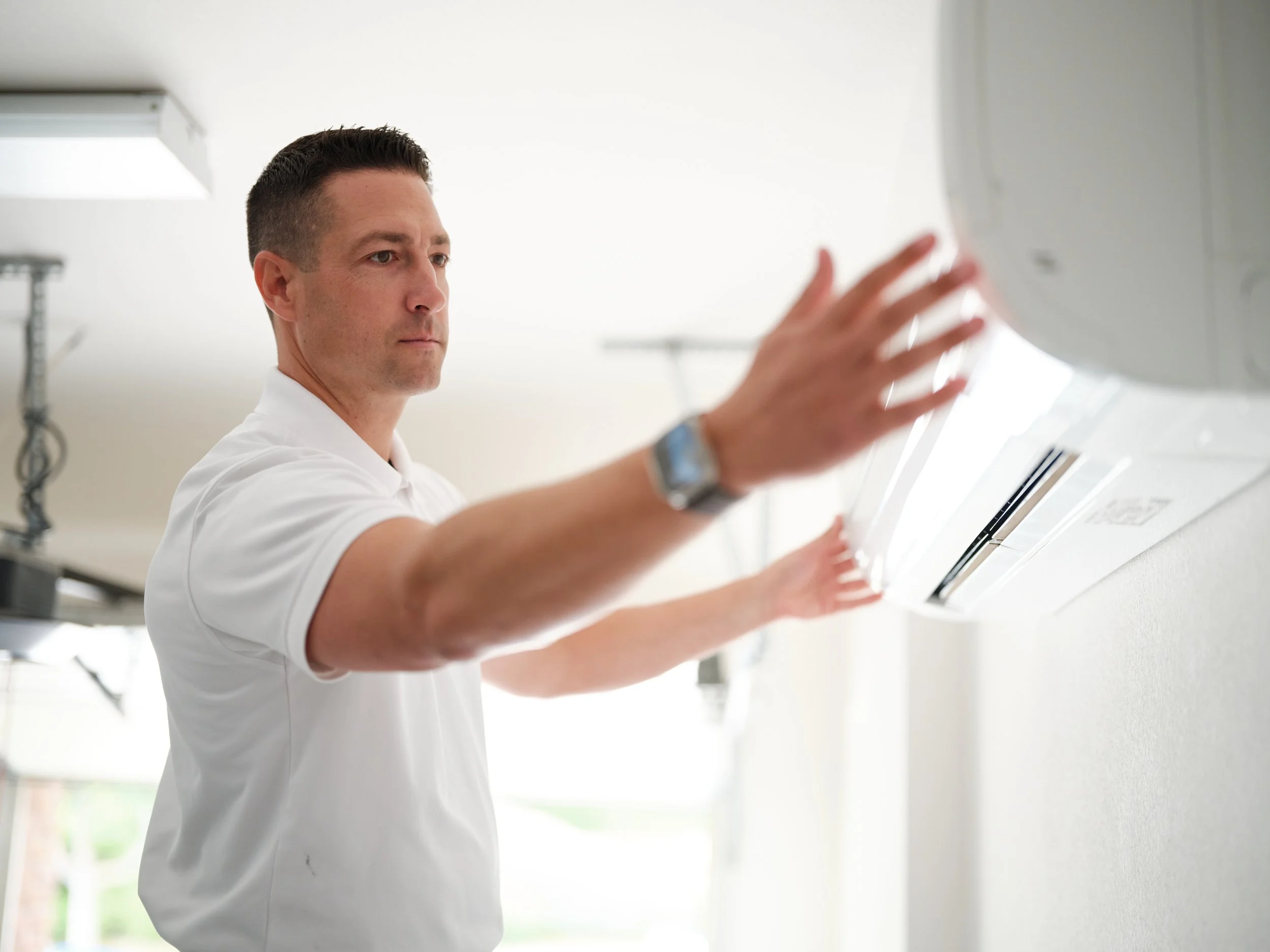
A ductless mini-split heat pump delivers targeted, efficient cooling and heating exactly where you need it. Modern units from manufacturers like Mitsubishi use inverter technology that ramps up and down based on demand, which means they're not blasting at 100% all the time. In Orange County's mild climate, heat pumps operate at or near peak efficiency nearly year-round. That's the math that makes them the smarter long-term investment.
How Each System Actually Works (and Why It Matters for Your Wallet)
Understanding the basic mechanics isn't just nerdy HVAC trivia. It directly explains why one system costs more to run than the other in our climate.
A gas furnace burns natural gas to create heat. That's it. Natural gas flows into a burner, ignites, heats a metal heat exchanger, and a blower pushes air across that exchanger and through your ductwork. Even the most efficient gas furnaces on the market top out around 97-98% AFUE (Annual Fuel Utilization Efficiency), meaning for every dollar of gas you burn, you get roughly 97 cents worth of heat. You can never exceed 100% because you're limited by the energy stored in the fuel itself.
A heat pump doesn't create heat at all. It moves it. Using a refrigerant cycle powered by electricity, a heat pump extracts thermal energy from the outdoor air and transfers it inside your home. In summer, it reverses the process and works exactly like an air conditioner, pulling heat out of your home and dumping it outside. Because it's moving heat rather than generating it, a modern heat pump can deliver 300-400% efficiency. For every unit of electricity it consumes, it delivers three to four units of heating energy. The industry measures this as COP (Coefficient of Performance) or HSPF2 (Heating Seasonal Performance Factor), and in Orange County's mild climate, these numbers stay high nearly year-round.
This efficiency gap is the entire reason heat pumps save money in our area. Orange County winters rarely dip below 40°F, which means heat pumps operate at or near their peak efficiency essentially all heating season. In colder climates where temperatures regularly drop below freezing, the math changes because heat pumps have to work harder to extract warmth from frigid air. But that's not our reality. Our climate is nearly ideal for this technology.
The other major mechanical difference is that a gas furnace only heats. You still need a separate air conditioning unit for summer cooling. A heat pump handles both heating and cooling in one system. That means when you're comparing costs, you need to compare a gas furnace plus an air conditioner against a single heat pump system. This distinction matters enormously for both upfront price and long-term maintenance costs, and we'll get into those numbers shortly.
The Real 2026 Energy Costs in Orange County
Let's talk about what you're actually paying to run these systems right now, because this is where the conversation gets interesting.
Southern California Edison's average residential rate sits at approximately 34.5 cents per kWh as of January 2026. That number reflects the slight decrease from the October 2025 rate of 35.3 cents per kWh, though the practical impact is modest. If you're on a tiered plan, you're paying around 31 cents per kWh for baseline usage and 42 cents per kWh once you exceed your allocation. On a time-of-use plan, rates swing from as low as 24 cents per kWh during off-peak hours to as high as 74 cents per kWh during summer on-peak windows. If you're an Orange County Power Authority (OCPA) customer, you may see a small additional discount on the generation portion of your bill, though SCE still handles delivery charges for everyone.
Here's the context that matters: SCE residential rates have increased roughly 83% over the past decade, with a 25% jump in just the three years since 2022. Another proposed rate hike of approximately 12.9% has been part of the 2026 conversation, though the January adjustment actually brought rates down slightly. The bottom line is that electricity in Orange County is expensive and trending more expensive over time.
Now for gas. SoCalGas residential bundled rates (which include transportation, procurement, and surcharges) average approximately $2.08 per therm as of January 2026. That seems stable until you realize the procurement component alone jumped 40.2% compared to February 2025. The commodity price of natural gas has been volatile, and SoCalGas has proposed increasing its monthly customer charge to $15 in 2026 (up from $10 in 2025), with plans to reach $20 by 2027. That monthly charge hits you whether you use any gas or not. If you eliminate your gas connection entirely by switching to a heat pump, you save that fixed cost every single month on top of whatever you save on actual fuel.
So what does this mean for monthly operating costs? For a typical 2,000-square-foot Orange County home, you can expect a gas furnace and AC combo to run roughly $180 to $280 per month across a full year, factoring in both your SCE bill for the AC and your SoCalGas bill for heating. A heat pump system running the same home typically lands between $120 and $220 per month, depending on your energy usage habits, insulation quality, and which SCE rate plan you're on.
The savings aren't dramatic on a single monthly bill, but they compound. Over a full year, most Orange County homeowners see $600 to $1,200 in total energy savings with a heat pump. Over the 15-year expected life of the system, that's $9,000 to $18,000 in reduced utility costs. And that calculation assumes energy rates stay flat, which they absolutely will not. Every rate increase from either SCE or SoCalGas widens the gap.
There's one more cost most people forget about entirely: the SoCalGas connection fee. If you keep a gas furnace, you maintain a gas line and pay that monthly customer charge regardless of how much gas you use. Over 15 years at the current and proposed rates, that fixed charge alone adds up to roughly $2,700 to $3,600 in costs that simply disappear if you go all-electric. When homeowners ask us why their neighbor says their heat pump "pays for itself," this is one of the biggest hidden factors.

The gas furnace vs. heat pump debate isn't about technology. It's about what makes sense for your family. Lower monthly bills. Year-round comfort without two separate systems to maintain. A home that stays cool when the Santa Ana winds hit and warm on the handful of cold nights we get in Orange County. That's what the right HVAC decision actually looks like.
Installation Costs: What You'll Actually Pay in Orange County in 2026
National cost averages are basically useless for Southern California. Labor rates are higher here, permitting is more involved, and many older Orange County homes require electrical upgrades to support a heat pump. Here are the real prices we’re quoting right now for fully installed systems.
A standard gas furnace and AC combo for a typical 1,200 to 1,800-square-foot home runs $9,500 to $13,500 installed. For a larger home in the 1,800 to 2,500-square-foot range, you're looking at $11,500 to $15,500. These prices cover a 14-16 SEER, single-stage system with a standard efficiency furnace, including all labor, materials, permits, and warranty.
A heat pump system (whether central ducted or ductless mini split) for a comparable 1,200 to 1,800-square-foot home costs $11,000 to $16,000 installed. For larger homes (1,800 to 2,500 square feet), the range is $13,000 to $19,000. These are 18-20 SEER2, variable-speed systems that qualify for the highest efficiency ratings. A 5-ton system for homes over 2,500 square feet can reach $15,500 to $22,000 or more, especially if ductwork modifications or electrical panel upgrades are involved.
The upfront gap between a gas furnace/AC combo and a heat pump system is typically $2,000 to $5,000. That gap narrows considerably when you factor in the fact that you're getting one system instead of two. You're not buying a furnace and an air conditioner. You're buying a single heat pump that does both jobs. When your AC would have needed replacement in 8-12 years anyway, the heat pump is already handling cooling at no additional cost.
Premium heat pump models from manufacturers like Carrier, Trane, and Lennox sit at the higher end of those ranges. The Carrier Infinity 26, for example, runs $14,500 to $19,000 installed and operates at just 54 dB, which is quieter than a normal conversation. Trane's XV20i lands at $13,500 to $18,500 and offers some of the best cold-weather performance available. If you're looking for the best value, the York YXV 21 SEER typically comes in at $11,500 to $16,000.
One cost factor that catches people off guard is the potential need for an electrical panel upgrade. Many older Orange County homes built in the 1960s through 1980s have 100-amp or 150-amp panels that may not support a heat pump's electrical requirements. If your panel needs upgrading, that adds $1,500 to $3,000 to the project. Your contractor should evaluate this during the initial inspection, not after installation day.
The Rebate and Tax Credit Landscape Has Changed Dramatically
If you've been researching this topic for a while, you probably saw information about generous federal tax credits for heat pumps. That landscape shifted significantly heading into 2026, and it's important to understand exactly where things stand.
The federal 25C Energy Efficient Home Improvement Credit, which offered up to $2,000 for qualifying heat pump installations, officially expired on December 31, 2025. This credit was part of the Inflation Reduction Act and was originally set to run through 2032, but Congress ended it early through the budget reconciliation legislation passed in mid-2025. If you installed a qualifying system before that deadline, you can still claim the credit on your 2025 tax return filed during the 2026 tax season. But any heat pump installed in 2026 or later does not qualify for this federal credit.
On the state side, TECH Clean California's single-family heat pump HVAC incentives became fully reserved statewide in November 2025 and are no longer accepting new reservations. The HEEHRA (Home Electrification and Appliance Rebates) program, which offered income-qualified homeowners $4,000 to $8,000 toward heat pump installations, became fully reserved for Southern California as of January 7, 2026. All new reservation requests are being placed on a waitlist with no guarantee of funding. These programs may receive additional funding in the future, but for now, they're effectively closed for new applicants in our area.
So does this mean the financial case for heat pumps has weakened? Not as much as you'd think. The federal credit was capped at $2,000, and while that's meaningful, it represented roughly 10-15% of a typical heat pump installation cost. The operating cost savings over a 15-year system life ($9,000 to $18,000) dwarf that credit many times over. The math still works, it just takes slightly longer to reach the break-even point without the incentive boost.
It's also worth noting that gas furnaces never qualified for these rebates in the first place. The 25C credit did offer up to $600 for high-efficiency furnaces (97% AFUE or higher), but that was a much smaller incentive. The playing field between the two systems is actually more level now than it was when heat pumps had a significant rebate advantage.
Keep checking with your HVAC contractor about new programs as they emerge. California's commitment to electrification hasn't changed, and new utility-level incentives or state programs may become available throughout 2026 and beyond. We track these closely at J Martin and will let you know what's available at the time of your installation.
The 15-Year Total Cost of Ownership Comparison
This is where the real decision should be made. Not on sticker price, not on a single month's utility bill, but on what you'll spend over the full life of the system. Here's how the numbers play out for a typical 2,000-square-foot Orange County home.
For a gas furnace and AC setup, your total 15-year cost includes the initial installation ($11,500 to $15,500 for a mid-range system), annual maintenance for two separate systems ($300 to $500 per year), estimated utility costs combining electricity for cooling and gas for heating ($2,400 to $3,360 per year), the SoCalGas connection fee ($180 to $240 per year), and at least one major repair over the system's life ($500 to $2,000). That brings the total 15-year cost to roughly $55,000 to $85,000, depending on energy prices and usage patterns.
For a heat pump, the 15-year picture includes installation ($13,000 to $19,000), annual maintenance for a single system ($200 to $350 per year), estimated electricity-only utility costs ($1,440 to $2,640 per year), no gas connection fee, and comparable repair costs ($500 to $2,000). The total 15-year cost comes in at approximately $37,000 to $63,000.
Even at the conservative end, the heat pump saves $15,000 to $22,000 over its lifetime. At the higher end of usage, the savings can reach $20,000 or more. The heat pump's higher upfront cost is typically recovered within 3 to 5 years through lower operating costs, after which it's pure savings.
These numbers also don't account for the likelihood of continued rate increases from both SCE and SoCalGas, which would further favor the heat pump. And if you have or plan to install solar panels , the equation tilts even more dramatically. Solar panels generate electricity, not natural gas. A heat pump powered by your own solar production effectively runs for free during daylight hours.
Orange County's Climate Is Basically Made for Heat Pumps
This point can't be overstated, and it's the single biggest reason the gas-vs-electric debate plays out differently here than it does in, say, Chicago or Minneapolis. Orange County's Mediterranean climate features warm, dry summers and mild winters. Our average winter lows hover in the mid-40s to low-50s, and we rarely see temperatures below 40°F.
Heat pump efficiency drops as outdoor temperatures fall. In truly cold climates where temperatures regularly hit the teens or single digits, a heat pump's COP drops significantly, and a gas furnace may indeed be cheaper to operate during the coldest months. Some homeowners in those climates opt for a dual-fuel system that pairs a heat pump with a gas furnace backup for the coldest days.
But that's not our climate. In Orange County, a heat pump operates at or near peak efficiency during our entire heating season. There is no meaningful cold-weather penalty here. The handful of nights per year when temperatures dip into the upper 30s represent such a tiny fraction of total heating hours that they don't move the needle on annual operating costs.
Our climate does present a unique challenge that affects both systems: the Santa Ana winds. These hot, dry wind events bring dust, debris, and dramatically low humidity. Both gas furnaces and heat pumps need proper filtration and regular filter changes to handle Santa Ana conditions, but the outdoor condenser on a heat pump may collect more debris during these events and benefit from periodic cleaning. This is a maintenance consideration, not a dealbreaker, and it applies to any split-system air conditioner as well.
Coastal Orange County communities like Huntington Beach and Dana Point also deal with salt air corrosion, which can affect the outdoor coils of both heat pumps and traditional AC condensers. If you're within a few miles of the coast, look for units with corrosion-resistant coatings and plan on slightly more frequent outdoor unit maintenance.
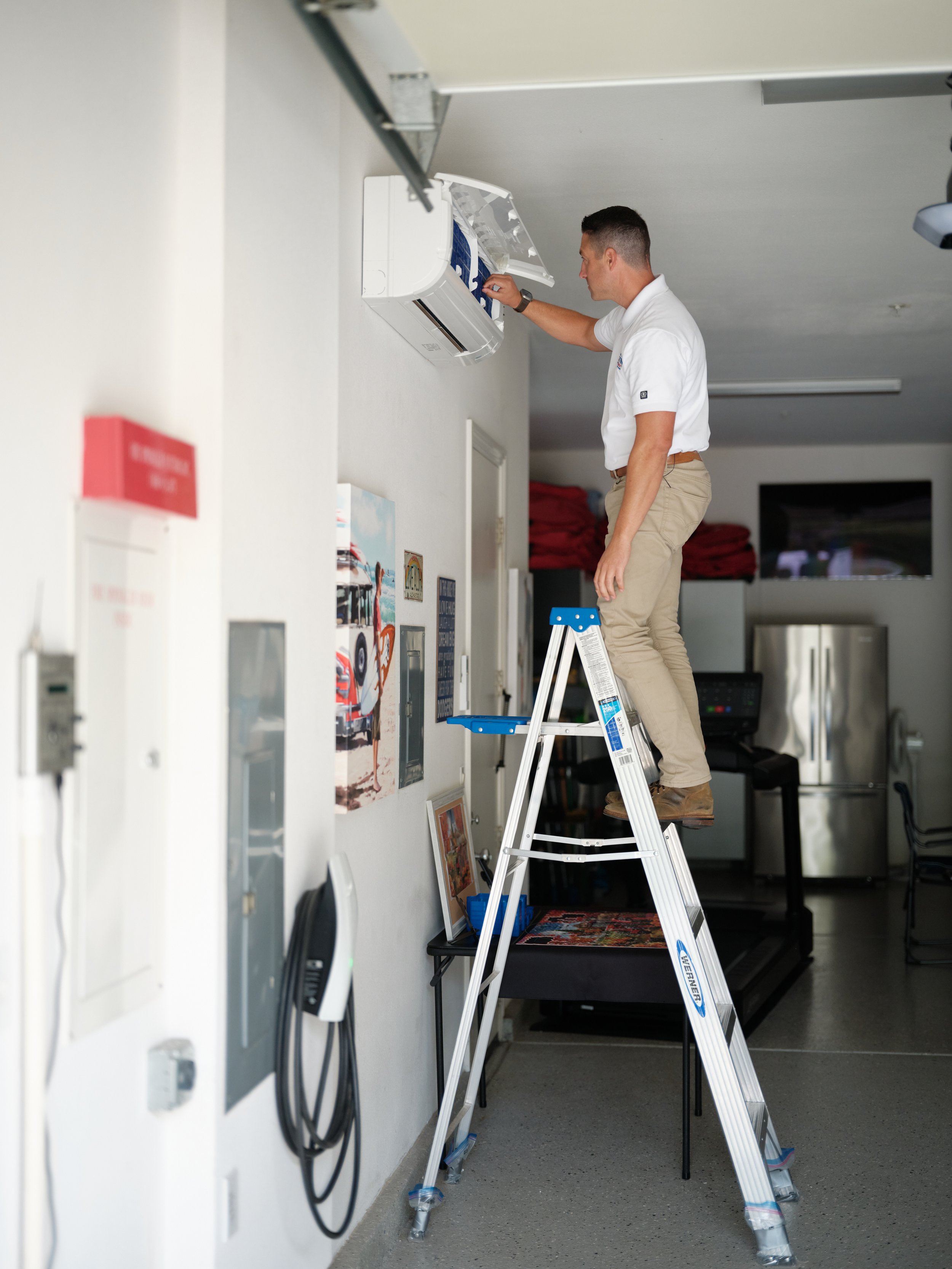
One system. Heating and cooling. No ductwork needed. A mini-split heat pump turns any problem room into a comfortable space year-round. Get a free quote from J Martin: (714) 462-4686.
The Refrigerant Factor: R-410A and What Comes Next
If you've been reading about HVAC lately, you've probably seen headlines about the R-410A refrigerant phase-out. This affects both heat pumps and air conditioners, since both use refrigerant to transfer heat. Here's what matters for your purchasing decision.
Manufacturing and importing new R-410A was phased down starting January 1, 2025. Existing R-410A inventory can still be sold and installed, but the supply is finite and prices for the refrigerant itself are expected to climb over the next several years. Newer systems are transitioning to R-454B (sold under the brand name Opteon XL41) and other low-GWP (Global Warming Potential) refrigerants.
If you install a system that uses R-410A in 2026, you'll still be able to get it serviced and recharged for the foreseeable future. R-410A isn't being banned for existing systems, only for new manufacturing. But if you're thinking long-term (and with a 15-year system life, you should be), a heat pump using next-generation refrigerant future-proofs your investment. Many 2026-model heat pumps now ship with R-454B, and beginning January 1, 2026, any systems eligible for HEEHRA rebates must use refrigerants with a GWP of 700 or lower, which eliminates R-410A.
This is another subtle advantage for the heat pump side of the equation. If you install a new gas furnace and AC combo in 2026, the AC portion likely still uses R-410A from existing inventory. When that AC eventually needs refrigerant service in 5-10 years, the cost of R-410A could be significantly higher than it is today. A heat pump installed with R-454B avoids that future cost risk entirely.
California's Regulatory Direction: Where This Is All Heading
Even if the current numbers were perfectly equal (and they're not), California's regulatory trajectory heavily favors heat pumps. Understanding this isn't about politics. It's about making a practical investment decision.
California's 2026 building code will require the vast majority of new homes to be built with heat pumps rather than gas heating. The California Air Resources Board (CARB) is advancing zero-emission appliance standards that could require heat pump replacements when gas furnaces reach end-of-life by 2030, though exact implementation timelines are still being determined. The Bay Area already has approved regulations requiring gas furnaces to be replaced with heat pumps starting in 2029, and similar rules are expected to spread to other California regions.
For Orange County homeowners, this means a gas furnace installed today could potentially be the last one you're allowed to install, depending on how quickly these regulations move south. If you plan to sell your home in the next decade, a heat pump system may offer better resale value as buyers increasingly expect electrified homes. And if you plan to stay, choosing a heat pump now means you won't face a forced conversion later.
None of this means gas furnaces are being ripped out of homes tomorrow. Existing systems are grandfathered under current regulations. But the direction is clear, and investing in the technology that California is actively promoting makes practical sense even beyond the pure cost comparison.
DIY Maintenance Steps to Keep Either System Running Efficiently
Regardless of which system you choose, regular maintenance is the single most important factor in maximizing efficiency and lifespan. Here are the steps any homeowner can handle without calling a technician.
Replace your air filter every 30 to 90 days, depending on filter type and household factors like pets and allergies. A clogged filter forces both furnaces and heat pumps to work harder, increasing energy consumption by 5-15% and accelerating wear on components. If you have pets, lean toward monthly changes.
Keep the area around your outdoor unit (whether it's an AC condenser or heat pump) clear of debris, plants, and storage items. You need at least two feet of clearance on all sides for adequate airflow. After Santa Ana wind events, check for accumulated dust and debris on the outdoor coils and gently rinse them with a garden hose if needed. Turn the system off first.
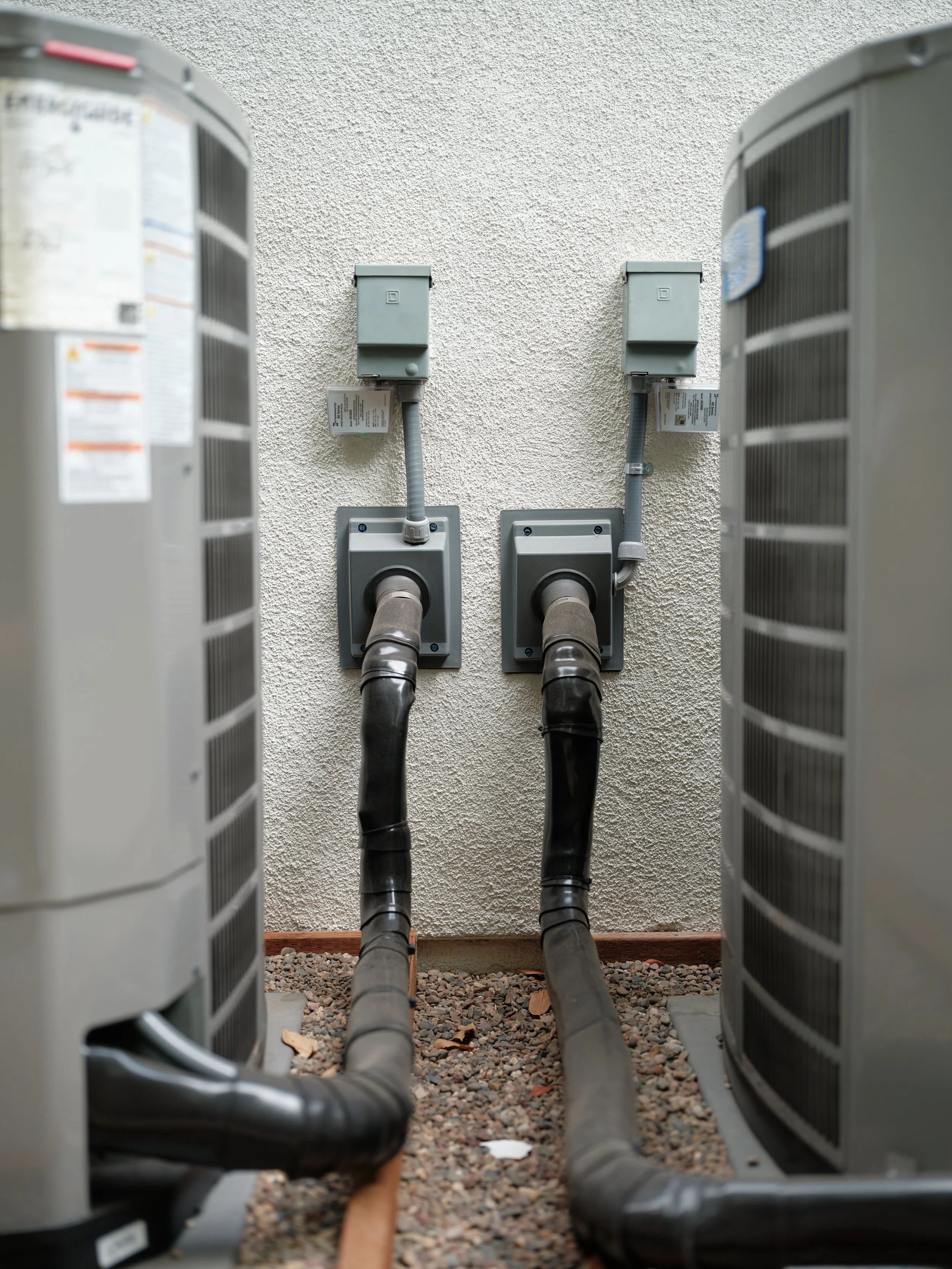
See how clean the area around these outdoor units is? Gravel base, no plants crowding the coils, clear access to the electrical disconnects. That's what proper clearance looks like. After Santa Ana winds, check for dust and debris on the outdoor coils and gently rinse them with a garden hose from inside out. Turn the system off first. Takes 10 minutes and keeps your system running efficiently.
Check your thermostat settings seasonally. For heating, setting your thermostat to 68°F when you're home and 55-60°F when sleeping or away strikes a good balance between comfort and efficiency. If you have a programmable or smart thermostat, set schedules rather than manually adjusting. Consistent scheduling prevents the system from working overtime to recover from large temperature swings.
Inspect your visible ductwork annually for obvious gaps, disconnections, or damage. Leaky ducts waste 20-30% of conditioned air, which means you're paying to heat or cool your attic or crawlspace instead of your living areas. If you notice uneven temperatures between rooms, hot or cold spots, or rooms that never seem comfortable, ductwork issues could be the culprit.
For gas furnaces specifically, make sure the area around the unit is free of flammable materials and that the exhaust flue isn't blocked or damaged. If you smell gas (a rotten egg odor), leave the house immediately and call SoCalGas at 1-800-427-2200. Do not flip light switches, use your phone inside the home, or try to find the leak yourself.
For heat pumps, check that the outdoor unit isn't iced over during the rare cold snaps we get. Modern heat pumps have automatic defrost cycles, but if you notice persistent ice buildup, it could indicate a refrigerant issue or a defrost control problem that needs professional attention.
When to Call a Professional
Annual professional maintenance is essential for both system types and isn't something to skip or postpone. For a gas furnace, a qualified technician should inspect the heat exchanger for cracks (which can leak carbon monoxide), test the gas valve and ignition system, check the burner flame pattern, verify proper venting, and clean components that accumulate soot and combustion byproducts. A cracked heat exchanger is a serious safety hazard that's virtually impossible to detect without professional equipment.
For a heat pump, annual professional service should include checking refrigerant levels and looking for leaks, testing electrical connections and controls, cleaning the indoor evaporator coil, verifying the reversing valve operates correctly, and measuring airflow across the coil. Low refrigerant is the most common cause of heat pump inefficiency, and even a small leak that drops the charge by 10% can reduce heating output by 20% or more.
If you notice any of the following, call an HVAC professional rather than trying to diagnose the issue yourself: unusual noises like grinding, screeching, or banging from either system type; strange smells from your heater that persist beyond the first few minutes of seasonal startup; a heat pump that runs constantly without reaching the set temperature; a gas furnace with a yellow or flickering pilot flame instead of a steady blue one; or any system that trips breakers or blows fuses repeatedly.
At J Martin Indoor Air Quality, we offer thorough maintenance through our True Maintenance Plan that covers both system types. We'll also give you an honest assessment of your current system's condition and whether repair or replacement makes more financial sense for your situation.
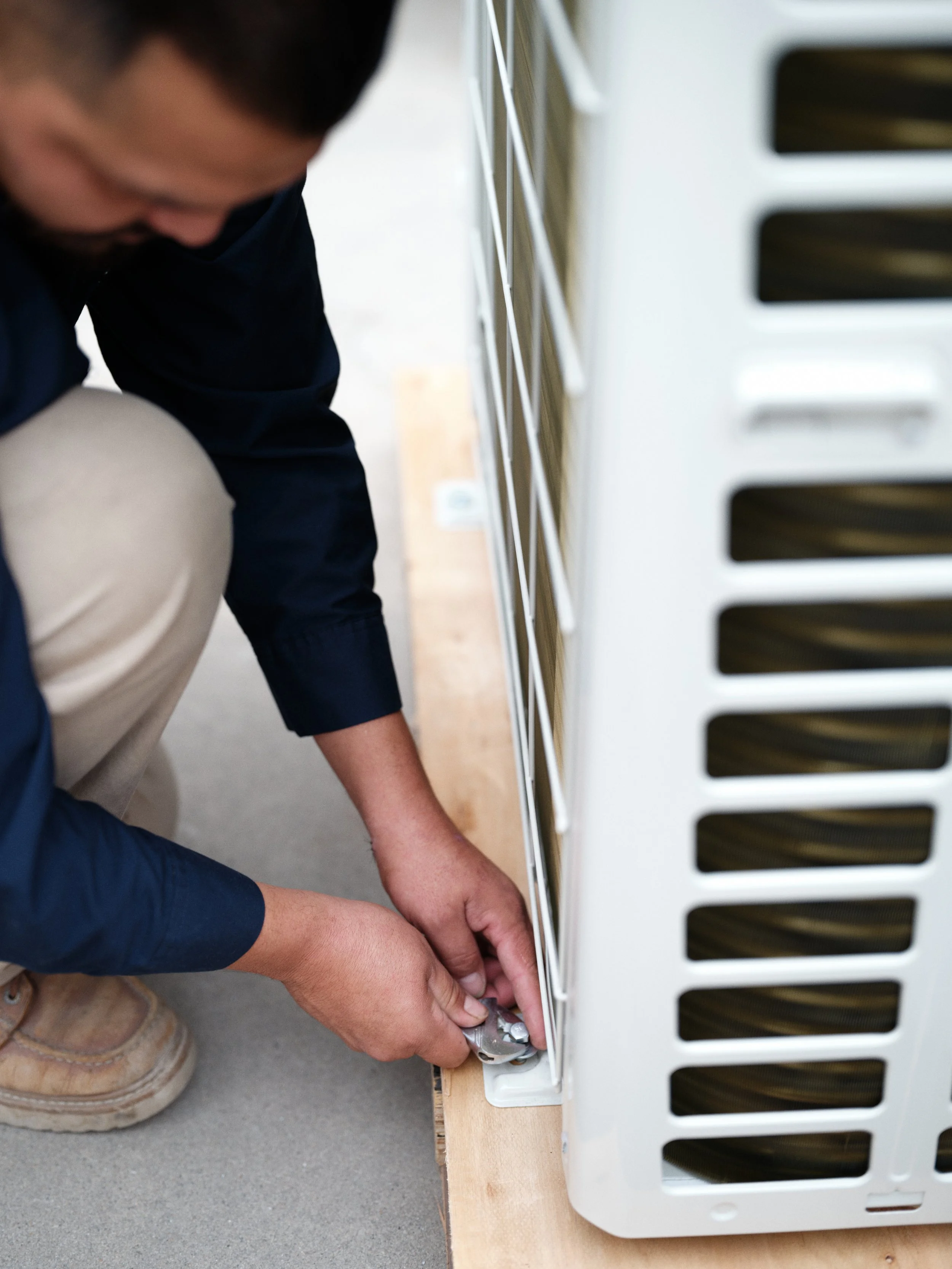
Installation quality matters as much as the equipment itself. Our technicians take the time to properly mount, level, and secure every outdoor unit because a heat pump that's installed correctly runs more efficiently, produces less noise, and costs less to maintain over its lifetime. We've installed over 5,000 systems across Orange County since 2003, and every one gets this level of care.
The Bottom Line for Orange County in 2026
For the majority of Orange County homeowners, a heat pump is the smarter financial choice in 2026. The upfront cost premium of $2,000 to $5,000 over a gas furnace and AC combo is typically recovered within 3-5 years through lower energy bills and the elimination of your gas connection fee. Over the full 15-year life of the system, total savings range from $15,000 to $22,000 or more. Our climate is nearly perfect for heat pump technology, with mild winters that allow the system to operate at peak efficiency year-round. And California's regulatory direction continues to favor electrification, making the heat pump a more future-proof investment.
There are still legitimate scenarios where a gas furnace makes sense. If your home has a brand-new, fully functional air conditioner and only the furnace needs replacement, installing a standalone furnace at $4,000 to $6,000 may be more cost-effective than converting to a full heat pump system. If your electrical panel needs a major upgrade that adds $3,000 or more to the project cost, the payback period extends. And if you're on an extremely tight budget and need the lowest possible upfront cost, a basic gas furnace and AC combo will get the job done reliably.
But for most families in Yorba Linda, Anaheim, Brea, Fullerton, and throughout Orange County who are replacing an aging system or building new, the numbers point clearly toward a heat pump. The technology has matured, the efficiency is remarkable in our climate, and the long-term savings are real.
If you're ready to get real numbers for your specific home, call J Martin Indoor Air Quality at 714-462-4686 or visit jmartiniaq.com for a free heat pump installation consultation. We'll walk through your home's layout, insulation, electrical capacity, and ductwork condition to give you an accurate quote for both options, so you can make the decision with full information and zero pressure.
J Martin Indoor Air Quality | (714) 462-4686 | Services