
Why Is My Upstairs So Hot and Downstairs So Cold? The Orange County Two-Story Home Problem
Updated on May 26, 2026
Your downstairs is a comfortable 72 degrees. You walk upstairs to go to bed and it feels like you've entered a different climate zone. The thermostat on the wall says 72, but your upstairs bedrooms feel like 80-82 degrees. You crank the AC lower, which makes the downstairs freezing but barely touches the upstairs heat.
Sound familiar?
This is the most common complaint we hear from Orange County homeowners about their AC with two-story houses. The temperature difference between floors makes half your house uncomfortable no matter what you do. Set the thermostat for downstairs comfort and the upstairs is miserable. Set it for upstairs comfort and everyone downstairs needs sweaters.
Here's the frustrating truth: this isn't just your house. It's physics combined with construction choices made 20-40 years ago when most Orange County tract homes were built. But that doesn't mean you're stuck with it.
Let's talk about why this happens, what's normal versus what indicates a fixable problem, and most importantly, what you can actually do about it.
The Physics Problem: Why Heat Rises and Cold Sinks
The temperature difference between your upstairs and downstairs isn't a mystery. It's basic physics that happens in every two-story home in Orange County.
Warm air is less dense than cold air. When air heats up, the molecules move faster and spread apart, making the air lighter. Cold air is denser and heavier. In your home, this means warm air naturally rises to upper floors while cold air settles downstairs.
This process is called thermal stratification, and it happens continuously in every multi-level building. Your HVAC system is constantly fighting against it.
In a typical two-story Orange County home, the natural temperature difference between upstairs and downstairs runs 8-10 degrees. That's not a malfunction. That's physics doing what physics does.
So if your downstairs is 70 degrees and your upstairs is 78-80 degrees, your house is behaving exactly as expected for a two-story structure without any additional temperature control measures.
But here's the problem: "normal" doesn't mean "acceptable" for your comfort. And there are ways to work with physics instead of just accepting uncomfortable bedrooms.
The Orange County Construction Factor
Most two-story homes in Yorba Linda, Anaheim Hills, and surrounding Orange County areas were built between 1970-2000. These decades saw massive tract home development, and builders followed construction practices that made sense economically but created temperature challenges.
Single-Zone HVAC Systems
The vast majority of Orange County two-story homes have single-zone HVAC systems. One thermostat controls one furnace and one air conditioner that's supposed to heat and cool your entire house.
The thermostat is almost always located on the first floor, usually in a hallway or living room. It measures the temperature in that specific spot and tells your HVAC system to turn on or off based on what it senses there.
Your upstairs has no say in the matter. The thermostat downstairs hits 72 degrees, the AC shuts off, and your 80-degree upstairs bedrooms just have to deal with it.
This isn't a design flaw specific to your house. This is how most residential HVAC systems work. Single-zone systems are cheaper to install, simpler to maintain, and work perfectly fine in single-story homes where temperature stratification isn't a factor.
In two-story homes, single-zone systems create the exact problem you're experiencing.
Minimal Attic Insulation
Many older Orange County homes were built with attic insulation levels of R-19 or less. That's the thermal resistance rating, and it's inadequate for Orange County summers where attic temperatures routinely hit 140-160 degrees.
Your roof absorbs heat from the sun all day. Without sufficient insulation, that heat radiates down into your upstairs rooms. It's like having a heating element above your bedrooms that you can't turn off.
Modern building codes recommend R-30 to R-38 attic insulation for Orange County. If you go up to your attic and can see the tops of your ceiling joists, you have insufficient insulation.
This is especially problematic in hillside neighborhoods in Yorba Linda and Anaheim Hills where south and west-facing roofs get intense sun exposure from morning until evening.
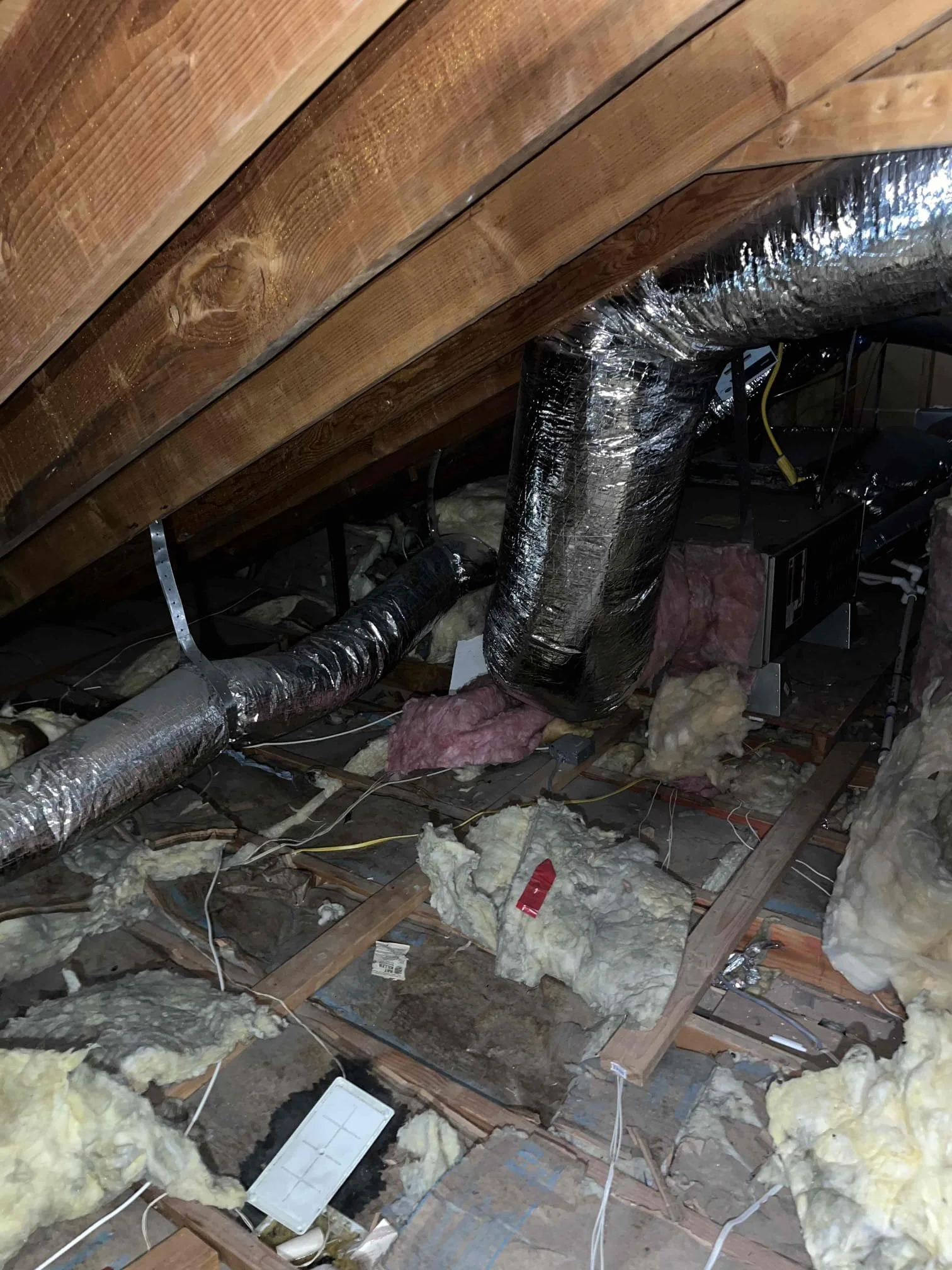
An Orange County attic in the condition we find most often during temperature imbalance diagnostics: original insulation compressed to half its rated R-value, batts displaced around ductwork, and flex ducts running through a space that reaches 150 to 160 degrees on a 95-degree day. This is what makes your upstairs unlivable in summer.
Ductwork Designed for Balanced Airflow That Doesn't Account for Physics
When your HVAC system was installed, the ductwork was sized to deliver proportional airflow to each room based on square footage. A 12x14 bedroom gets a certain CFM (cubic feet per minute) of airflow. A 20x16 master bedroom gets more.
But this balanced approach doesn't account for the fact that upstairs rooms are fighting against rising heat while downstairs rooms benefit from sinking cold air.
The result: your upstairs gets the "right" amount of airflow according to engineering calculations, but it's not enough to overcome the natural temperature stratification plus the heat radiating down from your attic.
How to Tell If Your Temperature Difference Is Normal or a Problem
Not every upstairs/downstairs temperature difference requires professional intervention. Some are just reality. Others indicate fixable issues with your HVAC system or home.
Your Temperature Difference Is Probably Normal If:
The gap is 8-10 degrees during peak heat
If your downstairs is 72 degrees and your upstairs is 80-82 degrees on a 90+ degree day, that's consistent with what physics predicts for a two-story home.
It improves significantly at night
Once the sun sets and your attic stops absorbing heat, the temperature difference should narrow. If your upstairs cools to within 3-5 degrees of downstairs after 9 PM, your system is working properly.
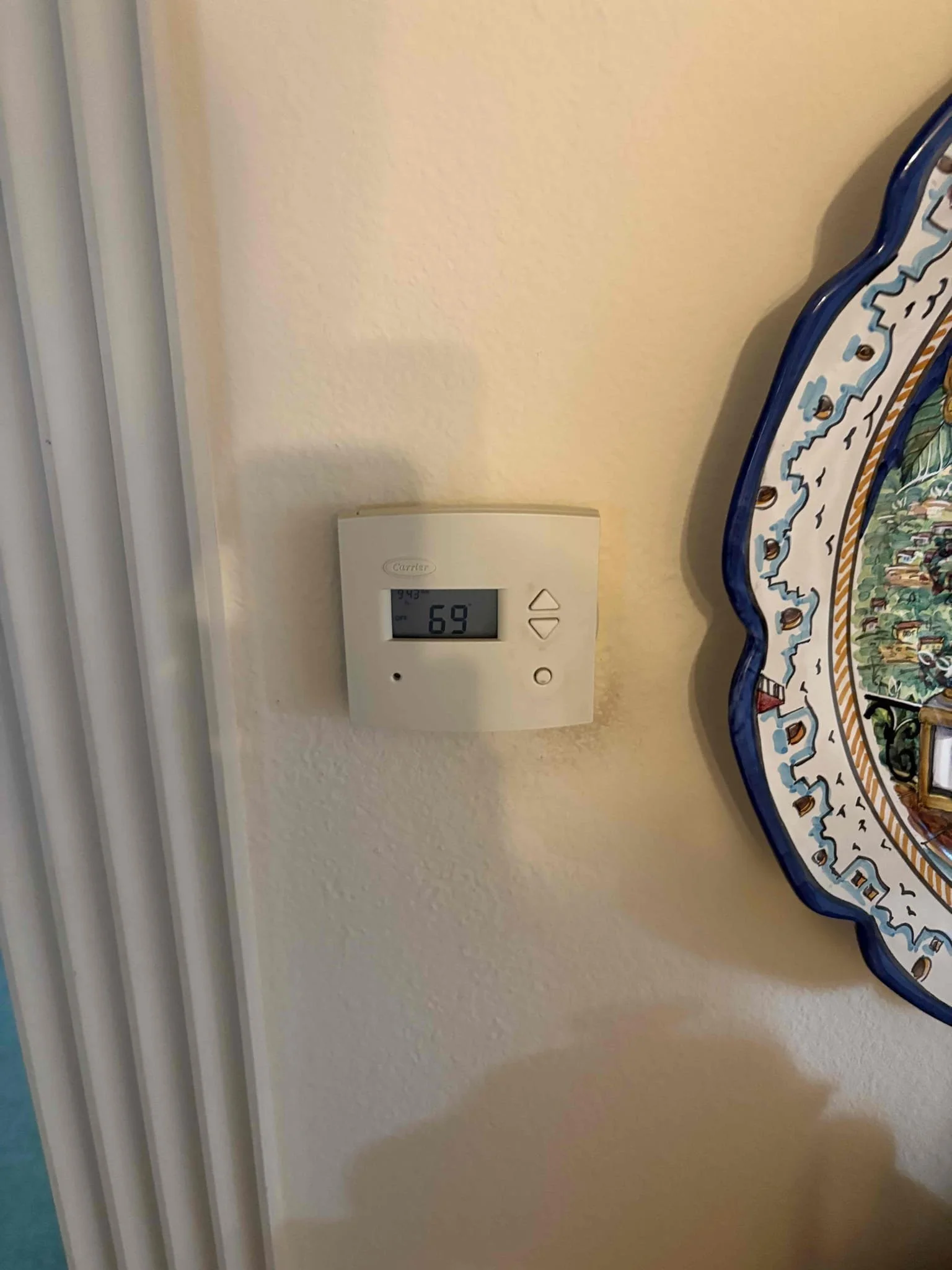
Your downstairs thermostat says 69 degrees. Your upstairs bedrooms? Probably 78-80 degrees. Single-zone systems can't solve two-story temperature problems. J Martin offers zoning solutions for Orange County homes. Call (714) 462-4686.
The gap is consistent across all upstairs rooms
If every upstairs bedroom is roughly the same temperature (within 2-3 degrees of each other), you don't have ductwork problems. You just have a normal two-story temperature stratification issue.
Airflow from all vents feels similar
Go to each room and put your hand in front of the vent. The air volume and temperature should feel consistent throughout the house. If upstairs vents blow the same amount of cool air as downstairs vents, your ductwork is balanced.
Your Temperature Difference Indicates a Problem If:
The gap exceeds 12-15 degrees consistently
If your downstairs is 70 degrees and your upstairs is 85+ degrees, something beyond normal physics is happening. This often indicates insufficient insulation, duct leaks, or inadequate HVAC capacity.
One or two upstairs rooms are dramatically hotter than others
If your master bedroom is 85 degrees but the room next door is 78 degrees, you have an airflow problem. This could be blocked vents, disconnected ductwork, or undersized ducts to that specific room.
Upstairs vents blow weak or warm air
If you hold your hand in front of an upstairs vent and barely feel any airflow, or the air feels room temperature instead of cool, you have a serious ductwork issue. This often indicates duct leaks in the attic where 20-30% of your conditioned air is escaping before it reaches the vents.
The temperature gap persists all night
If your upstairs is still 8-10 degrees warmer than downstairs at 2 AM when outdoor temperatures have dropped and your attic has cooled, your insulation is insufficient or your ductwork has major leaks.
Your AC runs constantly but never satisfies the upstairs
If your system runs for hours without bringing upstairs temperatures down to something reasonable, you're either undersized for your home's cooling load or losing massive amounts of conditioned air through duct leaks.
The Five Most Common Causes We Find When Diagnosing Temperature Imbalance
After 15 years of service calls in Orange County dealing with upstairs/downstairs temperature complaints, here's what we actually find when we diagnose these issues:
1. Inadequate Attic Insulation (About 40% of Cases)
We climb into the attic and immediately see exposed ceiling joists with 3-4 inches of old, compressed insulation between them. Sometimes we find sections with no insulation at all.
On a 95-degree day, these attics reach 150-160 degrees. With R-19 insulation or less, significant heat transfers directly into upstairs rooms. It's like trying to keep your upstairs cool while someone holds a heating pad against the ceiling.
Adding blown-in insulation to bring the attic up to R-38 typically costs $1,500-2,500 for an average Orange County home. It's not glamorous, but it's often the single most effective fix for reducing upstairs temperatures by 5-8 degrees. If you want to understand the mechanics of why insulation has such an outsized effect on HVAC performance, our guide on how attic insulation affects your HVAC efficiency walks through the diagnostic signs of failing insulation and the long-term savings Orange County homeowners typically see.
2. Duct Leaks in the Attic (About 25% of Cases)
Ductwork runs through your attic to deliver conditioned air to upstairs rooms. Over 20-30 years, connections loosen, seams separate, and gaps form at register boots where ducts connect to ceiling vents.
When your attic is 150 degrees and you're pumping 55-degree air through leaky ducts, you lose cooling capacity fast. Studies show typical duct leakage ranges from 15-20%, but we've seen homes losing 40% or more.
You're paying to cool your attic instead of your bedrooms. Meanwhile, your upstairs stays hot because only 60-70% of the conditioned air actually makes it to the vents.
Duct sealing costs $1,200-3,000 depending on attic accessibility and the extent of leaks. It's labor-intensive work, but homes with properly sealed ductwork see immediate improvement in upstairs cooling.
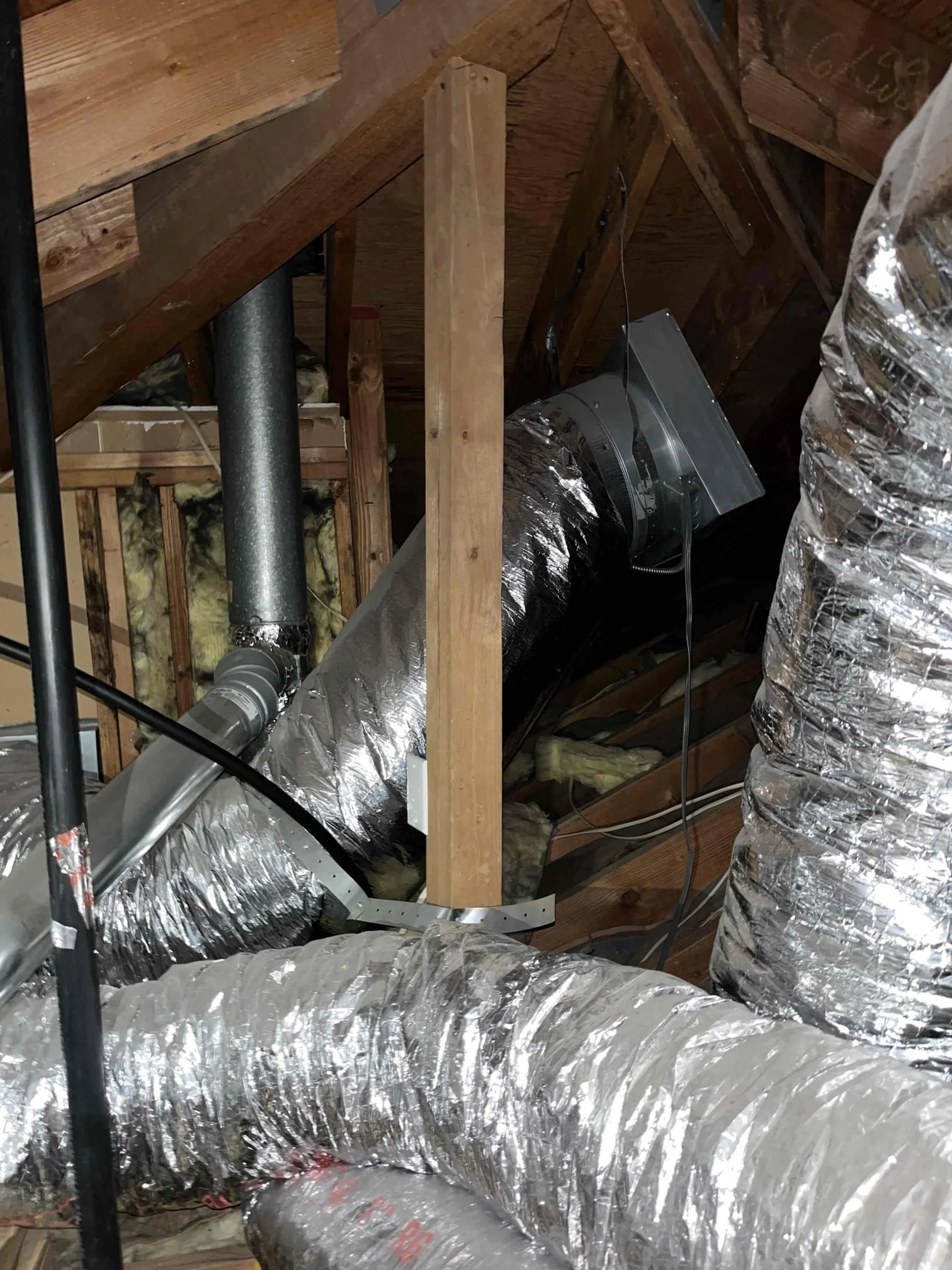
Your AC runs constantly but your upstairs stays hot? This is often why. These duct connections in your attic have loosened over 20-30 years. Studies show typical homes lose 15-20% of cooling through duct leaks, but we've seen homes losing 40%+. It's fixable.
3. Single Thermostat Location That Favors Downstairs (About 20% of Cases)
Your thermostat sits in a first-floor hallway that stays naturally cooler because it's shaded, away from windows, and benefits from sinking cool air.
That spot hits 72 degrees quickly, so your AC shuts off even though your west-facing master bedroom upstairs is still 82 degrees in full afternoon sun.
The location isn't wrong. It's just measuring the temperature of the easiest-to-cool spot in your house and making system decisions based on that reading.
This is harder to fix without installing a zoned system (which we'll discuss shortly), but simply moving the thermostat to a more representative location on the first floor can help. You want it on an interior wall, away from windows, doors, and vents, in a room you actually use.
4. Blocked or Closed Vents That Restrict Upstairs Airflow (About 10% of Cases)
We show up and find furniture blocking return vents, closed supply vents because someone thought they were "saving energy," or register boots that were never properly cut out when carpet was installed.
Each blocked vent reduces airflow to that room and creates imbalance throughout the system. Your HVAC is designed for specific airflow volume. When you block vents, you don't reduce energy use. You just create pressure imbalances that make the system work harder and cool less effectively.
This is the easiest fix. Move the furniture. Open the vents. Properly cut carpet around register boots. Total cost: $0 to $150.
5. Undersized or Aging HVAC System (About 5% of Cases)
Less commonly, we find systems that were undersized from the beginning or are 15+ years old and have lost cooling capacity due to aging components.
If your AC was sized for 1,800 square feet but you later added a 400 square foot bonus room upstairs, the system struggles. Or if you have a 20-year-old system with a partially failed compressor or low refrigerant from a slow leak, it can't keep up with cooling demands.
These situations usually require system replacement, which ranges from $6,000-15,000 depending on the size and complexity of your home. Before committing to a full replacement at that range, run the numbers against the cost of repairing what you have. Our AC repair-versus-replace decision framework walks through the five factors that determine which choice saves you more over the next decade, including system age, refrigerant type, and repair history.
Six Things You Can Do Right Now to Improve Upstairs Cooling
Before you spend thousands on major upgrades, try these DIY fixes. Some work better than others depending on your specific situation, but they're all worth attempting.
1. Close Blinds and Curtains on West and South-Facing Windows Before Noon
Upstairs bedrooms with windows facing west get hammered by afternoon sun. South-facing rooms get sun all day. This solar heat gain can raise room temperature 10-15 degrees even with the AC running.
Close blinds, curtains, or shades by 11 AM on these windows. Keep them closed until sunset.
This simple step reduces your upstairs cooling load by 25-30%. Many Yorba Linda homeowners with large west-facing master bedrooms see immediate improvement just from blocking direct sunlight.
2. Run Your HVAC Fan on "On" Instead of "Auto"
Most thermostats have two fan settings: Auto (fan runs only when heating or cooling) or On (fan runs continuously).
Switching to "On" keeps air circulating throughout your house 24/7 instead of only during active cooling cycles. This helps mix the hot upstairs air with cooler downstairs air, reducing temperature stratification.
The downside: your electric bill increases $20-40 per month from continuous fan operation, and indoor humidity might rise slightly because the fan keeps running even when the AC isn't actively dehumidifying.
But for many Orange County homeowners, this tradeoff is worth it. A $30 monthly cost to make upstairs bedrooms 3-5 degrees cooler is cheaper than most alternatives.
3. Partially Close Downstairs Vents to Force More Air Upstairs
This one's controversial because we just told you not to close vents. But there's a difference between closing vents completely and partially restricting them.
If you partially close (about 50%) a few downstairs vents in rooms that tend to get too cold, you redirect more airflow to upstairs rooms. You're not completely blocking airflow or creating major pressure imbalances. You're just nudging the system to send more conditioned air where you need it most.
Start by partially closing vents in rooms like guest bedrooms or the downstairs hallway that nobody occupies during the day. Monitor the effect on upstairs temperatures.
If it helps, leave it. If it makes no difference or your downstairs becomes uncomfortable, open them back up.
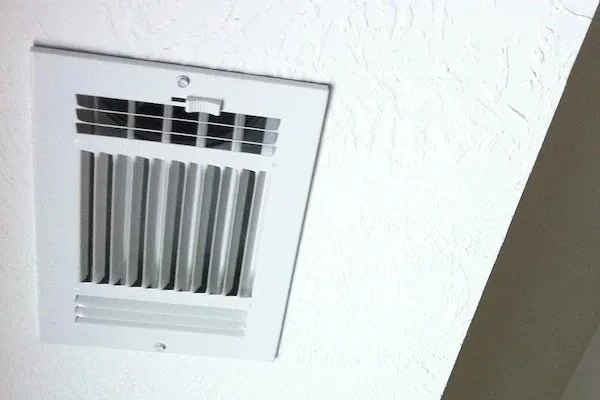
We know we said don't close vents, but there's a nuance here. Partially closing downstairs vents (about 50%) in rooms that get too cold can redirect airflow upstairs without creating pressure problems. J Martin helps Orange County homeowners find the right balance for their system.
4. Add Attic Insulation Yourself or Hire a Professional
If you're handy and your attic is accessible, you can add blown-in insulation yourself for $400-800 in materials. Home improvement stores rent blowers for $75-150 per day.
If you're not comfortable in attics or your attic has limited access, professional installation costs $1,500-2,500.
This is the highest-return investment for reducing upstairs temperatures. Taking your attic from R-19 to R-38 can lower upstairs room temperatures by 5-8 degrees and reduce your cooling costs by 20-30%.
5. Use Ceiling Fans in Upstairs Bedrooms
Ceiling fans don't lower air temperature. They move air across your skin, which creates evaporative cooling that makes you feel 3-5 degrees cooler.
In summer, ceiling fans should rotate counterclockwise (when looking up at them) to push air downward. This creates a wind-chill effect that makes 78 degrees feel like 73-74 degrees.
If your upstairs bedrooms don't have ceiling fans, installing them costs $150-400 per room. It's a one-time expense that makes sleeping in upstairs bedrooms significantly more comfortable without touching your thermostat.
6. Seal Air Leaks Around Windows, Doors, and Attic Access
Hot outdoor air infiltrates your home through gaps and cracks. In two-story homes, much of this infiltration happens upstairs where hot attic air leaks into living spaces around recessed lights, attic access doors, and wall penetrations.
Check your attic access door. If there's no weather stripping or insulation attached to the back of the door, hot attic air freely flows into your hallway.
Add weather stripping ($10-20) and insulation board ($15-25) to the attic door. Seal gaps around windows and doors with caulk or weather stripping. These small fixes add up to measurable temperature improvement.
The Zoned HVAC System Solution: When It Makes Sense and When It Doesn't
The most effective permanent solution for upstairs/downstairs temperature imbalance is installing a zoned HVAC system.
A zoned system divides your home into separate areas (typically upstairs and downstairs) with individual thermostats for each zone. Motorized dampers in your ductwork open and close to direct airflow where it's needed based on what each thermostat is calling for.
When your upstairs thermostat reads 80 degrees and your downstairs reads 72 degrees, the system automatically sends more cooling upstairs and less downstairs. It adjusts continuously based on actual conditions in each zone.
How Zoning Actually Works
Your existing HVAC system stays in place. A control panel is added that connects to multiple thermostats (one per zone). Motorized dampers are installed in your main ductwork branches.
When the upstairs thermostat calls for cooling, the control panel opens the upstairs damper and partially closes the downstairs damper. Your system runs normally, but airflow is directed primarily upstairs.
When both zones are satisfied, the system shuts off. When only downstairs needs cooling, airflow reverses.
The result: independent temperature control for each level. You can set your upstairs to 72 degrees and your downstairs to 75 degrees if that's what makes sense for your comfort and usage patterns.
What Zoning Costs
Adding a two-zone system to an existing single-zone HVAC typically costs $2,500-5,000 depending on your home's layout and ductwork configuration.
That's not insignificant, but it's far less than replacing your entire HVAC system, and it solves the temperature imbalance problem permanently.
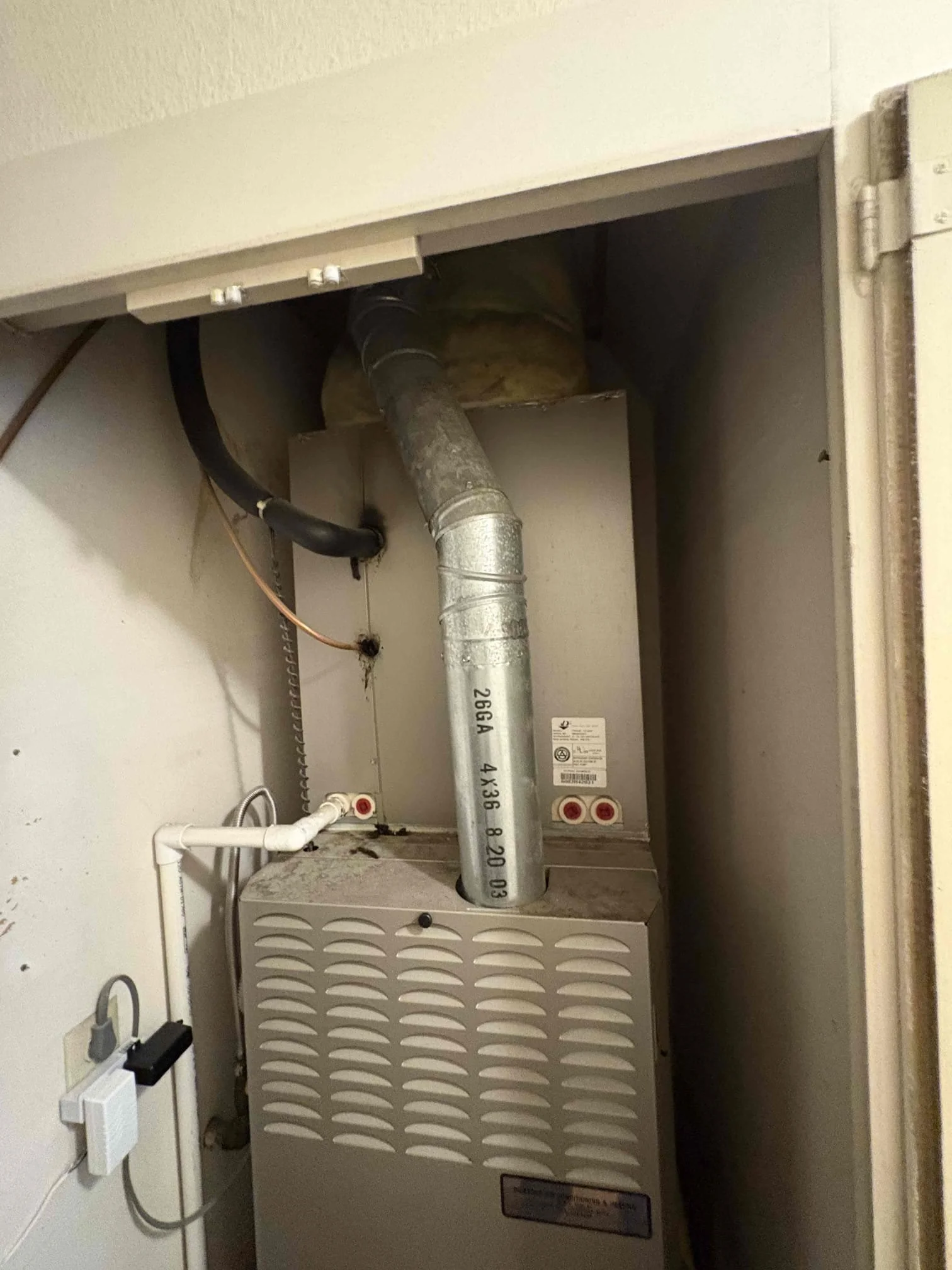
This single-zone system can be upgraded with zoning dampers, giving upstairs and downstairs independent temperature control. Or if it's 15+ years old, replacement with a modern variable-speed system offers better efficiency and comfort. J Martin helps you choose what makes sense for your home and budget.
When Zoning Makes Sense
Zoning is worth considering if:
Your temperature difference between floors exceeds 10 degrees consistently
You've already addressed insulation and duct leaks but still have significant imbalance
You have family members with different temperature preferences (someone upstairs wants it cooler than people downstairs)
You use upstairs and downstairs at different times (bedrooms at night, living areas during day)
Your HVAC system is relatively new (5-10 years old) so you're not ready to replace it
When Zoning Doesn't Make Sense
Zoning might not be worth it if:
Your HVAC system is 15+ years old and nearing replacement anyway
Your temperature imbalance is only 5-7 degrees (normal range that insulation and airflow adjustments can handle)
Your ductwork is in terrible condition and needs replacement
You have major duct leaks that should be sealed first
You have inadequate insulation that should be addressed first
We always recommend fixing the fundamentals (insulation, duct sealing) before adding zoning. There's no point in perfectly distributing conditioned air if you're losing 30% of it through leaky ducts.
The Two-System Approach: When One HVAC System Isn't Enough
Some larger Orange County homes (2,500+ square feet) were built with two completely separate HVAC systems from the beginning. One system handles upstairs, one handles downstairs, each with its own thermostat.
This isn't zoning. This is two independent systems that operate completely separately.
If you're building new or doing a major renovation, the two-system approach offers maximum flexibility and comfort. Each floor maintains exactly the temperature you want without compromise.
If you're considering adding a second system to an existing home, the cost ranges from $6,000-12,000 for a complete second system including ductwork installation.
This makes economic sense if:
Your existing system is undersized and struggling with your home's total cooling load
You have a large home (2,500+ square feet) where one system genuinely can't keep up
You're planning to stay in the home long-term (10+ years) to recoup the investment
Your upstairs has its own attic space and wall cavities where new ductwork can be run without major construction
For most Orange County two-story tract homes in the 1,500-2,200 square foot range, zoning makes more economic sense than adding a second system.
What Modern Heat Pump Systems Offer for Temperature Balance
If your HVAC system is approaching replacement age (12-15+ years), modern variable-speed heat pump systems offer significant advantages for managing upstairs/downstairs temperature differences.
Unlike traditional single-stage systems that run at 100% capacity or off, variable-speed systems can run anywhere from 40% to 110% capacity. They ramp up and down to match your home's exact cooling needs moment by moment.
This matters for two-story homes because variable-speed systems can run longer at lower speeds, which increases air circulation throughout the house. More circulation means better mixing of hot and cold air, which naturally reduces temperature stratification.
They also dehumidify better at low speeds, which makes the air feel cooler at the same temperature. A variable-speed system might maintain your home at 76 degrees with 45% humidity, which feels identical to 73 degrees at 60% humidity with a single-stage system.
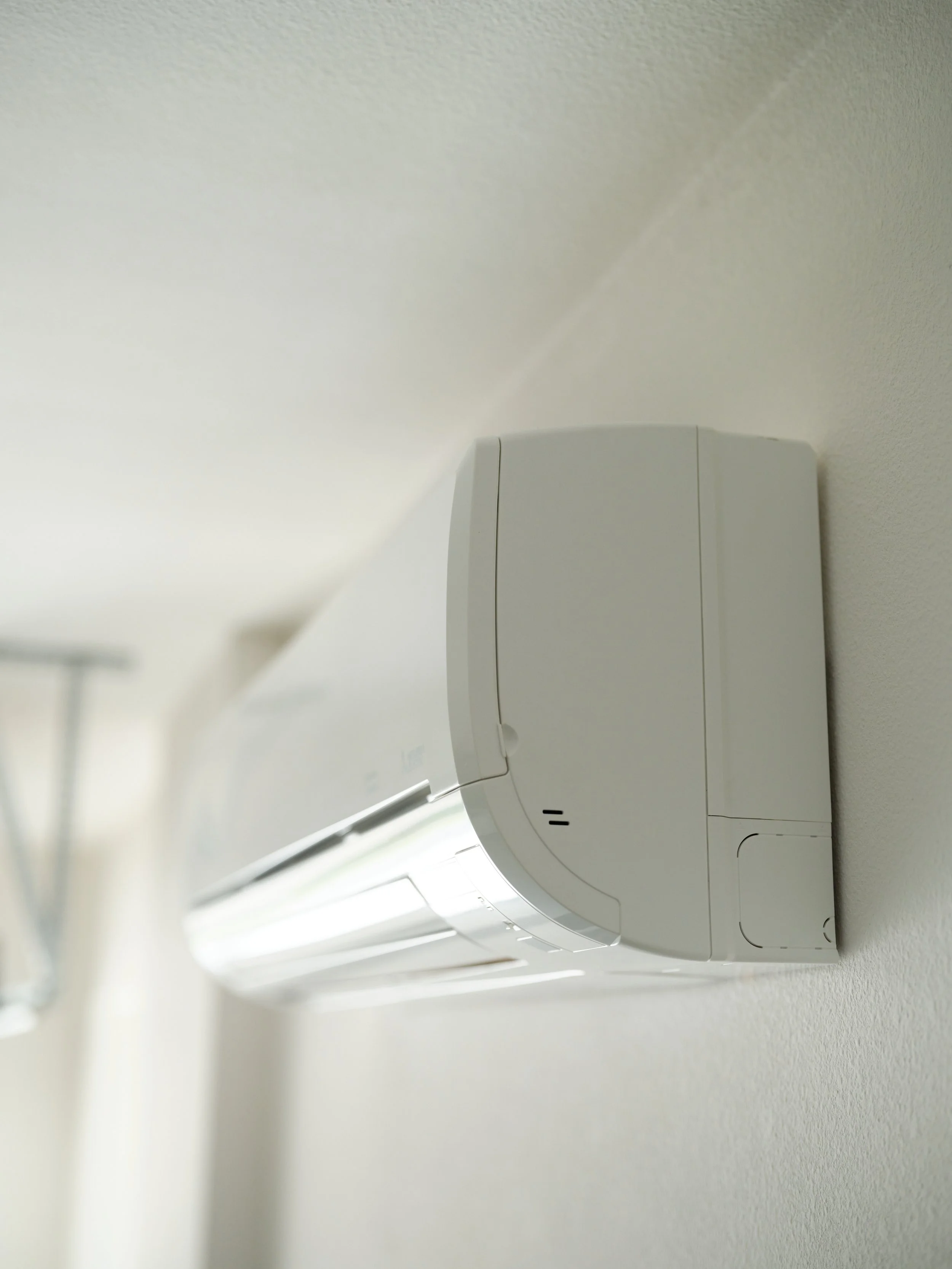
This ductless mini-split gives one upstairs bedroom its own independent cooling without requiring ductwork or a full system replacement. For Orange County homeowners whose upstairs won't cool down, mini-splits offer targeted relief while your main system handles the rest of the house.
Modern heat pumps also offer better energy efficiency (SEER2 ratings of 16-20+ versus 13-14 for older systems), which offsets the higher initial cost over time through lower monthly utility bills.
If you're looking at system replacement, ask about variable-speed heat pumps with optional zoning. It's the best of both worlds: efficient operation plus independent floor temperature control.
The Real Cost of Doing Nothing
Many Orange County homeowners live with uncomfortable upstairs temperatures for years because fixing it seems expensive or complicated.
Let's talk about what "doing nothing" actually costs.
Wasted Energy
When you set your thermostat to 68 degrees trying to cool your upstairs to something reasonable, your downstairs ends up at 62-65 degrees. You're overcooling half your house just to barely cool the other half.
This overcooling increases your summer electricity bills by 20-30%. For an average Orange County home, that's an extra $40-80 per month, or $240-480 per cooling season.
Over 10 years, that's $2,400-4,800 in wasted energy costs. Which is more than the cost of adding insulation and sealing ducts.
Shortened HVAC Lifespan
Running your system at maximum capacity for extended periods to try to cool your upstairs wears out components faster. Compressors, capacitors, and fan motors all degrade more quickly under continuous full-load operation.
The typical AC lifespan in Orange County is 12-15 years. Homes that constantly battle temperature imbalance issues see system failures at 10-12 years instead.
That's 2-3 years of lost life, which translates to replacing your system sooner and more often over your lifetime in the home.
Comfort and Sleep Quality
This one's harder to quantify, but sleeping in an 82-degree bedroom night after night for months on end affects your health, mood, and productivity.
Poor sleep quality has documented effects on physical health, mental wellbeing, and daily functioning. Is that worth avoiding a $2,000-5,000 investment to make your home comfortable?
What To Do Next: Getting Your Orange County Home Properly Diagnosed
If you're tired of the upstairs/downstairs temperature battle, here's the smart approach:
Step 1: DIY Assessment
Try the no-cost and low-cost fixes first. Close upstairs window coverings. Switch your fan to "On." Partially close some downstairs vents. See if these simple changes make enough difference.
If they help significantly, you might have solved your problem for under $100.
Step 2: Professional Assessment
If DIY fixes don't solve it, schedule an HVAC assessment with someone who can evaluate your insulation levels, check for duct leaks, measure actual airflow at each vent, and diagnose the root cause.
This shouldn't cost more than $150-250 for a thorough evaluation.
A good HVAC company will prioritize fixes by cost-effectiveness: insulation first, duct sealing second, system modifications third.
Step 3: Address Fundamentals
Add attic insulation and seal duct leaks before considering zoning or system replacement. These foundational fixes often solve 70-80% of the problem at a fraction of the cost of more complex solutions.
Step 4: Advanced Solutions Only If Needed
If you've addressed insulation and ductwork but still have significant temperature imbalance, then consider zoning or system upgrades.
Most Orange County two-story homes don't need advanced solutions. They need proper insulation and sealed ductwork, which should have been done correctly when the house was built but weren't.
Let's Fix Your Upstairs/Downstairs Temperature Problem
You shouldn't have to choose between freezing downstairs or sweating upstairs. Your two-story Orange County home can maintain comfortable temperatures throughout with the right fixes.
For Professional Assessment and Solutions:
If you want J Martin to evaluate your home's temperature imbalance and recommend the most cost-effective fixes, call (714) 406-5001
We'll assess your attic insulation, check ductwork for leaks, measure airflow at vents, and give you honest recommendations on what will actually solve your problem.
We're not going to push zoning or system replacement if adding insulation and sealing ducts will fix it. We'll tell you what makes sense for your specific home and budget.
From adding insulation to sealing ducts to installing zoning systems, J Martin handles every solution mentioned in this guide. We'll assess your Orange County home, explain your options, and prioritize fixes by cost-effectiveness. Call (714) 462-4686.
For Emergency Service:
If your AC has stopped working completely or you're experiencing system failure, we offer same-day emergency service throughout Yorba Linda, Anaheim Hills, and Orange County.
For Second Opinions:
If another company told you that you need a $12,000 system replacement to fix your temperature imbalance, get a second opinion. Often there are far less expensive solutions that work just as well.
J Martin Indoor Air Quality | (714) 462-4686 | Services
Common Questions About Upstairs/Downstairs Temperature Differences
Is a 10-degree temperature difference between upstairs and downstairs normal?
Yes. In a typical two-story home, an 8-10 degree difference during peak cooling season is normal due to physics (heat rises) and attic heat gain. This doesn't mean you have to accept it, but it's not a sign of system malfunction. Temperatures exceeding 12-15 degrees indicate fixable problems like insufficient insulation or duct leaks.
Should I close downstairs vents to force more cool air upstairs?
Partially closing downstairs vents (about 50%) in rooms that get too cold can help redirect airflow upstairs. Never completely close vents, as this creates pressure imbalances. Start with non-essential rooms like guest bedrooms or hallways. Monitor the results and adjust. If it doesn't help or makes downstairs uncomfortable, open them back up.
Will a bigger AC system solve my temperature imbalance?
No. Oversized systems create more problems than they solve (short cycling, poor dehumidification, uneven cooling, higher energy bills). The issue isn't insufficient cooling capacity - it's airflow distribution and heat loss. Fix insulation, seal ducts, and consider zoning before even thinking about a larger system.
How much does it cost to add attic insulation in Orange County?
Professional installation to bring an average Orange County home from R-19 to R-38 costs $1,500-2,500. DIY costs $400-800 in materials if you rent the blower and do it yourself. This is typically the highest-return investment for reducing upstairs temperatures, often lowering them by 5-8 degrees.
What's the difference between a zoned system and having two separate HVAC systems?
A zoned system uses one HVAC unit with multiple thermostats and motorized dampers to direct airflow to different areas based on demand. Two systems means two complete, independent HVAC units. Zoning costs $2,500-5,000 to add to existing systems. Two systems cost $6,000-12,000 to install from scratch. For most Orange County homes under 2,500 square feet, zoning makes more economic sense.
Why is my upstairs colder than downstairs in winter?
This is less common but happens when heated air rises to the attic and escapes due to poor insulation or when downstairs return vents pull too much air away from upstairs rooms. Check attic insulation levels and make sure all upstairs supply vents are fully open. The fan-on-auto switch affects this too - running the fan continuously helps distribute heat more evenly.
Can ceiling fans really make a difference in upstairs temperature?
Ceiling fans don't lower air temperature, but they make you feel 3-5 degrees cooler through air movement and evaporative cooling. This matters because it allows you to set your thermostat 3-4 degrees higher (saving energy) while maintaining the same comfort level. For upstairs bedrooms that stay warm at night, ceiling fans make sleeping significantly more comfortable.
How do I know if my ductwork has leaks?
Common signs include: weak airflow from certain vents, some rooms that never reach the right temperature, visible gaps or disconnections in accessible ductwork, and high energy bills despite normal thermostat settings. Professional duct testing costs $200-400 and measures exactly how much air you're losing. Typical duct leakage ranges from 15-20%, but we've seen homes losing 40%+ of conditioned air in the attic.
Related Articles: