
Summer AC Prep for Orange County: Your 2026 Checklist
Posted on July 6, 2026
Prepping your AC for an Orange County summer comes down to seven tasks: replace the air filter, hose down the outdoor condenser, flush the condensate drain line, test the thermostat, run a 20-minute function check before the first heat wave, walk the refrigerant lines for ice and oil stains, and book a professional HVAC maintenance tune-up before the end of May. Five of those tasks are Saturday-morning DIY. Two of them, the refrigerant inspection and the full tune-up, are best handled by a licensed technician with gauges and an electrical meter.
The reason this list matters more in Orange County than in most of California is climate spread and rate structure. Anaheim Hills runs 10 to 15 degrees hotter than coastal Newport Beach on summer afternoons, and SCE's TOU-D-4-9PM peak rate climbs to 58 cents per kilowatt-hour from June 1 through October 1. Walking into June with a clean, calibrated, leak-free system is the difference between a $1,200 cooling bill and an $1,800 one.
We have been doing this seasonal prep work for Orange County families since 2014. Our full-time technicians, Jesus, Jack, Angel, Carlos, Christian, and the rest of the crew, see the same pattern: the systems we tune up in late April and May breeze through summer; the systems whose owners skipped a tune-up tend to call us in mid-July when the capacitor pops on the hottest day of the year.

From coastal Newport Beach to inland Anaheim Hills, J Martin has prepped Orange County AC systems for summer since 2014. Same crew, same trucks, no subcontractors.
Quick Answer
Your seven-task summer AC prep list, in priority order: replace the filter with a MERV 8 to 11 model, hose down the outdoor condenser coils, flush the condensate drain line with a quarter-cup of white vinegar, test the thermostat by setting it five degrees below room temperature, run a 20-minute function check on a mild morning, walk the refrigerant lines for ice or oil stains, and book a professional tune-up ($129 to $299) before late May. The first six are Saturday-morning DIY. The seventh requires a licensed technician. Skipping the tune-up turns a $40 capacitor swap into a $400 emergency call when the system fails on a 100-degree day.
Why Summer AC Prep Matters More in Orange County
Orange County's summer climate is unforgiving in ways that the cost calculators built for "average California" tend to miss. A 2,400 square foot home in Newport Beach often runs comfortably on a 3-ton system with mild ocean breezes for free pre-cooling at night. The same square footage in Anaheim Hillstypically needs a 4-ton system, sees afternoon highs in the high 90s for weeks at a stretch, and gets very little overnight relief in late July and early August. Inland tract homes from the 1970s and 1980s are particularly hard-hit. Their original return-air ducts are usually undersized for the cooling loads we now demand, and a clogged filter pushes them past the breaking point.
The other half of the OC summer equation is utility cost. Southern California Edison's residential time-of-use plans charge their highest rates between 4 p.m. and 9 p.m. on summer weekdays, which is exactly the window when most of us run our AC hardest. On TOU-D-4-9PM, the peak rate is 58 cents per kilowatt-hour. On TOU-D-5-8PM, summer weekday peak hits 74 cents per kilowatt-hour. Off-peak rates drop to roughly 23 cents. SCE's overall residential rates also rose roughly 12.9 percent heading into 2026. Translation: every kilowatt-hour your AC wastes because of a dirty filter, a fouled coil, or a low refrigerant charge costs more this year than it did last year, and a lot more if it happens during peak hours.
For our scheduled tune-up customers, late April and May are the booking window we push hardest. Tune ups in this window catch the small problems (a weak capacitor, a low refrigerant charge, a sticking contactor) before they become the kind of failure that takes the system down on a Saturday during a heat wave. Once temperatures cross 95 degrees, our schedule fills up fast, and the same tune-up that takes 75 minutes in May becomes a same-day emergency call in July.
Southern California Edison's summer peak rate of 58 cents per kilowatt-hour on TOU-D-4-9PM applies from June 1 through October 1, weekdays from 4 p.m. to 9 p.m. Off-peak rates drop to roughly 23 cents. A clean, calibrated AC system uses peak hours less and runs efficiently when it does, which is where most summer savings come from.
Task 1: Replace the Air Filter (DIY, 5 Minutes, $15 to $40)
The single highest-leverage prep task is the cheapest. A new air filter installed before the first heat wave costs $15 to $40 at any hardware store and prevents the cascade of problems that a dirty filter causes: reduced airflow, frozen evaporator coil, capacitor stress from longer run cycles, and a 5 to 15 percent efficiency hit on the entire system. For Orange County homes, we recommend a MERV 8 to 11 pleated filter, which is the sweet spot between particle capture and airflow resistance. Anything higher than MERV 13 in a residential system can choke airflow and stress the blower motor unless the duct system is specifically sized for it.
Replacement frequency in Orange County depends on your household. Homes with no pets and no allergy sufferers can usually run a 1-inch pleated filter for 60 to 90 days. Homes with shedding dogs or cats need a fresh filter every 30 to 45 days. Homes near construction or in parts of Yorba Linda with active wildfire smoke days need to check the filter weekly during smoke events and replace it whenever it goes visibly gray. If you can hold the filter up to a light source and see almost nothing through it, it is overdue.
Two notes that catch homeowners off guard. First, filter sizing matters. The size printed on the existing filter is the one to buy; an undersized filter that lets air bypass it does roughly nothing. Second, the arrow on the filter frame must point toward the air handler. Backwards installation collapses the pleats and causes the same airflow problem you were trying to fix. For a deeper walkthrough on filter selection, our guide on picking the right HVAC filter goes through MERV ratings, sizing, and pet-household considerations in detail.
Task 2: Clear and Wash the Outdoor Condenser (DIY, 30 Minutes, $0)
The outdoor condenser unit is the half of your AC system that releases heat from your home into the outside air. When the aluminum fins on the condenser are blocked by leaves, grass clippings, dust, dryer-vent lint, or salt buildup, the system has to work harder and longer to dump the same amount of heat. Industry research indicates that a dirty condenser coil can reduce heat transfer by up to 30 percent. That translates directly into longer run times, higher bills, and more stress on the compressor and capacitor.
The cleaning process is straightforward and takes about 30 minutes. First, shut off power to the outdoor unit. There is usually a disconnect box mounted on the wall next to the condenser; pulling the disconnect cuts power. If you do not see one, switch off the AC breaker at the main panel. Second, remove visible debris by hand: leaves, twigs, palm fronds, anything stuck against the fins or the cabinet. Third, take a garden hose with a gentle spray nozzle (not a pressure washer) and rinse the fins from the inside out, working top to bottom. Pressure washers bend fins and void warranties on most systems.
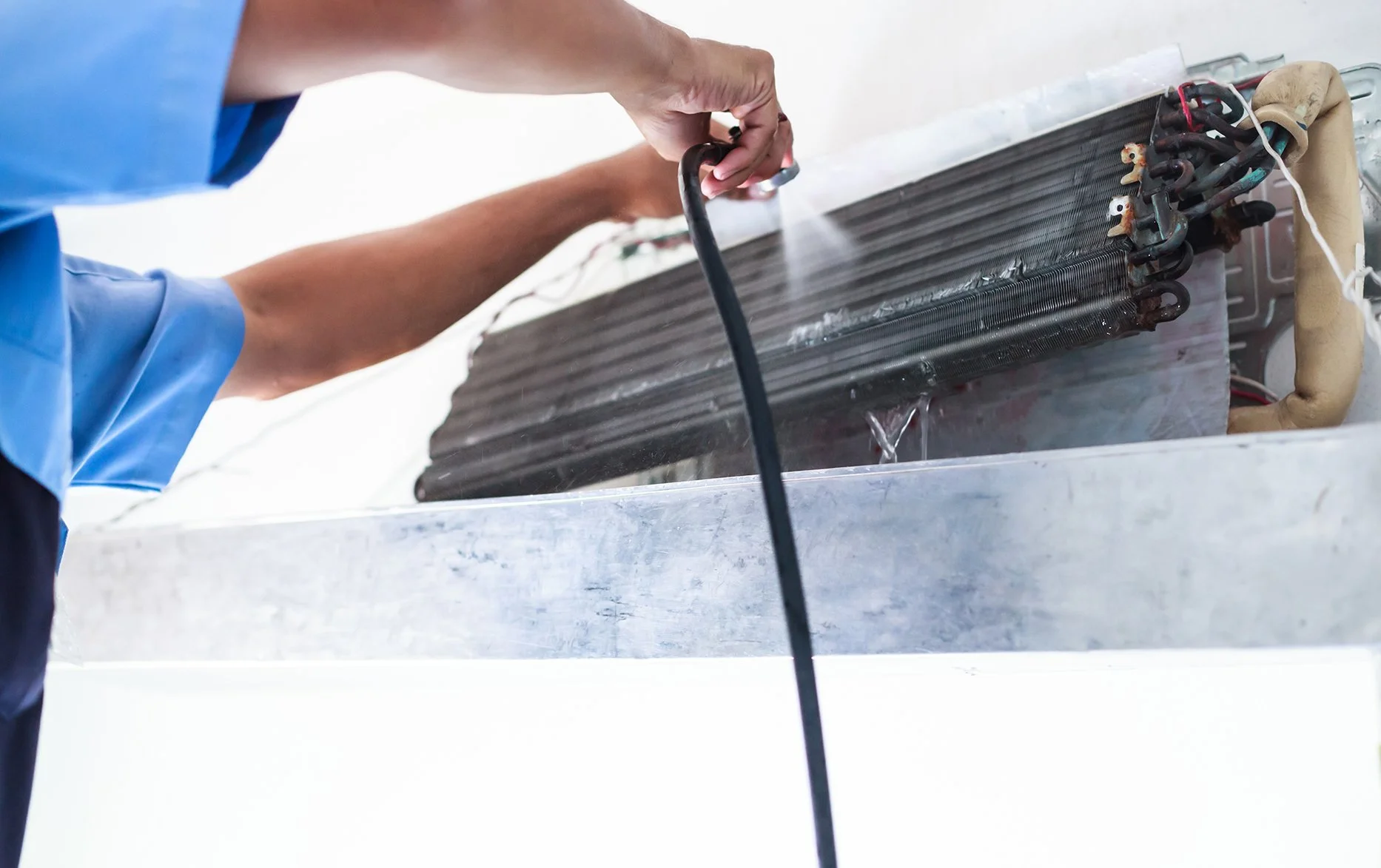
Most homeowners never see what's actually happening inside their AC unit. This is what a real coil cleaning looks like, and it's a big part of why your summer bill stays lower.
Coastal homes need this task more than inland homes. Salt-laden marine air corrodes aluminum fins quickly in Laguna Niguel, Newport Beach, Corona del Mar, and adjacent coastal neighborhoods. We commonly see condenser cabinets in those areas with visible white salt residue and aluminum fins that have started to flake. A bi-annual rinse with fresh water (May and October) extends the equipment's life by years. Inland homes have a different problem: dust, pollen, and in fall, ash from wildfires. The cleaning approach is identical, but the timing matters more, since wildfire ash can clog a condenser in a single afternoon.
Two safety notes. Never run the system while the disconnect is pulled. After you turn power back on, wait at least 5 minutes before starting the AC at the thermostat. The compressor needs that time to equalize internal pressures, and short-cycling it after a power interruption is a fast way to damage it.
Task 3: Flush the Condensate Drain Line (DIY, 10 Minutes, $5)
Every central AC system pulls humidity out of the air and drips that condensate into a small PVC drain line that routes it outside or to a floor drain. In Orange County's climate, that line is a magnet for algae, mold, and slime buildup, and the most common single cause of "my AC is leaking water from the ceiling" calls in July is a clogged condensate line. The fix takes 10 minutes and costs about $5 in supplies.
The maintenance ritual is to pour a quarter-cup of distilled white vinegar (or a 50/50 vinegar-water solution) into the access port at the top of the drain line every month during heavy AC use. The vinegar's acidity kills algae and mold and dissolves the biofilm that causes clogs. The access port is usually a T-shaped fitting with a removable cap, near where the drain line exits the air handler. If your air handler is in the attic (common in tract homes from Placentia and Fullerton), the access port is up there with it, and so is the secondary drain pan that catches overflows.
Why this matters: when the primary drain clogs and the secondary drain pan fills, water either runs out of the secondary drain (you will see water dripping from a small white pipe outside, near a window) or, worse, overflows the pan and drips through your ceiling. Ceiling damage from a clogged AC drain line averages $2,000 to $5,000 in repairs, all from a $5 bottle of vinegar's worth of neglect. We see at least one of these calls a week from June through September.
Task 4: Test and Recalibrate Your Thermostat (DIY, 15 Minutes, $0 to $300)
Before the first heat wave, do a basic thermostat function test. Set the thermostat 5 degrees below the current room temperature. Within about a minute, you should hear the AC kick on and feel cool air at the supply registers. Then set the thermostat 5 degrees above room temperature and confirm the system shuts off cleanly. If the AC takes longer than 90 seconds to start, runs and never reaches setpoint, or short-cycles on and off in under three minutes, you have an issue worth diagnosing now, not in July.
Battery-powered thermostats need a fresh set of AA batteries every spring. Failing batteries are responsible for a surprising number of "my AC just stopped working" service calls in late June. Wired thermostats do not need new batteries, but they often have a small backup battery for memory retention; check your owner's manual.
If you are still on a 1990s-era manual or basic programmable thermostat, summer is the right time to upgrade. ENERGY STAR data shows that smart thermostats save the average household roughly 8 percent on heating and cooling bills, with savings ranging from 5 to 26 percent depending on prior thermostat habits. Each degree of setback during away or sleep hours saves an additional 1 to 3 percent. ENERGY STAR certified models qualify for utility rebates ranging from $25 to $150 in California, and SCE has run thermostat rebate programs in past summers that are worth checking before you buy. For an Orange County specific breakdown, our piece on smart thermostat real savings data walks through the math for a typical OC home.
Installation is moderate-difficulty DIY for most homes built since 2000, since they tend to have a C-wire (the constant-power wire that smart thermostats need). Older tract homes often do not have a C-wire and will need either a power adapter or a quick electrical pull, which is the moment most homeowners call us.
Task 5: Run a 20-Minute Function Check Before the First Heat Wave (DIY, 20 Minutes, $0)
Pick a mild morning when outdoor temps are 70 to 85 degrees, set the thermostat to 68, and let the system run for 20 minutes. This is the most diagnostic single thing a homeowner can do, and it surfaces problems while you still have time to fix them.
What to watch for. Stand at a supply register about 10 feet from the air handler and feel the air. Healthy systems deliver supply air that is 18 to 22 degrees colder than the air at the return register; the technical term is "temperature split." A split under 14 degrees suggests low refrigerant, a dirty coil, or a failing compressor. A split over 25 degrees suggests airflow problems, often from a clogged filter or closed registers. Walk through the home and verify all the supply registers are blowing similarly cold air. Rooms that are noticeably warmer than the rest are usually a duct or balancing problem rather than an AC problem.
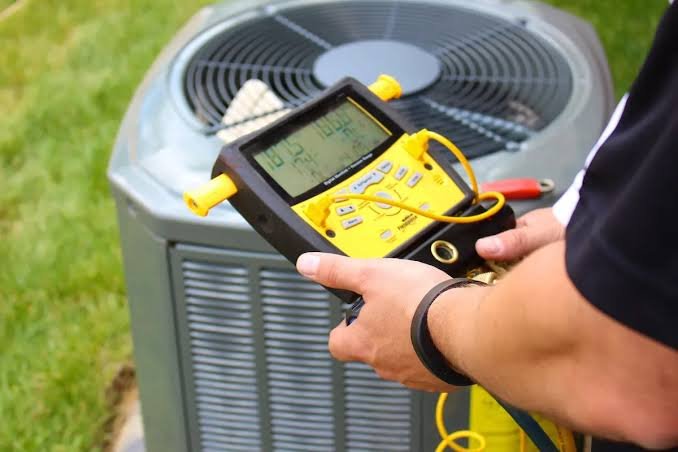
A real tune-up includes refrigerant pressure measured with calibrated gauges, not a guess. Book yours before the schedule fills up. Call J Martin at (714) 462-4686.
Listen for unusual sounds. The blower in the air handler should hum steadily without rattling or whining. The outdoor compressor should run smoothly without buzzing, banging, or clicking on and off in short bursts. Short cycling, where the system runs for 60 to 90 seconds and shuts off repeatedly, is a top-three call we get in July. The cause is often a low refrigerant charge, a dirty coil, an oversized system, or a failing capacitor. Our guide on why an AC runs but does not cool walks through the diagnostic flow in detail.
If anything during the function check looks off, do not wait. By mid-June, the schedule for every reputable HVAC company in Orange County is full a week out, and same-day calls are reserved for true emergencies (no cooling, water damage in progress).
Task 6: Walk the Refrigerant Lines for Ice, Oil Stains, or Corrosion (DIY, 10 Minutes, $0)
The two copper refrigerant lines that connect the indoor air handler to the outdoor condenser tell you a lot about system health. With the AC running for 15 minutes, walk to the outdoor unit and inspect the lines where they enter the house and where they connect to the condenser.
The smaller, uninsulated copper line should be warm to the touch (close to outdoor temperature). The larger, insulated line under the foam wrap should be cold, around 50 to 60 degrees, with no visible ice. Ice on the larger line means low refrigerant or restricted airflow inside, and continuing to run the system that way will damage the compressor. Power off the system and call a technician.
Look for oil stains at every joint. Refrigerant leaks pull lubricant out with them, and the telltale sign is a darker oily smudge or a wet spot at a fitting or where the line bends. Look for corrosion or kinking in the line itself. Newer 2025 and later residential systems use R-454B refrigerant in ducted systems and R-32 in ductless mini-splits. Older systems on R-410A are still legal to repair and service, and the EPA's late 2025 enforcement guidance lets contractors continue installing R-410A inventory manufactured before 2025. Parts and refrigerant for existing R-410A systems will be available for many years. R-410A (the standard residential refrigerant from 2010 through 2024) is being phased down, not banned overnight.
If your home still has the very old R-22 system (more common in Orange County tract homes that have not been touched since the 1990s), an R-22 refrigerant leak is now expensive to fix because R-22 has been banned from production since 2020 and recycled stock costs roughly $100 to $150 per pound. We routinely run repair-versus-replace calculations for R-22 systems, and replacement is usually the right call by year ten of an R-22 system's life. Our piece on repair versus replace walks through the framework.
Task 7: Book a Professional Tune-Up Before the End of May (Pro, 60 to 90 Minutes, $129 to $299)
The seventh task is the one that pays for itself the most reliably. A professional pre-summer tune-up in Orange County costs $129 to $299 in 2026 (basic at the lower end, comprehensive at the upper end). It catches what DIY checks cannot: refrigerant charge measured against the manufacturer's specification, capacitor microfarads tested under load, contactor pitting and arc damage, blower wheel imbalance, evaporator coil cleaning that requires opening up the cabinet, drain pan inspection, gas valve and ignition tests on dual-fuel systems, and a full electrical panel and amperage draw read.
The math on tune-up versus emergency repair is the part most homeowners do not see until it happens to them. A capacitor that is showing weakness during a May tune-up costs $15 to $80 in parts (often included in a comprehensive tune-up) and 5 minutes of the technician's time. The same capacitor failing on a 102-degree afternoon in mid-July becomes an emergency call: $250 to $400, sometimes higher with after-hours rates. HVAC industry data shows we replace more capacitors between June and October than the rest of the year combined, because heat is brutal on these components when they are working their hardest.
A weakening AC capacitor caught during a May tune-up costs $15 to $80 in parts. The same capacitor failing during a July heat wave costs $250 to $400 as an emergency call. The tune-up that found it pays for itself two times over the moment one preventable failure is avoided.
The timing window matters. We push our customers to book in late April and May because once temperatures cross 95 degrees the schedule fills up, and the same tune-up that takes 75 minutes in May becomes a same-day emergency call in July. Our True Maintenance Plan customers get priority booking in this window, and we hold those slots for them through the end of May. Our cost breakdown of AC tune-up costs in Orange County goes through what is included at each price tier in detail.
One question we get often: is a chain-store $20 or $49 tune-up worth it? Almost never. Those prices cover a 15-minute visual check; nothing gets opened up, nothing gets measured, and the visit is usually a sales channel for replacement quotes rather than actual maintenance. A real tune-up at the price point above takes 60 to 90 minutes, includes refrigerant pressure measurements with calibrated gauges, and produces a written checklist of what was done.
Pre-Summer Prep Tasks at a Glance
The full task list with timing, cost, and DIY-versus-pro guidance is in the table below. Cost ranges are current as of May 2026 for Orange County.
Pre-Summer AC Prep Tasks for Orange County Homes (2026)
| Task | DIY or Pro | Time | Cost | Best Done By |
|---|---|---|---|---|
| Replace air filter (MERV 8 to 11) | DIY | 5 minutes | $15 to $40 | April or May, then every 30 to 90 days |
| Clear and wash outdoor condenser | DIY | 30 minutes | $0 | Late April to mid-May |
| Flush condensate drain line | DIY | 10 minutes | $5 | May, then every 30 days through October |
| Test and recalibrate thermostat | DIY (upgrade is pro) | 15 minutes | $0 to $300 | Late April to mid-May |
| Run 20-minute function check | DIY | 20 minutes | $0 | Mild morning in early May |
| Inspect refrigerant lines | DIY (repair is pro) | 10 minutes | $0 | Same morning as function check |
| Professional tune-up | Pro | 60 to 90 minutes | $129 to $299 | Late April to end of May |
The total time investment for the DIY portion of the list, done in one block, is about 90 minutes. The professional tune-up adds another 60 to 90 minutes. If you can carve out a Saturday morning in early May, the entire list is done before 11 a.m.
How Much You Can Save by Prepping vs. Skipping
The dollar case for summer AC prep is more lopsided than most homeowners realize. The capacitor math alone covers a comprehensive tune-up in most years: a $250 to $400 emergency capacitor call avoided once every three or four summers pays for the tune-up several times over.
The bigger savings come from efficiency. A clean filter, clean condenser coil, calibrated thermostat, and properly charged refrigerant system can run 15 to 25 percent more efficiently than the same system neglected. For an Orange County home running a 4-ton AC during a typical summer, that translates to roughly $200 to $400 in summer cooling savings, before any heat-wave events. Heat waves push the gap wider, since the inefficient system runs longer and during peak rate hours.
The third category of savings is avoided damage. The two most expensive avoidable summer events we see are compressor failures from chronic low-refrigerant operation ($1,800 to $3,200 to replace, often pushing homeowners into a full system replacement of $8,000 to $18,000) and ceiling water damage from clogged condensate drain lines ($2,000 to $5,000). Both are caught by tasks on the list above.
A 4-ton Orange County AC running 15 to 25 percent more efficiently than a neglected system saves roughly $200 to $400 per summer, before counting the value of any avoided emergency calls. Across the average ten-year service life, that math adds up to thousands of dollars at SCE's 2026 rates.
Our maintenance-plan customers consistently report the lowest summer cooling bills in their neighborhoods, and that is not coincidence. A system that gets a real tune-up every spring stays clean, stays charged correctly, and stays out of trouble. For homeowners who want to track their own savings, our piece on why energy bills get so high in Orange County covers the relationship between system age, maintenance state, and SCE billing.
When DIY Isn't Enough: Signs You Need a Pro Visit Now
Some symptoms during your function check are not "watch and see" issues. They are stop-running-the-system-and-call-someone issues. The five most common in Orange County: warm air coming out of the supply registers when the AC is on, ice forming on the larger refrigerant line or the indoor evaporator coil, the breaker tripping when the AC starts, a loud buzzing or rattling from the outdoor unit, and a burning smell from any part of the system.
Warm air with the system running typically means refrigerant is leaking, the compressor is failing, or the contactor is burned out. Ice on the lines means refrigerant is low or airflow is blocked, and continuing to run the system risks slugging liquid refrigerant back to the compressor, which is one of the most expensive failures we deal with. A tripping breaker means electrical resistance somewhere in the system, often a shorted compressor winding or a failing capacitor pulling locked-rotor amps. Loud buzzing or rattling at the condenser is usually the contactor or a fan motor near failure. Burning smell is electrical insulation overheating somewhere, and that one is non-negotiable: shut the system off at the breaker.
If any of those show up during your prep, you can reach our team at (714) 462-4686 for same-day or next-day service. We do not charge premium rates for diagnostic visits in Orange County, and our techs are trained to give you a real repair-versus-replace recommendation rather than an upsell.
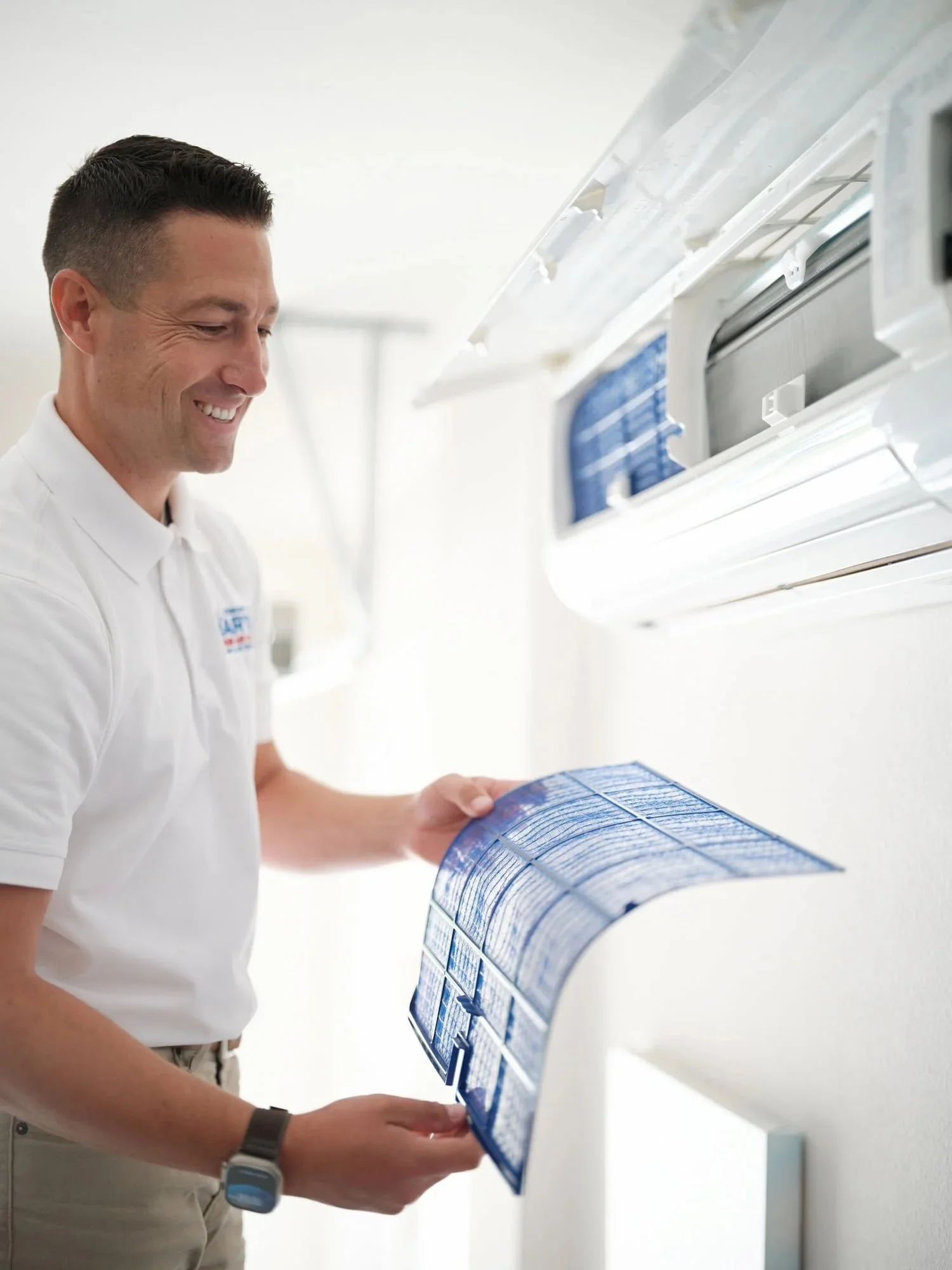
J Martin technicians check the small things, like filter fit and airflow direction, that homeowners often miss. That attention to detail is what keeps your system running efficiently all summer.
Frequently Asked Questions
When is the best time to schedule an AC tune-up in Orange County?
Late April through the end of May is the optimal window. Outdoor temperatures in that window are mild enough that technicians can take their time on each job, schedules are not yet full, and any problems found can be repaired before the first heat wave. Once temperatures cross 95 degrees, usually around mid-June, schedules fill up and the same tune-up that took 75 minutes in May becomes a same-day emergency call.
How much does a summer AC tune-up cost in Orange County in 2026?
A basic AC tune-up in Orange County costs $129 to $199 in 2026. A comprehensive tune-up (with refrigerant pressure check, capacitor testing, electrical panel readings, and coil cleaning) costs $199 to $299. Watch out for chain-store offers under $50; those are visual inspections, not real maintenance, and almost always exist as a sales channel for replacement quotes.
Can I prep my AC for summer without calling a professional?
You can do six of the seven tasks on this list yourself: filter replacement, condenser cleaning, condensate drain flush, thermostat test, function check, and refrigerant line inspection. The seventh, the actual tune-up with refrigerant pressure measurement and capacitor testing, requires a licensed technician with calibrated gauges and an electrical meter. Doing all six DIY tasks plus the professional tune-up gives you the most thorough prep possible.
What MERV rating should I use for my AC filter in Orange County?
MERV 8 to 11 is the right range for most Orange County homes. MERV 8 captures pollen, dust, and pet dander effectively at the lowest airflow restriction. MERV 11 adds finer-particle capture (mold spores, smoke residue) at slightly higher resistance. Filters above MERV 13 should only be used in systems specifically designed for them; in standard residential systems, they choke airflow and stress the blower motor.
Why does my AC capacitor fail in summer?
Capacitors fail in summer because heat accelerates the breakdown of the dielectric material inside them, and they are running hardest during peak cooling demand. HVAC industry data shows more capacitors are replaced between June and October than the rest of the year combined. A weakening capacitor caught during a May tune-up costs $15 to $80 in parts; the same capacitor failing on a 102-degree afternoon in July costs $250 to $400 as an emergency call.
Should I cover my outdoor AC unit in summer when not in use?
No. AC condensers are designed to live outdoors and need airflow around them at all times to dissipate heat. Covers trap moisture against the cabinet, which encourages corrosion and gives rodents a sheltered place to nest in the wiring. The only time a partial cover (top only) is recommended is in winter to keep falling debris out of the cabinet, and even then, a board across the top is usually enough.
Will a smart thermostat actually lower my summer cooling bill?
Yes, by roughly 8 percent on average for cooling, according to ENERGY STAR data, with savings ranging from 5 to 26 percent depending on prior thermostat habits and how aggressively the schedule is set. Each degree of setback during away or sleep hours saves another 1 to 3 percent. ENERGY STAR certified models qualify for utility rebates of $25 to $150 in California. The savings are real, but they depend on actually using the schedule features rather than overriding them constantly.
My AC uses R-410A refrigerant. Should I worry about the phase-out for summer 2026?
No. Manufacturing of new R-410A residential split systems ended January 1, 2025, but the EPA's late 2025 enforcement guidance lets contractors continue installing existing R-410A inventory and continue repairing and servicing the millions of R-410A systems already in homes. Refrigerant and parts will be available for many years. New systems sold from 2025 onward use R-454B (ducted) or R-32 (ductless), but your existing R-410A system is fine to operate, repair, and prep for summer normally.
Get Your AC Ready Before the First Heat Wave
If you have not had a tune-up since last spring, the smart move is to book one before Memorial Day weekend. After Memorial Day, our schedule shifts toward emergency calls, and the same tune-up that takes a leisurely 75 minutes in May tightens up to a 60-minute window squeezed between repair calls. The tune-up cost is the same; the experience is just calmer in May.
J Martin Indoor Air Quality has served Orange County families since 2014. Licensed, bonded, and insured (CA Contractor License CL#998956), with a 4.97-star rating across thousands of reviews and more than 5,000 OC families served. When you call us, Kathryn or Alexis answers from our Anaheim office, not a national call center. When a tech arrives at your home, it is Jesus, Jack, Angel, Carlos, Christian, or another full-time member of our crew, in a J Martin uniform and a J Martin truck. We do not run subcontractors, we do not push replacements you do not need, and we do not run high-pressure sales pitches.
Call us at (714) 462-4686 for same-day service or to book your pre-summer tune-up, or request a free in-home consultation. For broader seasonal context, our spring AC prep guide for Yorba Linda and our Orange County AC maintenance checklist cover the rest of the year. For the full HVAC maintenance service we offer, including our True Maintenance Plan, the service page has the details. And if your AC is already showing summer trouble signs, our air conditioning repair team handles same-day diagnostic visits across all 26 Orange County cities we serve.