
AC Maintenance Checklist for Orange County Homeowners (2026)
Posted on July 28, 2026
A complete AC maintenance checklist for Orange County homeowners includes seven core tasks: replacing or cleaning the air filter every 30 to 90 days, clearing debris from the outdoor condenser unit, flushing the condensate drain line, inspecting the evaporator coil, testing thermostat calibration, checking visible ductwork and vents for leaks, and scheduling at least one professional tune-up per year. Completing these tasks consistently keeps your system running at peak efficiency, prevents the most common causes of AC breakdowns, and can reduce your cooling costs by 15% to 25% compared to a neglected system.
The specifics matter more than the list itself, though. Orange County's climate puts unique stress on residential AC systems that a generic national checklist does not account for. Inland cities like Anaheim Hills and Yorba Linda routinely hit 95 to 100 degrees on summer afternoons, and during Santa Ana wind events, fine dust coats condenser coils and clogs filters faster than homeowners expect. Coastal cities deal with salt air corrosion. Every home in the county runs on Southern California Edison power at an average residential rate of 34.5 cents per kilowatt-hour as of January 2026, which means an inefficient system costs real money every single day it runs.
We have performed thousands of professional HVAC maintenance visitsacross Orange County since 2014. When our technician Jesus arrives at a home in Anaheim Hills for a spring tune-up and finds the condenser coil caked in a quarter-inch of dust, a filter that has not been changed since the previous summer, and a condensate line growing algae, he is not surprised. He sees some version of that combination at roughly four out of every ten maintenance calls. The homeowner is usually surprised to learn that those three issues alone can reduce their system's cooling output by 20% to 30% and add $40 to $60 per month to their Edison bill during peak summer.
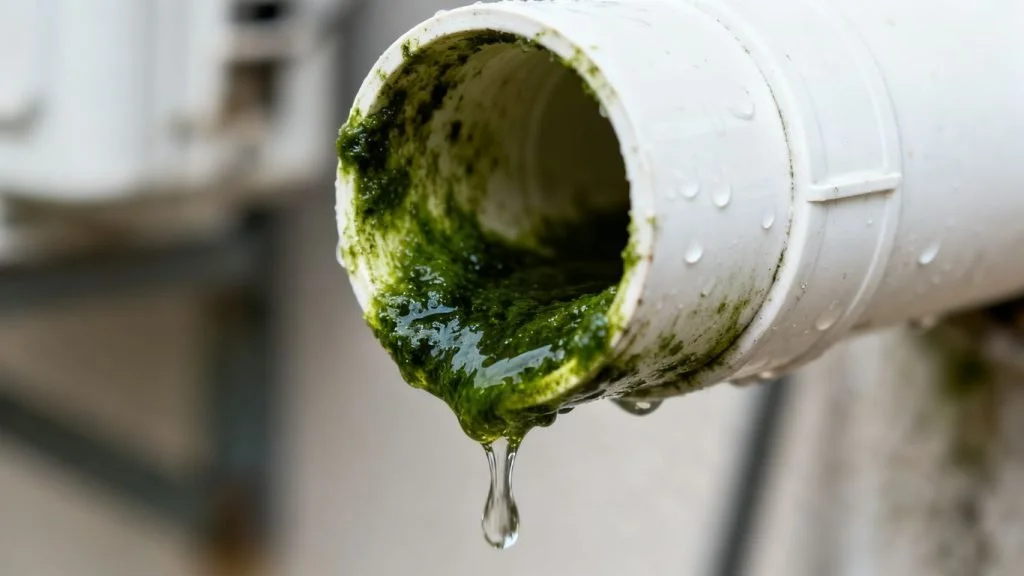
We see this on roughly four out of ten maintenance calls in Orange County: a condensate drain line packed with algae and sludge. A monthly vinegar flush prevents it. Most homeowners don't know until water is dripping from the ceiling.
Quick Answer
An Orange County AC maintenance checklist has two layers. The homeowner layer includes replacing the air filter every 30 to 90 days, clearing two feet of space around the outdoor condenser, flushing the condensate drain with a quarter cup of distilled vinegar monthly, and confirming the thermostat reads accurately. The professional layer, performed once or twice per year, includes refrigerant level verification, electrical connection testing, evaporator and condenser coil cleaning, and a full system performance test. A standard professional tune-up in Orange County costs $129 to $199 in 2026. Skipping maintenance increases the risk of emergency breakdowns that cost 50% to 100% more than routine service calls.
Why AC Maintenance Matters More in Orange County Than Most Places
The generic advice to "get your AC serviced once a year" undersells what Orange County's climate actually demands from residential cooling systems. This county spans two distinct climate zones within a 30-mile drive. Coastal cities like Newport Beach and Laguna Niguel enjoy moderate summers where the AC runs part-time. Inland cities like Yorba Linda, Anaheim Hills, Brea, and Placentia experience sustained heat that forces AC systems to run 10 to 14 hours a day from June through September.
That runtime difference changes everything about maintenance frequency. A system running six hours a day accumulates wear at roughly half the rate of one running twelve. Filters clog faster. Condensate drain lines grow algae faster. Electrical connections loosen under thermal cycling. Compressor oil degrades. The system that a coastal homeowner maintains once a year might need attention twice a year for an inland homeowner who runs it twice as many hours.
Then there is the dust factor. Orange County's inland valleys sit at the receiving end of Santa Ana wind corridors that sweep fine particulate from the desert into residential neighborhoods. That dust settles on outdoor condenser coils, embeds itself in air filters, and coats evaporator coils on the indoor side. After a Santa Ana event, our technicians routinely find filters that were clean two weeks earlier already showing visible restriction.
The financial case is straightforward. At SCE's current average residential rate of 34.5 cents per kWh, a typical 3-ton AC system running at peak efficiency costs roughly $180 to $250 per month during July and August. That same system running at 75% efficiency because of dirty coils, a clogged filter, and low refrigerant costs $240 to $335 per month. Over a four-month summer, deferred maintenance can add $250 to $400 to your Edison bill. A professional tune-up costs $129 to $199. The math resolves itself.
At SCE's 2026 residential rate of 34.5 cents per kWh, a neglected AC system can cost an Orange County homeowner $250 to $400 more per summer than a well-maintained one. A professional tune-up costs $129 to $199.
The DIY AC Maintenance Tasks You Can Handle Today
About half of a proper AC maintenance checklist involves tasks that any homeowner can do without tools, training, or risk. These are the tasks that keep your system healthy between professional visits. Doing them consistently is the single biggest factor in how long your AC lasts and how much it costs to run.
Replace or Clean Your Air Filter Every 30 to 90 Days
The air filter is the most important maintenance item on the entire checklist and the one most often neglected. A clean filter allows unrestricted airflow through the system. A dirty filter forces the blower motor to work harder, reduces cooling output, increases energy consumption by 5% to 15%, and in severe cases can cause the evaporator coil to freeze. ENERGY STAR recommends checking filters monthly and replacing them at minimum every three months.
In Orange County, the replacement interval depends on your location and household. Homes in inland cities with pets should replace standard one-inch filters every 30 to 45 days during the summer cooling season. Homes in coastal cities without pets can typically go 60 to 90 days. Homes with higher-rated filters (MERV 11 or above) may go slightly longer, but the tradeoff is that higher-MERV filters restrict more airflow when they load up with particles, so checking them monthly is still essential. For more detail on filter types and ratings, we wrote a full guide on how often to replace your HVAC filters that covers the nuances by filter type and household situation.
Clear the Area Around Your Outdoor Condenser Unit
Your outdoor condenser needs at least two feet of clearance on all sides to pull air across its coils efficiently. Overgrown bushes, stacked patio furniture, pool equipment, and accumulated leaves all restrict airflow and force the compressor to work harder. Walk around the unit quarterly and clear anything within that two-foot perimeter. If the condenser fins (the thin metal slats on the outside of the unit) are visibly bent or matted with debris, you can gently rinse them with a garden hose from the inside out. Do not use a pressure washer, which bends the fins and can damage the coil.
We see this issue constantly in neighborhoods with mature landscaping. Homes in Coto de Caza, Ladera Ranch, and Mission Viejo often have lush plantings around outdoor equipment that looked great when installed but eventually grow into and around the condenser. Our technician Angel once spent 20 minutes at a Ladera Ranch home cutting back jasmine vines that had grown completely through the condenser fins. The homeowner had been running the AC all summer wondering why it could not keep the house below 78 degrees. After clearing the vegetation and cleaning the coils, the system cooled the house to 72 within an hour.
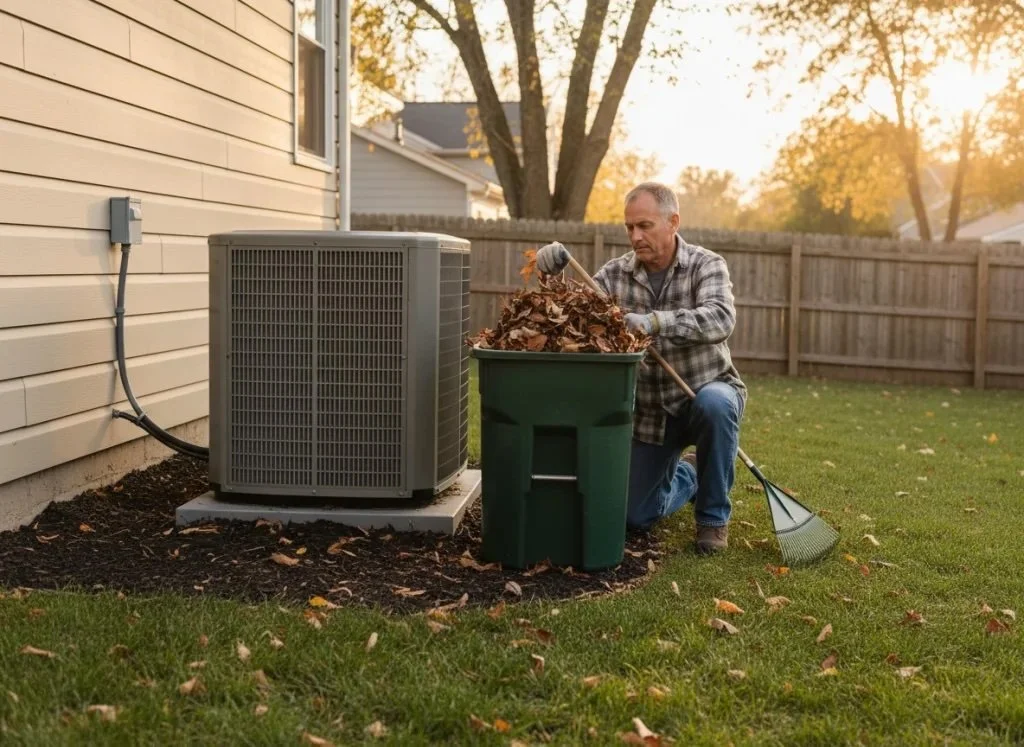
Your outdoor condenser needs two feet of clearance to run efficiently. Before the first 95-degree day hits Orange County, take 10 minutes to clear leaves and debris from around your unit. Call J Martin at (714) 462-4686 if you need a full tune-up.
Flush the Condensate Drain Line Monthly During Cooling Season
Your AC removes moisture from indoor air as part of the cooling process. That moisture drips off the evaporator coil into a drain pan and exits the house through a PVC condensate drain line, usually terminating outside near the foundation or at a floor drain. Over time, algae, mold, and sludge build up inside the line and eventually clog it. When the line clogs, water backs up into the drain pan and can overflow, causing water damage to ceilings, walls, and flooring.
The fix is simple. Once a month during the cooling season, locate the drain line access point (usually a capped T-fitting near the indoor air handler), remove the cap, pour in a quarter cup of distilled white vinegar, let it sit for 30 minutes, then flush with warm water. The vinegar kills algae and bacteria before they form a blockage. This takes five minutes and prevents one of the most common AC service calls we see in Orange County, especially during the humid late-summer months of August and September when monsoon moisture pushes inland from the Gulf of California.
Check Your Thermostat Calibration and Settings
A thermostat that reads two or three degrees off can cause your system to short-cycle (turn on and off too frequently) or run longer than necessary. Test accuracy by placing a separate thermometer next to the thermostat and comparing readings after 15 minutes. If they differ by more than two degrees, recalibrate or replace the thermostat. While you are at it, confirm that the thermostat is set to "auto" fan mode rather than "on." The "on" setting runs the blower continuously even when the compressor is off, which adds to your electric bill and can reintroduce humidity into the house during the off-cycle.
Inspect Visible Ductwork and Keep Vents Open
If you have accessible ductwork in your attic, garage, or crawl space, visually inspect it once a year for obvious signs of damage: disconnected sections, crushed flex duct, visible holes, or deteriorating duct tape at joints. According to ENERGY STAR, leaky ductwork can waste 15% to 25% of the conditioned air your system produces, meaning you are paying to cool your attic instead of your living room. Report any damage to your HVAC technician at your next maintenance visit.
Inside the house, make sure all supply and return vents are open and unobstructed. Closing vents in unused rooms is a common misconception that actually increases static pressure in the duct system, forces the blower to work harder, and can cause the evaporator coil to freeze. For the full explanation of why this happens, see our article on HVAC maintenance tasks you can do yourself.
What a Professional AC Tune-Up Actually Includes in Orange County
A legitimate professional AC tune-up is a 60 to 90 minute diagnostic and maintenance visit, not a 20-minute filter swap with an upsell pitch. Here is what a thorough tune-up covers and why each step matters for your system's performance and lifespan.
Refrigerant Level Verification
Your AC's refrigerant (the chemical that absorbs heat from indoor air) must be charged to the manufacturer's exact specification. Too little refrigerant reduces cooling capacity and forces the compressor to work harder. Too much refrigerant increases discharge pressure and can damage the compressor. A proper check measures superheat and subcooling against the manufacturer's target values for your specific model, not just whether refrigerant is "present." With the R-410A refrigerant phase-out now in effect (manufacturing of new R-410A systems ended January 2025 and new installations in 2026 must use R-454B or R-32), maintaining proper charge in existing R-410A systems is especially important because reclaimed R-410A supply is tightening and recharge costs are rising.
Electrical Connection Testing
Thermal cycling (the repeated heating and cooling of electrical components as the system turns on and off) gradually loosens wire connections, corrodes terminals, and degrades capacitors. A technician tests voltage and amperage draw on the compressor, condenser fan motor, and blower motor, then checks capacitor microfarad readings against the rated values. A failing capacitor is the single most common AC repair our team performs in Orange County. Catching one during a $150 tune-up prevents a $250 to $350 emergency service call when it fails on a 100-degree Saturday in August.
A failing capacitor is the most common AC repair in Orange County. Catching it during a $150 tune-up prevents a $250 to $350 emergency repair call when it fails during a heat wave.
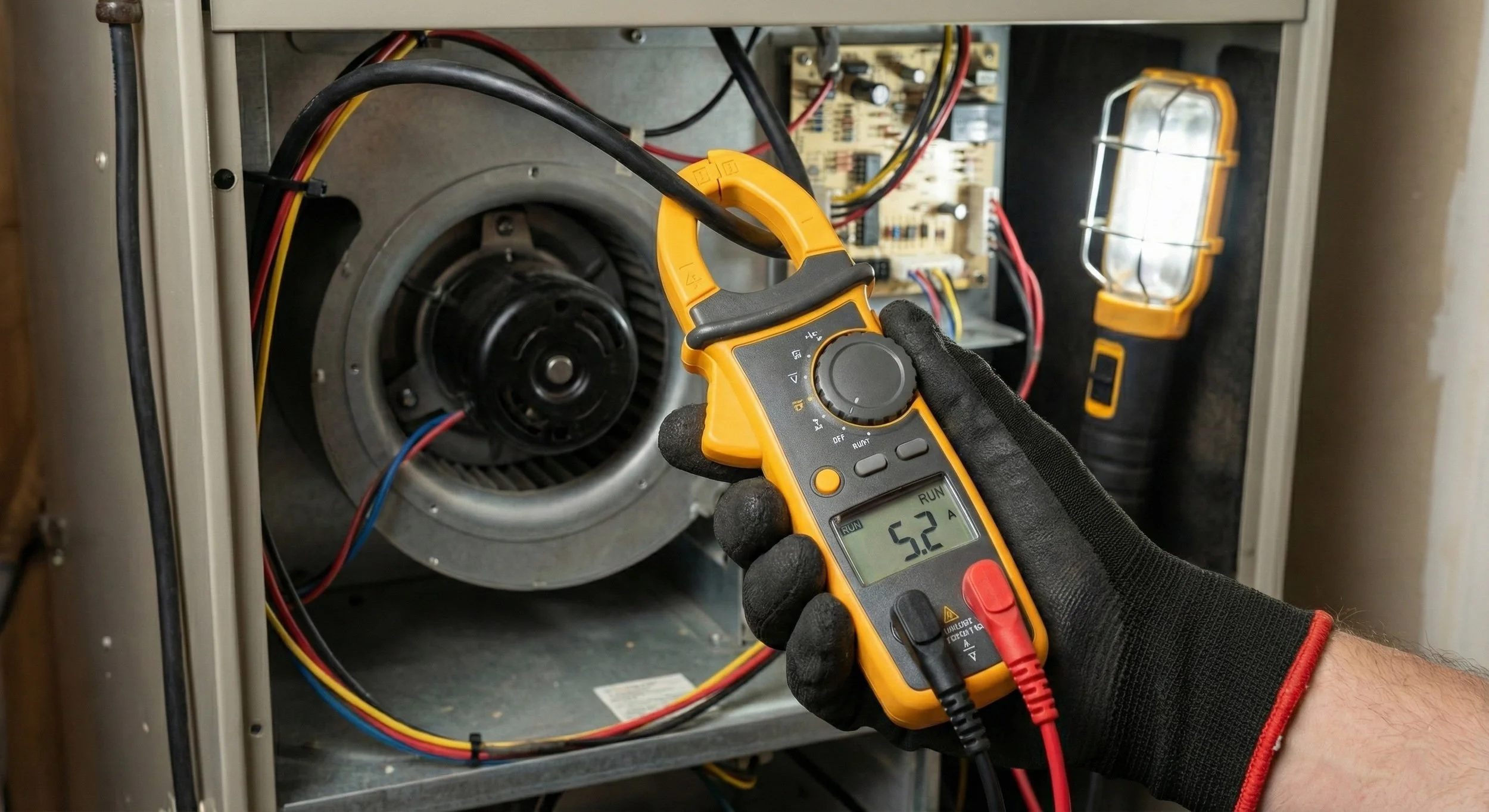
Loose electrical connections and failing capacitors don't give much warning before they fail, usually on the hottest day of the year. J Martin technicians test voltage, amperage draw, and capacitor readings on every tune-up visit. Call (714) 462-4686 to schedule before summer.
Evaporator and Condenser Coil Cleaning
Dirty coils are the second most common efficiency killer after clogged filters. The outdoor condenser coil releases heat absorbed from inside your home. When it is coated in dust, pet hair, cottonwood fluff, or pollen, it cannot release heat efficiently and the compressor runs longer and hotter. The indoor evaporator coil absorbs heat from your home's air. When it is dirty, it absorbs less heat per cycle and the system runs longer to reach the thermostat setpoint. Professional coil cleaning for the outdoor unit typically costs $75 to $200 when done as part of a tune-up. Standalone coil cleaning visits run $100 to $300 depending on severity. Systems cleaned annually deliver 10% to 46% more airflow compared to systems that have not been cleaned, according to industry research data.
Full System Performance Test
After completing the individual checks, the technician runs the system through a full cooling cycle and measures supply and return air temperatures at the air handler. The temperature differential (the difference between the air going in and the cooled air coming out) should be 15 to 22 degrees Fahrenheit. A split outside that range indicates a problem: low refrigerant, a dirty coil, a failing compressor, or restricted airflow. This single measurement tells us more about your system's health than any other diagnostic step.
AC Maintenance Checklist: DIY Tasks vs. Professional Service
The following table breaks down every item on a thorough AC maintenance checklist, showing which tasks a homeowner can handle and which require a licensed technician. Use this as your reference guide throughout the year. All cost estimates reflect Orange County pricing as of 2026.
Complete 2026 AC Maintenance Checklist for Orange County: DIY vs. Professional Tasks
| Maintenance Task | DIY or Professional | Frequency | Estimated Cost |
|---|---|---|---|
| Replace or clean air filter | DIY | Every 30 to 90 days | $5 to $25 per filter |
| Clear debris from condenser area | DIY | Quarterly | Free |
| Flush condensate drain with vinegar | DIY | Monthly (cooling season) | Under $5 |
| Check thermostat calibration | DIY | Twice per year | Free |
| Inspect visible ductwork | DIY | Annually | Free |
| Keep all vents open and unblocked | DIY | Ongoing | Free |
| Refrigerant level check | Professional | Annually | Included in tune-up |
| Electrical connection testing | Professional | Annually | Included in tune-up |
| Evaporator coil cleaning | Professional | Annually | Included in tune-up |
| Condenser coil cleaning | Professional | Annually | $75 to $200 (or included) |
| Full system performance test | Professional | Annually | Included in tune-up |
A standard professional tune-up in Orange County runs $129 to $199 and typically covers all the professional items in the table above. Comprehensive tune-ups that include deeper coil cleaning and duct inspection run $199 to $299. If a company offers a tune-up for $49 or $59, ask what is actually included. A legitimate 60 to 90 minute inspection with refrigerant and electrical checks cannot be performed profitably at that price point, which usually means the low price is a door-opener for upselling repairs. We wrote a detailed breakdown of what you should actually expect to pay in our guide to AC tune-up costs in Orange County.
How Much AC Maintenance Costs in Orange County in 2026
The total annual cost of maintaining your AC system in Orange County depends on whether you handle the DIY portion yourself and how many professional visits you schedule. For a typical single-system home, the annual maintenance budget looks like this.
The DIY costs are minimal. A year's supply of standard one-inch MERV 8 filters costs $30 to $60 for four to six filters. A gallon of distilled white vinegar for drain line maintenance costs $3 to $5 and lasts the full cooling season. Total DIY cost per year: roughly $35 to $65.
The professional tune-up is the larger expense. A standard annual tune-up runs $129 to $199. A comprehensive tune-up with full coil cleaning runs $199 to $299. Most homeowners in Orange County should plan on one professional visit per year, ideally in spring before the cooling season starts. Homeowners in inland cities like Anaheim Hills, Yorba Linda, and Brea who run their systems heavily through summer may benefit from a second visit in early fall to clean the condenser coil after months of dust accumulation.
Maintenance plans (sometimes called service agreements) offer a way to lock in annual tune-up pricing and often include priority scheduling and discounted repair rates. Our True Maintenance Plan at J Martin includes annual tune-ups, priority scheduling, and parts and labor discounts on any repairs discovered during the visit. The value of a maintenance plan increases with the age of your system, because older systems are more likely to need repairs that the plan discounts help offset.
Adding it up, a responsible AC maintenance budget for an Orange County homeowner is $165 to $265 per year. That is less than two months of the energy cost difference between a maintained and neglected system. The investment pays for itself before summer is over.
Total annual AC maintenance cost for an Orange County homeowner: $165 to $265, including DIY supplies and one professional tune-up. That investment pays for itself in energy savings within the first two months of summer.
When to Schedule Your AC Maintenance in Orange County
Timing matters for two reasons: availability and performance. HVAC contractors in Orange County are busiest from mid-June through September, when emergency repair calls surge during heat waves. If you wait until July to book a maintenance appointment, you may wait a week or more. If you book in March, April, or early May, you get same-day or next-day scheduling and the peace of mind that your system is ready before the first 95-degree day arrives.
From a system performance standpoint, spring is the ideal window because it gives your technician the chance to catch and fix any issues before you need the system at full capacity. A worn capacitor discovered in April gets replaced for $150 to $300 during a scheduled visit. That same capacitor fails on a 102-degree Saturday in August and the emergency repair costs $250 to $400, assuming a technician is available that day. Our team at J Martin typically sees a two to three week booking lag for non-emergency calls during July heat waves. By contrast, spring appointments are usually available within 48 hours.
For homeowners who want a second annual check, early October is the right time. The cooling season is winding down, the system has accumulated four months of dust and runtime wear, and the technician can assess whether any end-of-season repairs are needed before the system sits idle through winter. This is also a good time to transition to a heating inspection if you have a furnace or heat pump, catching both systems before their respective peak seasons.
The Real Cost of Skipping AC Maintenance
The numbers on deferred maintenance are unambiguous. Well-maintained HVAC systems run 15% to 25% more efficiently than neglected ones. On a system that costs $200 per month to operate during summer, that efficiency gap translates to $30 to $50 per month in wasted energy, or $120 to $200 over a four-month cooling season. Over a five-year period of deferred maintenance, the cumulative energy waste alone exceeds $600 to $1,000.
Energy waste is only part of the equation. Emergency HVAC repairs cost 50% to 100% more than standard service calls, largely due to after-hours and weekend premiums. The average HVAC repair in Orange County costs approximately $400, but emergency calls during heat waves routinely run $500 to $800 for the same repair that would cost $300 to $600 during a scheduled visit. Running equipment to failure, where you skip all maintenance and wait until the system breaks, costs three to ten times more than a proper maintenance program over the life of the system.
Then there is equipment lifespan. A well-maintained AC system in Orange County typically lasts 15 to 20 years. A neglected system in the same climate often fails at 8 to 12 years. Given that a full system replacement costs $10,000 to $22,000 in Orange County in 2026, the difference between 12 years and 18 years of service life represents thousands of dollars in avoided replacement cost. For a detailed look at what happens when you skip maintenance entirely, see our article on the true cost of skipping HVAC maintenance.
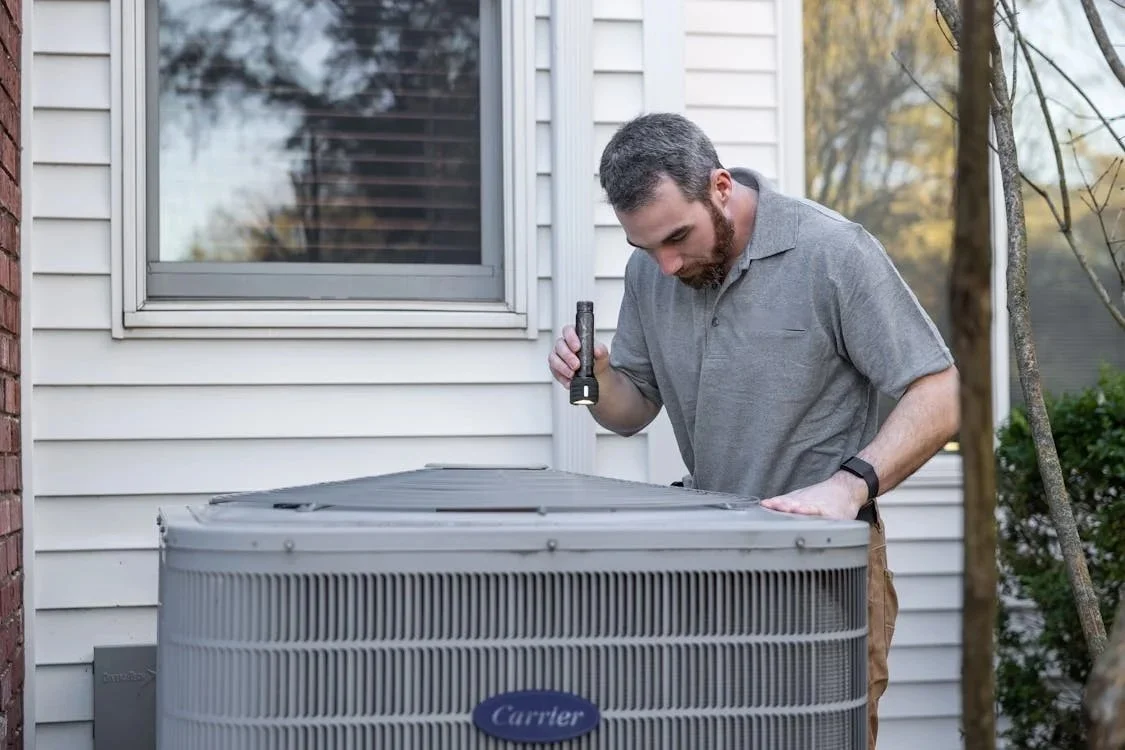
A real AC tune-up includes a close inspection of your outdoor condenser coils, not just a glance from five feet away. J Martin technicians check for dust buildup, bent fins, refrigerant leaks, and airflow restrictions that reduce your system's cooling output and add to your SCE bill every month it goes unaddressed.
What to Look for in an Orange County AC Maintenance Provider
Not every company offering a "tune-up" delivers the same service. When evaluating HVAC maintenance providers in Orange County, focus on what the visit actually includes rather than the price on the coupon.
A thorough tune-up should take 60 to 90 minutes for a single system. Any company that dispatches a technician who is in and out in 20 minutes did not check refrigerant levels, test electrical components, or clean coils. Ask specifically whether the visit includes superheat and subcooling measurements (the proper refrigerant test) and capacitor microfarad readings (the proper electrical test). If those terms draw a blank, the company is not performing a comprehensive inspection.
Verify that the company holds a valid California Contractor License and employs W-2 technicians rather than subcontractors. Subcontracted technicians may be competent, but they have no long-term relationship with the company or your equipment history. At J Martin, every technician on our crew (Jesus, Jack, Angel, Irvin, Kevin, Tony, Christian, Rex, Carlos, Santiago, and Joel) is a full-time W-2 employee. When you call, Kathryn or Alexis answers at our Anaheim office. There is no national call center, no dispatching a stranger from a subcontractor pool.
Finally, watch for the bait-and-switch. A $49 tune-up special that turns into a $2,000 repair recommendation is a red flag. Legitimate maintenance providers will identify real issues and give you time to decide. If a technician tells you your system needs $1,500 in repairs and pressures you to authorize the work on the spot, get a second opinion. Honest contractors, including us, would rather lose a sale than pressure a homeowner into work they do not need.
Frequently Asked Questions
How often should I have my AC professionally serviced in Orange County?
Most Orange County homeowners should schedule one professional AC tune-up per year, ideally in March, April, or early May before the cooling season starts. Homeowners in inland cities like Yorba Linda, Anaheim Hills, and Brea who run their systems heavily through summer may benefit from a second visit in early fall. The annual tune-up costs $129 to $199 in Orange County as of 2026.
What does a professional AC tune-up include?
A thorough AC tune-up includes refrigerant level verification with superheat and subcooling measurements, electrical connection testing, capacitor microfarad readings, evaporator and condenser coil cleaning, condensate drain line inspection, thermostat calibration check, and a full system performance test measuring supply and return air temperature differential. The visit should take 60 to 90 minutes for a single system.
How often should I change my AC filter in Orange County?
In Orange County, standard one-inch filters should be replaced every 30 to 45 days during summer in inland cities, and every 60 to 90 days in coastal cities with lower dust and runtime. Homes with pets should change filters every 30 to 60 days regardless of location. Higher-rated filters (MERV 11 and above) may last slightly longer but should still be checked monthly because they restrict more airflow as they load up.
How much does AC maintenance cost per year in Orange County?
Total annual AC maintenance cost for an Orange County homeowner runs $165 to $265. That includes $35 to $65 for DIY supplies (filters and vinegar for drain line maintenance) plus $129 to $199 for one professional tune-up. Comprehensive tune-ups with deep coil cleaning run $199 to $299. Maintenance plans that include annual tune-ups and repair discounts are also available from most reputable contractors.
Can I clean my AC condenser coils myself?
You can do a basic rinse of the outdoor condenser coils with a garden hose, spraying from the inside out to push debris off the fins. Do not use a pressure washer, which bends the delicate fins and can damage the coil. For a thorough cleaning that removes embedded dirt and restores full heat transfer efficiency, a professional coil cleaning ($75 to $200) is recommended at least once per year. In dusty inland areas of Orange County, twice-yearly professional cleaning may be worthwhile.
What happens if I skip AC maintenance entirely?
Skipping AC maintenance reduces system efficiency by 15% to 25%, which at SCE's 2026 rate of 34.5 cents per kWh adds $120 to $200 per cooling season to your electric bill. It also shortens equipment lifespan from a potential 15 to 20 years down to 8 to 12 years and increases the likelihood of emergency breakdowns that cost 50% to 100% more than routine repairs. Over the life of the system, deferred maintenance costs thousands more than a $165 to $265 annual maintenance budget.
Is an HVAC maintenance plan worth it in Orange County?
An HVAC maintenance plan is worth considering for homeowners with systems older than five years, when the probability of needing repairs increases. Plans typically include one or two annual tune-ups, priority scheduling during peak season (which matters in Orange County where July and August wait times can stretch to two weeks), and 10% to 20% discounts on parts and labor for any repairs. The value depends on your system's age and condition, but for most homeowners with aging equipment, the repair discounts alone offset the plan cost within the first needed repair.
Keep Your AC Running Right All Summer
An AC maintenance checklist is only useful if you actually follow it. The DIY tasks on this list take less than 30 minutes per month during the cooling season. The professional tune-up takes one visit per year. Together, they protect your system's efficiency, prevent the most common breakdowns, extend your equipment's lifespan by years, and keep your SCE bill from climbing higher than it needs to.
J Martin Indoor Air Quality has served 5,000 or more Orange County families since 2014, maintaining and repairing every major brand of residential AC system across all 26 cities in our service area. We hold California Contractor License CL#998956 and carry a 4.97-star rating across thousands of reviews. When you schedule a tune-up with us, a full-time crew member arrives on time, spends the full 60 to 90 minutes your system deserves, and gives you an honest assessment of what it needs. If a $15 filter change solves the problem, that is what we recommend. We do not sell repairs you do not need.
Call us at (714) 462-4686 to schedule your AC tune-up before summer, or request a free consultation online. Ask about our True Maintenance Plan for annual HVAC maintenance service with priority scheduling and repair discounts.