
SEER2 vs SEER Rating: What Orange County Homeowners Need to Know in 2026
Posted on July 23, 2026
SEER2 is the updated federal efficiency rating that replaced the original SEER standard on January 1, 2023, using a harder testing method that produces numbers roughly 5% lower than the old SEER scale for the same piece of equipment. A system that was labeled 16 SEER before the change is now labeled approximately 15.2 SEER2, even though nothing about the equipment itself changed.
The confusion this creates is real. When homeowners in Orange County start shopping for a new air conditioner or heat pump, they see SEER2 numbers that look lower than what their old system was rated, and the natural assumption is that the new equipment is somehow worse. It is not. The Department of Energy simply changed the test to better reflect how AC systems actually perform in real homes with real ductwork, and the result is a more honest number.
We install Daikin, Carrier, Lennox, Trane, and several other major brands across Orange County, and every system we quote through our professional AC replacement service now carries a SEER2 rating. Understanding what that number means, how it compares to the old SEER scale, and what minimum your home is required to meet in California's Southwest region will save you from overpaying, underbuying, or falling for misleading sales pitches from contractors still throwing around old SEER numbers.
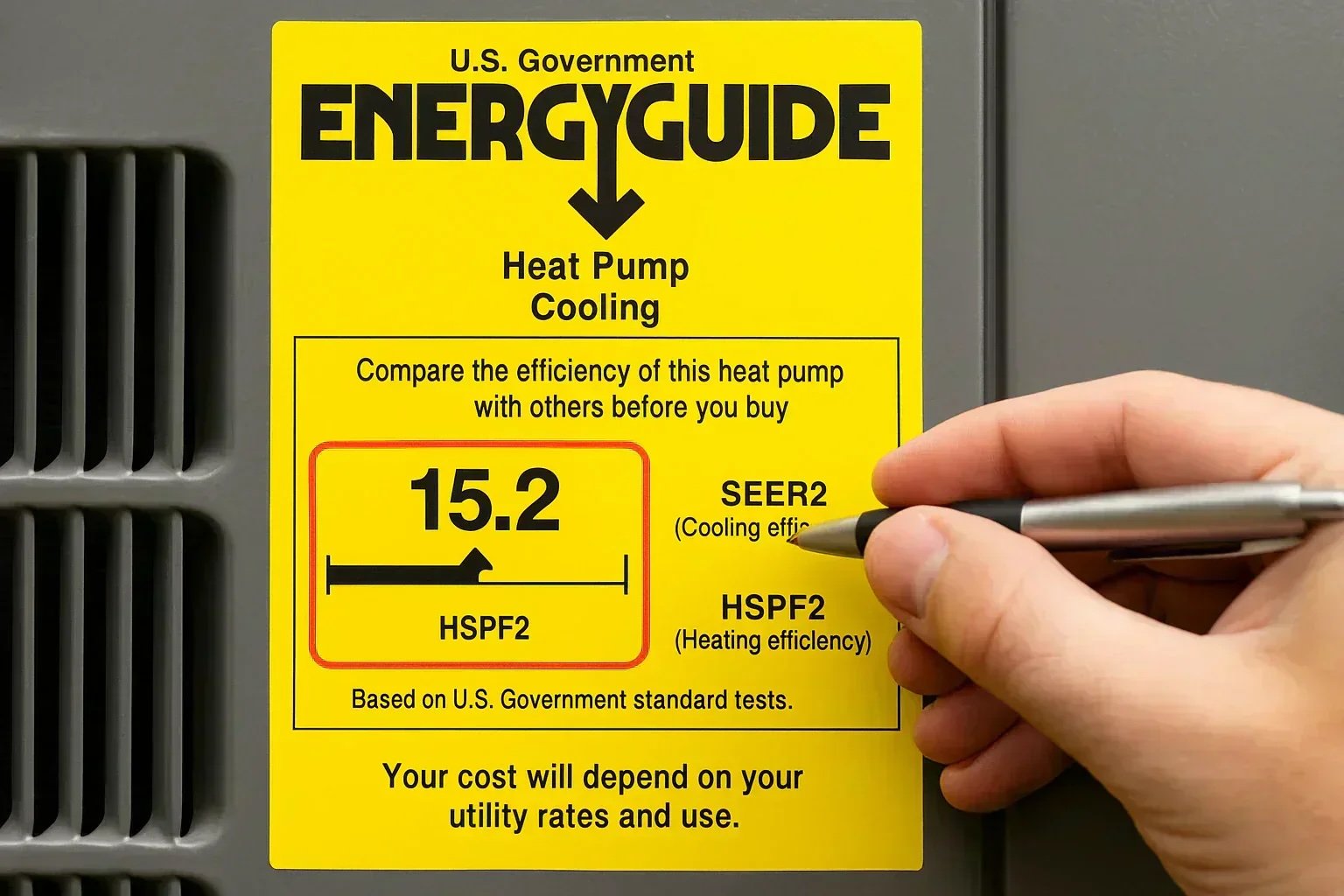
That yellow EnergyGuide label tells you exactly what a new system will cost to run in Orange County. If your current AC does not have one, or if it is more than 10 years old, you are likely paying more than you should every month. Call J Martin at (714) 462-4686 to find out what a SEER2-rated replacement would save you.
Quick Answer
A 16 SEER unit is now labeled approximately 15.2 SEER2. A 14 SEER is now 13.4 SEER2. The equipment did not change. The test changed. In Orange County (part of the DOE's Southwest region), the 2026 minimum for a new split-system air conditioner under 45,000 BTU is 14.3 SEER2. For units 45,000 BTU and above, the minimum is 13.8 SEER2. Heat pumps must meet 14.3 SEER2 regardless of capacity.
What Changed on January 1, 2023
The U.S. Department of Energy updated its testing protocol for residential air conditioners and heat pumps, replacing the old SEER metric with SEER2. The change was not about the equipment. It was about how the equipment gets tested before a manufacturer can print a number on the spec sheet.
Under the original SEER standard, lab technicians tested AC units using an external static pressure of just 0.1 inches of water column (IWC). That is an extremely low resistance level, roughly equivalent to an AC system running with no ductwork attached at all. Almost no home in Orange County, or anywhere else, operates under those conditions. Real homes have supply ducts, return ducts, filters, registers, bends, and sometimes decades of dust buildup adding resistance to airflow.
The new SEER2 standard uses the M1 testing procedure, which raises external static pressure to 0.5 IWC. That is five times the original test pressure and much closer to what a typical residential duct system actually produces. When the same air conditioner is tested under this higher, more realistic resistance, its measured efficiency comes out lower, typically by about 4.5% to 7%.
This is why a unit that was marketed as 16 SEER is now marketed as approximately 15.2 SEER2. The compressor, the coil, the fan motor, and the refrigerant circuit are identical. The only thing that changed is the number, because the test got harder.
The DOE also updated the companion metrics. EER became EER2 (measuring efficiency at a single high-temperature operating point), and HSPF became HSPF2 (measuring heating efficiency for heat pumps). The same principle applies to both: harder test, lower number, same equipment.
SEER vs SEER2: Side-by-Side Comparison
The easiest way to understand the difference is to see both standards next to each other. The table below breaks down the key distinctions between the old SEER and the new SEER2 rating system.
Key Differences Between SEER and SEER2 Efficiency Rating Standards
| Feature | SEER (Old Standard) | SEER2 (Current Standard) |
|---|---|---|
| Effective dates | Before January 1, 2023 | January 1, 2023 to present |
| Testing procedure | ARI 210/240 | AHRI 210/240 with M1 procedure |
| External static pressure | 0.1 IWC | 0.5 IWC |
| Reflects real-world ductwork? | No (idealized conditions) | Yes (simulates typical home ducts) |
| Typical rating range (residential AC) | 14 to 26 | 13.4 to 24.7 |
| Minimum for CA Southwest (split AC under 45K BTU) | 15.0 SEER | 14.3 SEER2 |
| Companion metrics | EER, HSPF | EER2, HSPF2 |
For homeowners comparing a quote on new equipment to the sticker on their existing system, the conversion is straightforward. Divide the old SEER number by approximately 1.05 to get the SEER2 equivalent.
SEER to SEER2 Approximate Conversion Chart for Residential Air Conditioners (2026)
| Old SEER Rating | Approx. SEER2 Equivalent | Notes |
|---|---|---|
| 13 SEER | 12.4 SEER2 | Below current federal minimum everywhere |
| 14 SEER | 13.4 SEER2 | Below CA Southwest minimum for small split AC |
| 15 SEER | 14.3 SEER2 | Meets CA Southwest minimum for split AC under 45K BTU |
| 16 SEER | 15.2 SEER2 | Mid-range efficiency |
| 18 SEER | 17.1 SEER2 | High efficiency |
| 20 SEER | 19.0 SEER2 | Premium efficiency |
| 22 SEER | 21.0 SEER2 | Ultra-premium (inverter-driven units) |
| 25 SEER | 23.8 SEER2 | Top-tier (select ductless mini-splits) |
These conversions are approximate. Actual SEER2 ratings for specific models may vary slightly because the M1 test procedure affects different equipment designs differently. Always check the manufacturer's official SEER2 rating for the specific model you are considering. For a deeper look at how efficiency ratings apply to your specific home, our guide on what SEER rating you need for Orange County walks through the decision by home size and climate zone.
What the California Southwest Region Requires in 2026
Orange County falls within the DOE's Southwest region for HVAC efficiency standards. This matters because the Southwest has higher minimum efficiency requirements than the North or Southeast regions, reflecting the region's heavy cooling loads.
As of 2026, these are the federal minimum SEER2 requirements for new equipment installed in Orange County.
For split-system central air conditioners with a cooling capacity under 45,000 BTU per hour (which covers most 2-ton and 3-ton residential systems), the minimum is 14.3 SEER2. That is equivalent to the old 15 SEER under the previous standard. For split-system central air conditioners at 45,000 BTU per hour and above (typically 4-ton and 5-ton systems), the minimum drops slightly to 13.8 SEER2, equivalent to the old 14.5 SEER. For heat pumps of any capacity, the national minimum is 14.3 SEER2 and 7.5 HSPF2.
In Orange County, you cannot legally install a new split-system air conditioner under 45,000 BTU with a SEER2 rating below 14.3. Any contractor offering to install a "14 SEER" system in 2026 is either using outdated terminology or trying to install non-compliant equipment.
California adds another layer through Title 24, the state's building energy efficiency code. The 2025 edition of Title 24, which took effect January 1, 2026, pushes even further by making heat pump space heating the baseline expectation for new construction and requiring duct leakage testing below 4% for any new HVAC installation or major alteration. While Title 24 does not override the federal SEER2 minimums for the equipment itself, it creates additional performance requirements around duct sealing, insulation (R-6 minimum for all ducts), and system commissioning that affect overall system efficiency.
When Jesus or Jack arrives at an Orange County home to quote a replacement system, the SEER2 minimum is the floor, not the ceiling. We typically recommend systems rated between 16 and 20 SEER2 for most Orange County homes, depending on the home's size, sun exposure, insulation quality, and the homeowner's budget.
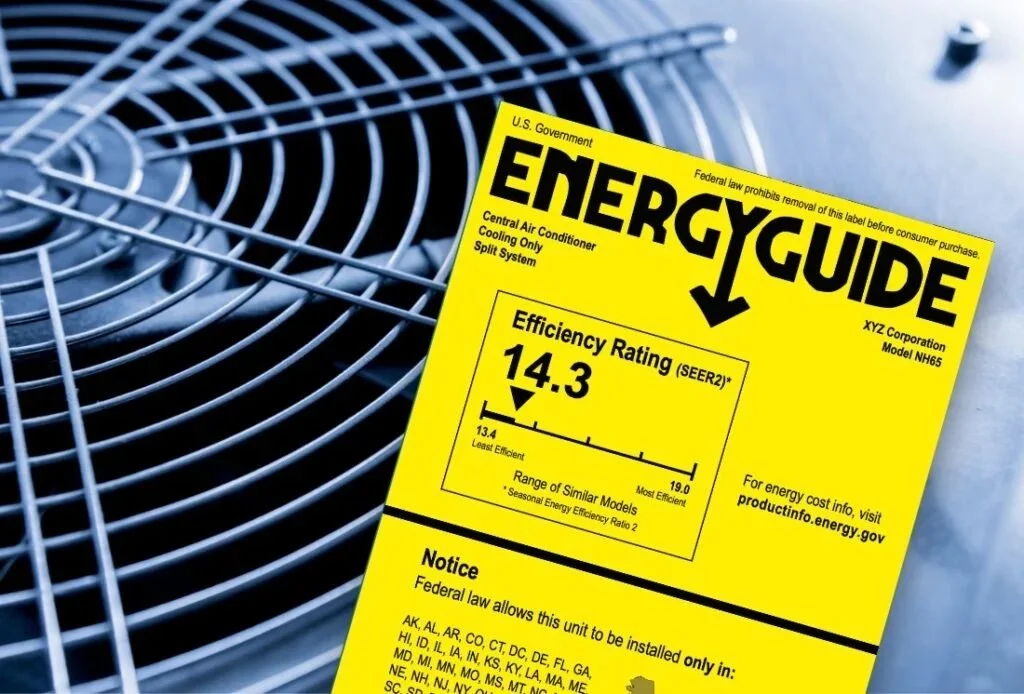
14.3 SEER2 is the floor in California. Where your next system lands above it determines what you pay SCE every summer. Call J Martin to find the right number for your home: (714) 462-4686.
How SEER2 Ratings Affect Your Energy Bills in Orange County
The SEER2 number on your air conditioner directly determines how much electricity it consumes per unit of cooling output. A higher SEER2 rating means the system converts more of the electricity it draws into actual cooling, wasting less energy as heat and mechanical friction. In a region like Orange County, where Southern California Edison's average residential electricity rate sits at approximately $0.345 per kilowatt-hour as of early 2026, the difference between efficiency tiers adds up quickly.
Here is what a typical 3-ton (36,000 BTU per hour) central air conditioner costs to operate annually in Orange County at various SEER2 levels, assuming approximately 1,200 cooling hours per year (a reasonable estimate for inland OC cities like Anaheim Hills, Yorba Linda, and Placentia that run AC heavily from May through October).
Estimated 2026 Annual Cooling Costs for a 3-Ton AC in Orange County by SEER2 Rating
| SEER2 Rating | Annual Energy Use (kWh) | Est. Annual Cost (at $0.345/kWh) | Annual Savings vs 14.3 SEER2 |
|---|---|---|---|
| 14.3 SEER2 (minimum) | 3,021 kWh | $1,042 | -- |
| 16 SEER2 | 2,700 kWh | $932 | $110 |
| 18 SEER2 | 2,400 kWh | $828 | $214 |
| 20 SEER2 | 2,160 kWh | $745 | $297 |
| 22 SEER2 | 1,964 kWh | $678 | $364 |
Over a 15-year system lifespan (the typical useful life of a well-maintained AC in Orange County), the difference between a minimum-efficiency 14.3 SEER2 system and an 18 SEER2 system adds up to roughly $3,210 in energy savings. Jump to a 20 SEER2 unit and the lifetime savings reach approximately $4,455.
Those numbers assume current SCE rates. Electricity prices in Southern California have increased an average of 4% to 6% per year over the past decade, which means the real lifetime savings will likely be higher than these projections.
A 3-ton air conditioner rated at 18 SEER2 costs approximately $214 less per year to operate than the minimum-efficiency 14.3 SEER2 equivalent in Orange County, based on SCE's 2026 average residential rate of $0.345 per kWh. Over 15 years, that difference adds up to roughly $3,210 in energy savings.
One important caveat: these estimates assume approximately 1,200 cooling hours per year. Homes in coastal cities like Newport Beach and Laguna Niguel may run their AC closer to 800 to 1,000 hours annually, reducing the dollar savings. Homes in hotter inland areas like Anaheim Hills, Yorba Linda, and Brea may run closer to 1,500 to 1,800 hours, increasing the savings substantially. Your actual savings depend on your specific location, thermostat settings, home insulation, and how aggressively you cool.
What SEER2 Rating Should You Look For When Replacing Your AC
The "right" SEER2 rating depends on how long you plan to stay in the home, how much cooling you use, and how much you are willing to invest upfront to lower your monthly bills. There is no single correct answer, but there is a framework that helps Orange County homeowners make the decision with confidence.
For homeowners on a tight budget who need a reliable system at the lowest upfront cost, a 14.3 to 16 SEER2 unit gets the job done. You are meeting the legal minimum (or slightly above), and for a coastal home that runs AC moderately, the energy cost difference compared to higher tiers may not justify the premium.
For most Orange County homeowners, particularly those in inland cities where summer temperatures regularly exceed 95 degrees, the 17 to 20 SEER2 range represents the sweet spot. The energy savings are meaningful (roughly $150 to $300 per year compared to minimum efficiency), and the upfront cost premium is typically $1,500 to $3,500 over a base-tier system. At those numbers, the efficiency upgrade pays for itself within 7 to 12 years, well within the system's expected lifespan.
If you are already past the research phase and need help choosing a system now, call our team at (714) 462-4686 for a free in-home evaluation with no pressure.
For homeowners who prioritize maximum efficiency, comfort features like variable-speed compressors and precise humidity control, and the quietest possible operation, the 20+ SEER2 tier delivers. Systems in this range almost always feature inverter-driven compressors that ramp up and down continuously rather than cycling on and off, which eliminates the temperature swings that make some rooms feel uncomfortable. The premium is significant, often $4,000 to $7,000 over a base system, but the combination of energy savings, comfort, and noise reduction is worth it for many homeowners.
When Angel quoted a system replacement for a homeowner in Travis Ranch (Yorba Linda) last summer, the conversation came down to exactly this framework. The home was a 2,400 square foot two-story built in the mid-1980s with original ductwork and limited attic insulation. The existing system was a 13 SEER unit from 2009 that was struggling to cool the upstairs bedrooms past 78 degrees on triple-digit days. We recommended an 18 SEER2 Daikin system with a two-stage compressor, which brought the upstairs within two degrees of the thermostat set point and dropped the homeowner's summer SCE bill by roughly $45 per month compared to the old system. The upfront cost was approximately $2,800 more than the minimum-efficiency option, but the energy savings alone will recover that within about seven years.
The Refrigerant Factor: R-410A Phase-Out and New SEER2 Equipment
The shift to SEER2 ratings happened alongside another major industry change: the phase-out of R-410A refrigerant. As of January 1, 2025, manufacturers can no longer produce new residential split-system air conditioners or heat pumps that use R-410A. New equipment now ships with next-generation refrigerants, primarily R-454B for ducted central systems and R-32 for ductless mini-splits.
Both R-454B and R-32 are classified as A2L refrigerants, meaning they are mildly flammable under specific conditions. This classification requires updated installation protocols, which is one reason it matters who installs your system. Our technicians, including Jesus, Jack, Angel, and the rest of the full-time J Martin crew, have completed manufacturer training on A2L refrigerant handling for every brand we install.
The connection to SEER2 matters because new refrigerants and new compressor technology go hand in hand. The latest inverter-driven compressors designed for R-454B and R-32 achieve SEER2 ratings that would have been impossible with older refrigerant chemistry. Daikin's residential lineup, for example, has largely transitioned to R-32 across its premium and mid-range models, and the efficiency gains are notable: the Daikin DZ9VC achieves up to 22.5 SEER2, while the Oterra series sits at 20 to 21 SEER2.
For a deeper look at what the refrigerant transition means for your existing system, see our R-410A phase-out guide for Orange County homeowners. For homeowners replacing an older R-410A or R-22 system, the transition is seamless from your perspective. Your new system arrives with the correct refrigerant factory-charged, and the only thing you need to know is that R-410A cannot be "swapped" into R-454B or R-32 equipment (or vice versa). If your existing R-410A system still has years of life left, you can continue to service it with R-410A, which remains available through reclaimed and stockpiled supplies.
Brands and SEER2 Ratings Available in Orange County
Not all brands distribute equally across the SEER2 spectrum. Here is what we see most often when quoting replacements for Orange County homeowners.
Daikin is our primary brand for central HVAC systems, and their 2026 residential lineup spans from approximately 14.3 SEER2 at the entry level to 22.5 SEER2 at the top. The Daikin FIT series, a compact option popular in homes with tight equipment closets, reaches up to 17.5 SEER2. The Entra series hits 18 SEER2 in a mid-range price bracket. The Oterra and DZ9VC premium lines reach 20 to 22.5 SEER2 with full inverter technology and R-32 refrigerant.
Carrier, Lennox, Trane, and the other major brands we install offer similar ranges. Carrier's Infinity series tops out around 24 SEER2 in select configurations. Lennox's SL28XCV reaches up to 23.5 SEER2. Trane's XV20i sits around 21.5 SEER2. At the entry level, all of these manufacturers offer units at or near the 14.3 SEER2 federal minimum.
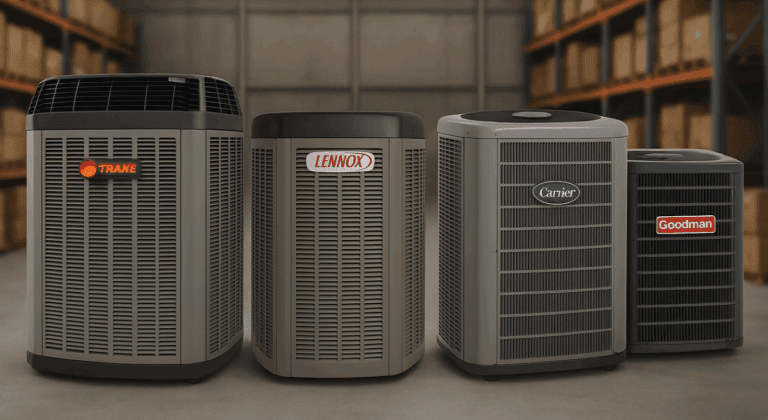
One of the most common questions we get from Orange County homeowners is which brand is best. The honest answer is that a well-installed 18 SEER2 system from any of these manufacturers will outperform a poorly installed 22 SEER2 system every time. The brand is the last thing we talk about. The efficiency tier and the installation quality are the first.
For ductless mini-splits, which we install from Daikin, Mitsubishi, and Fujitsu (our three factory-trained brands), SEER2 ratings run even higher. Many single-zone mini-split models achieve 20 to 25+ SEER2 because they eliminate duct losses entirely, which is one of the factors SEER2 now accounts for in its testing.
The brand matters less than the installation quality and the SEER2 tier you choose. A perfectly installed 18 SEER2 system will outperform a poorly installed 22 SEER2 system every time. Duct leaks, improper refrigerant charge, and undersized return air paths can erase the efficiency advantage of a premium unit entirely.
The Real Cost of Going Higher Efficiency in 2026
Higher SEER2 ratings cost more at the register. The question is whether the energy savings justify the premium over the system's lifetime.
A complete AC and furnace replacement in Orange Countytypically runs between $10,000 and $14,000 for a standard-efficiency system in 2026. Moving from a 14.3 SEER2 system to an 18 SEER2 system adds roughly $1,500 to $3,500 to the installed price, depending on brand, capacity, and whether additional modifications (like duct sealing or electrical panel upgrades) are needed. Jumping to a 20+ SEER2 inverter system can add $4,000 to $7,000.
One factor that has changed significantly in 2026 is the disappearance of the federal Section 25C Energy Efficient Home Improvement Credit. Our breakdown of California HVAC rebates and tax credits in 2026 covers this shift in detail. This tax credit, which covered 30% of qualified costs up to $2,000 for heat pumps and $600 for central AC units, expired on December 31, 2025 under the One Big Beautiful Bill Act signed in July 2025. Homeowners who installed qualifying equipment before the deadline could claim the credit on their 2025 tax return, but it is no longer available for equipment installed in 2026.
The federal Section 25C tax credit for energy-efficient HVAC equipment expired on December 31, 2025. Homeowners installing new AC or heat pump systems in 2026 should check for remaining California state rebates and SCE utility incentives, which can still offset $300 to $1,500 of the cost depending on equipment type and income level.
That does not mean there are no incentives left. California state rebate programs and SCE utility incentives remain available in 2026, with combined values typically ranging from $300 to $1,500 depending on the equipment type, efficiency tier, and the homeowner's income level. We help homeowners navigate available rebates as part of every replacement quote.
Even without the federal credit, the math on higher efficiency still works for most Orange County homeowners, particularly those in inland cities with heavy cooling loads. An 18 SEER2 system that costs $2,500 more than the minimum-efficiency alternative saves roughly $214 per year at current SCE rates. That is a payback period of about 11 to 12 years, and with SCE rates rising 4% to 6% annually, the actual payback is likely closer to 8 to 9 years. Over 15 years, the net savings after recovering the upfront premium are roughly $700 to $1,500, and that number grows every year electricity gets more expensive.
Common Mistakes Homeowners Make When Comparing SEER Ratings
The transition from SEER to SEER2 has created several traps that catch homeowners during the shopping process.
The most common mistake is comparing an old system's SEER rating directly to a new system's SEER2 rating and concluding the new system is less efficient. It is not. When a homeowner tells us their existing system is rated 16 SEER and the replacement quote shows 15.2 SEER2, they sometimes hesitate, thinking they are downgrading. In reality, a 15.2 SEER2 unit performs identically to the old 16 SEER unit. The test changed, not the equipment.
The second mistake is assuming a higher SEER2 number always means a better investment. Efficiency has diminishing returns. The jump from 14.3 to 18 SEER2 saves substantially more per dollar spent than the jump from 18 to 22 SEER2. For a coastal Orange County home that runs AC moderately, the premium for a top-tier inverter system may never pay for itself through energy savings alone (though the comfort and noise benefits may still make it worthwhile).
The third mistake is ignoring installation quality. SEER2 ratings are measured under controlled lab conditions. In a real home, duct leaks, poor airflow design, incorrect refrigerant charge, and improper sizing can reduce actual efficiency by 20% to 40%. We have seen homes in Brea and Fullerton where a "high-efficiency" system installed by another contractor was performing at effectively 12 SEER2 because the ductwork was leaking conditioned air into the attic. This is why California's updated Title 24 code now requires duct leakage testing below 4% for any new installation or major alteration.
The fourth mistake is shopping on SEER2 alone without considering the full system. A high-SEER2 condenser paired with an undersized evaporator coil, an old furnace with a single-speed blower, or deteriorating ductwork will never deliver its rated efficiency. The SEER2 rating applies to the complete matched system, not just the outdoor unit. When we quote a replacement, we evaluate the entire air path, from the return grille through the ductwork, the evaporator coil, the furnace blower, and out to the supply registers, to make sure the new equipment can actually deliver the efficiency you are paying for.
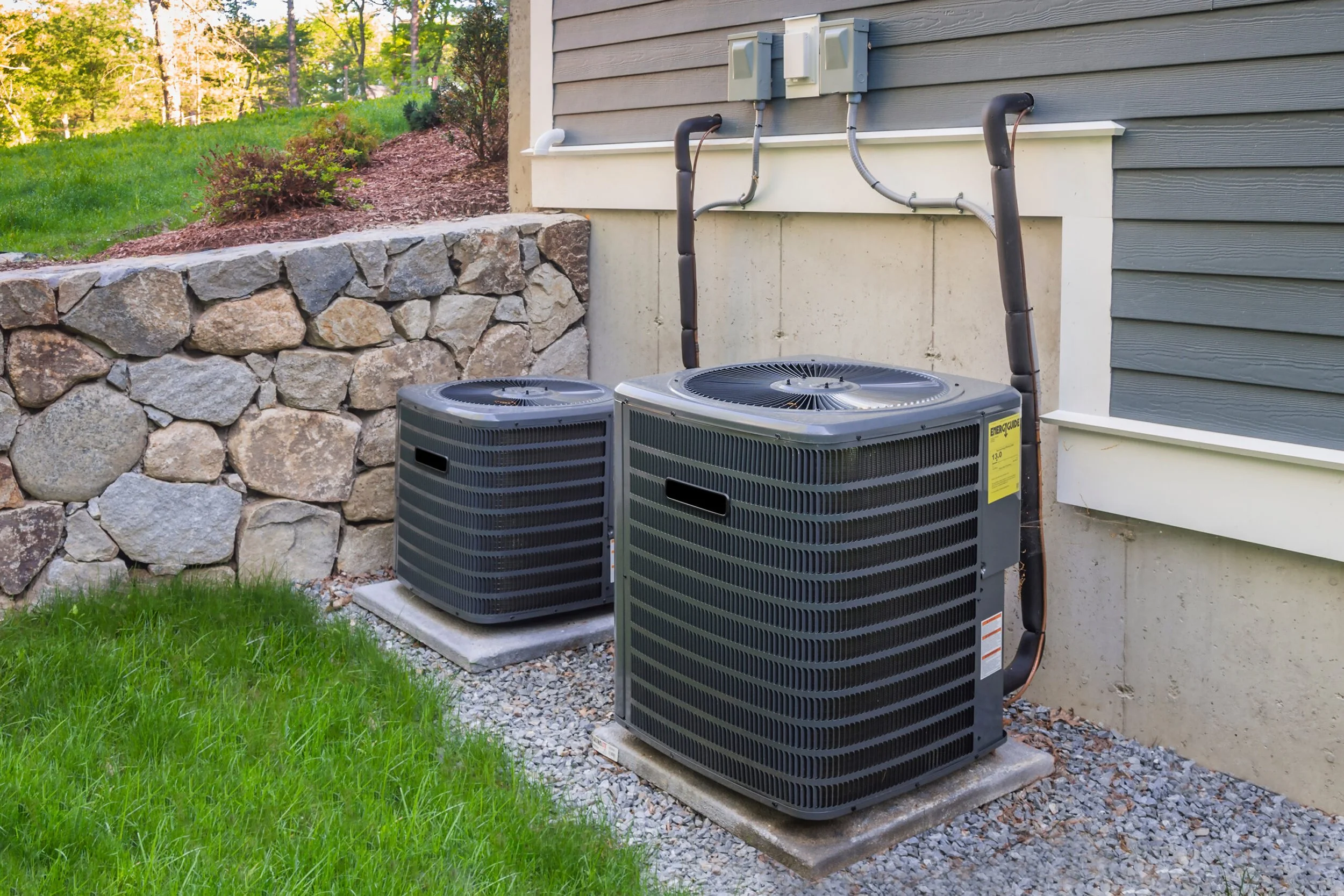
Two outdoor condenser units mean two completely independent systems, one for each floor of your two-story home. If your Orange County home is still fighting the hot upstairs problem with a single unit, this is what the solution looks like installed. Call J Martin at (714) 462-4686 to find out if a dual system is right for your home.
Frequently Asked Questions
Is a higher SEER2 number always better?
A higher SEER2 rating means higher energy efficiency, but it does not always mean a better financial investment. The energy savings between efficiency tiers diminish as you move up the scale. For most Orange County homeowners, the 17 to 20 SEER2 range offers the best balance of upfront cost and long-term savings. Systems above 20 SEER2 deliver additional comfort benefits like variable-speed operation and quieter performance, but the extra energy savings alone may not justify the premium in moderate-use coastal homes.
What is the minimum SEER2 rating allowed in California?
California falls in the DOE's Southwest region, which has some of the highest efficiency minimums in the country. For split-system central air conditioners under 45,000 BTU per hour, the minimum is 14.3 SEER2. For split-system units at 45,000 BTU and above, the minimum is 13.8 SEER2. Heat pumps must meet 14.3 SEER2 and 7.5 HSPF2 regardless of capacity. Any new system installed in Orange County in 2026 must meet these minimums.
Can I still buy an AC with the old SEER rating?
No. As of January 1, 2023, all new residential air conditioners and heat pumps manufactured in the United States carry SEER2 ratings exclusively. You will not find new equipment rated under the old SEER standard. If a contractor quotes you a system using only old SEER numbers, they are either referencing the approximate SEER equivalent for comparison purposes or using outdated marketing materials.
How much money will a higher SEER2 rating save me each year in Orange County?
Based on SCE's 2026 average residential rate of $0.345 per kilowatt-hour and a typical 3-ton system running approximately 1,200 cooling hours per year, upgrading from the minimum 14.3 SEER2 to 18 SEER2 saves roughly $214 per year. Upgrading to 20 SEER2 saves approximately $297 per year. Over a 15-year system lifespan, those savings total $3,210 and $4,455 respectively, and likely more given rising electricity rates.
What is a good SEER2 rating for Orange County?
For inland Orange County cities like Anaheim Hills, Yorba Linda, Brea, and Placentia where summer temperatures regularly exceed 95 degrees, we recommend 17 to 20 SEER2 for the best return on investment. For coastal cities like Newport Beach and Laguna Niguel with milder summers, 15 to 18 SEER2 is often sufficient. Homeowners prioritizing maximum comfort and noise reduction should consider 20+ SEER2 inverter systems regardless of location.
Does SEER2 apply to mini-splits?
Yes. Ductless mini-split systems are rated under the same SEER2 standard as central air conditioners. Mini-splits typically achieve higher SEER2 ratings than ducted systems because they eliminate duct losses entirely. Many single-zone mini-split models from Daikin, Mitsubishi, and Fujitsu, the three brands J Martin is factory-trained on, achieve 20 to 25+ SEER2. Multi-zone mini-split systems generally rate lower, in the 17 to 22 SEER2 range, depending on the number of indoor units.
Will my old AC with a SEER rating need to be replaced?
No. The transition from SEER to SEER2 does not require you to replace your existing system. Your current air conditioner will continue to operate exactly as it always has, regardless of whether it carries a SEER or SEER2 label. The new standard applies only to newly manufactured equipment. When your existing system eventually reaches end of life (typically 15 to 20 years for well-maintained equipment in Orange County), the replacement will carry a SEER2 rating.
Ready to Find the Right Efficiency Rating for Your Home?
Choosing the right SEER2 rating is not about chasing the highest number. It is about matching the system's efficiency to your home's cooling load, your budget, and your long-term plans. Whether you are replacing a failing system this summer or planning ahead for next year, understanding the difference between SEER and SEER2 puts you in a stronger position to evaluate quotes from Orange County air conditioning professionals and avoid paying for efficiency you will never recover.
J Martin Indoor Air Quality has served Orange County families since 2014. Licensed, bonded, and insured (CA Contractor License CL#998956), with a 4.97-star rating across thousands of reviews. When you call, you reach Kathryn or Alexis at our Anaheim office, not a national call center. When a technician arrives, it is Jesus, Jack, Angel, or another member of our full-time crew, never a subcontractor.
Call us at (714) 462-4686 for a free in-home efficiency evaluation, or request a consultation online. We will walk through your options at every SEER2 tier with honest, upfront pricing and zero pressure.