
Best HVAC System for 2-Story Homes in Orange County
Posted on July 21, 2026
The best HVAC system for a 2-story home in Orange County is a variable-speed, two-zone system that independently controls upstairs and downstairs temperatures, typically costing $12,000 to $20,000 installed. This setup solves the single most frustrating problem in two-story OC homes: the upstairs running 5 to 7 degrees hotter than the downstairs while both zones share one thermostat.
A standard single-zone system can cool an entire two-story home, but it cannot balance the temperature difference caused by the stack effect (hot air naturally rising, cold air sinking) and uneven solar gain across stories. The result is constant complaints from one floor while the other runs overcooled and overworked. That's why our air conditioning replacement team starts every two-story consultation with the same question: does the home have independent zone control? When Jesus and Angel retrofit two-story homes across Anaheim Hills and Yorba Linda, the first diagnostic step is always checking that. In 90% of older homes and even some newer ones, the answer is no, which means the homeowner has been fighting physics for years.
We've served over 5,000 Orange County families since 2014, and the two-story comfort problem ranks in the top three reasons homeowners call us for replacements. This guide walks you through your five main HVAC options, what each costs, and which makes the most sense for your situation.
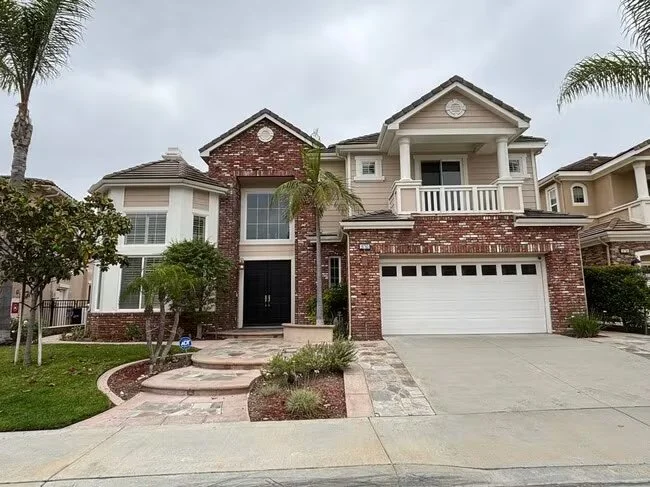
Is your Yorba Linda two-story home running 8 degrees hotter upstairs than down? That is not a comfort issue. It is an HVAC problem, and J Martin can fix it. Call (714) 462-4686 for a same-day assessment.
Quick Answer
A variable-speed heat pump with two-zone zoning ($12,000 to $20,000) provides the best comfort and energy savings for 2-story Orange County homes. If budget is tighter, a zoned single-stage AC system ($10,000 to $15,000) solves the temperature imbalance at lower cost. If your home is under 1,200 square feet per floor, a dual-unit system (one AC per floor, $13,000 to $22,000) may be cleaner and more efficient. For homes built before 1990 with poor return ductwork, multi-zone mini-splits ($14,000 to $24,000) often outperform traditional ducted systems.
Why Two-Story Homes Need Different HVAC Strategy
A single HVAC system pushing cooled air through one set of ducts cannot independently manage two stories with different sun exposure, insulation quality, and occupancy patterns. Three physical forces work against single-zone comfort in 2-story homes.
The stack effect is the most powerful. Hot air rises. Cold air sinks. During cooling season, when the upstairs absorbs afternoon solar heat through south and west-facing windows, that hot air naturally wants to rise further (even though it's already the upper floor) while downstairs air, cooled by AC, wants to sink. The ductwork can partially manage this, but a thermostat mounted on the downstairs wall will shut the system off once downstairs reaches 72 degrees, leaving the upstairs at 78 or 79. Conversely, if you set the thermostat to 70 to cool the upstairs, the downstairs freezes at 65. A single sensor cannot satisfy two microclimates in different vertical zones.
Solar gain varies dramatically between floors. An Anaheim Hills or Yorba Linda two-story home (we've written about why your upstairs stays so hot while the downstairs freezes) with significant west-facing glass on the second floor will experience upstairs temperatures 8 to 12 degrees hotter than the downstairs on summer afternoons, even with closed blinds. The upstairs absorbs direct afternoon sun; the downstairs is shaded by the roof overhang and the second floor itself. Single-zone cooling cannot adapt to this uneven load.
Ductwork imbalance is the third culprit. Most older two-story homes built in the 1970s and 1980s have return air ducts concentrated downstairs and supply ducts biased toward the main living areas. The upstairs bedrooms often get 30% to 40% less conditioned air than they should. When you add a zoning system that allows independent upstairs and downstairs control, the imbalance often becomes visible for the first time, because now you can isolate and measure which floor is actually getting enough CFM (cubic feet per minute) of air.
The solution to all three problems is zoning or dual conditioning. Instead of one thermostat controlling one system, you install dampers in the ductwork that split the system's output into two independently controlled zones, each with its own thermostat. Or you install two separate systems entirely. Or you use variable-speed equipment that can modulate its output to match demand on each floor without needing dampers.
Five HVAC Options for 2-Story Comfort
You have five main paths. Each has a cost range, a comfort ceiling, and a best-use scenario.
Option 1: Standard Single-Zone AC (No Zoning)
A traditional split-system AC with a single thermostat and no dampers. Cost: $8,500 to $14,000 for a new system. Energy efficiency: SEER2 (the updated federal efficiency rating that replaced the old SEER standard in 2023) 14.3 to 18 (California minimum is 14.3 for units under 45,000 BTU, which is roughly equivalent to the old SEER 15). For more on efficiency ratings, see our guide on understanding SEER ratings for Orange County. Comfort for 2-story homes: Poor. You'll have the hot upstairs, cold downstairs problem indefinitely. This option is only viable if your home is truly open-concept and small enough that temperature gradients don't matter, or if you're on a strict budget and plan to sell within 5 years.
Option 2: Single System Plus Zoning Add-On
You keep your existing or new single AC unit and add a two-zone damper system with two thermostats. The dampers allow the single compressor to serve both zones. Cost to retrofit: $1,700 to $2,800 added to a new system installation. Energy savings: 20 to 30% reduction compared to non-zoned cooling, according to the Department of Energy. Comfort: Excellent for most homes. The single compressor runs slightly longer to balance both zones, but each floor gets independent temperature control. Best for: Homes with solid existing ductwork, moderate floor-to-floor temperature differences (5 to 7 degrees), and budgets in the $10,500 to $16,000 range. This is the most popular retrofit we perform in OC.
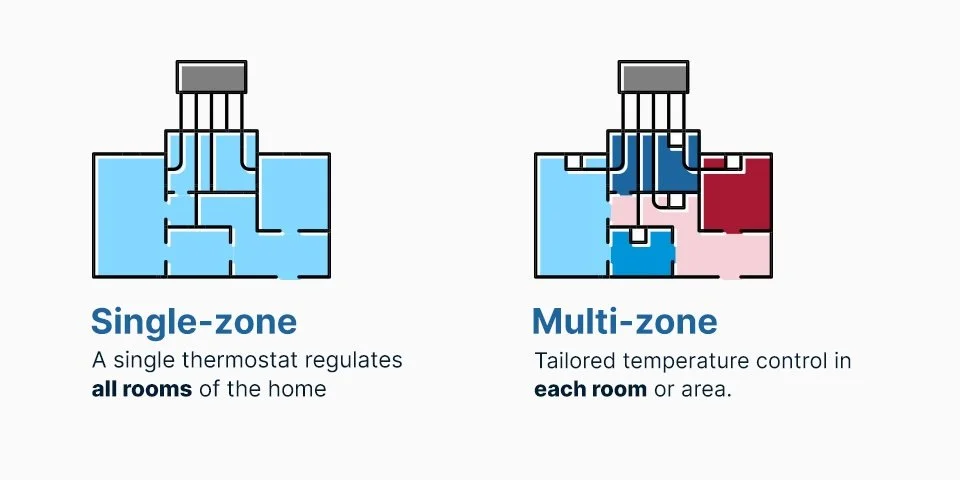
Single-zone AC was never designed to balance two floors with different sun exposure, different occupancy patterns, and different heat loads. Multi-zone systems give each area of your home independent control. J Martin has installed zoning systems in hundreds of two-story Orange County homes since 2014.
Option 3: Dual-System Setup (Separate AC Per Floor)
Two independent AC units, typically one inside the attic or garage serving upstairs, one serving downstairs. Cost: $13,000 to $22,000 installed. Efficiency: Each unit runs at peak efficiency for its specific zone; no imbalance penalty. Comfort: Excellent. Each floor is completely independent. Best for: Homes where ductwork is severely compromised, where attic or garage space allows a second unit, or where you want zero compromise on comfort. The installation is messier (more outdoor condenser units, more refrigerant lines) but the result is transparent comfort control.
Option 4: Variable-Speed Two-Zone Heat Pump
A high-end inverter compressor (like the Daikin DZ9VC) that varies its output continuously rather than running at full capacity or off. Paired with a two-zone damper system. Cost: $12,000 to $20,000 installed. Efficiency: SEER2 up to 22.5 for high-end models; energy savings of 20 to 40% compared to single-stage systems. Comfort: Excellent. The variable-speed compressor modulates output to match the lower-demand zone, reducing short-cycling and eliminating the "overshoot" problem where the system overshoots one zone while reaching the other. Annual savings: $300 to $650 on cooling costs, often exceeding $1,000 when paired with a heat pump heating mode. Best for: Homeowners who plan to stay 10+ years, can afford premium equipment, and want the lowest long-term operating cost. This is the system we recommend most often.
Option 5: Multi-Zone Mini-Split System
Two to four independent wall-mounted heads (ductless units) serving different zones, all connected to a single outdoor compressor. Cost: 2-zone system $5,000 to $8,000, 3-zone $6,000 to $11,000, each additional head $2,000 to $7,000. Efficiency: SEER2 17 to 23 depending on brand. Comfort: Excellent. Each zone has its own thermostat and output control. Best for: Homes with poor ductwork, homes where you want to avoid additional return ducts, or homes where you're willing to accept visible indoor heads. Mini-splits are increasingly popular in Orange County for 2-story retrofits because they require zero ductwork modifications. The Daikin, Mitsubishi, and Fujitsu systems we install regularly handle two-story OC homes beautifully. If you're past the research phase and ready for an evaluation, call us at (714) 462-4686 for a same-day or next-day assessment.
Comparison Table: HVAC Systems for 2-Story Orange County Homes
| System Type | Installation Cost | SEER2 | 2-Story Comfort | Energy Savings | Best For |
|---|---|---|---|---|---|
| Standard Single-Zone AC | $8,500 – $14,000 | 14.3 – 18 | Poor | None | Budget-conscious, small open-concept homes |
| Single-Zone AC + 2-Zone Dampers | $10,500 – $16,000 | 14.3 – 18 | Excellent | 20% – 30% | Solid ductwork, moderate temperature imbalance |
| Dual AC System (Two Units) | $13,000 – $22,000 | 14.3 – 18 | Excellent | 25% – 35% | Compromised ductwork, maximum independence |
| Variable-Speed Heat Pump + 2-Zone | $12,000 – $20,000 | 17 – 22.5 | Excellent | 30% – 40% | Long-term homeowners, maximum efficiency |
| Multi-Zone Mini-Split (2–3 zone) | $5,000 – $11,000 | 17 – 23 | Excellent | 30% – 40% | Ductwork-poor homes, retrofit-friendly |
The three best options for most Orange County 2-story homeowners are the zoned single-stage system, the variable-speed heat pump with zoning, and the mini-split system. Your choice depends on your home's ductwork condition, your budget, and how long you plan to stay.
How to Choose the Right System: The Three Assessment Questions
Before you decide, answer three diagnostic questions about your home.
1. What is the Manual J Load Calculation for Your Home?
A Manual J calculation (which we discuss in our AC sizing guide for Orange County homes) takes into account your home's square footage, insulation, window area, solar orientation, ceiling height, and Orange County climate zone to determine the exact cooling capacity you need. Professionals measure this in BTU (British Thermal Units) per hour. A typical 3,000 square foot two-story OC home needs 40,000 to 52,000 BTU of cooling capacity. An undersized system will run constantly and fail early. An oversized system will short-cycle (turn on and off rapidly), which shortens compressor life and wastes energy.
Never accept a system recommendation from a contractor without a Manual J calculation. The correct size is not a guess, and many OC homes are sized incorrectly by 10% to 20%, which costs hundreds annually in wasted energy and accelerated equipment failure.
If your home has never had a proper load calculation, ask for one. Any competent HVAC contractor (we include this in every quote) will run the numbers. The zoning layer sits on top of the correct base size.
2. What is Your Ductwork Condition?
Walk into your attic and inspect the ducts visually. Are they intact, or do you see crushed sections, separations, or obvious leaks? Are return ducts connected properly, or do they pull air from unintended spaces like the attic itself? A ductwork assessment determines whether your home can support a simple zoning retrofit (add dampers to existing ducts) or whether you need a more comprehensive approach like a dual system or mini-splits.
Poor ductwork in two-story homes often explains why the upstairs stays hot. The return air path is compromised, so upstairs air cycles inefficiently. When Tony or Kevin evaluates a retrofit in Mission Viejo or Placentia, the ductwork assessment usually takes 30 to 45 minutes and reveals whether zoning alone will solve the problem or whether you need bigger changes.
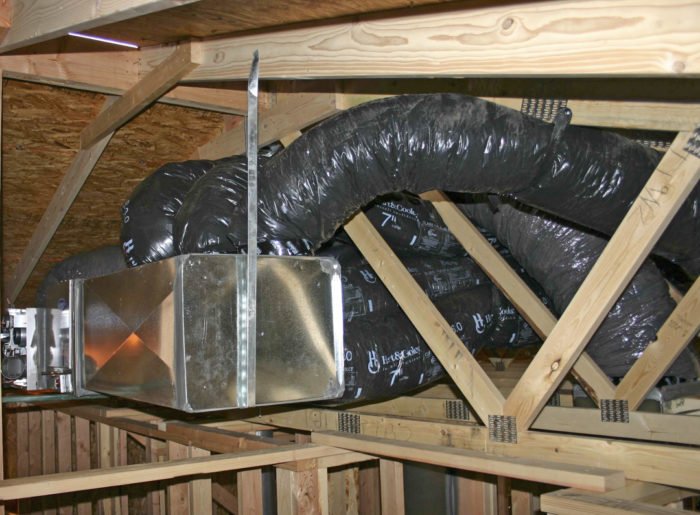
Ductwork condition is the first thing J Martin evaluates on every two-story HVAC consultation. Compromised attic ducts are responsible for up to 40% of the airflow your upstairs rooms never receive. Knowing what is up there before you invest in a new system saves you from solving the wrong problem.
3. How Much Temperature Difference Between Floors Are You Currently Experiencing?
Set your thermostat to a fixed temperature, wait two hours for the system to stabilize, then measure the actual temperature on each floor with a calibrated thermometer. A 2 to 3 degree difference is normal. A 5 to 7 degree difference indicates you definitely need zoning. An 8+ degree difference suggests you need either zoning plus ductwork repair, a dual system, or mini-splits.
These three answers determine your starting point. The Manual J size tells you what system capacity to target. The ductwork condition tells you whether zoning is feasible. The current temperature difference tells you how urgently you need comfort control.
Understanding Zoning: How Dampers, Thermostats, and Panels Work
If you choose a zoned system, here's what you're actually paying for and why it works.
A zoning system adds three components to a standard AC setup. First, electronic dampers installed inside the ductwork split the single system's output into two pathways, one for the upstairs zone and one for the downstairs. These dampers are motorized butterfly valves that open and close based on thermostat demand. When the upstairs hits 72 degrees, the upstairs damper closes and the downstairs damper opens fully. When both zones need cooling, both dampers open proportionally.
Second, you install two thermostats instead of one, one on each floor. Each thermostat reads its local temperature and signals the zone panel when it needs cooling.
Third, the zone panel (like the Honeywell HZ432 TrueZONE, which we install regularly) is a control box that orchestrates the dampers and the single compressor. It ensures the system operates safely when both zones are calling for cool, and prevents short-cycling when only one zone is satisfied.
The cost adds $1,700 to $2,800 to a new system installation because of the dampers, thermostats, and panel, plus labor to retrofit the ductwork. The energy benefit is substantial: zoning reduces runtime by 20 to 30% on average because the system no longer overshoots one zone while chasing the other.
One misconception: zoning does not reduce the size of the compressor or condenser. You still need the full capacity outdoor unit. The zoning layer just allows smarter distribution of that capacity between two floors. This is why a zoned single-stage system costs less than a dual-system retrofit but delivers 85% of the comfort benefit.
Variable-Speed Compressors vs. Single-Stage for Two-Story Homes
When you add zoning to a single-stage compressor (the standard type that runs at full capacity or not at all), the system works well but with one minor inefficiency. The compressor still cycles on and off at full blast. When only the downstairs needs cooling on a mild day, the full-capacity compressor kicks in, cools the downstairs quickly, and shuts off. When both zones call for cooling, it runs at full blast until the less-demanding zone reaches setpoint, then overshoots and cycles off.
A variable-speed (inverter) compressor modulates its output continuously. On a mild day, it might run at 40% capacity to serve just the downstairs. On a hot day, it ramps to 100% to handle both zones. This continuous modulation eliminates overshooting, reduces wear on the compressor, and cuts energy consumption by an additional 10 to 15% compared to a zoned single-stage system.
The cost premium for variable-speed equipment is $2,000 to $4,000 above a comparable single-stage system. For a two-story home where you plan to stay 10+ years, the energy payback period is typically 4 to 6 years, and you save another $300 to $650 annually in cooling costs. If you add heat pump heating (increasingly common in OC homes), the annual savings can exceed $1,000.
When Jack or Angel recommends a variable-speed system, they're betting on your long-term comfort and your power bill. It's not for every budget, but it's the right choice if you can afford it.
Cost Breakdown: What You're Actually Paying For
Let's build a real 2026 estimate for a typical 3,000 square foot Yorba Linda or Anaheim Hills two-story home needing a new zoned AC system.
2026 Cost Breakdown: Zoned Variable-Speed AC System for 2-Story Orange County Home
| Component | Cost Range | Notes |
|---|---|---|
| Variable-speed compressor outdoor unit | $3,500 – $5,500 | SEER2 17 to 22.5 (Daikin DZ6VS or similar) |
| Indoor air handler / coil replacement | $2,000 – $3,500 | Must be matched to outdoor unit |
| Ductwork (new sections, sealing, balancing) | $1,500 – $3,000 | Varies by existing condition |
| Two-zone damper system (dampers, panel, thermostats) | $1,700 – $2,800 | Honeywell HZ432 or similar |
| Refrigerant lines, connectors, electrical upgrades | $800 – $1,500 | Depends on outdoor unit location |
| Labor (2 to 3 days, 2 technicians) | $2,500 – $4,200 | Includes Manual J, testing, balancing |
| Permits, inspection, disposal of old equipment | $400 – $700 | OC county and city fees |
| Total System Cost (Installed) | $12,400 – $21,200 | Typical estimate: $16,500 |
Prices in Orange County have risen 18 to 25% since 2023 due to supply chain pressure and increased labor rates. These numbers reflect 2026 market reality. A quote below $10,000 for a zoned system should trigger skepticism about corners being cut. A quote above $23,000 suggests you're paying a premium for brand name or specialty work.
Request an itemized quote that breaks down labor, materials, and overhead. This helps you compare apples to apples when you get multiple bids. We provide full-line-item pricing with no surprises.
2026 Rebates and Tax Credits: What's Actually Available Now
The Section 25C federal tax credit (which covered 30% of qualifying heat pump and HVAC equipment costs, capped at $2,000) expired on December 31, 2025. If you're reading this in 2026, you cannot claim that credit for new installations. It's gone. Don't let anyone tell you otherwise.
Here's what IS available in 2026 for Orange County homeowners.
SCE Heat Pump Rebate
Southern California Edison offers $1,000 rebates per heat pump system (up to $2,000 per home for two systems) when you replace gas furnace or AC with a heat pump. This is still active. The system must meet SEER2 15 or higher and be installed by a licensed contractor. We handle the rebate paperwork for you.
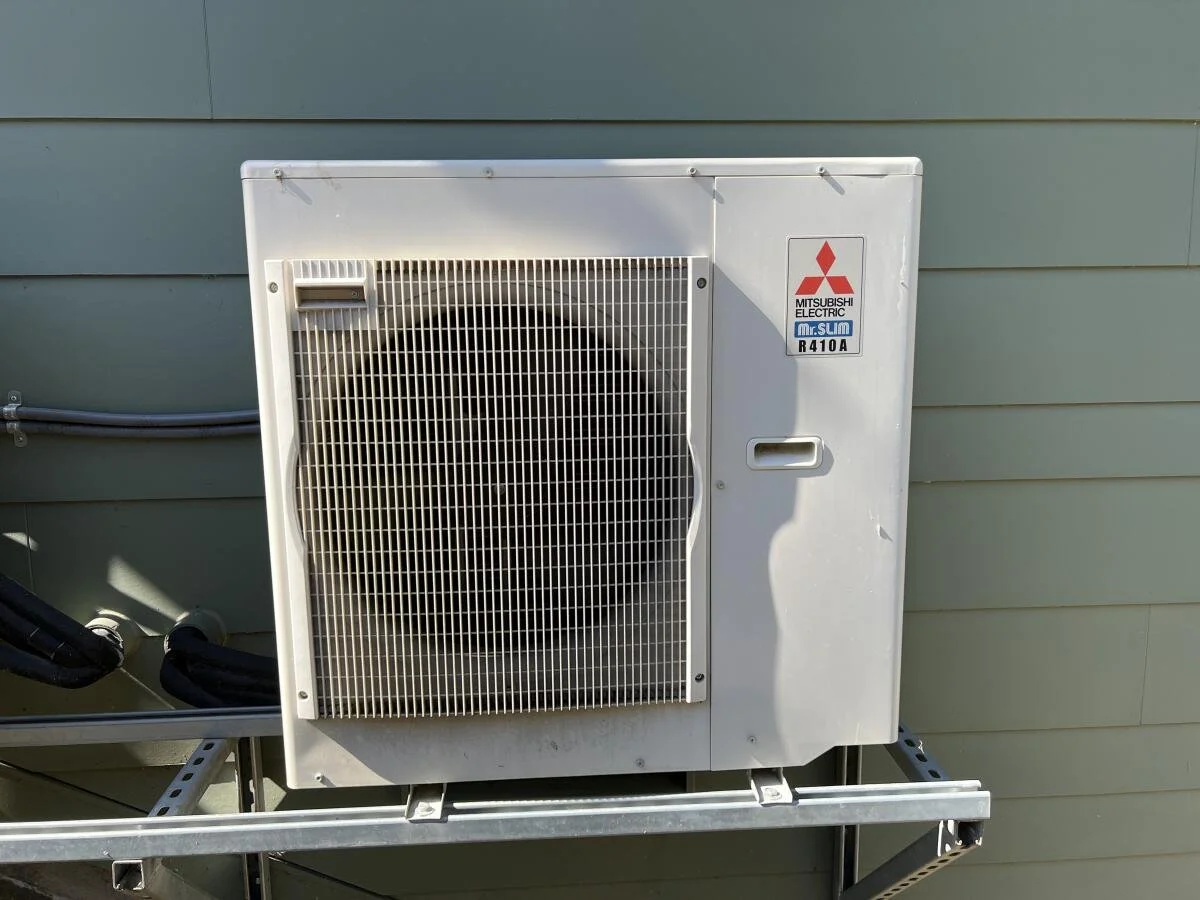
If your Orange County two-story home has ductwork that cannot be saved, a mini-split system like this Mitsubishi Mr. Slim is often the fastest path to independent zone control on both floors. Call J Martin at (714) 462-4686 to find out if your home is a candidate.
TECH Clean California Rebate
The state TECH Clean program offers up to $3,100 for gas-to-heat-pump replacements in eligible homes, plus additional rebates for electrical panel upgrades if needed. This program still has funding available as of April 2026, though allocations vary by district. We can check your home's eligibility and help you apply.
Federal Geothermal Tax Credit (30%, Through 2032)
If you're installing a geothermal heat pump (rare in OC homes due to cost and space, but possible), the 30% federal tax credit is still available through 2032. This is a different technology than air-source heat pumps and is much more expensive to install ($20,000 to $40,000), but the credit applies.
California Energy Commission (CEC) Programs
Various city and county energy efficiency programs may offer small rebates or low-interest financing for HVAC upgrades. These vary by municipality. We can check what's available for your specific address in Orange County.
One critical caveat: the HEEHRA single-family rebate program (which had offered up to $8,000 for heat pump replacements) had its allocation fully reserved as of February 2026. New applications are likely waitlisted. Don't count on that one.
Total realistic rebate opportunity for a 2026 heat pump upgrade in OC: $1,000 to $4,100 depending on your specific program eligibility. This reduces your net cost after rebates to approximately $8,500 to $17,000 for a high-end variable-speed zoned system.
Installation Timeline and What to Expect
A full system replacement with zoning typically takes 2 to 3 days on-site with a crew of two technicians. Here's the sequence.
Day one morning includes the Manual J calculation, final equipment selection, permit applications, and system shutdown. Day one afternoon covers removal of the old outdoor condenser and indoor coil, plus ductwork assessment. Day two is equipment installation, ductwork modifications, damper installation, refrigerant charge, and electrical connections. Day three involves pressure testing, control calibration, zone balancing, and final inspection. We stay until you're comfortable with the new system, thermostat operation, and the two-zone control workflow.
The most important part: system balancing happens on day three. This is where we measure the CFM (airflow) to each zone, adjust damper positions, verify the thermostats are reading correctly, and confirm that both zones can reach and hold their setpoints independently. Skipping this step (some contractors do) means you'll never actually get the two-zone comfort you paid for.
We also set up the dual thermostat interface so you understand which is which, how to create schedules independently (upstairs might wake at 6 AM, downstairs at 7 AM), and when to call us if something feels off.
During installation, your home will be without AC for the duration of days one and two. We typically start early and finish by late afternoon on day two so you have cooling before bedtime. If you have elderly family members, pregnant residents, or anyone with medical cooling needs, let us know in advance so we can schedule around that.
Why Variable-Speed and Zoning Matter for Long-Term OC Homeowners
We've worked on two-story homes across Fullerton, Placentia, Santa Ana, and the coastal hills for over a decade. The pattern is consistent: homes that stayed with single-zone AC for 15+ years experience compressor failure earlier than homes with zoning, because the continuous cycling to reach two different floor temperatures adds stress. Homes with variable-speed equipment in our service area have shown 30 to 40% lower cooling costs and significantly longer equipment lifespan.
If you're installing a system you plan to use for 15+ years, the extra $3,000 to $5,000 for variable-speed capability pays for itself and then some. If you're flipping the home in 3 years, a standard zoned system is sufficient.
The zoning retrofit is non-negotiable for 2-story homes, but the variable-speed premium is a math problem. Do the energy payback math for your own timeline and budget.
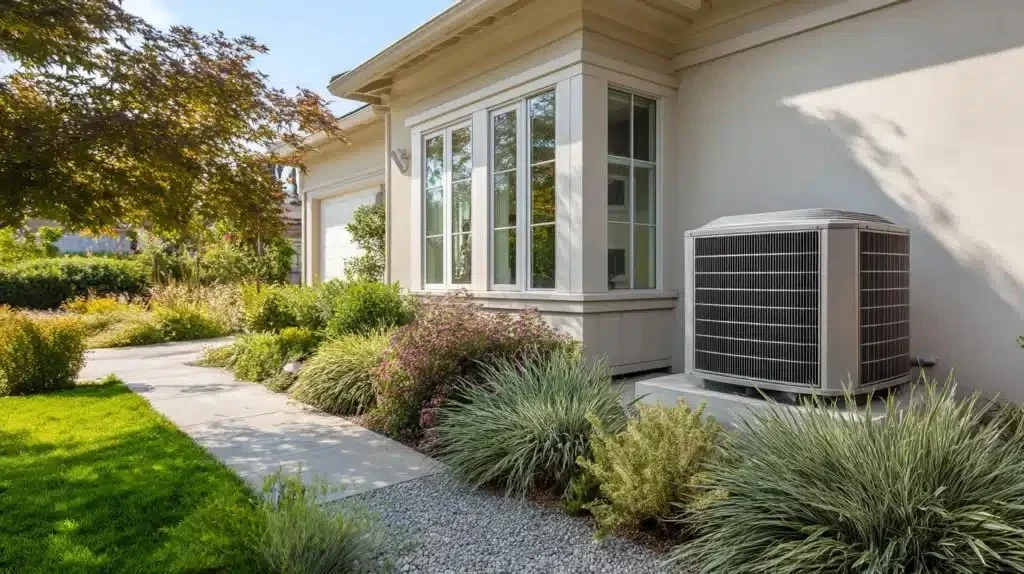
A properly sized and correctly installed outdoor condenser unit is the foundation of every two-story comfort solution J Martin designs. Equipment selection, placement, refrigerant line routing, and electrical connections all affect how well your system performs for the next 15 years. We get those details right the first time.
Frequently Asked Questions
What's the difference between zoning dampers and a dual system?
Dampers split one compressor's output between two zones. A dual system means two completely separate compressors, each serving one floor. Dual systems offer 100% independence and slightly higher efficiency because each compressor is sized specifically for one floor. Damper zoning is less expensive and sufficient for most homes. Choose dual systems when ductwork is severely compromised or when you want absolute independence on each floor.
Will zoning help if my upstairs stays at 78 degrees and the downstairs is 70?
Yes, absolutely. That 8-degree difference indicates you need zoning and likely ductwork balancing or repair. Zoning alone often closes 60% to 70% of that gap. If the gap remains larger after zoning is installed and balanced, the issue may be ductwork undersizing upstairs, which can be addressed with supplemental return ducts or a more aggressive damper opening for the upstairs zone.
Can I add zoning to my existing AC system?
Yes, if your outdoor compressor and indoor coil are in good working order (typically 8 to 10 years old or newer), you can retrofit dampers, thermostats, and a zone panel for $1,700 to $2,800. This is much cheaper than a full replacement. We can inspect your system and tell you if retrofit zoning makes sense or if you need a full replacement.
Are mini-splits as efficient as variable-speed ducted systems?
Mini-splits achieve similar SEER2 ratings (17 to 23) as variable-speed units, and some actually outperform because there's no ductwork loss. However, mini-splits have visible indoor heads on each wall, which some homeowners dislike aesthetically. They're extremely efficient for homes with poor ductwork but require accepting the wall-mounted look.
What happens if one zone fails?
If one damper fails in a zoned system, the other zone can still operate, though comfort is reduced. The failed zone either gets no cooling (if the damper stuck closed) or excessive cooling (if stuck open). A failed damper typically costs $800 to $1,200 to replace. This is rare but possible over 15+ years. Dual systems and mini-splits have less single-point failure risk because each zone has its own independent compressor.
Is a heat pump necessary for two-story comfort?
No. Zoned air conditioning solves the two-story temperature problem. A heat pump (which provides both heating and cooling) is a separate decision, and it offers additional annual savings only if you're using the heating mode. In mild OC winters, heat pump heating is less critical than in colder climates. Zoning plus standard AC is sufficient for comfort. Heat pump conversion is worth considering if your home currently heats with gas and you want to maximize efficiency, but it's not required for the two-story cooling problem.
How long before zoning equipment pays for itself?
A $2,000 zoning retrofit typically pays back in energy savings within 3 to 5 years on a system running continuously in peak OC summer. A $5,000 variable-speed premium pays back in 4 to 7 years depending on your home's solar exposure. After payback, you're in pure savings territory. This is why we recommend variable-speed for homeowners planning to stay 10+ years.
Call J Martin to Evaluate Your Two-Story Home
We've diagnosed and solved the two-story HVAC problem in hundreds of Orange County homes since 2014. Whether you need a Manual J calculation to understand your current sizing, a ductwork assessment to see if retrofit zoning is feasible, or a full system design for replacement, we can help.
J Martin Indoor Air Quality has served Orange County families since 2014. Licensed, bonded, and insured (CA Contractor License CL#998956), with a 4.97-star rating across thousands of reviews. When you call, Kathryn or Alexis answers at our Anaheim office, not a national call center. If a zoning retrofit gets you through another 5 years, that's what we'll recommend. We don't sell replacements you don't need.
Call us at (714) 462-4686 for same-day service, orrequest a free in-home consultation.
For more information on the best HVAC system for your 2-story home, explore our complete air conditioning services, or read our full heat pump vs gas furnace comparison.