
What SEER Rating Do I Need for Orange County? A Homeowner's Guide to AC Efficiency
Updated on May 14, 2026
If you're shopping for a new air conditioner or heat pump in Orange County, you've probably come across the term SEER rating, and immediately felt overwhelmed. The numbers seem arbitrary, the terminology recently changed (hello, SEER2), and every contractor you talk to recommends something different. Some push the highest efficiency unit they sell because it pads their commission. Others just quote you the cheapest option and move on. Neither approach actually helps you make the right decision for your home and your budget.
Here's what we've learned after installing over 5,000 HVAC systems across Anaheim, Yorba Linda, Brea, Fullerton, and the rest of Orange County: the "best" SEER rating isn't the highest number you can find. It's the one that makes financial sense based on where you live, how much you pay for electricity, how often your AC runs, and how long you plan to stay in your home. And in Orange County, those factors create a very specific equation that looks different from Phoenix, Miami, or even Sacramento.
We had a customer in Placentia last summer who'd been sold a 24 SEER system by a big-box company when a 17 SEER unit would have made way more sense for her 1,400-square-foot home. The sales rep talked a great game about "maximum savings," but when we ran the actual numbers, her payback period was well over 15 years, basically the entire lifespan of the equipment. She paid thousands extra upfront for savings she'd never fully recoup. That's the kind of thing that happens when contractors sell based on margin instead of math. This guide is designed to make sure that doesn't happen to you.
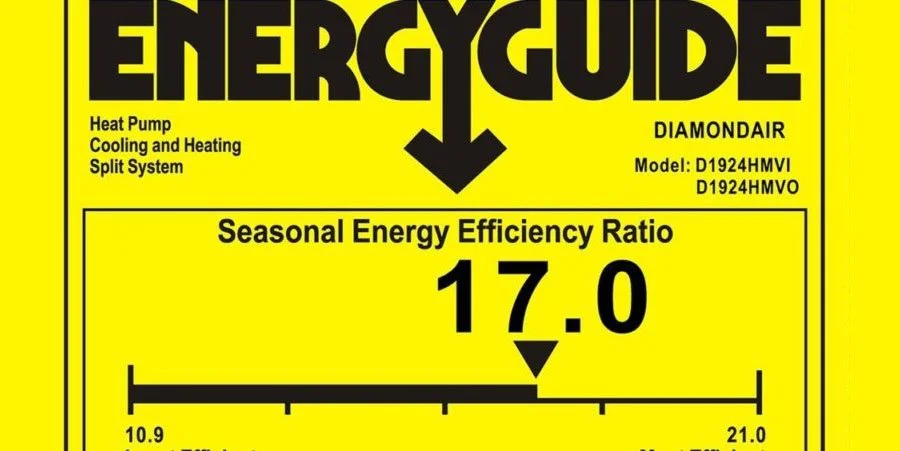
If your HVAC system is over 10 years old, your SEER rating may be costing you more than you realize. Upgrading to a higher efficiency model can lower monthly utility bills.
What Is a SEER Rating and Why Should You Care?
SEER stands for Seasonal Energy Efficiency Ratio. Think of it like miles per gallon for your car. A car rated at 30 MPG uses less gas to travel the same distance as one rated at 20 MPG. Similarly, an AC unit rated at 20 SEER uses less electricity to produce the same amount of cooling as one rated at 14 SEER.
The actual calculation involves dividing the total cooling output (measured in BTUs) by the total electrical energy input (measured in watt-hours) over a range of outdoor temperatures from 65°F to 104°F. But you don't need to worry about the math. What matters is understanding that a higher SEER number means lower electricity consumption for the same amount of cooling, and in Orange County, where Southern California Edison's rates are climbing every year, that distinction hits your wallet directly.
Here's the part that matters for us locally. Your AC isn't running the same number of hours as someone in Phoenix or someone in Seattle. In our climate, most homes run their air conditioning roughly 1,500 to 2,000 hours per year. That's significantly more than the national average but not as extreme as desert climates where AC runs nearly year-round. This middle ground is actually what makes the SEER decision so critical here, you're in the zone where choosing wisely saves real money, but overspending on ultra-high efficiency may not pay back as quickly as a contractor in Scottsdale might promise.
SEER vs. SEER2: What Changed in 2023 and Why It Matters Right Now
If you've been Googling air conditioners recently, you've probably noticed two different rating systems floating around: SEER and SEER2. This isn't marketing fluff. In January 2023, the Department of Energy officially switched to SEER2 as the standard for all new residential HVAC equipment. The reason is straightforward, the old testing method wasn't very realistic.
Under the original SEER testing, air conditioners were evaluated at very low static pressure, essentially a clean lab setting with almost no resistance on the system. That's nothing like your actual house, where air has to push through feet of ductwork, past filters, around bends, and through registers. SEER2 testing uses higher static pressure that much more closely simulates real-world conditions with actual ductwork. The result is a more honest number.
Because the testing is tougher, SEER2 numbers come out slightly lower than the old SEER numbers for the exact same equipment. A unit that was previously rated at 16 SEER might now carry a rating of 15.2 SEER2. Same unit. Same performance. More accurate label.
This creates real confusion when you're comparing contractor quotes. If one quote lists a 16 SEER system and another lists a 15.2 SEER2 system, they might actually be identical equipment. We've had homeowners in Fullerton come to us thinking they'd been quoted a "downgrade" by another contractor when in reality the second quote was just using the newer rating system. Always make sure you're comparing apples to apples, either all SEER or all SEER2, before making a decision. Any contractor quoting you in 2026 should be using SEER2 numbers exclusively.
What's the Minimum SEER Rating Required in California?
California falls under the Department of Energy's Southwest region, which has the highest minimum efficiency requirements in the country. As of January 2023, the minimum SEER2 rating for new air conditioners here is 14.3 SEER2 for split systems under 45,000 BTU and 13.8 SEER2 for larger units. Under the old rating system, that 14.3 SEER2 minimum is roughly equivalent to a 15 SEER rating.
What this means practically is that you cannot legally purchase or have installed a new air conditioner in Orange County that falls below this threshold. Every unit available for sale in our market should meet or exceed it. If someone is offering you a suspiciously cheap system, it's worth verifying that it carries the proper SEER2 certification for our region.
California also has additional energy code requirements under Title 24 that go beyond just the efficiency rating stamped on the equipment. These regulations cover duct sealing, insulation levels, and overall system design. This is important because a high-SEER unit installed with leaky ductwork and thin attic insulation won't perform anywhere near its rated efficiency. We see this constantly in older neighborhoods throughout Anaheim, Fullerton, and Brea where original ductwork from the '70s and '80s was never designed for modern high-efficiency systems. If you want to understand how your ductwork factors into the equation, our Complete Guide to Air Duct Cleaning breaks down everything from signs of dirty ducts to how professional cleaning improves efficiency. And if insulation is the weak link, our post on How Attic Insulation Affects Your HVAC Efficiency digs into why the stuff above your ceiling might matter more than the rating on your outdoor unit.
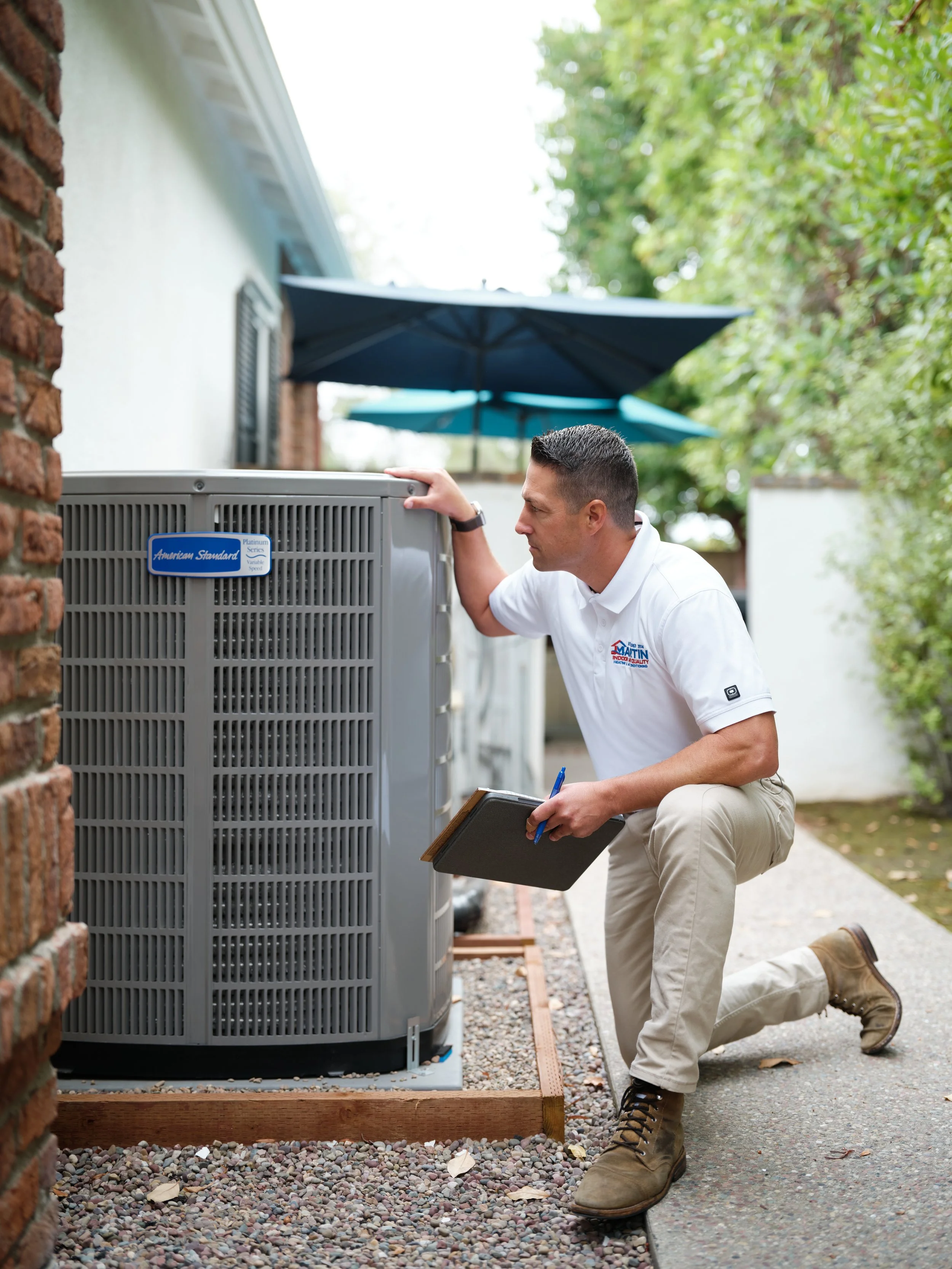
Before the next Orange County heat wave hits, make sure your AC system is operating at an efficiency level that makes financial sense for your home.
What SEER Rating Is Best for Orange County? Our Honest Recommendation
This is the question everyone wants answered, and here's the truth we tell every homeowner who calls us: for most Orange County homes, a system in the 16 to 20 SEER2 range offers the best balance of upfront cost, energy savings, and long-term value. That's a range, not a single number, because the right answer depends on your specific situation. Let's break it down.
14.3 SEER2: The Bare Minimum
The least expensive option upfront, typically saving you $1,500 to $3,000 compared to mid-range systems. This makes sense in a narrow set of circumstances: if you're on a very tight budget, selling your home within two to three years, or cooling a small space (under 1,200 square feet) that's well-insulated with newer windows. We installed a minimum-efficiency system for a retired couple in Villa Park last year who were downsizing within 18 months. For their situation, spending an extra $2,500 on efficiency they'd never recoup made zero sense, and we told them that. But for most Orange County homeowners planning to stay put, the minimum usually ends up costing more over time through higher monthly bills.
16-17 SEER2: The Sweet Spot for Most Orange County Homes
This is where we see the best return on investment for the majority of our customers. You're saving roughly 15 to 25 percent on cooling costs compared to minimum efficiency, and the price premium is typically $1,200 to $2,500 over baseline. These systems often include two-stage compressors that provide more consistent temperatures and better humidity control, which actually matters on those muggy late-September days when Santa Ana winds aren't blowing and the coastal moisture just hangs in the air.
For a typical 2,000-square-foot home in Yorba Linda or Brea running the AC about 1,800 hours per year at current SCE rates, upgrading from 14.3 to 16 SEER2 saves approximately $250 to $400 per year. That means the extra upfront cost pays for itself in roughly four to seven years, well within the 15- to 20-year lifespan of the equipment. We installed a 17 SEER2 American Standard system in a two-story Anaheim Hills home last spring. The homeowner tracked his SCE bills against the prior year, and his July bill dropped by $87 compared to his old 13 SEER unit. August was even better. By the end of the first cooling season, he'd already recovered nearly a third of the efficiency premium. For a more detailed look at equipment costs and what we're quoting across different efficiency tiers, check out our 2025-2026 Guide on HVAC Replacement Cost in Orange County.
18-20 SEER2: Premium Efficiency That Pays Off for the Right Home
This range makes sense for larger homes (2,500+ square feet), houses that run AC heavily from May through October, and homeowners who plan to stay put for ten years or more. These systems almost always feature variable-speed compressors that ramp up and down based on demand rather than cycling on and off. The result is exceptionally consistent temperatures, superior humidity removal, and near-silent operation. The price premium is meaningful, typically $3,000 to $5,000 more than mid-range, but the annual savings are also larger, often $400 to $600 compared to minimum efficiency.
We did a full system replacement last fall for a family in Yorba Linda with a 3,200-square-foot home. They went with a 20 SEER2 variable-speed heat pump, and the difference was night and day. Their upstairs bedrooms, which used to be five to eight degrees warmer than the main floor, are now within a degree or two. Their system runs quietly in the background almost all day at low capacity instead of blasting on at full speed, cooling the house down, and shutting off. They told us their home has never been this comfortable.
20+ SEER2: Ultra-High Efficiency
Systems above 20 SEER2 exist, and they're impressive engineering. But here's the assessment many contractors won't give you: for most Orange County homes, the marginal savings between a 20 SEER2 and a 24 SEER2 system are relatively small compared to the price jump. You might save an additional $100 to $200 per year while spending $4,000 to $6,000 more upfront. The payback period stretches well beyond ten years. If maximum comfort and environmental impact matter more to you than pure financial return, these systems absolutely deliver. Many ductless mini-split systems operate in this ultra-high efficiency range, which is one reason they've become so popular for room additions, garage conversions, and ADUs across Orange County. Not sure which tier makes sense for your home? Call us at (714) 462-4686 and we'll run the numbers based on your actual square footage, usage patterns, and SCE rates. No guessing, no upselling.
The Refrigerant Change You Need to Know About: R-410A to R-454B
There's a major industry shift happening right now that directly affects your SEER decision, and most homeowners have no idea it's underway. As of January 2025, manufacturers can no longer produce new air conditioners or heat pumps that use R-410A refrigerant, the standard refrigerant that's been in virtually every residential AC system installed since 2010. R-410A split systems manufactured before the deadline had to be installed by January 1, 2026, and the industry is now fully transitioning to two new refrigerants: R-454B (which most major brands like Carrier, Lennox, Trane, and American Standard use for ducted systems) and R-32 (used primarily in ductless mini-splits by brands like Daikin and Mitsubishi).
Why does this matter for your SEER decision? A few reasons. First, new R-454B and R-32 systems cost more than the R-410A equipment they replaced. The redesigned components, additional safety sensors (both new refrigerants are classified as mildly flammable, or A2L), and retooled manufacturing have pushed prices up roughly 10 to 20 percent across the board. This price increase has already been baked into 2026 equipment pricing, so it's not something you can avoid, but it does affect the cost-vs-savings math when choosing between SEER tiers.
Second, R-32 systems, which are primarily found in ductless mini-splits, tend to be slightly more energy efficient than their R-410A predecessors. Some manufacturers report up to 12 percent better efficiency. So if you're considering a mini-split for a room addition or garage conversion, the new refrigerant actually works in your favor on the efficiency front.
Third, and this is the practical part: if your current system uses R-410A, it can absolutely keep running. Nobody is forcing you to replace it. But as R-410A production continues to be phased down (the EPA has already cut production by 40 percent from baseline levels), the cost of refrigerant for repairs and recharges will gradually increase over the coming years. We saw the same pattern play out with the R-22 phase-out over the last decade, toward the end, R-22 refrigerant was costing homeowners $150 to $200 per pound, compared to $30 to $50 per pound when it was still being produced. If your current R-410A system is approaching 12 to 15 years old and needs a refrigerant recharge, it's worth running the numbers on replacement versus repair with your contractor.
The bottom line: don't panic about the refrigerant change, but do factor it into your timeline. If you're replacing your system in 2026, you're getting R-454B or R-32 equipment regardless, and the SEER2 ratings on the new equipment reflect real-world performance with these new refrigerants.
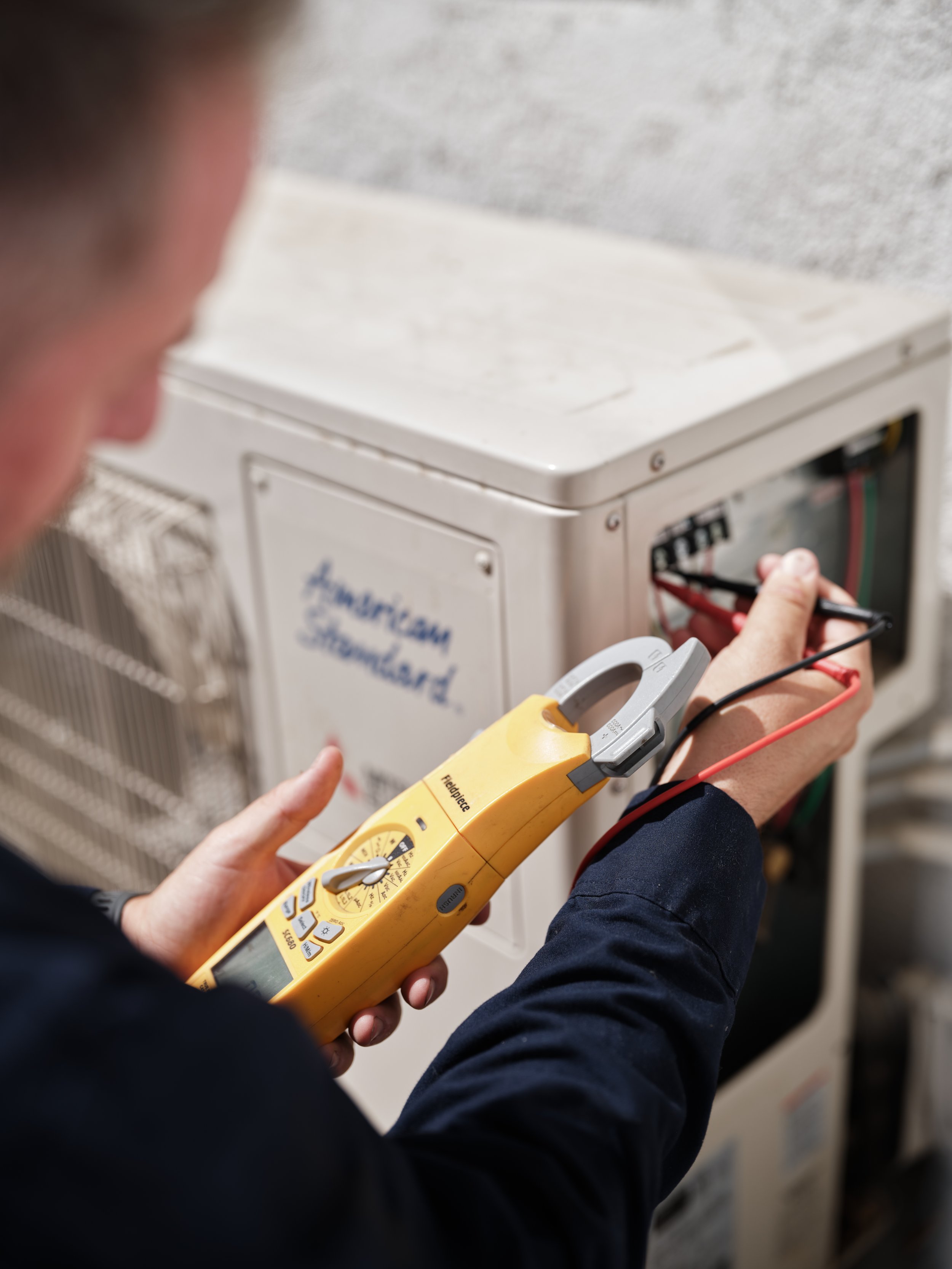
Not all efficiency losses show up on the EnergyGuide label. A professional inspection reveals what’s really happening.
Why Orange County's Climate Makes Your SEER Decision Unique
Orange County's Mediterranean climate creates specific conditions that directly affect how much value you get from a higher SEER rating. Understanding these local factors helps you make a smarter decision than just picking a number off a spec sheet.
Our cooling season is long but not extreme. Most homes run their AC from late April through October, with the heaviest usage in July, August, and September. That's roughly six to seven months of cooling, long enough to accumulate meaningful savings from higher efficiency but not as relentless as Phoenix where AC runs ten months a year. This extended season is part of why the 16-20 SEER2 range hits the sweet spot here.
Inland versus coastal makes a real difference. If your home is in Yorba Linda, Villa Park, Anaheim Hills, or the inland stretches of Brea, your summer temperatures regularly hit the mid-to-high 90s and occasionally push past 100°F. Your AC works harder, runs longer, and a higher SEER rating generates more savings. We've seen homes in Yorba Linda's eastern neighborhoods running their AC 200 to 300 more hours per year than comparable homes in west Anaheim that get afternoon ocean breezes. That extra runtime pushes the efficiency math solidly in favor of 18+ SEER2 for inland locations.
Santa Ana wind events create unique efficiency challenges. During Santa Ana conditions, typically October through March, hot, dry desert winds push temperatures up by 10 to 20 degrees seemingly overnight. These events force your AC to work at near-maximum capacity, and this is where the difference between a single-stage and a variable-speed system becomes really noticeable. A higher-SEER variable-speed system ramps up smoothly during these events rather than slamming on at full blast and cycling off, which is both more efficient and more comfortable. Santa Ana winds also push enormous amounts of dust and debris into your ductwork and outdoor unit, which can degrade efficiency over time. Our Complete Guide to Air Duct Cleaning covers how to protect your system from that kind of buildup, and our guide to DIY HVAC Maintenance Tasks shows you how to keep your outdoor condenser clear between professional tune-ups.
Southern California Edison rates make efficiency matter more here than almost anywhere. As of January 2026, SCE's average residential rate is approximately 34.5 cents per kilowatt-hour, roughly double the national average. And it keeps climbing. SCE raised rates by approximately 13 percent in October 2025 alone, and projections suggest continued increases through 2028 as the utility recovers costs for wildfire mitigation, grid hardening, and infrastructure upgrades. When electricity costs this much, every percentage point of efficiency improvement saves you more money than it would in states with cheaper power. At 34.5 cents per kWh, the difference between running a 14 SEER2 and an 18 SEER2 system for 1,800 hours per year on a 3-ton unit works out to roughly $400 to $550 in annual savings. Over 15 years, that's $6,000 to $8,000, easily justifying the higher upfront investment.
SCE also uses time-of-use rate plans that charge significantly more for electricity during peak afternoon and evening hours, exactly when your AC is working hardest. During summer months, peak rates can climb above 50 cents per kWh. A higher-efficiency system paired with a smart thermostat that pre-cools your home during off-peak hours can dramatically cut your exposure to those peak rates. If you haven't explored smart thermostat options yet, our complete guide to smart thermostats covers everything from which models work best to how much Orange County homeowners are actually saving.
Federal Tax Credits and California Rebates: Don't Leave Money on the Table
One of the most overlooked factors in choosing a SEER rating is the federal tax credit available through the Inflation Reduction Act. As of 2025, homeowners could claim up to $600 for a qualifying central air conditioner, but the system had to meet a minimum SEER2 of 17.0 and an EER2 of 12.0, and it had to be ENERGY STAR certified. That's significantly higher than California's minimum of 14.3 SEER2, which means a base-model system wouldn't qualify.
Heat pumps offer an even larger incentive, up to $2,000 in federal tax credits for qualifying systems. Given Orange County's mild winters and the fact that heat pumps handle both heating and cooling, this is a compelling option that many homeowners overlook. A heat pump operating at 18-20 SEER2 in our climate can run 30 to 50 percent more efficiently than a traditional gas furnace and AC combination, and the tax credit can effectively close the price gap between a mid-range and a premium system.
Since the Inflation Reduction Act's Energy Efficient Home Improvement Credit was available through the end of 2025, you'll want to verify the current status of these credits if you're reading this in 2026. Tax policy shifts, and the specific amounts and qualifying criteria may change. We always recommend consulting with your tax professional. But when these credits are available, they're a game-changer, we've seen them turn the math from "maybe I should go 18 SEER2" to "there's no reason not to" for dozens of our customers.
California also runs its own rebate programs through Southern California Edison, SoCalGas, and programs like the Self-Generation Incentive Program. These change periodically, but they can stack with federal credits. Ask your contractor about current incentives before finalizing your equipment choice, you might be surprised how much you can offset.
How to Calculate Your Actual Energy Savings by SEER Rating
Rather than trusting generic numbers from a manufacturer's brochure, here's how to estimate what different SEER ratings will actually cost you to operate in Orange County. These numbers use local data so you can see the real financial impact.
For a typical Orange County home with a 3-ton system (36,000 BTU), running approximately 1,800 cooling hours per year at the current SCE average residential rate of roughly 34.5 cents per kWh, the annual cooling costs shake out like this:
A 14.3 SEER2 system consumes approximately 4,531 kWh per year for cooling, costing about $1,563 annually. A 16 SEER2 system drops to approximately 4,050 kWh and $1,397, saving roughly $166 per year. An 18 SEER2 system comes in around 3,600 kWh and $1,242, saving $321 annually over the minimum. And a 20 SEER2 system uses about 3,240 kWh at $1,118, saving $445 per year compared to baseline.
These numbers assume average conditions. If your home is larger, if you keep the thermostat at 72 instead of 78, if your insulation is thin, or if you're in a hotter inland area, your actual savings will be higher. If you have a smaller home, keep the thermostat higher, or enjoy coastal breezes, savings will be on the lower end. And these calculations only account for cooling, if you're installing a heat pump, the efficiency gains carry through winter as well, increasing your total annual savings.
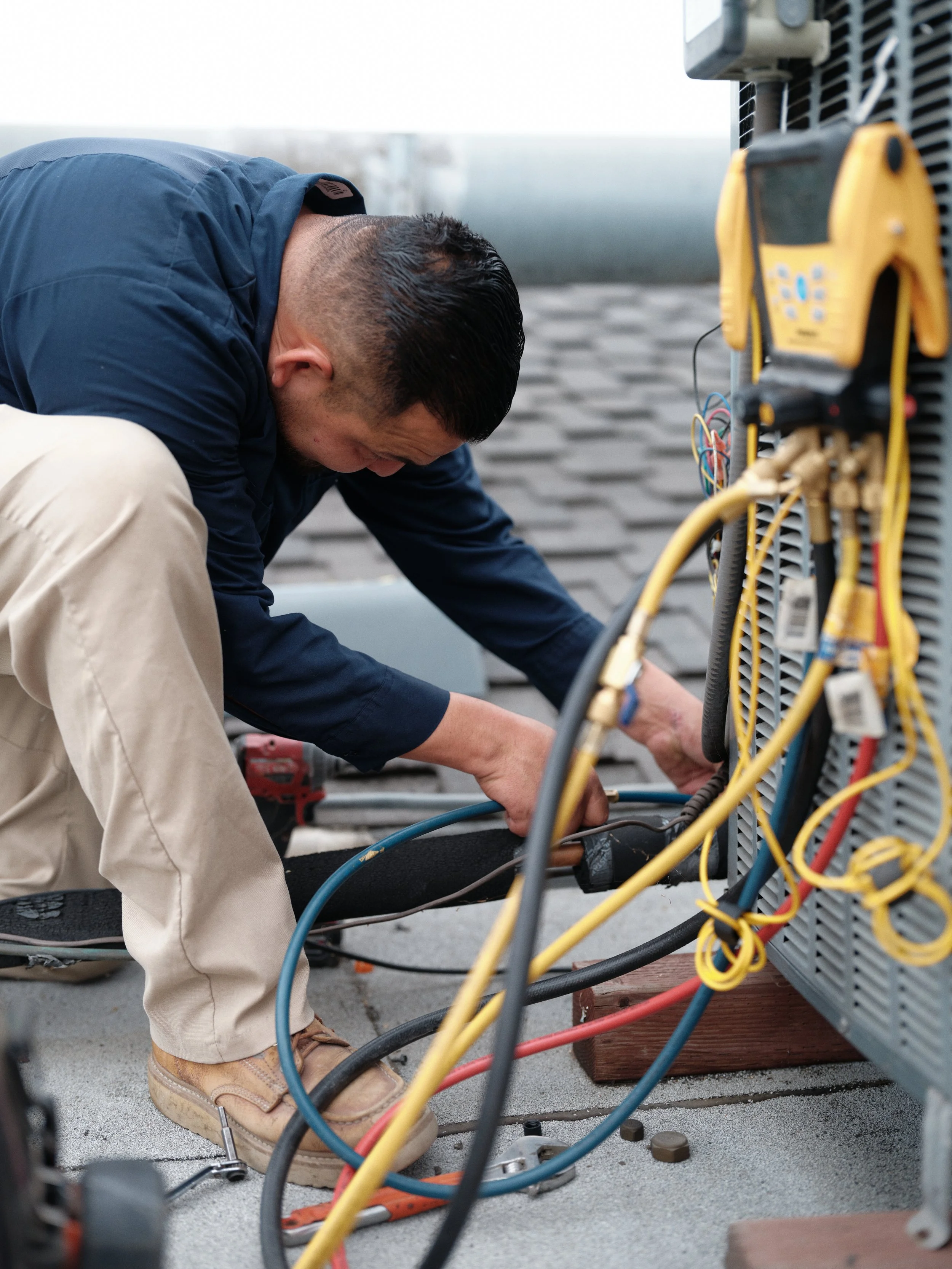
Even a high-efficiency 18 or 20 SEER2 system won’t deliver expected savings without precise installation and calibration.
The Factors That Matter More Than SEER Alone
Here's what surprises a lot of homeowners: SEER rating is only one piece of the efficiency puzzle, and it's not always the most important one. A perfectly rated system installed badly will underperform a modestly rated system installed correctly. We say this from experience, we've been called in to troubleshoot brand-new high-SEER systems installed by other companies that couldn't cool a home properly because the fundamentals were wrong.
Proper sizing is non-negotiable. An oversized system cools quickly but shuts off before it has time to dehumidify, leaving you with a cold but clammy house. An undersized system runs constantly and can't keep up on the hottest days. Both waste energy and reduce comfort. Proper sizing requires a Manual J load calculation that accounts for your home's square footage, insulation, window types, ceiling height, number of occupants, and local climate data. Any contractor who sizes your system by matching what you currently have or using a "one ton per 500 square feet" rule of thumb is cutting corners that will cost you money every month for the next 15 years.
Ductwork condition has an enormous impact. The Department of Energy estimates that the average home loses 20 to 30 percent of conditioned air through leaky, poorly insulated ductwork. If your ducts are bleeding 25 percent of the air your system produces into the attic, upgrading from 16 to 20 SEER2 doesn't gain you nearly as much as you'd expect. In many cases, investing in duct sealing and insulation alongside a mid-range SEER system delivers better real-world performance than buying the highest SEER equipment while ignoring the ductwork. We've seen this play out so many times in older Anaheim and Fullerton homes that we now evaluate ductwork condition as part of every replacement quote. If your ducts need attention, we'll tell you, because installing a $15,000 system on $2,000 worth of failing ductwork is like putting racing tires on a car with no alignment.
Installation quality is the invisible factor. Proper refrigerant charge, correct airflow across the evaporator coil, tight duct connections, accurate thermostat placement, and proper electrical connections all affect whether your system actually hits its rated SEER. Industry studies have shown that poor installation can reduce real-world efficiency by up to 30 percent. This is why choosing the right contractor matters as much, arguably more, than choosing the right SEER rating. We wrote about how we screen and train our HVAC technicians because the person installing your system directly determines whether you get the efficiency you paid for.
SEER Ratings for Ductless Mini-Splits vs. Central AC
Mini-splits deserve their own conversation because they play on a completely different SEER field. Ductless mini-split systems routinely achieve SEER2 ratings in the 20 to 30 range, numbers that would be exotic and extremely expensive in a central ducted system. This efficiency comes from two main advantages: they eliminate duct losses entirely (air goes directly from the unit to the room), and they use inverter-driven compressors that modulate output continuously instead of cycling on and off.
For Orange County homeowners, mini-splits have become one of our most requested installations. Room additions and ADUs are the most common scenario, extending existing ductwork to a new space is often impractical and expensive. Garage conversions to home offices or gyms are another big one, especially since so many of our customers started working from home and discovered their garages have zero climate control. And homes with stubborn hot spots, that upstairs master bedroom that's always eight degrees warmer than the kitchen, benefit enormously from a mini-split providing independent zone control.
One thing to understand about mini-split SEER ratings: because they don't have ductwork, their rated efficiency is much closer to their actual real-world performance. A central AC rated at 16 SEER2 might only deliver 12-13 SEER2 after duct losses, while a mini-split rated at 20 SEER2 typically delivers close to that full number. The real efficiency gap between a ducted system and a ductless system is often bigger than the label numbers suggest.
With the 2025 refrigerant transition, most mini-splits now run on R-32 refrigerant, which tends to offer slightly better efficiency than the R-410A it replaced. So the already-impressive SEER numbers on new mini-splits may actually be a touch better than what was available even a year ago.
Single-Stage vs. Two-Stage vs. Variable-Speed: What You're Actually Paying For
The SEER rating on any system is closely tied to its compressor type, and understanding the three options explains why higher-SEER units cost more and what you actually get for the premium.
Single-stage compressors run at one speed: full blast. They kick on at 100 percent capacity, cool the house until the thermostat is satisfied, then shut off entirely. This on-off cycling is the least efficient approach, which is why single-stage systems land in the 14-16 SEER2 range. They work, but they create temperature swings, that feeling of being cool right after the system runs, then gradually warming up before it kicks on again, and they're the loudest option.
Two-stage compressors run at two speeds: roughly 60-70 percent capacity for mild conditions and 100 percent for the hottest days. Since the system runs at the lower stage most of the time, it cycles less frequently, holds more consistent temperatures, removes more humidity, and runs significantly quieter. Two-stage systems generally fall in the 16-18 SEER2 range. We consider this the smart upgrade for homeowners who want noticeably better comfort without jumping to premium pricing.
Variable-speed compressors (also called inverter-driven) operate anywhere from about 25 percent to 100 percent capacity, continuously adjusting to match the cooling load. On a mild spring afternoon, the compressor might cruise at 30 percent for hours, holding a perfectly stable temperature with almost no sound. On the hottest August day, it ramps up to full capacity. This precision is why variable-speed systems achieve 18-24+ SEER2 and deliver the best comfort. The tradeoff is cost, typically $2,000 to $5,000 more than a comparable single-stage unit.
For Orange County specifically, two-stage and variable-speed systems offer particular value because of our temperature variability. We don't have constant crushing heat like Phoenix. We have hot afternoons that cool down nicely in the evening, warm fall days interrupted by sudden Santa Ana heat spikes, and spring transitions where the temperature can swing 20 degrees between morning and afternoon. A variable-speed system handles those fluctuations gracefully. A single-stage system just hammers on and off.
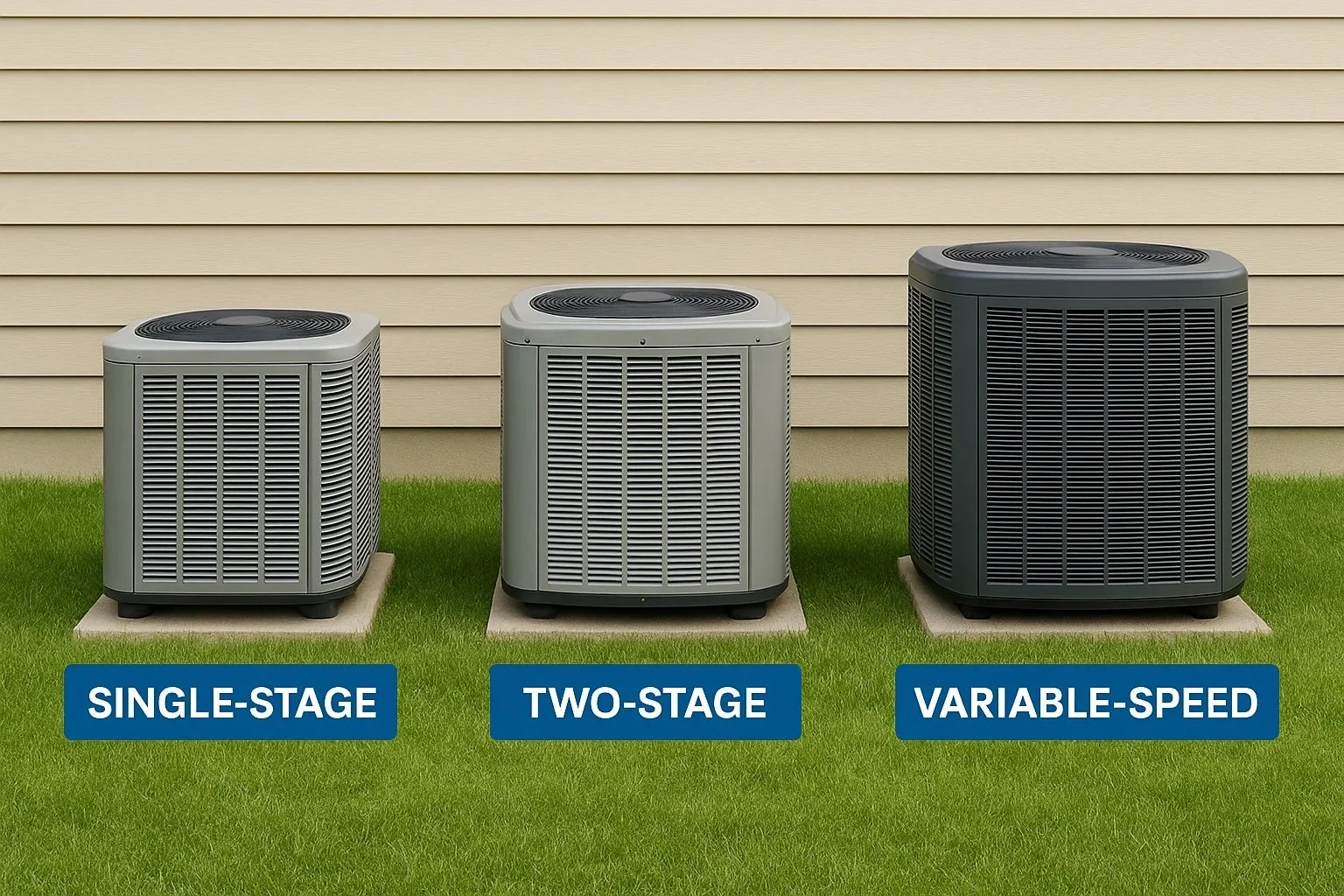
If you're upgrading your AC, don’t just compare SEER2 numbers. Compressor type plays a major role in comfort and long-term savings.
When Your HVAC System Is Telling You It's Time
Sometimes the SEER conversation isn't about choosing between efficiency tiers on a new system, it's about recognizing that your current system is costing you more than a replacement would. If you're not sure whether you're at that point yet, our repair-or-replace decision framework walks through exactly how to make that call. A few signals we see regularly in Orange County homes:
If your system is over 12 years old, it's very likely running at 10-13 SEER or lower, well below today's minimum. The efficiency gap between what you have and what's available now means replacement often pays for itself faster than most people expect. If your energy bills are climbing without a corresponding increase in usage, your system may be losing efficiency through wear, refrigerant issues, or degrading components. If you're hearing strange noises when your system kicks on, grinding, rattling, banging, those are signs that components are failing. Our post on why your heater smells weird when you first turn it on covers similar diagnostic territory for the heating side if you're noticing odd smells during the cooler months.
And if you're planning a renovation, adding square footage, or converting a garage, that's the ideal time to evaluate your entire HVAC setup, capacity, efficiency, ductwork, and insulation, as a complete system rather than piece by piece.
Give Us a Call, No Pressure, Just the Math
At J Martin Indoor Air Quality, we've been helping Orange County families navigate these decisions for over 15 years. We're a family-owned company with no commissioned salespeople, which means our recommendations are based on what makes sense for your home, not on what earns someone the biggest bonus. We install all major brands, including American Standard, Carrier, Lennox, Trane, Mitsubishi, and Daikin, and we'll walk you through options at multiple efficiency levels with transparent pricing.
When you call us, we'll do an actual Manual J load calculation. We'll inspect your ductwork and insulation. We'll run the savings numbers using your real electricity rate and your real usage patterns. And then we'll tell you what we'd do if it were our house, even if that means recommending a lower SEER rating than you came in expecting.
Call us at 714-462-4686 or visit our website to schedule a free consultation. We serve Yorba Linda, Anaheim, Brea, Fullerton, Villa Park, and communities throughout Orange County.
The Bottom Line on SEER Ratings for Orange County
Choosing the right SEER rating isn't about chasing the highest number or settling for the cheapest option. It's about understanding the math behind efficiency, respecting the unique factors of our local climate and electricity costs, and making a decision that balances upfront investment against long-term savings.
For most homes in our area, that sweet spot lands in the 16-20 SEER2 range. Pair the right efficiency rating with proper sizing, quality installation, sealed ductwork, good attic insulation, and regular maintenance, and you'll enjoy lower energy bills, better comfort, and a system that lasts well over a decade.
If you want to keep your existing system running as efficiently as possible while you decide, our guide on 5 DIY HVAC Maintenance Tasks You Can Do Yourself is a great starting point. And if you're already seeing the signs that it might be time, rising energy bills, uneven cooling, strange noises, or a unit approaching 15 years old, don't wait until the first triple-digit heat wave hits in July. The best time to replace your AC in Orange County is before you desperately need it, when you have time to make a thoughtful decision instead of a panicked one.
Your home's comfort and your family's monthly budget deserve better than a guess. Get the right SEER rating for your specific situation, and you'll feel the difference, in your living room and in your wallet.
About J Martin Indoor Air Quality
J Martin Indoor Air Quality is a family-owned HVAC company serving Orange County since 2003. With over 5,000 satisfied customers and a 4.97-star average rating, we specialize in honest, pressure-free HVAC solutions for homeowners in Yorba Linda, Anaheim, Brea, Fullerton, Villa Park, and surrounding communities. California Contractor License #998956.
J Martin Indoor Air Quality | (714) 462-4686 | Services