
How Much Does AC Repair Cost in Orange County? 2026 Price Guide
Updated on May 12, 2026
Last summer we got a call from a homeowner in Anaheim Hills. Her AC had been blowing warm air for two days. She'd already called another company. They told her the compressor was "toast," quoted her $8,200 for a full system replacement, and pressured her to sign that day because "the price goes up next week." She felt something was off, so she called us for a second opinion.
Our technician found a failed $35 capacitor. He replaced it in 20 minutes. Total bill: $189. Her system ran perfectly for the rest of the summer.
Stories like this are why we wrote this guide. Too many Orange County homeowners get taken advantage of during AC emergencies because they don't know what repairs should actually cost. They're hot, they're uncomfortable, they've got kids or elderly parents in the house, and they don't have time to comparison shop. So they say yes to whatever number someone puts in front of them.
At J Martin Indoor Air Quality, we've been repairing air conditioners across Orange County for 15 years. We've completed thousands of service calls in Yorba Linda, Anaheim, Brea, Fullerton, Villa Park, Placentia, and everywhere in between. We're going to share exactly what AC repairs cost in this market right now. Not national averages from a website that's never been to California, but the real numbers Orange County homeowners are paying in 2026.
This isn't a sales page. This is the information you need before anyone shows up at your door.
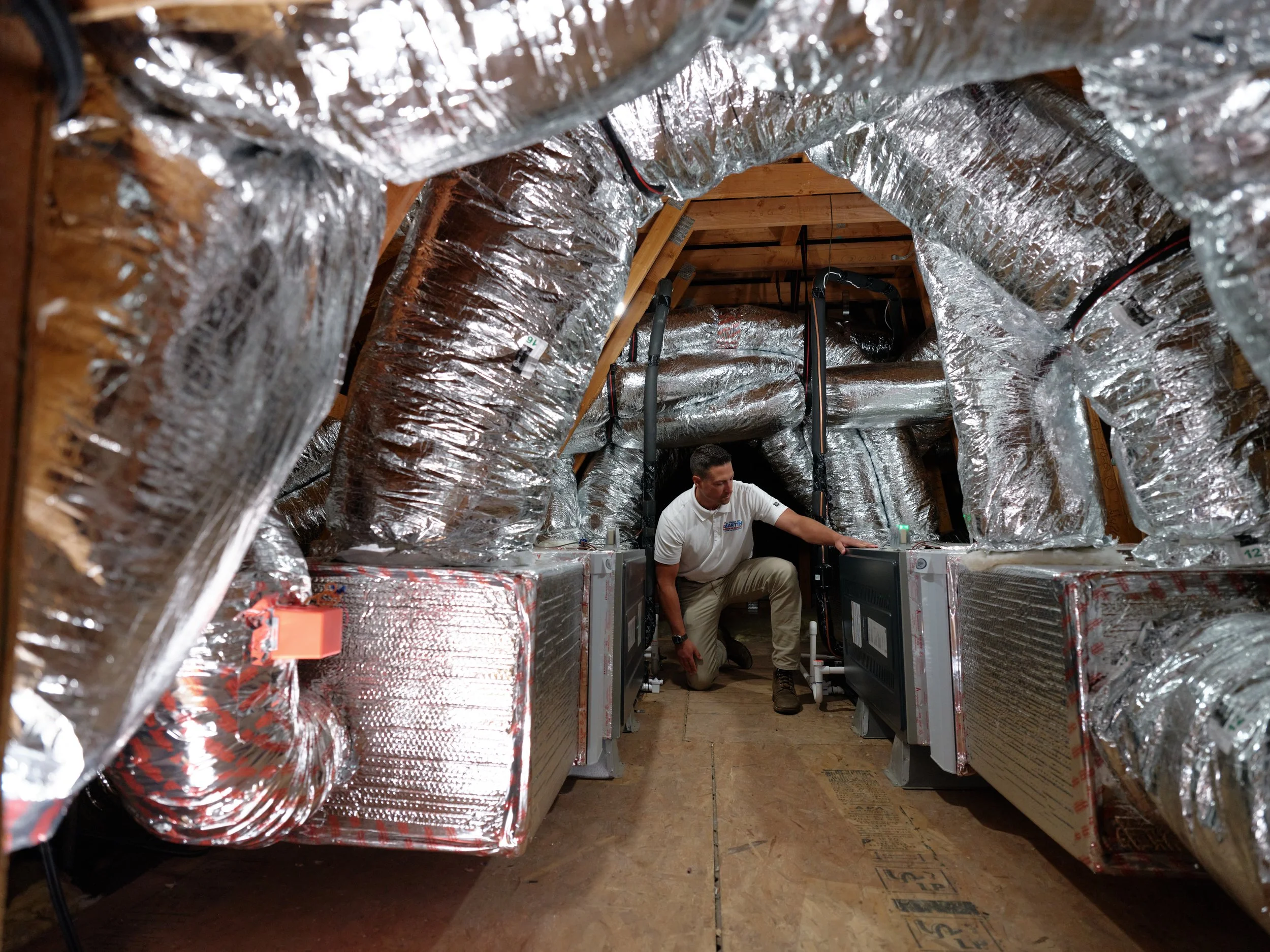
Most Orange County homes have their air handler sitting in the attic. When something goes wrong up there, every hour counts. J Martin technicians are trained to diagnose and repair attic HVAC systems fast so you're not waiting through a heat wave for answers. Call (714) 462-4686.
The Short Answer
Most AC repairs in Orange County fall between $150 and $600. That covers the common stuff like a blown capacitor, a bad contactor, a clogged drain line, or a basic refrigerant top-off. These repairs make up roughly 70% of the service calls we run across the county.
More involved repairs such as a blower motor swap, tracking down and fixing a refrigerant leak, or replacing an evaporator coil land in the $500 to $2,500 range. And the big one, compressor replacement, runs $1,500 to $3,000 or more depending on your system's size and brand.
The vast majority of homeowners will never need a repair above $600. The key is catching small problems before they cascade into expensive ones, and knowing when someone is inflating a number because they'd rather sell you a whole new system than fix what you've got.
What Every Common AC Repair Costs in Orange County 2026
These are real-world numbers based on what HVAC companies are charging across Orange County right now, including us. Not national data. Not 2019 figures. What people in Yorba Linda and Fullerton and Tustin are actually paying this year.
Service Call / Diagnostic Fee: $75 to $200
Before anyone can tell you what's wrong, a technician has to physically inspect your system. In Orange County, most companies charge $75 to $200 for this visit. Some waive it if you approve the repair. Others charge it regardless.
What matters here isn't the fee. It's what you get for it. A proper diagnostic means the technician checks electrical components with a multimeter, measures refrigerant pressures, inspects airflow, tests the thermostat, and actually runs the system while watching what happens. That takes 30 to 45 minutes of focused work. If someone glances at your system for five minutes and then quotes you $4,000, you're not getting a diagnosis. You're getting a sales pitch.
Capacitor Replacement: $150 to $400
If there were a "most likely to fail" award for AC components, the capacitor would win every year. It's a small electrical part that helps your compressor and fan motors start up and keep running. When it goes, your outdoor unit might hum without starting, run for a few seconds and stop, or just sit there doing nothing.
The part costs $15 to $80 depending on type. The rest is labor and the service call. A skilled technician swaps a capacitor in 15 to 30 minutes. If someone quotes you more than $400 for this repair, they're padding the bill or they're hoping you don't know what a capacitor costs.
We replace more capacitors between June and October than the rest of the year combined. Extreme heat is brutal on these components. They're working their hardest during Santa Ana wind events and mid-summer heat waves when your system runs for hours straight. A capacitor that was weakening slowly can fail suddenly on the hottest day of the year.
Contactor Replacement: $150 to $350
The contactor is an electrical relay that switches power to your compressor and condenser fan. When it fails or gets pitted from years of electrical arcing, your AC might not turn on at all, or it might keep running even after the thermostat tells it to stop (which is both annoying and expensive on your electric bill). The part is $20 to $50. Labor and service make up the rest. It’s a straightforward repair, 20 to 40 minutes for a technician who knows what they're doing.
Condensate Drain Line Cleaning: $100 to $250
Your AC pulls humidity from indoor air as part of the cooling process, and that water has to drain somewhere. It exits through a small PVC line, usually running from the air handler in your attic down through a wall and outside. Over time, algae, mold, and debris clog this line, and water backs up.
In most Orange County homes, the air handler sits in the attic. A clogged drain line in the attic means water on your ceiling. We've walked into houses in Yorba Linda where homeowners had water stains spreading across their bedroom ceiling because a $150 drain cleaning turned into a $3,000 ceiling repair while they were on vacation.
This is one of the most preventable repairs in HVAC. A maintenance visit catches this before it ever becomes a problem.
Thermostat Replacement: $100 to $350
If your system behaves erratically, cycling at weird times, not responding to adjustments, or displaying wrong temperatures, the thermostat might be the culprit. A basic digital thermostat replacement runs $100 to $200 installed. Upgrading to a smart thermostat like a Nest or Ecobee costs $200 to $350 with installation and programming.
Word of caution: make sure the problem actually is the thermostat. We've seen homeowners who paid $300 for a new thermostat when the real problem was a $5 blown fuse on the control board. The old thermostat was fine. A good technician verifies before recommending.
Refrigerant Recharge: $200 to $600
Your AC uses refrigerant, most commonly R-410A in systems installed after 2010 to move heat from inside your home to outside. If levels drop, cooling performance declines gradually. You'll notice longer run times, warm spots in the house, and eventually ice forming on your refrigerant lines.
R-410A costs $50 to $80 per pound installed in Orange County. Most systems need 2 to 5 pounds for a top-off, putting the total at $200 to $600 depending on how much you need.
Here's what every homeowner needs to understand about this repair: your AC system is sealed. Refrigerant doesn't "wear out" or "evaporate" or "get used up." If your system is low, it has a leak. Paying for a recharge without finding the leak is like inflating a tire with a nail in it. A reputable company always recommends leak detection alongside a recharge. The companies that just top off and leave are guaranteeing they'll see you again in a few months.
Refrigerant Leak Detection and Repair: $300 to $1,500
Finding the leak is the hard part. Technicians use electronic detectors, UV dye tests, or nitrogen pressure tests to locate the source. Where the leak is determines the cost.
A leak in a refrigerant line that can be welded and sealed: $300 to $600 including the recharge. A leak in the evaporator coil (inside the air handler): usually means replacing the whole coil, which bumps the total to $1,000 to $2,500. A leak in the condenser coil (outdoor unit): similar range, $900 to $2,300 for a coil replacement.
If your system runs on R-22 refrigerant (phased out in 2020), the math changes completely. R-22 now costs $150 to $300 per pound because it's no longer manufactured. A system that needs even a few pounds of R-22 can cost more per year in refrigerant than what you'd pay monthly on a new system. We laid out the full picture in our R-410A phase-out guide for Orange County homeowners.
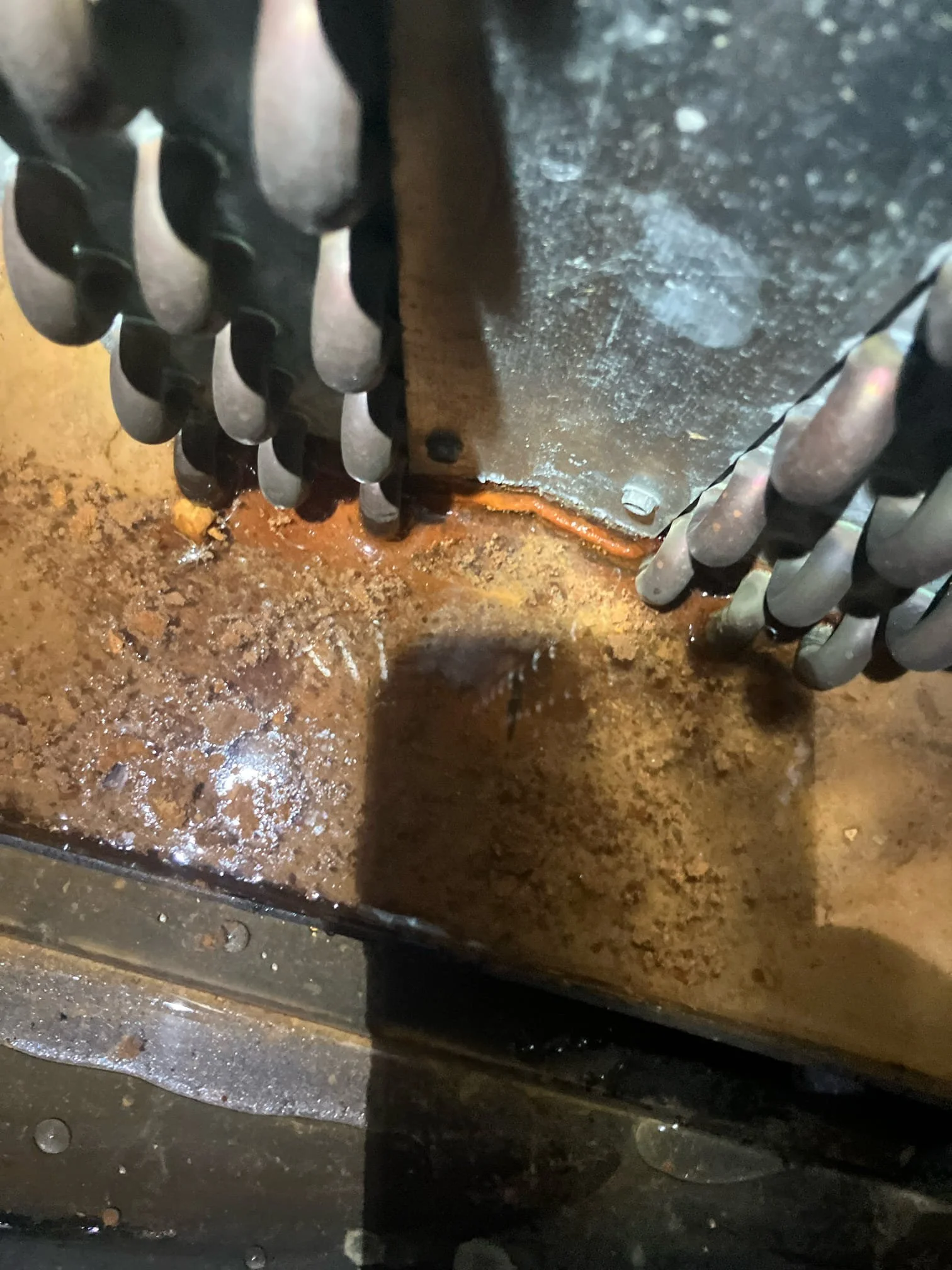
We never quote a repair without showing the homeowner exactly what we found. This corroded evaporator coil had been slowly leaking refrigerant for over a season. A recharge would have bought a few months of cooling before failing completely. The honest answer here was coil replacement, and we showed the homeowner this photo before we said a word about cost.
Fan Motor Replacement: $300 to $800
Your system has two key fan motors: the condenser fan (outdoor unit) and the blower motor (indoor unit). When the condenser fan fails, the outdoor unit stops spinning and your system overheats and shuts down. When the blower motor fails, air stops moving through your ducts.
Condenser fan motor replacement: $300 to $600. Blower motor replacement: $400 to $800, more if you have a variable-speed motor in a high-efficiency system. Variable-speed blower motors alone can cost $500 to $800 for the part. Brand matters here too — a Carrier blower motor and a Goodman blower motor aren't the same price.
Evaporator Coil Replacement: $1,000 to $2,500+
The evaporator coil is where your system actually cools the air, refrigerant flows through it and absorbs heat from the indoor air passing over it. When it develops a leak or corrodes beyond repair, replacement is the only option.
With manufacturer warranty coverage (typically 5 to 10 years): you pay labor and refrigerant, roughly $1,000 to $1,500. Without warranty: the total including parts, labor, and refrigerant climbs to $2,000 to $4,500.
This is where system age becomes the deciding factor. Replacing a warrantied coil on a 6-year-old system? Absolutely worth it. Spending $2,500 on an unwarrantied coil for a 13-year-old system? That's a serious conversation about whether that money is better spent toward a new system with a fresh warranty.
Compressor Replacement: $1,500 to $3,000+
The compressor is the most expensive single component in your AC system and the most expensive repair. When it fails, cooling stops completely. The air from your vents feels room temperature or warm, and no thermostat adjustment fixes it.
Most manufacturers offer a 10-year compressor warranty. If your system is under warranty, expect $800 to $1,500 for labor and refrigerant. Without warranty: $1,500 to $3,000 or more.
Here's the honest truth we give homeowners every time a compressor fails in an older system: if your AC is over 10 years old and the compressor dies, you should seriously consider replacing the entire system rather than just the compressor. A new compressor in an old system is a bet that every other aging component including the coils, the fan motors, the expansion valve, and the wiring that holds up for several more years. That bet often doesn't pay off. We've seen homeowners spend $2,500 on a compressor in a 14-year-old system, only to have the evaporator coil fail six months later. Now they've spent $5,000 on a system that still isn't reliable.
Circuit Board Replacement: $400 to $700
The control board is the brain of your system. When it fails, you get erratic behavior. The system ignores the thermostat, components don't activate, or the system behaves unpredictably. Replacement runs $400 to $700 installed. OEM boards cost more than generic replacements but tend to be more reliable.
Why the Same Repair Costs Different Amounts From Different Companies
You'll hear wildly different numbers if you call three companies for the same problem. Here's why.
Orange County-Specific Cost Factors
Labor is the biggest variable in any AC repair, and labor costs in Orange County are higher than national averages. The cost of living here drives technician wages, insurance, truck costs, warehouse space, and every other business expense. A legitimate, licensed, insured contractor operating out of Orange County has real overhead. This is why the $49 service call from a company that advertises on every coupon mailer should make you nervous, not excited. That price doesn't cover the cost of sending a truck to your house, which means they're making it up somewhere else.
Where your equipment lives also matters. Most Orange County homes have the air handler in the attic. Attic work in July means working in 130 to 150 degree temperatures, hunched over in tight spaces, with limited lighting. It's physically brutal work that takes longer and is more demanding than servicing equipment in a ground-floor utility closet. Technicians don't typically itemize an "attic surcharge," but the extra time and difficulty are built into the labor rate.
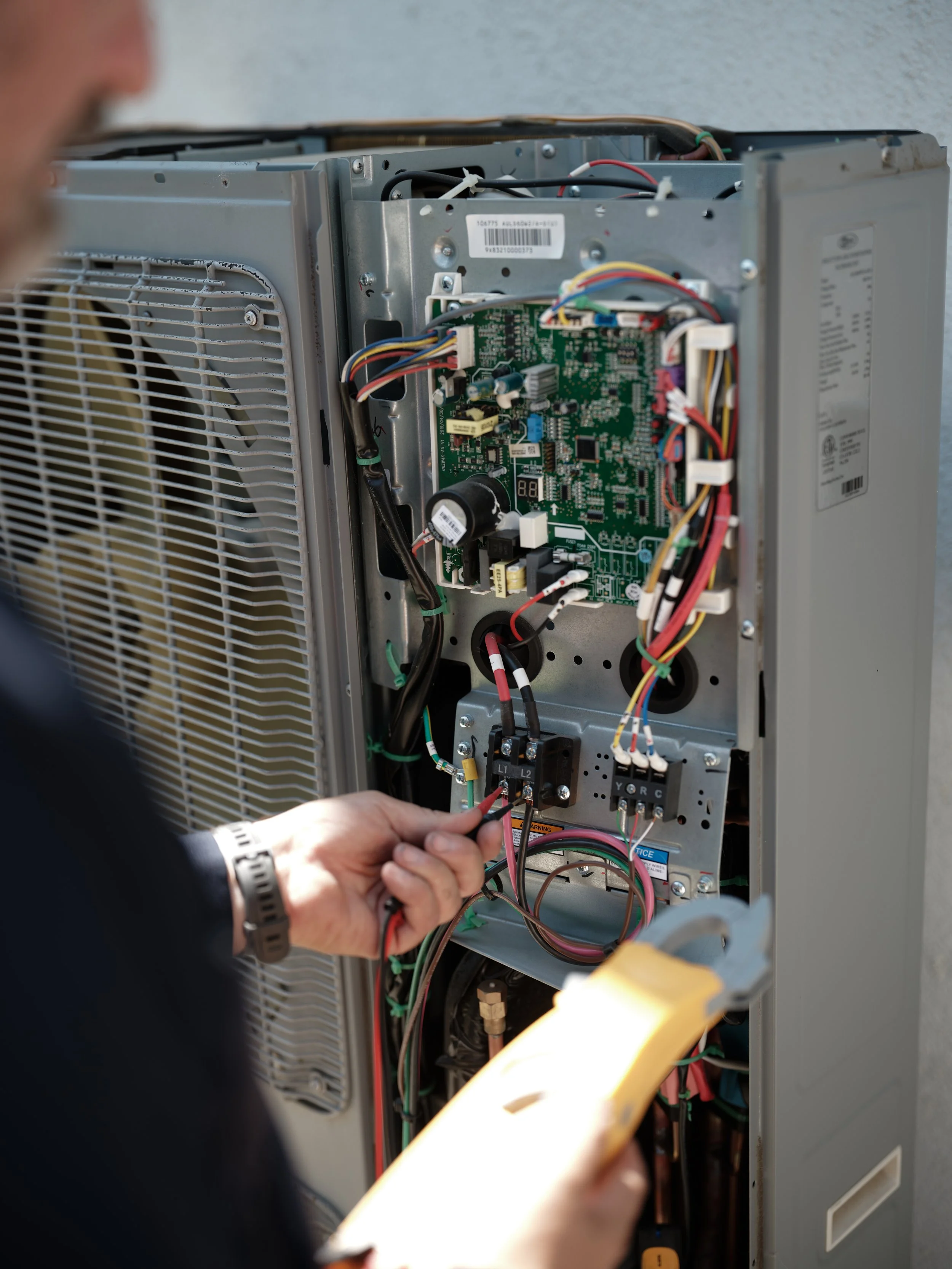
When your AC stops working, the problem could be a $20 contactor or a $500 control board. The only way to know is a real electrical diagnostic, not a glance from the driveway. J Martin technicians open the panel, test every component, and show you exactly what failed before recommending a single repair.
Time of Year and Urgency
We're busiest June through September. Peak-season emergency calls can cost 30 to 50% more than the same repair in April. After-hours labor runs $150 to $250 per hour compared to $75 to $150 during regular business hours. If you can schedule a non-urgent repair in the spring or fall, you'll save money and get a faster appointment.
That said, if it's 100°F especially during a Santa Ana winds storm event and your system is dead, an emergency call is absolutely worth the premium. Especially if you've got young kids, elderly family members, or pets in the house. There's a threshold where comfort becomes a safety issue, and we never want anyone to feel like they can't call because they're worried about cost.
Brand and Parts Availability
Some manufacturers use proprietary parts that cost more and take longer to source. Others use widely available components that every distributor in Orange County stocks. If your system uses a hard-to-find part, the technician might need to order it, which adds time and potentially overnight shipping costs. During peak season, part shortages on common components like certain capacitors and motors can also affect pricing and wait times.
Shady Contractor Tactics Orange County Homeowners Should Know About
This section exists because we hear these stories constantly. Homeowners come to us after getting quotes or having work done by other companies, and some of what we hear is genuinely troubling. These are the tactics to watch for.
The "Condemned System" Scare
A technician shows up, spends a few minutes looking at your system, and tells you it's "condemned" or "unsafe" and needs to be replaced immediately. They might use language like "I can't leave this running in good conscience" or "this is a carbon monoxide risk." Sometimes they'll put a red tag on your equipment.
Here's the reality: actual safety concerns with AC systems are rare. Gas furnaces can develop cracked heat exchangers that pose CO risks, but air conditioning systems don't produce carbon monoxide. If someone tells you your AC is a safety hazard and tries to sell you a $10,000 system on the spot, get a second opinion before you do anything. A real safety issue should be documentable and verifiable by another licensed contractor.
The "Your Refrigerant Is Completely Out" Upsell
Some companies deliberately overstate the amount of refrigerant your system needs, charging you for 8 pounds when you needed 3. Since most homeowners can't verify refrigerant levels independently, this is one of the easiest ways to inflate a bill. A good technician will show you the gauge readings before and after the recharge so you can see exactly how much was added.
Related: watch out for the company that keeps "topping off" your refrigerant every year without ever mentioning a leak. If your system needs refrigerant more than once, there's a leak. Period. A company that keeps charging you for recharges without fixing the underlying leak is milking your system for recurring revenue.
The "This Part Is About to Fail" Add-On
You call for a specific problem such as your system not cooling well. The technician fixes the real issue (a dirty filter or a weak capacitor) but then "finds" two or three other components that are "about to fail" and recommends replacing them all preventively. Suddenly your $200 repair becomes an $800 visit.
Preventive replacement isn't always wrong. A technician who spots a visibly swollen capacitor while replacing your contactor is doing you a favor by mentioning it. But if they're recommending replacing parts that are testing within normal ranges just because they're "old," that's padding the bill. Ask to see the test results. A good technician will show you a weak reading on the multimeter or point to visible damage.
The "We Can't Get Parts for This System" Push Toward Replacement
Some contractors will tell you that parts for your system are discontinued or unavailable, making replacement the only option. While this can be true for very old or uncommon systems, it's often exaggerated. Most major brand components remain available through distributors for 15 to 20 years after installation. If someone tells you they can't find parts for your 12-year-old Carrier or Trane system, they either didn't try very hard or they'd rather sell you new equipment.
When Repair Stops Making Sense (The Decision Frameworks)
At some point, continuing to repair an old system costs more than replacing it. Two simple decision tools help you find that line.
The 50% Rule. If the repair cost exceeds 50% of what a new system would cost, replacement is almost always the smarter financial move. A $2,000 compressor repair on a system that could be replaced for $7,000 to $10,000 puts you at that threshold, especially if the system is past the 10-year mark. We detail replacement costs for the Orange County market in our 2025-2026 HVAC replacement cost guide.
The $5,000 Rule. Multiply the repair cost by the age of your system in years. If the number exceeds $5,000, lean toward replacement. A $400 repair on a 10-year-old system: $4,000 you can go ahead and repair. A $500 repair on a 12-year-old system: $6,000, you should start shopping.
Frequency matters as much as cost. Two or more repairs in 12 months is a pattern, not bad luck. Aging systems don't have isolated problems. They have cascading failures. The capacitor goes this spring. The contactor goes in August. Then the blower motor next February. Each repair is "affordable" individually, but the cumulative total over 18 months can easily exceed what a new system would have cost, and you'd have a warranty instead of more worry.
Refrigerant type is a hard line. If your system uses R-22, every repair involving refrigerant gets exponentially more expensive. This isn't a trend that reverses. R-22 supplies are finite and shrinking. We consistently recommend replacement over continued R-22 repairs for any system over 12 years old.
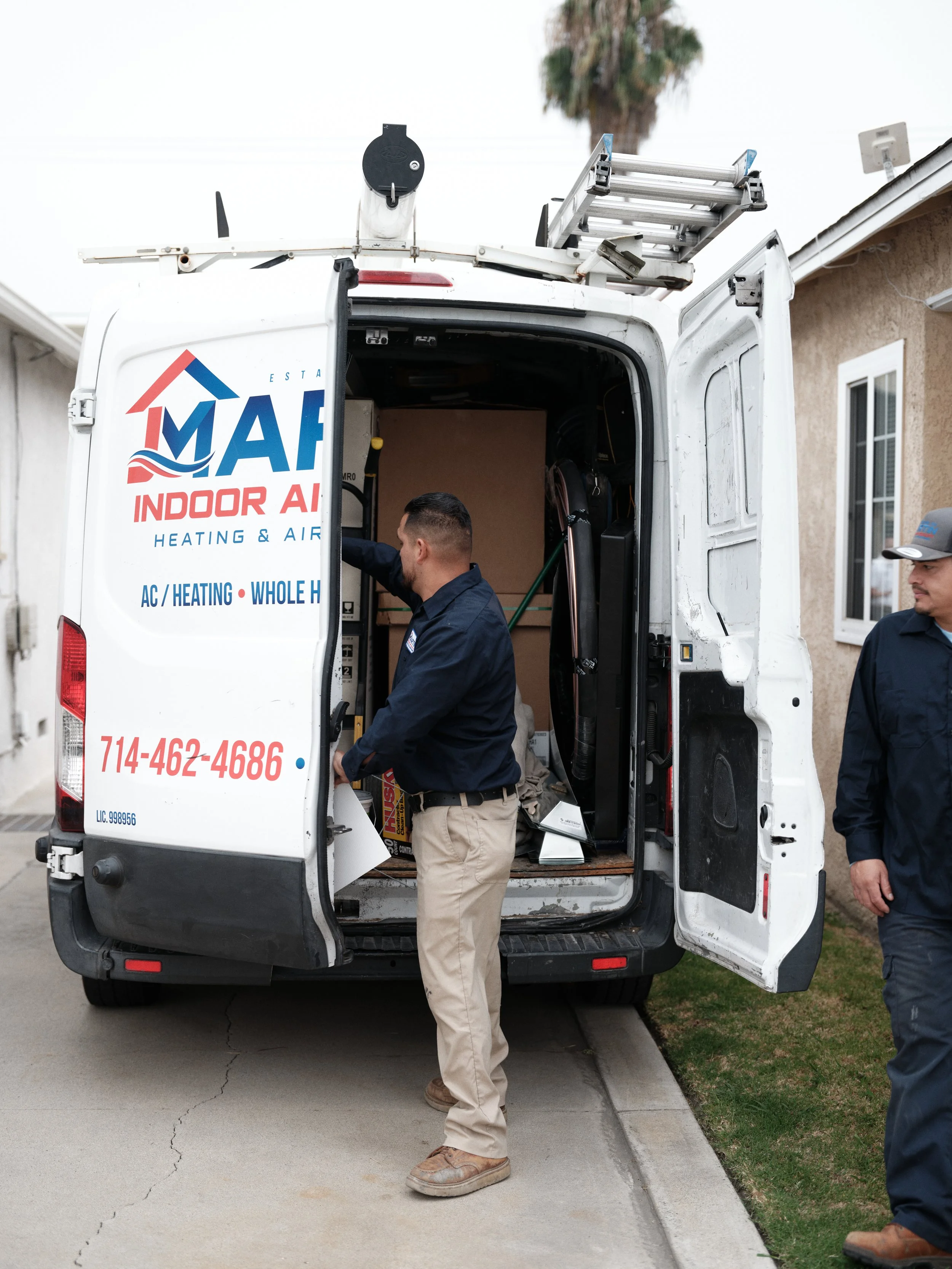
We hear this a lot from Orange County homeowners who called another company first: 'They came out, said they needed to order a part, and I waited four days with no AC.' A stocked truck is not a luxury. It is the baseline for a company that takes same-day service seriously. That is the standard J Martin holds every service call to.
What Annual Maintenance Actually Prevents (In Dollar Terms)
Annual HVAC maintenance in Orange County costs $100 to $200. Here's the math on what that prevents.
A maintenance visit catches a weakening capacitor before it fails during a heat wave. Replacing it during the visit costs the price of the part, $15 to $80. Replacing it on an emergency call in July costs $250 to $400. That's $170 to $320 saved on a single component.
A technician checks refrigerant pressures during every maintenance visit. Slightly low pressures mean a slow leak that can be found and repaired for $300 to $600 before you lose enough refrigerant to damage the compressor. A compressor that overheated and failed because of a slow refrigerant leak costs $1,500 to $3,000 to replace. The $200 maintenance visit that caught the leak early just saved you over a thousand dollars.
Flushing the condensate drain line during a maintenance visit takes five minutes and prevents the kind of attic water overflow that ruins ceilings and drywall. We've seen water damage repairs from clogged drain lines cost $2,000 to $5,000.
Cleaning condenser and evaporator coils reduces energy consumption by 5 to 15% and extends the life of your compressor and blower motor, the two most expensive components to replace. Systems with annual maintenance last 15 to 20 years on average. Neglected systems often fail at 10 to 12. Over a system's life, $200 per year in maintenance totals $3,000 to $4,000 and prevents tens of thousands in avoided emergency repairs and premature replacement.
The math isn't even close. Maintenance is the single best investment you can make in your HVAC system.
Warning Signs a Repair Call Is Coming
Your AC almost always gives warning signs before it quits entirely. Catching them early turns expensive emergency repairs into affordable scheduled service.
Cooling performance that declines gradually over days or weeks and the system takes longer to reach temperature, or it can't hold the set temperature during the hottest hours usually means low refrigerant, dirty coils, or a compressor starting to weaken. All of these are cheaper to address now than after a complete failure.
Sounds you've never heard before. Buzzing often means a failing contactor or loose wiring. Grinding points to motor bearings going out. Screeching is a belt or motor on its last legs. Banging or clanking means something has come loose inside the unit. None of these get better on their own, and all of them get more expensive the longer they run.
Your system cycling on and off every few minutes. This short cycling hammers your compressor with electrical surges every time it starts. Common causes include a dirty filter, low refrigerant, a failing thermostat, or an oversized system. Every short cycle brings that compressor closer to the $1,500+ replacement we talked about above.
Electricity bills that jumped 20 to 30% compared to the same month last year with no change in your habits. Your system is working significantly harder than it should, which usually indicates a mechanical problem or efficiency loss that will only get worse.
Water where it shouldn't be like puddles around your indoor unit, drips from the ceiling below your attic air handler, or stains on walls near supply vents. This usually means a clogged drain line or cracked drain pan, both cheap fixes that become expensive water damage claims if ignored.
Ice on your refrigerant lines during warm weather. This almost always means low refrigerant or severely restricted airflow. Turn your system off and call for service. Running it with ice on the lines can destroy the compressor.
Questions to Ask Before Hiring Anyone
Whether you call us or someone else, these questions protect you.
"Are you licensed by the California CSLB?" Every HVAC contractor must hold a C-20 license. Verify it at cslb.ca.gov in 30 seconds. No license number? No entry to your home.
"Do you charge a diagnostic fee, and does it apply toward the repair?" Know the answer before they arrive.
"Will you show me the problem before you do any work?" Good technicians show you the failed component, explain what happened, and present options. You should never feel ambushed by a number.
"Are your technicians on commission?" Commission pay creates incentive to recommend the most expensive option. At J Martin, our techs aren't on commission. The person in your house has zero financial motivation to sell you anything you don't need.
"What warranty do you offer on the repair?" Most reputable companies offer at least one year on parts and labor. If someone won't stand behind their work, that tells you everything.
The Honest Bottom Line
AC repair in Orange County costs what it costs. Labor rates here are higher than national averages because the cost of doing business in Southern California is higher. A licensed, insured, experienced technician who arrives in a stocked truck, diagnoses your problem accurately, repairs it correctly the first time, and warranties the work isn't going to charge you $49 for a service call. If someone is advertising a price that doesn't cover the cost of sending a truck to your house, they're making it up somewhere usually with inflated repair quotes once they're standing in your living room.
What you deserve is transparency. You deserve to know what a fair price looks like before someone shows up with a clipboard. You deserve to understand whether repairing or replacing makes more financial sense. And you deserve a company that tells you the truth even when the truth is "your system just needs a $15 air filter, you don't need us today."
That's how we operate at J Martin Indoor Air Quality. We're family-owned. Our techs aren't on commission. We've served over 5,000 families across Orange County with AC repair needs with a 4.97-star rating because being honest is better business than being pushy. If your AC needs attention, or you want a maintenance visit to make sure everything is solid heading into summer, call us at 714-462-4686. We'll give you a straight answer about what your system needs and what it doesn't.
J Martin Indoor Air Quality | (714) 462-4686 | Services
Sources: Angi 2026 HVAC Repair Cost Guide; HomeGuide 2026 AC Repair Cost Data; Fixr.com AC Repair Cost Data; Today's Homeowner 2026 AC Repair Pricing; Manta Orange County AC Service Cost Calculator 2026; AVS Heating and Air 2026 HVAC Repair Pricing Guide; J Martin Indoor Air Quality service records 2024-2026.