
Why Anaheim Hills Homes Need Bigger AC Units Than Coastal Orange County
Updated on May 15, 2026
We got a call last August from a homeowner in Deer Canyon. Nice home, about 2,400 square feet, two stories, built in the late 1980s. The AC had been replaced four years earlier by a well-known Orange County HVAC chain. Brand new 3.5-ton system. Should have been fine.
Except it wasn't fine. Every afternoon from June through October, the house couldn't get below 78 degrees no matter what the thermostat was set to. The system ran from noon until 10 PM without cycling off. The kids had stopped sleeping in their upstairs bedrooms during summer because the rooms were suffocating by bedtime. The family basically lived downstairs from May through September and had resigned themselves to the idea that their house just "runs hot." Energy bills were pushing $450 a month during peak summer.
They'd had two different companies come look at it. Both said the equipment was working correctly. And technically, they were right. There was nothing wrong with the equipment. The problem was that the system was sized for a coastal Orange County home, not an Anaheim Hills home. And that distinction, the one almost nobody talks about when selling & installing HVAC systems, is the difference between a house that stays comfortable and one that suffers through every summer.
After 15 years of serving Anaheim Hills and Orange County, this is one of the most common and most preventable problems we see at J Martin Indoor Air Quality. A system that would keep a Newport Beach or Huntington Beach home perfectly cool all summer will struggle badly in Anaheim Hills. The reasons go deeper than most homeowners realize, and the financial consequences of getting it wrong add up much faster than people expect.
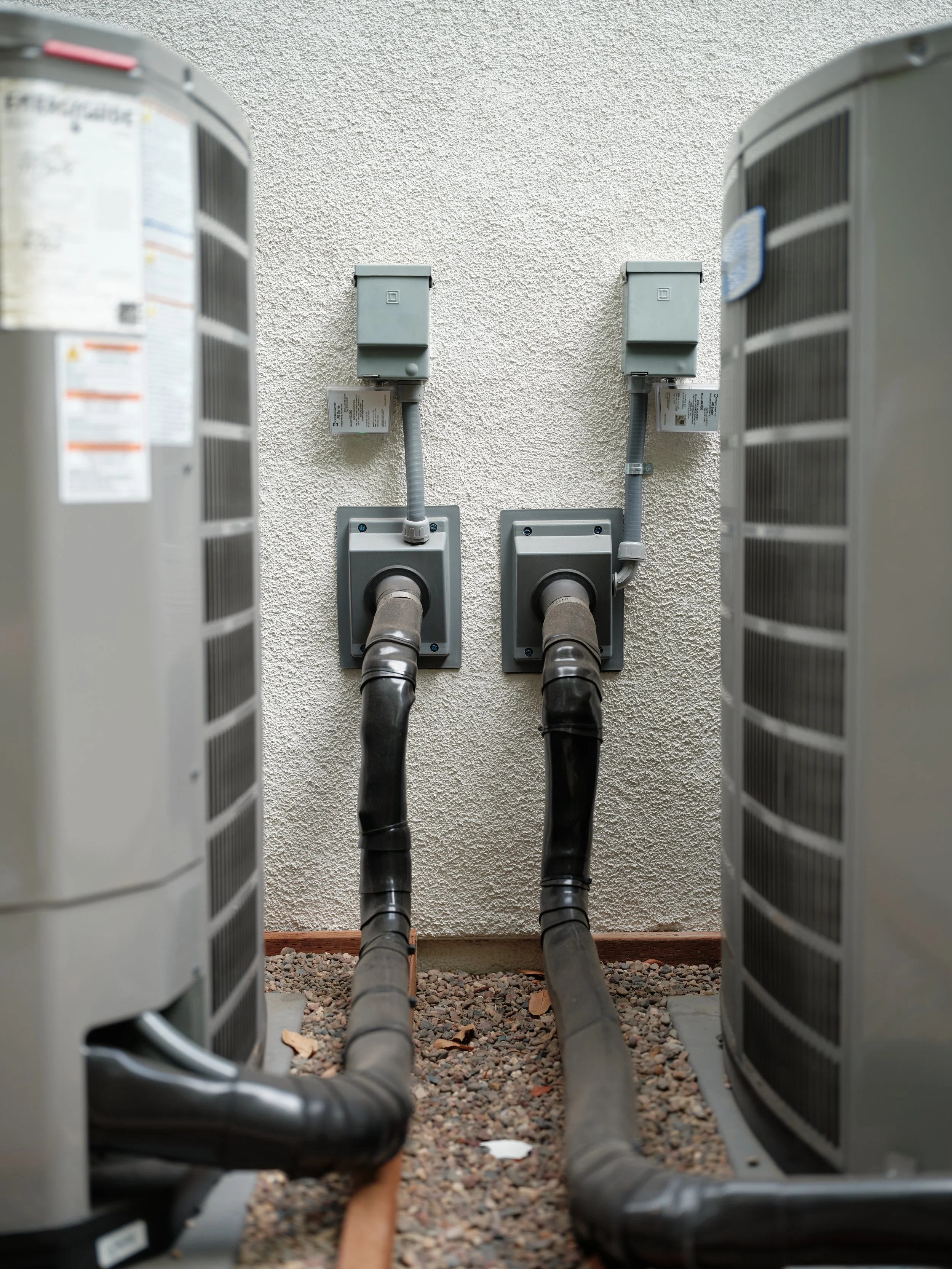
The outdoor condenser is where most homeowners start when something feels off with their AC. But the unit itself is rarely the whole story in Anaheim Hills. The real question is whether it was sized correctly for inland Orange County temperatures to begin with. A system that performs fine in Newport Beach can run nonstop for 14 hours a day in Anaheim Hills without ever reaching your thermostat setpoint.
The 10 to 20 Degree Problem
Here's the core issue, and it's simple enough to explain with a single comparison.
On a typical August afternoon, the high temperature in Huntington Beach or Newport Beach is around 75 to 80 degrees. That same afternoon, in Anaheim Hills, it's 90 to 100 degrees. During heat waves and Santa Ana wind events, that gap widens even further. Coastal cities might hit 85. Anaheim Hills hits 105 or higher. We've measured attic temperatures in Anaheim Hills homes during August that exceeded 155 degrees, while coastal attics on the same day were sitting around 115 to 120.
That 10 to 20 degree difference between coastal and inland isn't a minor detail. It fundamentally changes how much work your air conditioning system has to do. Your AC doesn't just produce cold air. It removes heat from your home. The hotter it is outside, the faster heat pours in through your roof, walls, windows, and every gap in the building envelope. A system that can comfortably handle a 75-degree exterior is working against a completely different thermal load than one fighting 100-degree heat.
In engineering terms, your AC's cooling capacity needs to overcome the temperature differential between your desired indoor temperature and the outdoor design temperature. In Newport Beach, where the summer design temperature is around 83 to 85 degrees, keeping a home at 75 means your system needs to overcome roughly a 10-degree differential. In Anaheim Hills, where the summer design temperature is closer to 95 to 100 degrees (and real-world peaks blow past that number regularly), the same system needs to overcome a 20 to 25-degree differential. That's roughly double the cooling load, and it directly translates to needing more cooling capacity.
This is why a properly sized 3-ton system in Newport Beach might need to be a 4 or even 5-ton system in Anaheim Hills for an identical floor plan. The homes are the same size. The cooling demand is not.
Why the Coast Gets a Free Pass Your Neighborhood Doesn't
People who live in Anaheim Hills already know it's hotter than the coast. That's not news. What most people don't fully appreciate is how many natural advantages coastal homes have that your home simply doesn't get, and how those advantages add up to make coastal HVAC systems' jobs dramatically easier.
Start with the Pacific Ocean. It acts as a massive thermal buffer for coastal cities, absorbing heat during the day and keeping air temperatures moderate. That familiar morning fog, the marine layer that burns off by late morning in Huntington Beach and Newport, keeps coastal rooftops and walls cooler for the first half of the day. By the time the sun is really beating down at 2 PM, a coastal home has only been absorbing serious heat for a few hours. In Anaheim Hills, your home has been soaking up full-intensity sun since 8 AM.
Then there's what happens after sunset. Coastal homes get evening ocean breezes and temperatures that drop into the mid-60s by 9 or 10 PM. Your AC system gets natural relief. In Anaheim Hills, the hills and canyons hold heat. On summer nights, especially during heat waves, overnight lows stay in the mid-70s. We've been on service calls in the Canyon Hills neighborhood at 8 PM in July where it was still 95 degrees outside. A coastal AC system gets 10 to 12 hours of natural recovery time every night. An Anaheim Hills system might get four or five hours of mild temperatures before the next day's heat cycle begins.

A coastal home in Newport Beach has the Pacific Ocean doing half the HVAC work for it. Morning marine layer, afternoon ocean breezes, and overnight lows in the mid-60s give the AC system hours of natural relief every day. If your Anaheim Hills home was sized like this one, your system has been fighting a losing battle every summer and the energy bills and wear on your equipment prove it.
And then there's the terrain itself. Anaheim Hills sits roughly 15 to 20 miles inland, in the foothills east of the Santa Ana Canyon. Many homes are built on exposed south and west-facing hillsides with minimal natural shading. The sun hits these slopes at steep angles for most of the day, and the terrain radiates stored heat back at the surrounding homes well into the evening. A flat coastal lot surrounded by other homes at sea level is a fundamentally different thermal environment than a hillside lot in Hidden Canyon with a south-facing roofline and nothing between you and the afternoon sun but air.
All of this means your AC system isn't just working harder during peak afternoon hours. It's fighting a longer battle every single day. A coastal system might work hard for 6 hours on a summer day. An Anaheim Hills system might work hard for 12 to 14. That's the real gap, and it's why sizing matters so much more here than at the beach.
The Sizing Mistake That Happens Over and Over
Here's where this becomes a practical problem rather than just a weather lesson.
When an HVAC company sizes a replacement system for your home, they're supposed to perform what's called a Manual J load calculation. This is a detailed, room-by-room analysis that accounts for your home's square footage, insulation levels, window count and orientation, ceiling heights, number of occupants, and critically, your local climate data. The outdoor design temperature is one of the most important inputs in this calculation, because it determines the maximum cooling load your system needs to handle.
The problem is that many HVAC contractors, especially the larger chains and franchise operations, don't actually perform Manual J calculations. They use rules of thumb. One ton of cooling per 400 to 500 square feet. Or they just match whatever tonnage was there before. These shortcuts might produce acceptable results in a temperate coastal climate where the margin for error is generous and the marine layer does half the work for you. In Anaheim Hills, where the cooling demand is significantly higher and the margin for error is razor thin, these shortcuts produce undersized systems.
We see this pattern constantly. A homeowner in the Canyon Hills or Woodlands neighborhoods calls because their relatively new AC can't keep up. We check the system and the equipment is functioning perfectly. Then we run a Manual J calculation and find that the home needs 4.5 or 5 tons of cooling, but a 3.5-ton system was installed because that's what the square footage "called for" using the generic rule of thumb. The contractor didn't account for the south-facing hillside exposure, the 100-degree design temperature, the thin 1980s-era insulation, or the older windows that are common in the Anaheim Hills tracts.
The homeowner paid $12,000 to $15,000 for a brand new system that was doomed to underperform from day one. Not because the equipment is bad, but because someone skipped the math. California has actually required Manual J calculations since 2008 for HVAC installations, but permit offices rarely enforce compliance, and the majority of systems installed in the state are sized using shortcut methods that ignore the very factors that make inland homes different from coastal ones.
If you want to understand what a proper installation process looks like and how to spot contractors who cut these corners, our guide on how to choose the right HVAC company walks through exactly what to look for during the bidding process.
What Living with an Undersized AC Actually Costs You
An undersized air conditioner doesn't just fail to keep your house cool. It creates a cascade of problems that affect your finances, your equipment's lifespan, and honestly, your quality of life in ways that go beyond thermostat readings.
The most obvious symptom is that the system runs continuously during hot afternoons without ever reaching the thermostat setpoint. On a 100-degree day, if your system doesn't have enough capacity to overcome the heat gain, it will run nonstop from noon until well past midnight. Your house might hold at 78 or 79 degrees when you want 74, and there's nothing you can do about it. Lowering the thermostat further just makes the system run longer without producing different results.
But the problems people don't immediately connect to AC sizing are often worse. Families stop using their upstairs bedrooms in summer, moving kids to air mattresses in the family room or den. Master bedrooms on the second floor become unusable from June through September. People buy portable AC units and window units to supplement the central system, adding electrical load and creating a patchwork of equipment that never quite solves the problem. We've walked into Anaheim Hills homes with three portable units running alongside the central system because the homeowner gave up on ever getting the house comfortable through the ducts.
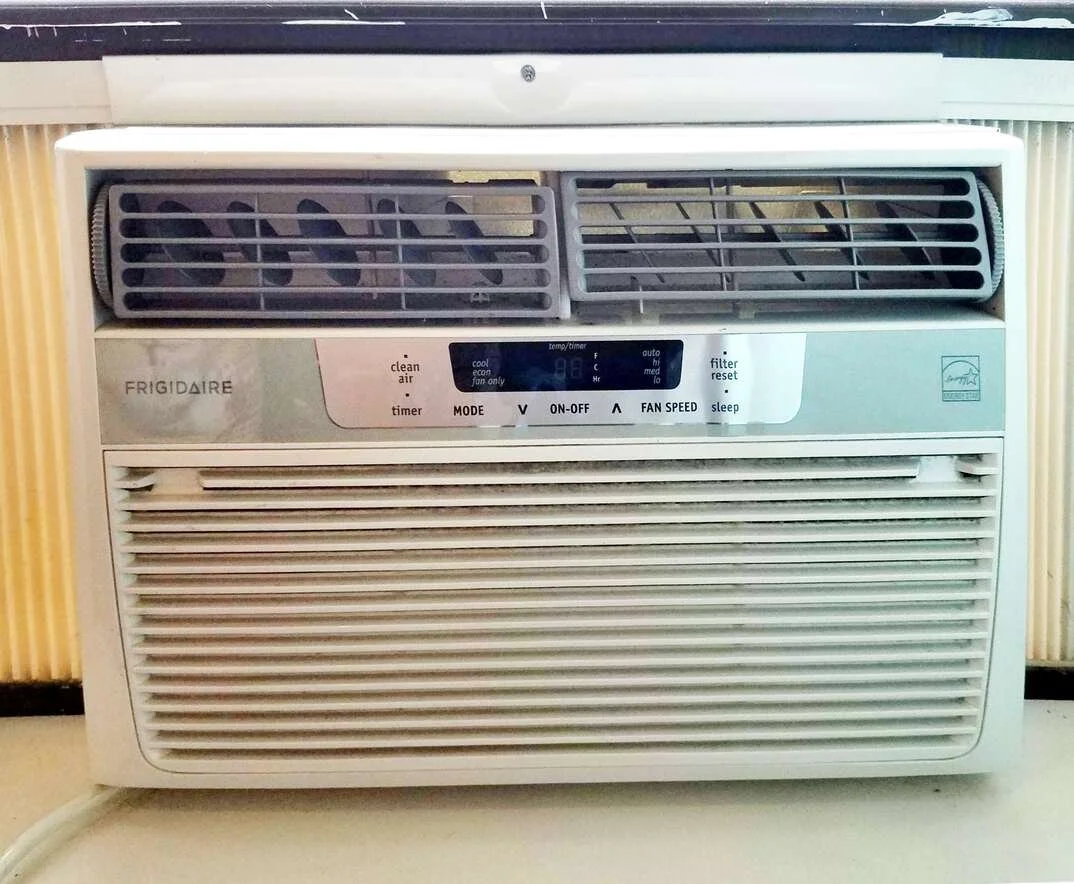
If you have a window unit running alongside your central AC in Anaheim Hills, your central system is telling you something. A properly sized system for your location should handle the entire house without supplemental help. Every summer you spend running window units on top of your central AC is money going toward a problem that a correctly sized system would have solved from the start.
The energy cost of continuous operation adds up fast. An undersized AC running 14 to 16 hours a day uses significantly more electricity than a properly sized system cycling normally. The difference typically runs $75 to $150 per month during the peak cooling season, which in Anaheim Hills lasts roughly five to six months, from May through October. That's $375 to $900 per year in excess energy costs. Over the 15-year life of the system, you're looking at $5,600 to $13,500 in wasted electricity, on top of the original cost of the equipment.
The mechanical toll is equally punishing. Compressors, fan motors, and electrical contactors are designed for cycling operation, not continuous marathon runs. A system that runs 14 to 16 hours a day ages roughly twice as fast as one that cycles normally. You'll see capacitors burning out, fan motors failing, and eventually the compressor (the most expensive single component in the system) giving up at year 7 or 8 instead of year 12 to 15. A compressor replacement runs $2,000 to $3,500 with labor. If that failure triggers a full system replacement five to seven years sooner than a properly sized system would have needed it, you're looking at $12,000 to $20,000 in premature replacement costs. When that bill arrives, homeowners are forced into a stressful mid-summer decision about whether to keep pouring money into the existing system or start over, which is exactly the situation our repair-or-replace decision framework was built to help homeowners think through clearly.
Add it all up and an undersized system can cost an Anaheim Hills homeowner $20,000 to $35,000 more over 15 years compared to a system that was correctly sized from the start. That Deer Canyon homeowner we mentioned at the beginning? After we replaced their 3.5-ton system with a properly calculated 5-ton heat pump and sealed the ductwork, their summer energy bills dropped by nearly $200 a month and the upstairs became livable for the first time in four years. The kids moved back into their bedrooms that same week.
On the flip side, an oversized system creates different problems, including short cycling that produces humidity issues, uneven temperatures, and wasted energy during the milder months of spring and fall. The real answer isn't oversizing or undersizing. It's correct sizing based on your specific home in your specific location.
How Anaheim Hills Compounds Every HVAC Weakness
Beyond raw temperature, several characteristics common to Anaheim Hills homes stack on top of the heat challenge to make things worse. Understanding these explains why the same floor plan needs dramatically different HVAC treatment depending on where it sits in Orange County.
Many Anaheim Hills homes are built on south and west-facing hillside lots that receive direct, unobstructed afternoon sun. According to Manual J solar gain calculations, a south-facing wall absorbs roughly 50 percent more heat than a north-facing wall of identical construction. A west-facing wall takes the full force of afternoon sun at the hottest part of the day. Homes in neighborhoods like Hidden Canyon and Canyon Terrace that sit on exposed hilltops get hit from multiple angles with minimal shading from neighboring structures or terrain. A Manual J calculation that doesn't carefully account for orientation and exposure will undersize these homes every time.
A large percentage of Anaheim Hills homes were also built during the 1970s and 80s tract home boom. They carry the same thin insulation, deteriorating ductwork, and single-zone system limitations that affect older homes across north Orange County. But in Anaheim Hills, those construction deficiencies are amplified by the higher heat load. A leaky duct that wastes 25 percent of conditioned air is annoying in any location. In a home that's already fighting 100-degree heat with a 150-plus degree attic, it's the difference between a comfortable house and one that can't get below 80. We opened up an attic in a Canyon Hills home last spring and found a 14-inch supply trunk completely disconnected from the plenum box. The previous HVAC company had installed a new system, connected the ducts, and apparently never checked whether the air was actually making it where it was supposed to go. That homeowner had been paying to cool their attic for two years without knowing it.
Anaheim Hills also sits squarely in the Santa Ana wind corridor. These hot, dry offshore winds blow through the canyons several times a year, spiking temperatures 15 to 25 degrees above normal and dropping humidity into single digits. The 2017 Canyon Fire 2 destroyed 25 homes and forced the evacuation of 16,570 residents from Anaheim Hills alone. Beyond the fire risk, the dust, pollen, ash, and particulate matter carried by these winds absolutely hammer HVAC systems. Filters clog faster. Outdoor condenser coils get coated with debris. And the temperature spikes push even properly sized systems to their limits, while undersized systems simply have no chance of keeping up. If your system is already making unusual noises during normal operation, a Santa Ana event will push it past the breaking point.
And then there's the two-story problem. The majority of two-story homes in Anaheim Hills were built with a single thermostat on the first floor controlling one HVAC system for the entire house. In a coastal location, this design is inconvenient but manageable; the temperature difference between floors might be 3 to 5 degrees. In Anaheim Hills, with a superheated attic directly above those upstairs bedrooms and 100-degree heat pouring through the roof, the upstairs can run 8 to 12 degrees warmer than the downstairs. No amount of additional tonnage will solve this with a single-zone system. This is a design problem, not a capacity problem, and the real solutions involve zoning, supplemental ductless cooling, or ductwork modifications. We devoted an entire blog post to why your upstairs is hot while the downstairs stays comfortable and the practical solutions that actually work.
How Anaheim Hills AC Sizing Should Actually Work
If you're replacing your AC system or evaluating whether your current system is properly sized, here's what the process should look like when it's done right.
A qualified HVAC contractor should perform a Manual J load calculation specific to your home using Anaheim Hills climate data, not generic Orange County averages. The summer design temperature for Anaheim Hills should be in the range of 95 to 100 degrees (the ACCA 0.4% cooling design value), not the 83 to 85 degrees appropriate for Newport Beach. That single input change alone can shift the calculated cooling requirement by a full ton or more of capacity.
The calculation should also account for your home's actual insulation levels (not assumed modern standards), your actual window types and orientations, your roof color and material, and critically, the condition of your ductwork. If your ducts are old, leaky, and running through a 150-degree attic, those losses need to be factored in. Otherwise the equipment will be sized for a theoretical home that doesn't match the one you're living in.
For a typical 2,000 to 2,500 square-foot two-story Anaheim Hills home from the 1980s with average insulation and standard windows, a properly calculated cooling load will generally call for 4 to 5 tons of capacity. That same floor plan in Newport Beach might need 3 to 3.5 tons. This is not an upsell. It's physics.
The current installed costs for these systems range from $11,500 to $15,500 for a standard AC and furnace package and $13,000 to $22,000 for a heat pump system depending on tonnage and efficiency level. We published these numbers with full transparency in our 2025-2026 HVAC Replacement Cost Guide for Orange County. Heat pumps are increasingly popular in Anaheim Hills because they provide both heating and cooling from a single unit, operate more efficiently than gas furnaces in our mild winters, and qualify for California rebates and federal tax credits up to $2,000.
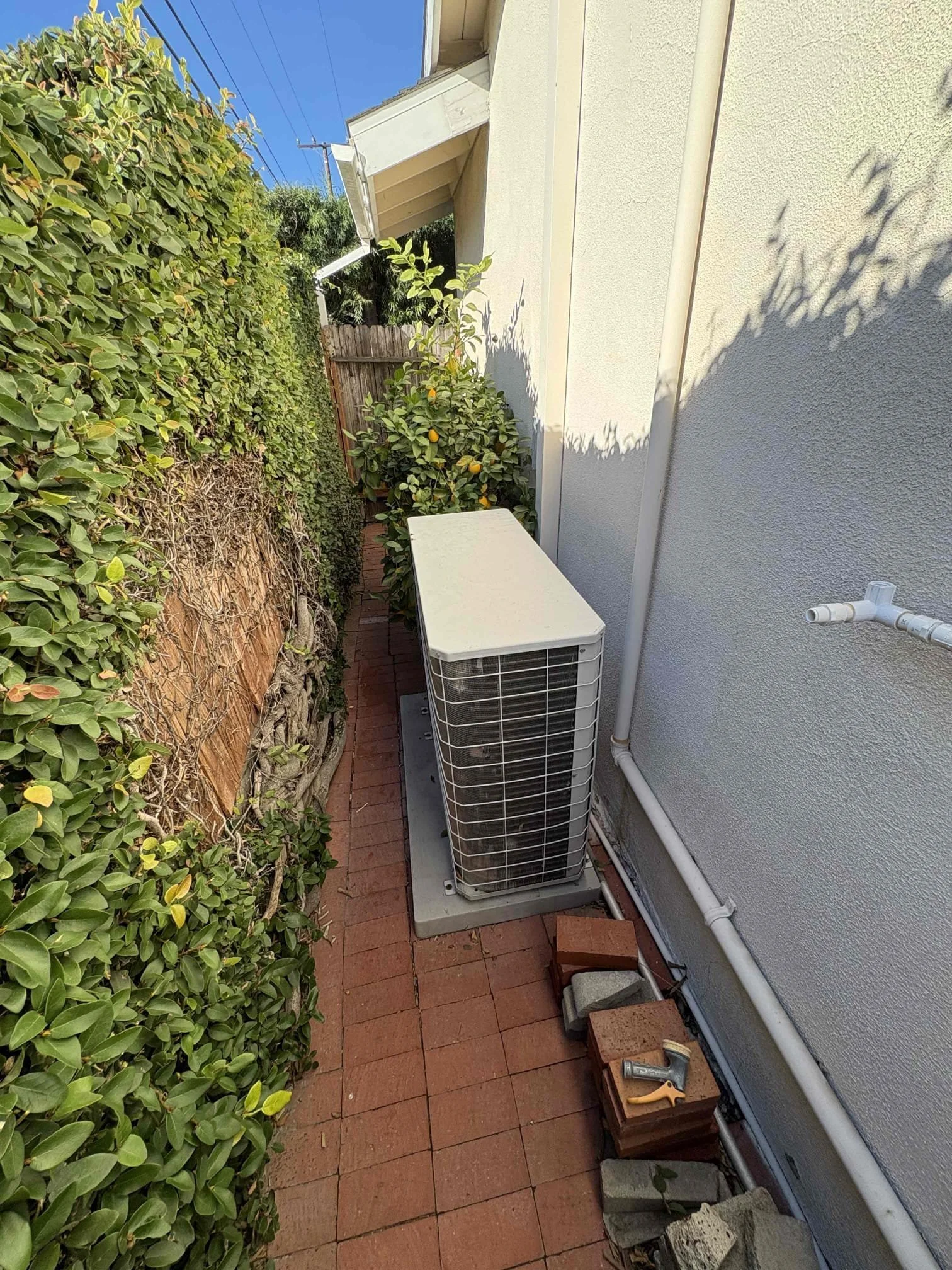
We hear this from Anaheim Hills homeowners all the time: 'The previous company said the system was the right size.' It probably was for the square footage. What it was not sized for was 100-degree summer afternoons, superheated attics, and the 12 to 14 hour cooling days that inland Orange County demands every summer. A quick check of the model number on your outdoor unit is the first step to knowing where you stand.
The Ductwork Factor Most People Miss
Even with a correctly sized system, your Anaheim Hills home won't perform well if the ductwork can't deliver the air. This is where the inland heat compounds problems that might be tolerable in a milder environment.
Your ductwork runs through the attic. In Anaheim Hills, that attic is 20 to 30 degrees hotter than a coastal attic on the same day. Every foot of uninsulated or poorly insulated duct running through that superheated space absorbs more heat than the same duct would near the coast. The California Energy Commission reports that the average duct system leaks roughly 30 percent of conditioned air. In Anaheim Hills tract homes with original grey flex ductwork from the 1970s and 80s, the combination of leakage and heat absorption means your system might be losing 40 to 50 percent of its effective cooling capacity before the air reaches a vent.
This is why we always recommend addressing ductwork before or alongside equipment replacement. A brand new 5-ton system connected to deteriorated ductwork will deliver the performance of a 3-ton system. You'll have paid for 5 tons of capacity and received 3 tons of comfort. Our Complete Guide to Air Duct Cleaning covers how to evaluate your ductwork condition and when cleaning makes sense versus when full replacement is the only real answer.
For Anaheim Hills homes specifically, we recommend R-8 insulated flex duct at minimum (compared to the R-4.2 common in original installations), mastic sealing at every connection point rather than duct tape, and elimination of unnecessary Y-splits that restrict airflow to distant rooms. A complete duct replacement in a typical Anaheim Hills tract home runs $4,000 to $12,000 depending on layout complexity, but the comfort improvement is immediate and the energy savings typically pay back the investment within three to five years.
What You Can Check This Weekend
If you're not ready for a full professional evaluation, there are several things you can do right now to figure out whether your Anaheim Hills home is dealing with a sizing problem, a ductwork problem, or both.
Start by observing your system's behavior on a hot day. Pick any summer afternoon when outdoor temperatures reach 95 degrees or higher (basically any day from June through September in Anaheim Hills). A properly sized system should cycle on for 15 to 20 minutes, then off for 10 to 15 minutes, reaching the thermostat setpoint regularly throughout the day. If your system runs continuously for hours without the house reaching temperature, it's almost certainly undersized for your location's cooling demand.
Next, measure the temperature at your supply vents while the system is running. Hold a thermometer right at a vent grille. The air coming out should be 15 to 20 degrees cooler than the room temperature. If the supply air is only 10 or 12 degrees cooler, heat is being absorbed somewhere between the equipment and the vent, which points to duct insulation or leakage problems in the attic.
Find your system's tonnage by looking at the model number on your outdoor condenser. Most manufacturers encode the capacity in the model string. Look for the numbers 024 (2 tons), 030 (2.5 tons), 036 (3 tons), 042 (3.5 tons), 048 (4 tons), or 060 (5 tons). Then consider your home's square footage and construction era. A 2,400 square-foot two-story 1980s home in Anaheim Hills with a 3-ton system is almost certainly undersized. That same home likely needs 4 to 5 tons based on a proper Manual J calculation.
While you're looking at the outdoor unit, check the refrigerant type on the nameplate. If it says R-22 or HCFC-22, your system was manufactured before 2010, the refrigerant is obsolete, and repair costs will only go up from here. We wrote a detailed guide on what the refrigerant phase-outs mean for your replacement timeline.
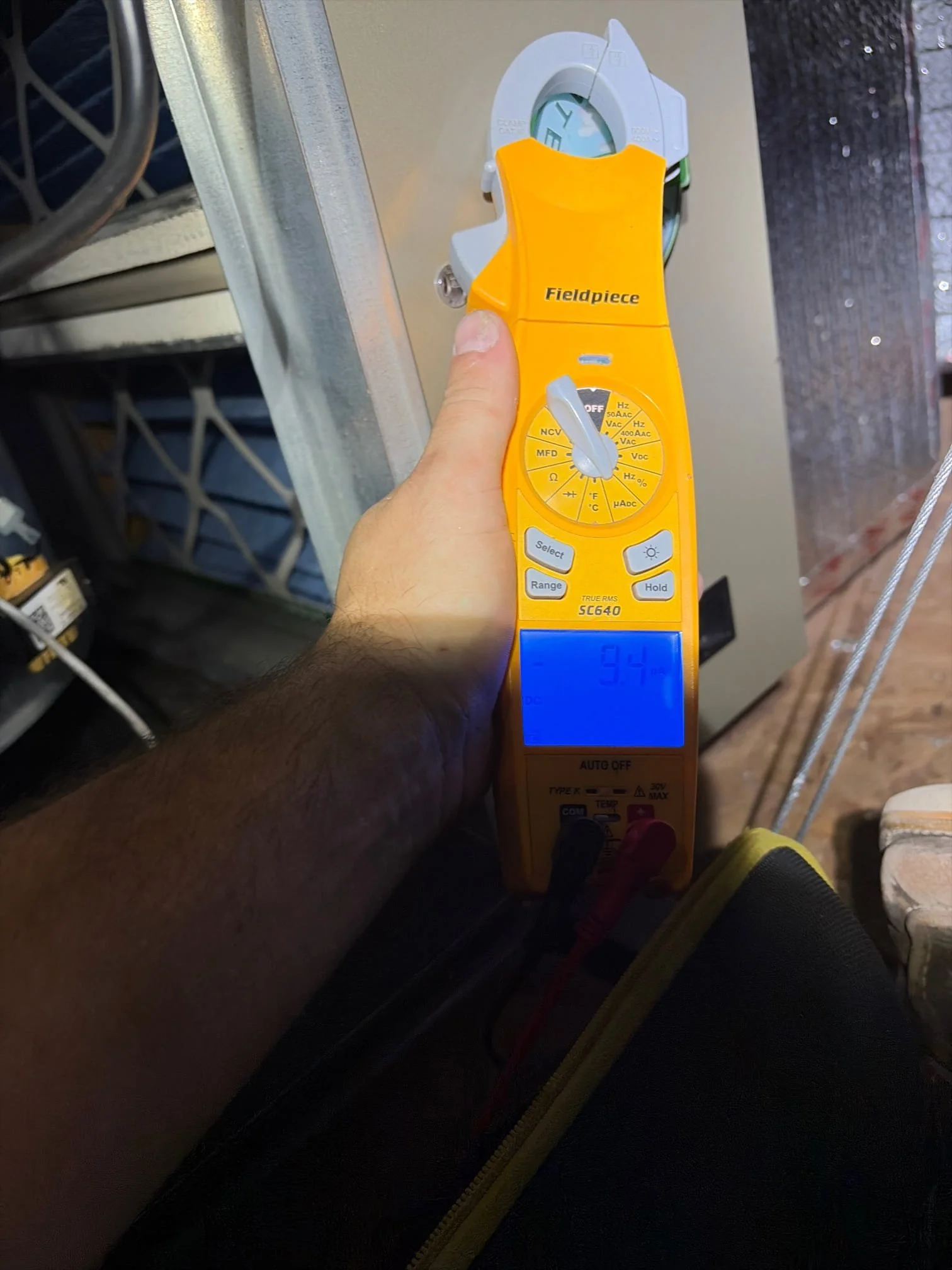
Every J Martin service call starts with actual diagnostics, not assumptions. In Anaheim Hills, where an undersized system and a properly functioning system can look identical from the outside, the only way to know what you are actually dealing with is to measure it. That is the difference between a contractor who tells you what you want to hear and one who tells you what your home actually needs.
Finally, check your air filter. This matters more in Anaheim Hills than almost anywhere else in Orange County. The combination of dry conditions, Santa Ana wind dust, canyon debris, and wildfire-season particulates means filters clog faster here than at the coast. A clogged filter restricts airflow, which reduces your system's effective capacity and can make an already undersized system perform even worse. During peak summer, check your filter every two to three weeks rather than monthly. And if your AC has been making unusual sounds, a clogged filter is the first and easiest thing to rule out.
The Right Approach for Anaheim Hills
If your home has been struggling, the solution isn't just buying a bigger unit and bolting it to the pad. The right approach addresses the whole system in an order that makes each step more effective.
Start with a Manual J load calculation using Anaheim Hills design temperatures, not county averages. Fix or replace the ductwork so the system can actually deliver its full capacity. Address insulation shortcomings, because most 1970s and 80s Anaheim Hills homes are significantly under-insulated by modern standards. Then size and install the right equipment based on real calculations, not rules of thumb.
This approach often reveals that the total investment is less than homeowners expect, because ductwork and insulation improvements reduce the required equipment capacity. A 2,400 square-foot home with poor insulation and leaky ducts might need 5 tons to compensate for all the losses. That same home with sealed ductwork and improved attic insulation might only need 4 tons, saving $1,500 to $3,000 on equipment while delivering better performance. And the insulation improvements pay dividends year-round, including during dry winter months when poor building envelope performance makes indoor air quality worse.
Your Anaheim Hills Home Deserves an Inland Strategy
Living in Anaheim Hills means you chose this community for its hill views, established neighborhoods, top-rated schools, and the sense of space that coastal Orange County can't match. What you didn't sign up for is an HVAC system that was designed like you live at the beach.
The 10 to 20-degree temperature difference between Anaheim Hills and the coast isn't something you can solve by turning the thermostat down further. It's a fundamentally different engineering challenge that requires different equipment sizing, different attention to ductwork and insulation, and a contractor who understands that a Manual J in Anaheim Hills is a completely different animal than one in Huntington Beach.
J Martin Indoor Air Quality has been serving Anaheim Hills homeowners since 2014. We understand the specific challenges of these neighborhoods because we work in them every day, from the original 1970s tracts near Nohl Ranch to the hillside homes in Canyon Terrace, Deer Canyon, and Hidden Canyon. We perform Manual J calculations on every installation using your actual local design temperature, not a county-wide average. Nobody on our team works on commission, so there's no incentive to sell you more tonnage than you need or less than your home actually requires.
If your Anaheim Hills home has been fighting a losing battle every summer, give us a call at 714-462-4686. We'll take a real look at your HVAC system, run the numbers for your specific home and location, and tell you exactly what we find. No pressure, no sales pitch, just the honest assessment your home has been waiting for.
J Martin Indoor Air Quality | (714) 462-4686 | Services