
How to Prepare Your Heater for Winter in Orange County (2026 Guide)
Posted on September 22, 2026
Preparing your heater for winter in Orange County means six tasks, ideally completed in October before the first cold snap: replace the air filter, run a 30-minute pre-season test cycle, clear an 18-inch zone around the furnace, schedule a professional tune-up ($89 to $250), test every carbon monoxide detector, and switch your thermostat from cooling to a heating schedule.
Of those six, the professional tune-up is the highest-leverage task. It is the only one that catches the safety problems you cannot see from the thermostat, including a cracked heat exchanger, a degraded ignition system, or a gas pressure issue. It is also the single most effective way to avoid the call homeowners across Orange County make every December: the no-heat call on the coldest night of the month.
For most Orange County homes, the heater sits idle from April through October. That seven-month dormancy is exactly why fall preparation matters more here than in colder climates where heating systems run constantly. Our heating contractor team handles roughly 200 fall tune-ups across Orange County between September and early November, and the patterns we see in those visits are the foundation of this guide.
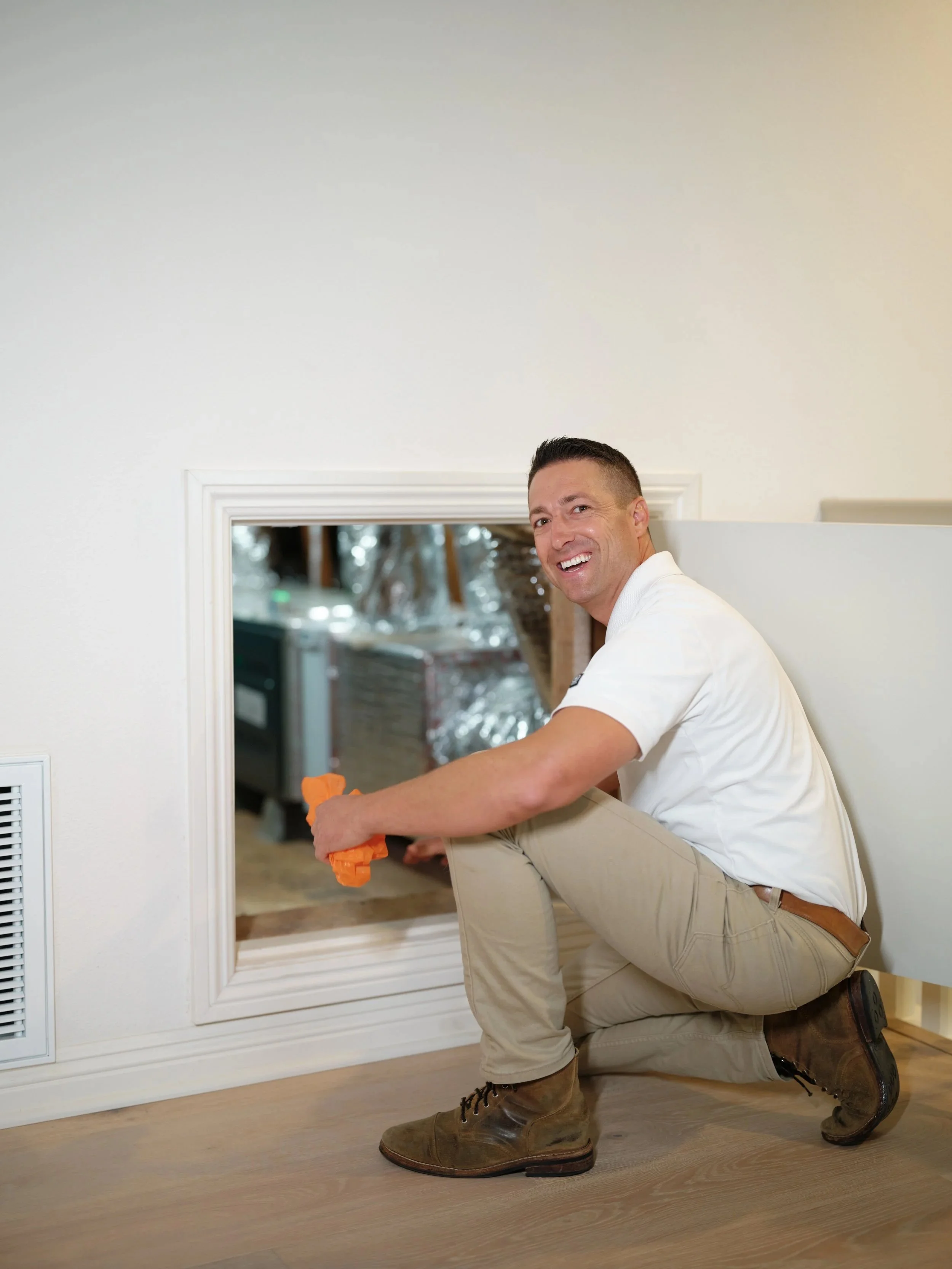
A real J Martin tune-up means a full-time employee inspecting your furnace, including the heat exchanger, not a subcontractor rushing through a checklist.
Quick Answer
To prepare your heater for winter in Orange County, complete six tasks before the first November or December cold snap: replace the air filter, run a 30-minute pre-season test cycle, clear an 18-inch zone around the furnace, schedule a professional tune-up, test every carbon monoxide detector, and reset your thermostat to a heating schedule. The professional tune-up runs $89 to $250 and is the most effective single step for preventing the no-heat call most Orange County homeowners only think to make once the temperature drops below 50 degrees.
Why Orange County Heaters Fail Differently Than Heaters Anywhere Else
The typical Orange County homeowner uses their heater between 600 and 1,000 hours per year. The typical homeowner in Denver uses theirs between 4,000 and 5,000 hours. That seven-to-one difference shapes everything about how heaters fail here, and it is why the playbook from a Midwest furnace company does not translate to Anaheim or Yorba Linda.
What we see, year after year, is what we call the double-shock pattern. A furnace sits idle through a long Orange County summer. Dust settles on the burners, the heat exchanger, and the blower wheel. Spider webs collect inside the cabinet. Rodents sometimes nest in the air handler. The blower motor bearings dry out without circulation. Then, in mid-November, an overnight low drops from 65 degrees to 38 degrees in a single 24-hour period, the homeowner clicks the thermostat to heat for the first time in months, and a system that was never inspected after a half-year of dormancy is asked to perform on demand.
Last December, our technician Jesus took a no-heat call in Anaheim Hills at 8:30 on a Saturday night. The homeowner had not run her heater since March. The first time she clicked it on that evening, the inducer motor seized and tripped the high-limit safety. Diagnosis took twelve minutes. The repair, including the inducer assembly and a labor charge for after-hours service, ran $612. A $129 tune-up in October would have caught the bearing wear and replaced the motor on a scheduled visit, on a weekday, with no after-hours premium and no cold house.
That is the case for the six-step preparation routine in this guide. Every step exists because we have watched homeowners pay three to five times more for the same outcome by waiting until something fails. If you have noticed strange smells when your heater first turns on after the long summer, we wrote a separate piece about what each smell means and when to worry.
Step 1: Replace or Inspect Your Air Filter (Late September to Early October)
Filter replacement is step one because a clogged filter is the single most common cause of furnace short-cycling we see during the first heating week of the year. When airflow is restricted, the heat exchanger overheats, the high-limit safety trips, and the furnace shuts off mid-cycle. Run that pattern long enough and you can crack the heat exchanger, which turns a $20 filter into a $1,800 repair or a $7,500 replacement.
How often you replace the filter depends on the MERV rating. A MERV 6 to 9 filter typically goes 90 days. A MERV 10 to 12 filter, which most Orange County homes with allergy concerns prefer, runs 60 days. A MERV 13 or higher filter, increasingly common in homes near the 91 freeway corridor where wildfire smoke is a fall reality, needs to be checked monthly during heavy use. Heating season counts as heavy use because the system is moving the same volume of air whether it is heating or cooling. We've published a full breakdown on how to pick the right HVAC filter if you want to dial in the rating for your home.
A clogged filter is the single most common cause of furnace short-cycling we see during the first heating week of the year. When airflow drops, the high-limit safety trips, and a $20 filter becomes the trigger for a much larger repair.
Two tactical notes. First, check your filter slot for the directional arrow before you slide the new filter in. Filters installed backward restrict airflow even when they are brand new. Second, write the install date on the cardboard frame with a Sharpie. Most homeowners cannot remember when they last changed it, and that uncertainty is exactly how the 90-day filter becomes a 9-month filter.
Step 2: Run a 30-Minute Pre-Season Test Cycle (Mid October)
The reason to run a test cycle in mid-October, not in mid-November, is that you need a buffer of 30 to 45 days to actually do something about whatever the test reveals. If your furnace fails to ignite on November 18 with overnight lows in the low 40s, you are calling for emergency service alongside everyone else in Orange County who waited. If the same furnace fails to ignite on October 14 with overnight lows still in the high 50s, you have an unhurried two-week window to get it diagnosed, parts ordered, and the repair completed.
The test itself is simple. Set your thermostat to heat. Move the temperature setpoint about five degrees above whatever the room currently reads. Then walk back to the furnace, stay there for the first five minutes, and listen.
You should hear, in order: the inducer motor spinning up, the gas valve clicking open, the burners igniting with a soft whoosh, and the blower starting after a 30 to 60 second delay. Warm air should reach the registers within five minutes. A faint dust burn-off smell, often compared to a hairdryer or a slightly singed odor, is normal for the first 15 to 30 minutes of the season. It is dust on the heat exchanger burning off, and it disappears once the system has run a full cycle. If the smell is sharp, oily, or chemical, or if you smell anything that resembles rotten eggs, shut the system off and step outside.
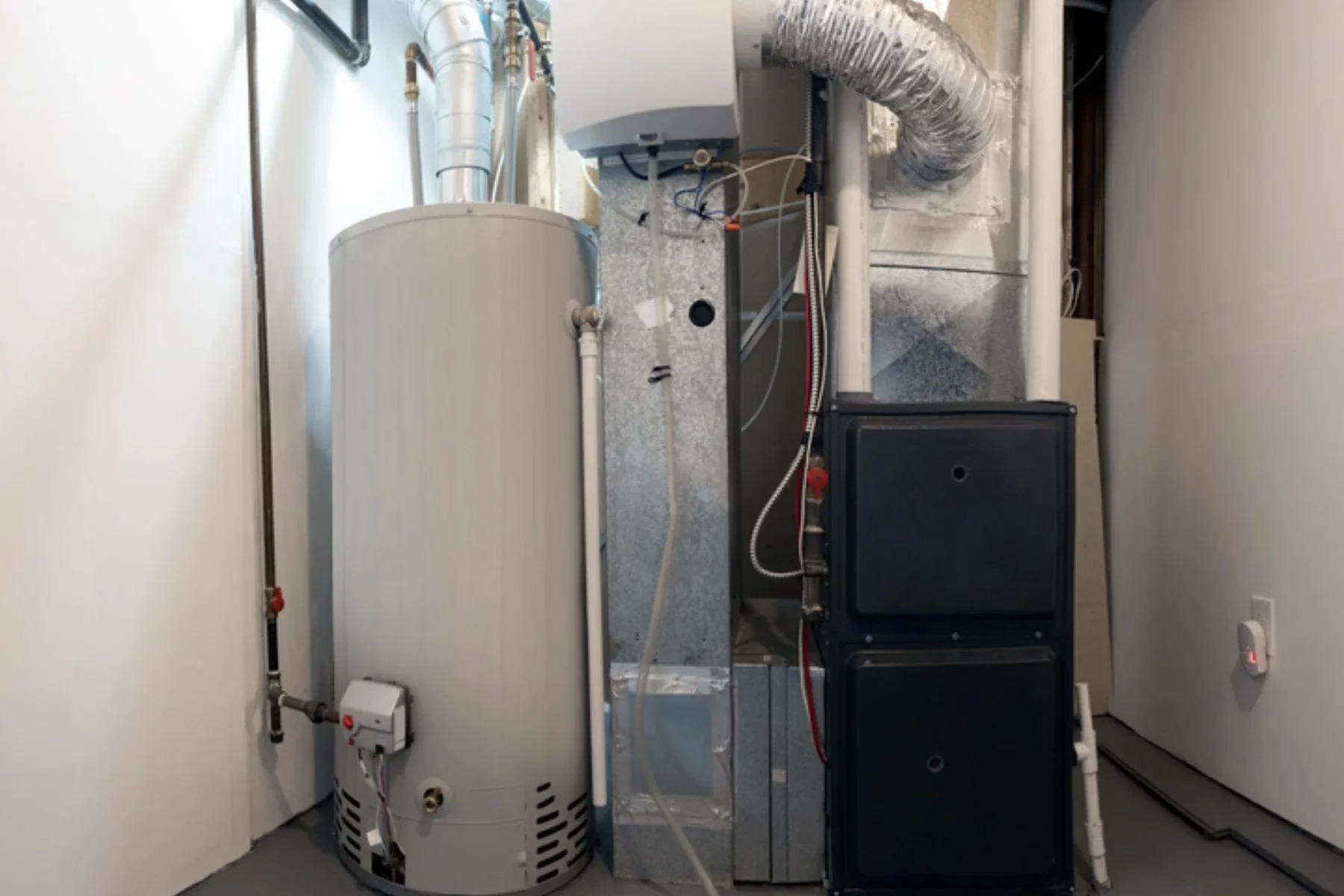
If your furnace closet looks like this, cluttered access, tangled lines, tight clearance, now's the time to get it inspected before the first cold snap. Call J Martin at (714) 462-4686.
Things that signal a real problem and should trigger a call to our team: a screeching or grinding sound from the blower, a cracking or popping noise that does not stop after a minute, no warm air after five minutes of operation, the system shutting itself off and restarting within 60 seconds (short-cycling), or any visible flame outside the burner enclosure. Our cornerstone guide on the seven things to check before you call us for a furnace repair walks through what is and is not a thermostat issue versus a real failure.
A faint dust burn-off smell during the first 15 to 30 minutes of heating season is normal. A sharp, oily, or rotten-egg smell is not. The first means dust on the heat exchanger. The second means turn the system off and call a professional.
Step 3: Clear an 18-Inch Zone Around Your Furnace (Late October)
Storage creep happens during summer when the furnace is unused. Holiday boxes go into the closet next to the furnace. Garage furniture migrates toward the wall where the unit sits. Garden equipment leans against the cabinet. By October, what was a clear safety zone in March is now buried, and we cannot do a tune-up safely (or at all) until we ask the homeowner to move five hundred dollars worth of stuff before we can open the access panel.
The 18-inch rule is the easy version of the actual code, which varies by the type of fuel, the type of installation, and the local jurisdiction. For practical purposes, give the cabinet at least 18 inches on every side that has a panel, vent, or burner intake. Combustible storage (cardboard, paint cans, gasoline, paper) needs to be moved out of that zone entirely. The space above and below the cabinet should also be clear of anything that could fall into a vent or block combustion air.
The location of your furnace changes what to look for. An attic furnace, common in Orange County tract homes built between 1985 and 2005, needs a clear safe path from the access hatch, secure decking, and good lighting. Our techs will not work in an attic that lacks safe footing, and getting that ready beforehand turns a 90-minute visit into a 60-minute visit. A closet furnace, common in 1970s and 1980s Yorba Linda and Fullerton tract homes, needs intact louvered doors so combustion air can flow into the closet, and nothing stacked against the cabinet on the inside. A garage furnace needs the area in front of it (not just the sides) clear of vehicles, and the relief valve and combustion air opening cannot be painted over or sealed by a previous owner.
If you have ever heard one of our technicians joke that we drive a service truck and a moving truck, this is why.
Step 4: Schedule a Professional Tune-Up (October to Early November)
The tune-up is the step that separates a furnace that quietly works for fifteen years from a furnace that surprises a family on Christmas Eve. It is also the step where pricing across Orange County varies the most, and where the difference between a $29 promotional ad and a comprehensive precision tune-up matters.
Here is how the pricing actually breaks down across Orange County for the 2026 season:
2026 Furnace Tune-Up Pricing in Orange County by Service Tier (J Martin and comparable independent OC contractors)
| Service Tier | Typical Price Range | What's Actually Included |
|---|---|---|
| Promotional "tune-up special" | $29 to $69 | Visual inspection, filter change if customer supplies the filter, often a sales pitch for repairs or replacement |
| Standard tune-up | $89 to $149 | Full combustion check, gas pressure test, burner cleaning, inducer and blower inspection, thermostat calibration, basic safety verification |
| Comprehensive precision tune-up | $150 to $250 | Everything in Standard plus heat exchanger inspection, capacitor amperage test, electrical connection torque check, condensate drain treatment for high-efficiency units |
| Maintenance plan annual visit | Bundled (often $0 incremental) | Comprehensive tune-up plus the matching summer AC visit, priority scheduling, and repair discounts. Our True Maintenance Plan members fall in this category. |
The $29 specials are a marketing tactic, not a service. They exist to get a technician inside your home so the company can sell you a $1,200 repair or a $9,000 replacement. We have inherited customers from those visits whose actual furnace problem was a $40 capacitor, but who were quoted full system replacement based on the loss-leader inspection. If a tune-up is priced below the cost of the technician's hour on site (about $90 in fully loaded labor), the company is making the money somewhere else.
What an honest tune-up actually does, beyond the printed checklist, is examine the heat exchanger. The heat exchanger is the metal barrier that separates burning gas from the air your home breathes. When it cracks, carbon monoxide can leak into the supply air. A heat exchanger inspection takes 30 to 60 minutes with a borescope or a visual sweep, and it is the only reliable way to detect cracks before they release carbon monoxide. The U.S. Consumer Product Safety Commission recommends an annual professional inspection of the entire heating system for exactly this reason.
A heat exchanger inspection takes 30 to 60 minutes and is the only reliable way to detect cracks before they release carbon monoxide. It is the single most important safety check in a furnace tune-up, and most $29 specials skip it entirely.
One more practical reason to do the tune-up: most furnace manufacturer warranties require documented annual professional maintenance to remain valid. If your seven-year-old Carrier or Trane fails under warranty and you cannot produce service records, the parts warranty is voided. We've put together a deeper breakdown of what furnace maintenance actually costs in Orange County for homeowners weighing per-visit pricing against an annual plan, and our broader fall HVAC maintenance checklist covers every system on a single visit.
When you call our Anaheim office to schedule, Kathryn or Alexis will book your visit on a weekday window. The technician who shows up will be a full-time J Martin employee, not a subcontractor, and that continuity is part of why our HVAC maintenance team can spot the year-over-year drift in a system that a new technician on every visit would miss.
If you are reading this in October and have not yet booked, the fastest path to a confirmed appointment is to call us at (714) 462-4686. October weekday slots fill in seven to ten days; by mid-November they fill in the same week.
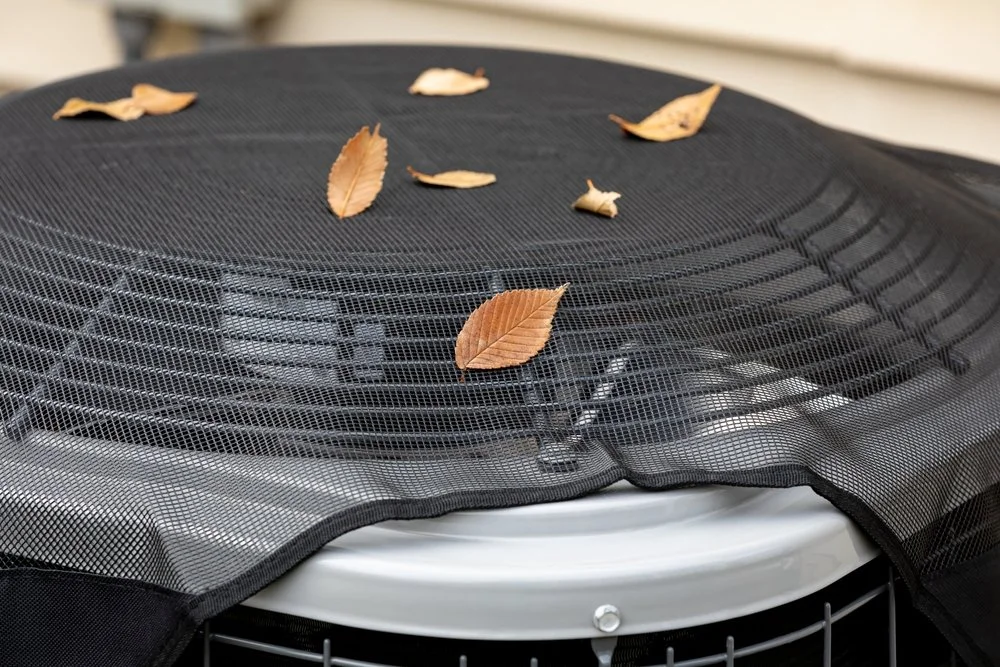
Leaves on the AC cover usually mean one thing: it's furnace season. If you haven't thought about your heater since March, you're right on schedule to start now.
Step 5: Test Every Carbon Monoxide Detector (Late October)
California has required carbon monoxide detectors in all single-family homes with attached garages or fossil-fuel appliances since July 1, 2011. If your home has a gas furnace, a gas water heater, a gas stove, an attached garage, or a wood-burning fireplace, that includes you. Detectors must be installed outside each separate sleeping area and on every level of the home, and they must be a model listed by the California State Fire Marshal.
The pre-winter routine has three parts. First, press the test button on every detector in the home. The alarm should sound for several seconds. If it does not, replace the battery and try again. If it still does not, replace the unit. Second, check the manufacture date printed on the back of each unit. Carbon monoxide sensors degrade over time and most units are rated for five to seven years of service. A detector that still beeps when tested can still fail to detect actual carbon monoxide if its sensor is past its service life. Third, confirm placement. The hallway outside the master bedroom is required, and a unit on each additional floor including the basement (if you have one) is required.
Why this step matters at exactly this point in the calendar: the highest-risk window for residential carbon monoxide exposure is the first heating week of the season, when a furnace that may have developed a hairline crack in the heat exchanger over the summer is asked to fire for the first time. Detectors that worked perfectly in March may not work in November.
If a carbon monoxide detector ever sounds, leave the house immediately and call 911 from outside. Do not re-enter until a fire department or qualified technician confirms the home is safe. Carbon monoxide is colorless and odorless, and headaches, nausea, or dizziness in multiple family members at once are signs of exposure.
If you want to dig deeper on this topic, our complete carbon monoxide safety guide for Orange County homeowners covers detector placement, the symptoms of low-grade chronic exposure (which often gets missed), and what to do if a detector trips while your family is asleep.
Step 6: Reset Your Thermostat for the Heating Season (Early November)
If you have a programmable thermostat or a smart thermostat, the cooling schedule from August is almost certainly wrong for November. Most thermostats hold separate cooling and heating schedules, but you have to manually switch the active program when the season changes. Many homeowners do not, which is why we get calls from families whose thermostats are set to 78 degrees overnight in December because that was the cooling setpoint from summer.
The Energy Star recommended winter setpoints are 68 degrees Fahrenheit when the home is occupied and awake, and 60 to 65 degrees overnight or when the house is empty. For most Orange County homes, those numbers are workable year after year. They balance comfort against energy cost on Southern California Edison's 2026 residential rate of approximately 33.2 cents per kilowatt-hour after the California Climate Credit. Lowering your nighttime setpoint by 7 degrees for 8 hours each night typically saves 5 to 10 percent on your winter heating bill.
While you have the thermostat open, change the batteries. Even hardwired thermostats usually have a backup battery that needs annual replacement. Set the fan switch to AUTO rather than ON. Continuous fan operation is fine in summer for moisture mixing, but in heating season it pulls warm air across cool ductwork and feels drafty at the registers. And if your thermostat is a 1990s mechanical model with a mercury switch, this is a good moment to budget for an upgrade. Modern smart thermostats are eligible for a manufacturer rebate from most California utility programs, and the install pays back in the first heating-and-cooling season.
The Pre-Winter Heater Prep Checklist: DIY vs Pro
Some of the six steps above are clearly homeowner tasks. Others should be left to a licensed technician. The line is not always obvious, and homeowners sometimes drift across it in either direction (overpaying for a 10-minute filter swap, or under-attempting the gas line check that should be a professional task). The table below shows where the natural split falls.
Pre-Winter Heater Preparation Tasks for Orange County Homeowners: DIY-Friendly vs Requires a Licensed Pro (2026)
| Task | DIY-Friendly | Requires a Licensed Pro |
|---|---|---|
| Replace 1-inch disposable air filter | Yes | No |
| Replace 4-inch or 5-inch media filter | Yes, with caution | Recommended for first replacement |
| Test thermostat by switching to heat mode | Yes | No |
| Replace thermostat batteries | Yes | No |
| Clear 18-inch zone around furnace | Yes | No |
| Test carbon monoxide detectors | Yes | No |
| Replace CO detectors over 5 years old | Yes (battery models) | Yes (hardwired models) |
| Inspect heat exchanger for cracks | No | Yes |
| Test gas pressure at the manifold | No | Yes |
| Clean burners and inspect ignition | No | Yes |
| Measure capacitor amperage | No | Yes |
| Inspect flue and venting system | No | Yes |
The pattern is straightforward. Anything you can do without removing a panel or measuring a combustion byproduct is fair game for a homeowner. Anything that involves opening the cabinet, putting a meter on a gas line, or inspecting the heat exchanger is a professional task, both for safety and because doing it without the right tools usually means doing it incorrectly.
Special Considerations for Orange County's Inland Cities
The coastal-versus-inland temperature gap matters for heater preparation in a way that surprises homeowners who have lived only in one of those zones. Newport Beach and Huntington Beach see overnight winter lows that rarely fall below 48 degrees, and homes there often coast through January with the heater barely engaging. Inland cities, including homes across Anaheim Hills, Yorba Linda neighborhoods, Brea, and Diamond Bar, regularly see overnight lows in the high 30s and low 40s during December and January cold snaps.
Two practical implications. First, inland furnaces work harder, which means they accumulate wear faster and the case for an annual tune-up is stronger. A coastal home's furnace might run 400 hours per year. An Anaheim Hills furnace might run 1,200. Second, the older 1970s and 1980s tract homes that dominate inland Yorba Linda, Fullerton, and parts of Anaheim Hills often have undersized return ducts. A return that was sized for a 60,000 BTU furnace in 1978 is the same return now feeding an 80,000 BTU 80-percent-AFUE replacement that went in during a 2014 retrofit. The undersized return restricts airflow, the heat exchanger overheats, and the furnace short-cycles. The fix is rarely a new furnace. The fix is a return-air duct upgrade, which a good fall tune-up should flag.

Big homes, big systems, easy to forget one of them. If your property has more than one furnace, fall is the time to get all of them checked before winter.
If you have switched from a gas furnace to a heat pump in the last few years (a common move under the federal Inflation Reduction Act tax credits and Southern California Edison's TOU-D-PRIME rate plan for electrified homes), the preparation routine is mostly the same. You still need a clean filter, a test cycle, a clear zone around the air handler, and an annual professional check of the refrigerant charge and defrost controls. The heat exchanger inspection step does not apply (heat pumps have no combustion chamber), but the carbon monoxide detector requirement still does if you have a gas water heater, gas stove, or attached garage.
Frequently Asked Questions
When should I have my heater serviced in Orange County?
Schedule a furnace tune-up between mid-September and early November. October is the ideal window because most Orange County homeowners are not yet thinking about heating, so technician availability is high and prices are stable. By December, demand spikes and you may wait two to three weeks for a non-emergency appointment. We recommend booking your appointment at least three weeks before you expect to need the heater.
How much does a furnace tune-up cost in Orange County?
A standard furnace tune-up in Orange County runs $89 to $149 in 2026. A comprehensive precision tune-up that includes a heat exchanger inspection runs $150 to $250. Promotional specials in the $29 to $69 range typically do not include a real combustion or heat exchanger check and are usually structured as a sales call for larger repairs or replacement.
Do I really need a heater tune-up if I barely use it?
Yes, and here is the counterintuitive part: light-use furnaces in Orange County actually fail more often per heating hour than heavy-use furnaces in colder states. The reason is that long dormant periods allow dust accumulation, dried-out bearings, rodent intrusion, and minor corrosion to develop without the system running them off through use. A heater that runs 600 hours per year still needs the same annual safety inspection as one that runs 4,000 hours per year, and the cost of that inspection is small relative to the repair cost it prevents.
What does a furnace tune-up actually include?
A real furnace tune-up should include a combustion analysis, a gas pressure test at the manifold, a burner inspection and cleaning, a heat exchanger inspection, an ignition system test, a blower motor amperage check, a capacitor reading, a thermostat calibration, a flue and venting inspection, and a filter change. The visit typically takes 60 to 90 minutes for a standard tune-up and 90 to 120 minutes for a comprehensive precision tune-up that includes a borescope heat exchanger inspection.
How do I know if my heater is unsafe to run?
Stop running your heater and call a licensed HVAC technician immediately if you notice any of the following: a yellow or orange flame instead of a steady blue flame, a persistent burning or chemical smell that lasts longer than 30 minutes after first ignition, soot or black streaking around the furnace cabinet or vents, two or more family members reporting headaches or dizziness that improve when they leave the house, or any time a carbon monoxide detector sounds. Each of these can indicate a cracked heat exchanger or a venting failure, both of which require professional diagnosis before further use.
How long does a gas furnace last in Orange County?
A gas furnace in Orange County typically lasts 18 to 25 years with annual maintenance, which is on the higher end of the national average because our climate puts so few heating hours on the equipment. Without annual maintenance, the typical lifespan drops to 12 to 15 years and the failure mode often becomes the heat exchanger rather than a wear part, which is the difference between a $400 repair and a full replacement.
Can I do my own heater inspection to save the tune-up cost?
You can complete the homeowner-level steps in this guide (filter change, test cycle, area clearing, CO detector test, thermostat reset) without a technician, and those steps catch a meaningful share of common issues. What a homeowner cannot safely do is the heat exchanger inspection, the gas pressure measurement, the combustion analysis, or the electrical component testing. Skipping the professional portion saves $89 to $250 in the short term and risks a four-figure repair or a safety incident in the medium term, which is why we recommend the homeowner steps and the professional tune-up as complements, not substitutes.
The Bottom Line on How to Prepare Your Heater for Winter
If you take only one thing from this guide, take this: the most predictable failure pattern we see in Orange County is a homeowner who clicks the heat on for the first time on a 39-degree November night and discovers that the system that worked perfectly in March no longer works at all. The fix for that pattern is to prepare your heater for winter in October, while temperatures are still in the 60s and 70s and a service appointment is a phone call, not a three-week wait.
The six steps in this guide (filter, test cycle, clear zone, professional tune-up, carbon monoxide detectors, thermostat reset) take a homeowner about an hour of attention and a single $89 to $250 service visit. They are the difference between a furnace that performs on demand and a furnace that surprises you on the coldest night of the year.
Our heating contractor team serves all 26 Orange County cities we cover, with full-time technicians who have been on the J Martin crew for years rather than rotating subcontractors who never see the same house twice. That continuity is part of why we are able to spot the slow drift in a system year over year that a one-off tune-up cannot catch.
Schedule Your Fall Heater Tune-Up With J Martin
J Martin Indoor Air Quality has served more than 5,000 Orange County families since 2014. Licensed, bonded, and insured (CA Contractor License CL#998956), with a 4.97-star rating across thousands of reviews. When you call, you reach Kathryn or Alexis at our Anaheim office, not a national call center. When a technician arrives, it is a full-time J Martin employee, not a subcontractor.
Our True Maintenance Plan covers your furnace tune-up in fall and your AC tune-up in spring on a single annual membership, with priority scheduling and discounts on any repairs needed throughout the year. Most members find that the plan pays for itself in the first repair it prevents.
Call us at (714) 462-4686 to schedule your fall heater tune-up, or request a free in-home consultation. We service all 26 Orange County cities and offer same-day appointments for emergency no-heat calls when the cold snap catches you before the tune-up does.