
Mini Split vs. Central AC for Yorba Linda Homes: Which System Saves More Money in 2026?
Updated on May 23, 2026
Your 20-year-old central AC finally died on a 95-degree afternoon. Or maybe it's still limping along, but your summer electric bills keep climbing and you know replacement is coming soon. Now you're facing the question every Orange County homeowner asks: do I replace it with another central AC system, or is this the time to switch to mini splits?
The answer isn't the same for everyone. Your home's layout, existing ductwork condition, how you actually use your space, and what rebates you qualify for all matter more than any generic "this one is better" advice.
Let's break down the real costs, actual savings, and honest tradeoffs between ductless mini splits and central AC for Yorba Linda homes in 2026. We'll talk about upfront costs, monthly energy bills, what rebates are actually available right now, and which system makes financial sense for different situations.
What's Actually Different Between Mini Splits and Central AC
Both systems move heat from inside your home to outside (cooling) or vice versa (heating). Both have an outdoor unit and equipment inside your home. The difference is how they deliver that conditioned air.
Central AC systems use ductwork to distribute cooled air throughout your home. One indoor air handler (usually in the attic or garage) pushes air through a network of ducts to vents in each room. One thermostat controls the entire system. When it reaches the set temperature, the whole system shuts off.
Most Yorba Linda tract homes built in the 1970s-2000s came with central AC and existing ductwork. Replacing a central AC system means keeping that infrastructure and swapping out the outdoor compressor and indoor air handler.
Mini split systems skip the ductwork entirely. Small refrigerant lines connect the outdoor unit directly to individual air handlers mounted on walls (or ceilings) in each room you want to condition. Each indoor unit has its own controls. You can set your living room to 72 degrees, your bedroom to 68 degrees, and leave the guest room off completely. If you're new to ductless systems and want a fuller breakdown of how they work, where they fit best, and what to expect from installation, our complete guide to ductless mini splits in Orange County covers the pros, cons, and best use cases in detail.
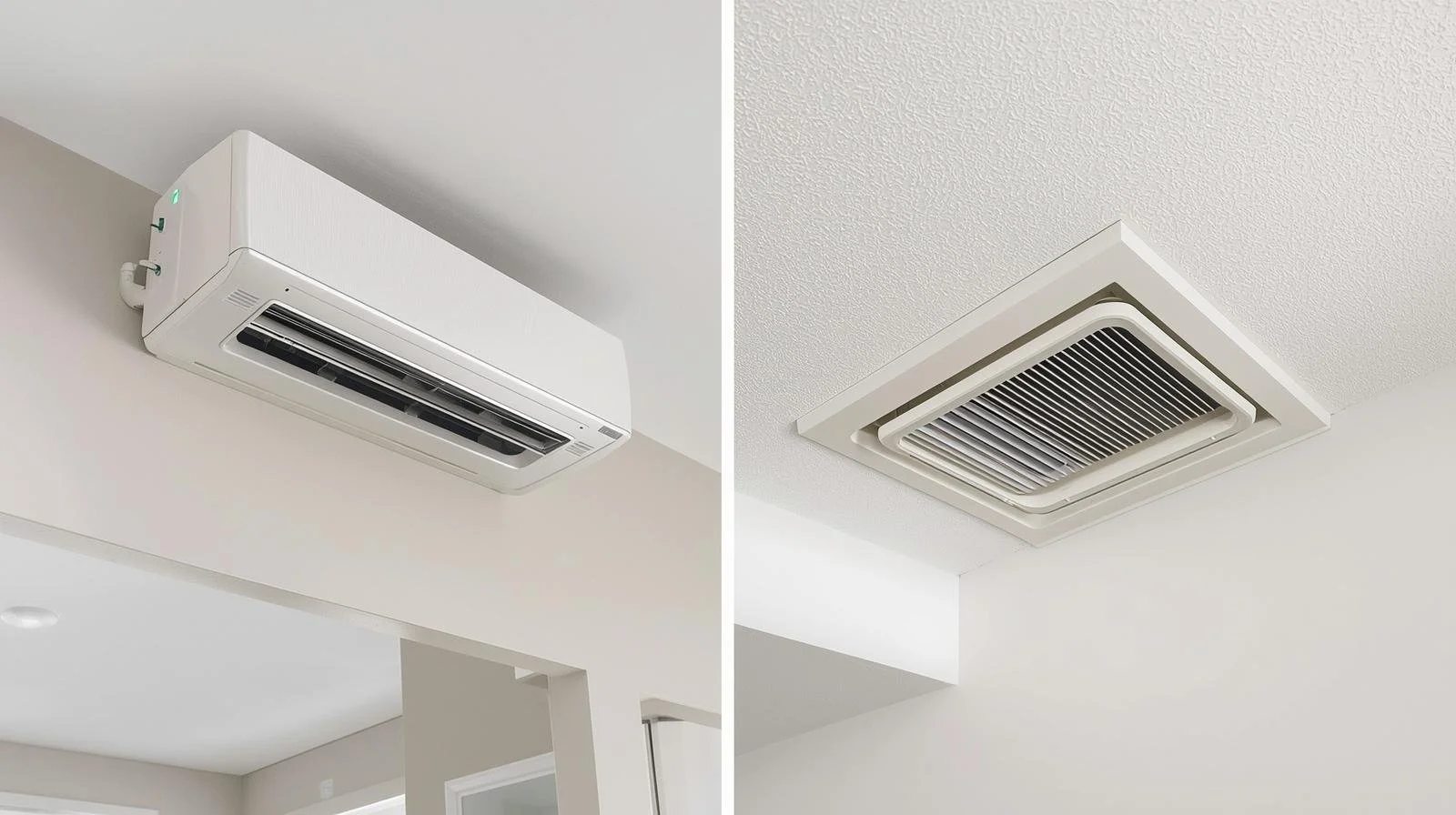
Deciding between mini split styles for your Yorba Linda home? J Martin provides free in-home assessments to show you both options. Call (714) 462-4686 today.
Mini splits are technically heat pumps, which means they provide both heating and cooling. Most can heat your home down to outdoor temperatures of 5-10 degrees, though Yorba Linda rarely sees anything close to that cold.
The critical difference: mini splits eliminate ductwork, which also eliminates the 20-30% energy loss that occurs when cooled air travels through ducts in a hot attic.
The Real Upfront Costs in 2026
Let's talk actual numbers for a typical 1,800 square foot Yorba Linda home.
Central AC Replacement (with existing ductwork):
If your home already has ductwork in good condition, replacing your central AC system with a new 3-ton unit costs $6,000-10,000 installed.
This includes:
Outdoor condenser unit
Indoor air handler or evaporator coil
New refrigerant (R-410A being phased out, replaced by R-454B in 2025+)
Labor, permits, and start-up
Higher-efficiency systems (SEER2 18-20+) cost more upfront but use less energy. Variable-speed systems that adjust capacity based on demand run $8,000-12,000.
If your ductwork needs significant repair or replacement, add $2,000-8,000 depending on accessibility and how much needs work. Homes with ductwork in the attic typically pay more than homes with ducts in the garage or crawlspace.
Mini Split Installation (new system):
For that same 1,800 square foot home, a multi-zone mini split system costs $8,000-15,000 installed.
This typically includes:
One outdoor unit (24,000-36,000 BTU capacity)
3-4 indoor wall units for main living areas and bedrooms
Refrigerant lines connecting outdoor to indoor units
Electrical work (each indoor unit needs power)
Labor, permits, and start-up
Single-zone mini splits (one outdoor unit, one indoor unit) for a specific room or addition cost $3,500-6,000 installed.
The price varies significantly based on:
Number of zones (indoor units) - more zones = higher cost
Indoor unit style (wall-mounted is cheapest, ceiling cassettes cost more)
System efficiency rating (SEER2 ratings of 20-30+)
Brand (Mitsubishi, Daikin, Fujitsu command premium prices)
Installation complexity (long refrigerant line runs, multiple floors, electrical panel upgrades)
Why mini splits cost more upfront: Each indoor unit requires individual installation, refrigerant line runs, electrical connections, and wall penetrations. A central AC system requires one air handler installation. Labor costs add up quickly with multiple indoor units.
The exception: If you're building new or your home has no existing ductwork, mini splits often cost less than central AC plus new ductwork. Installing ductwork from scratch adds $4,000-12,000 to central AC costs.
The Monthly Energy Cost Reality
This is where mini splits show their advantage. But the actual savings depend on how you use your home.
Central AC Energy Use:
A typical 3-ton central AC system (SEER2 14-16) in a 1,800 square foot Yorba Linda home costs approximately $110-160 per month to run during summer (June-September).
That's based on:
8-10 hours of daily operation during peak cooling months (around 500-700 kWh per month)
Southern California Edison average residential rate of 34.5 cents per kWh as of January 2026
Time-of-use rates ranging from 24-74 cents per kWh depending on time of day
System running at full capacity when it's on
Newer high-efficiency systems (SEER2 18-20) reduce this to $85-125 per month. Variable-speed systems that can run at partial capacity save even more.
The ductwork tax: Even if your ducts are in decent shape, you're losing 15-25% of cooled air through leaks and heat gain as air travels through a 140-degree attic. You're paying to cool your attic instead of your living space.
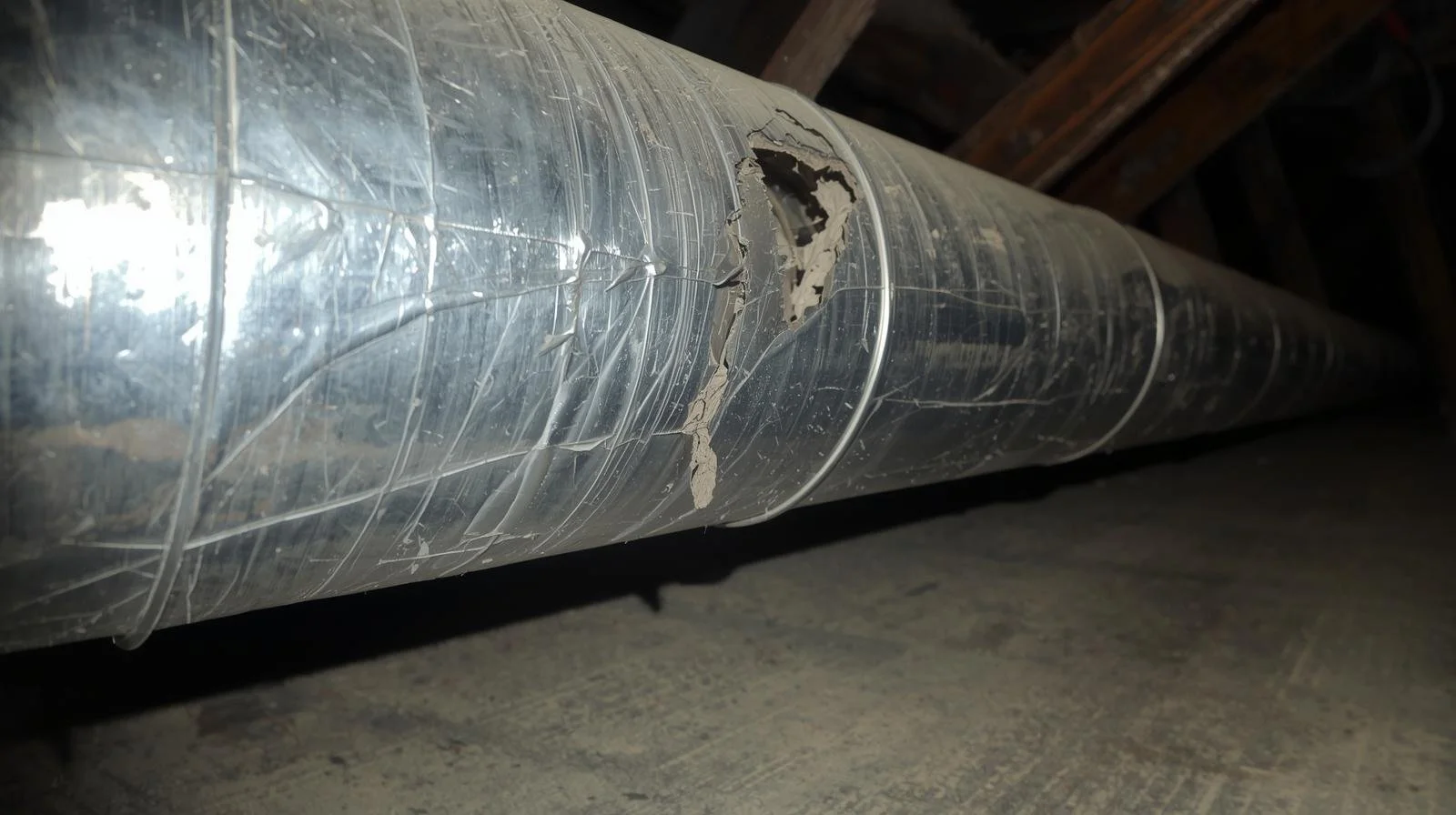
This is what we find in most Orange County homes over 20 years old. That leak means 20-30% of your cooled air never reaches your living space. J Martin tests your ductwork before recommending whether to repair, replace, or switch to mini splits.
Mini Split Energy Use:
A comparable mini split system (SEER2 20-25) costs approximately $60-95 per month to run during summer.
The savings come from:
No ductwork losses (all cooled air goes directly into living spaces)
Variable-speed operation (runs at 40-60% capacity most of the time instead of 100%)
Zone control (you only cool rooms you're actually using)
Higher efficiency ratings (most mini splits are SEER2 20+ compared to 14-16 for standard central AC)
Real-world example from our Yorba Linda customers:
Family of four, 2,000 square foot home, both adults work from home:
With central AC: $145/month average summer cooling costs After switching to mini splits: $75/month average summer cooling costs
Annual summer savings: $280 Over 15 years: $4,200 in energy savings
But this only works because they actively use zone control. They turn off mini splits in bedrooms during the day and turn off the living room units at night. If they ran every mini split at the same temperature 24/7, savings would be minimal.
The zone control requirement: Mini splits only save money if you actually use them strategically. Set it and forget it doesn't work. You need to turn off units in rooms you're not occupying.
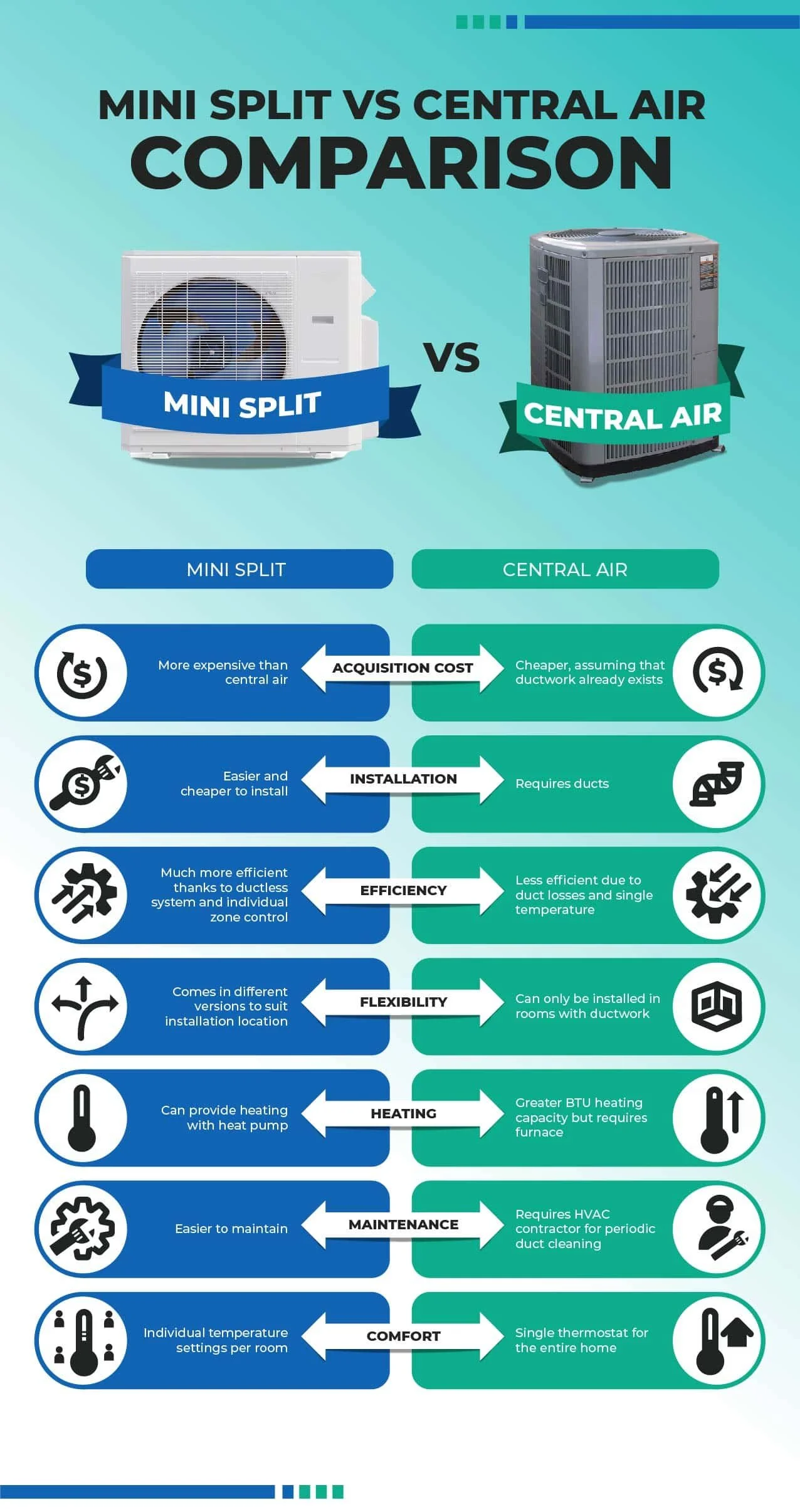
Every Yorba Linda homeowner asks the same question: 'Which system will actually save me money?' The answer isn't one-size-fits-all. Your ductwork condition, how you use your home, and available rebates all matter more than generic advice.
What Rebates Are Actually Available in 2026
This is where things get complicated, but also where you can save significant money.
Federal Tax Credit (available to everyone):
30% of equipment and installation costs, up to $2,000 per year for qualified heat pump systems including mini splits.
Requirements:
SEER2 16+ and HSPF2 8.5+ (most mini splits qualify easily)
Installed by December 31, 2025 to claim on 2025 taxes
You claim this when you file your taxes using Form 5695. It's a tax credit (reduces taxes owed), not a rebate (cash back), so you only benefit up to the amount you owe in federal taxes.
California HEEHRA Rebates (income-qualified only):
As of January 2026, these rebates are nearly fully reserved statewide:
Households earning under 80% Area Median Income: $8,000 rebate
Households earning 80-150% AMI: $4,000 rebate
For Orange County, 80% AMI is approximately $85,000 for a family of four. 150% AMI is approximately $160,000 for a family of four.
Critical timing note: Central and Southern California regions are close to fully reserved. Northern California expected to be fully reserved by January 2026. New income verifications only being accepted in Northern region starting January 2026.
If you qualify by income but haven't already gotten an approved income verification code, you've likely missed this rebate opportunity.
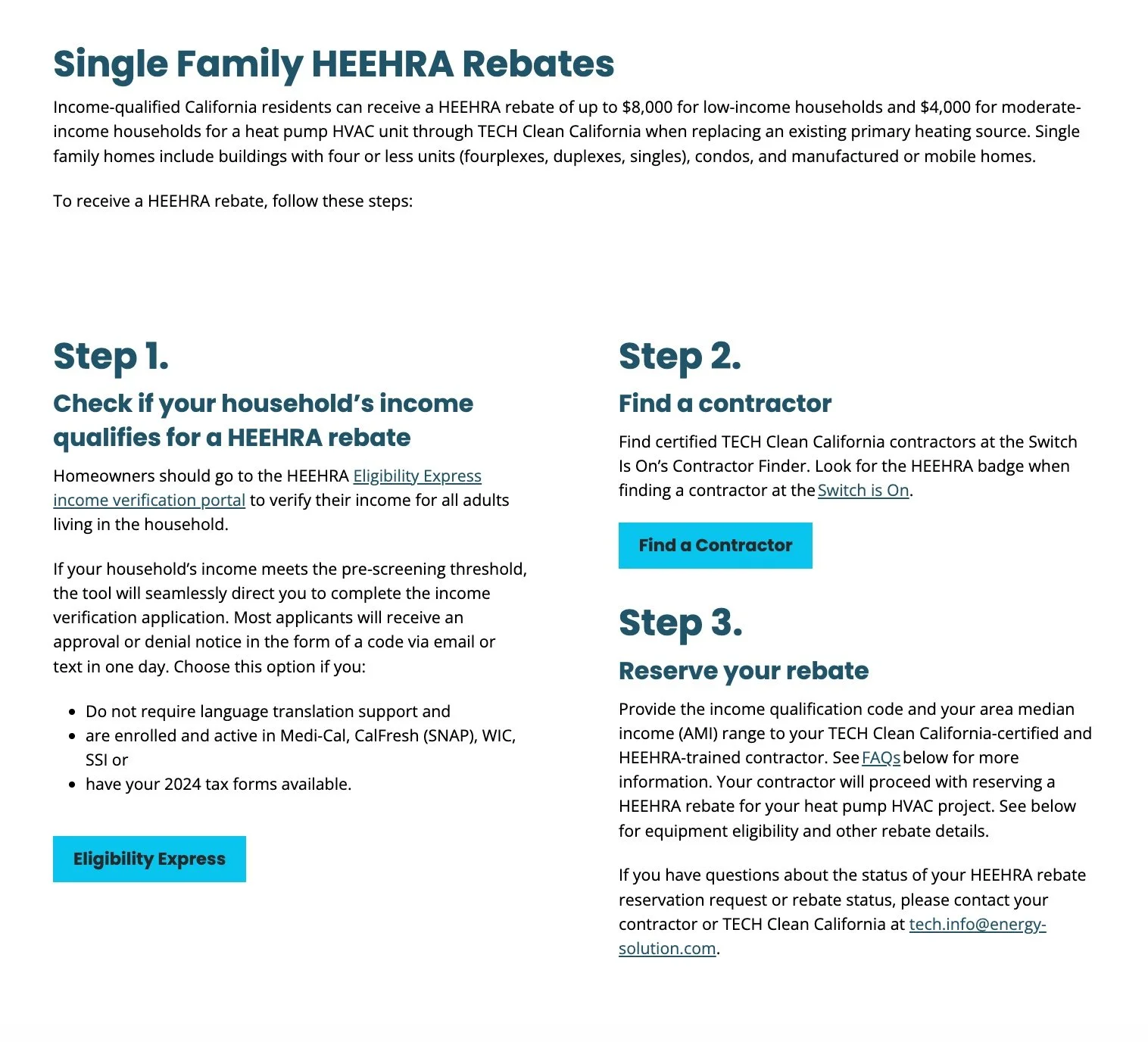
TECH Clean California rebates are still available for mini split installations in Orange County—but income-qualified HEEHRA rebates are nearly gone. J Martin helps you navigate which rebates you qualify for. Call (714) 462-4686 before funds run out."
TECH Clean California Incentives:
Market-rate incentives (available to all homeowners): $1,000-1,500 for mini split heat pump installations
Requirements:
Must use TECH-certified contractor
Must enroll in utility demand response program (like OhmConnect)
Must replace existing HVAC, not new construction
These are much easier to access than HEEHRA rebates but offer smaller amounts.
Utility Company Rebates:
Southern California Edison and other utilities offer additional rebates, typically $300-800 depending on system efficiency and size.
Realistic total rebate scenario for most Yorba Linda homeowners:
Non-income-qualified household installing a $12,000 mini split system:
Federal tax credit: $2,000
TECH Clean California: $1,000
Utility rebate: $500
Net cost after rebates: $8,500
Income-qualified household (if you secured HEEHRA approval already):
HEEHRA rebate: $4,000-8,000
Federal tax credit: $2,000
TECH Clean California: $1,000
Net cost after rebates: $1,000-5,000
For central AC replacement, rebates are more limited. The federal tax credit only applies to heat pump systems, not traditional AC. You're looking at utility rebates of $200-500 maximum.
When Central AC Makes More Financial Sense
Mini splits aren't always the answer. Here's when sticking with central AC is smarter:
Your existing ductwork is in good shape
If you have well-sealed, properly insulated ducts with minimal leakage, the energy efficiency advantage of mini splits shrinks significantly. A new high-efficiency central AC system (SEER2 18+) will perform nearly as well as mini splits if it's not fighting duct losses.
Have your ductwork professionally tested for leakage. If leakage is under 10%, repairing and sealing ducts plus installing a new central AC system often costs less than switching to mini splits.
You want one thermostat controlling the whole house
Some people find zone control annoying. If you want to set one temperature for your entire home and not think about it, central AC delivers that simplicity. Mini splits require active management to maximize savings.
You hate the look of wall-mounted units
Mini split indoor units are visible. Wall-mounted units stick out 8-10 inches from the wall. Some people find them obtrusive. Ceiling cassette options exist but cost significantly more ($1,000-2,000 extra per unit).
Central AC vents are low-profile and familiar. Some Orange County homeowners simply prefer the clean look of traditional vents over wall units.
Your home is larger (2,500+ square feet) with many rooms
As home size increases, the number of mini split indoor units required grows. A 3,000 square foot home might need 6-8 indoor units. At that scale, the installation cost often exceeds central AC, and the complexity of managing multiple zones becomes cumbersome.
Central AC excels at conditioning large, open spaces consistently.
You're selling your home within 2-3 years
The payback period for mini splits through energy savings typically runs 8-12 years. If you're not staying long-term, you won't recoup the higher upfront cost.
New central AC improves home value. Mini splits might appeal to some buyers and turn off others. Central AC is the safe, expected choice that won't raise questions.
When Mini Splits Make More Financial Sense
Here's where mini splits pay off:
Your ductwork is shot
If your ducts have significant leakage (20%+ is common in Orange County homes 20+ years old), you're wasting huge amounts of energy. Repairing ductwork costs $2,000-5,000. Replacing it entirely costs $4,000-10,000.
At those prices, paying $10,000-12,000 for mini splits that eliminate ducts entirely makes economic sense.
You have hot/cold spots that drive you crazy
If your upstairs bedrooms are always 10 degrees warmer than downstairs, mini splits solve this instantly. Individual room control means your master bedroom can be 68 degrees while your living room is 74 degrees.
You're not overcooling half your house trying to cool the other half.
You actually use different areas at different times
Work from home? Cool your home office to 72 degrees during the day, turn it off at 6 PM. Cool bedrooms at night, turn them off in the morning.
Families who genuinely use zone control see 30-40% energy savings compared to central AC.
You're adding space without existing ducts
Converting a garage, adding a room, finishing an attic - mini splits provide heating and cooling without running new ductwork through existing walls.
A single-zone mini split ($3,500-5,000) costs far less than extending your central AC system ($4,000-8,000 including ductwork).
You want heating without a separate furnace
Mini splits provide heating down to 5-10 degrees outdoor temperature. Yorba Linda winter lows rarely drop below 40 degrees. A mini split system handles 100% of your heating needs, eliminating your gas furnace.
You're getting heating and cooling in one system. Central AC only cools. You'd still need a furnace or separate heat source.
You qualify for HEEHRA rebates (and secured approval already)
If you have an approved income verification for the $4,000-8,000 HEEHRA rebate, mini splits become dramatically more affordable. A $12,000 system net cost drops to $4,000-8,000 after all rebates.
At that price point, the energy savings payback period shrinks to 3-5 years.
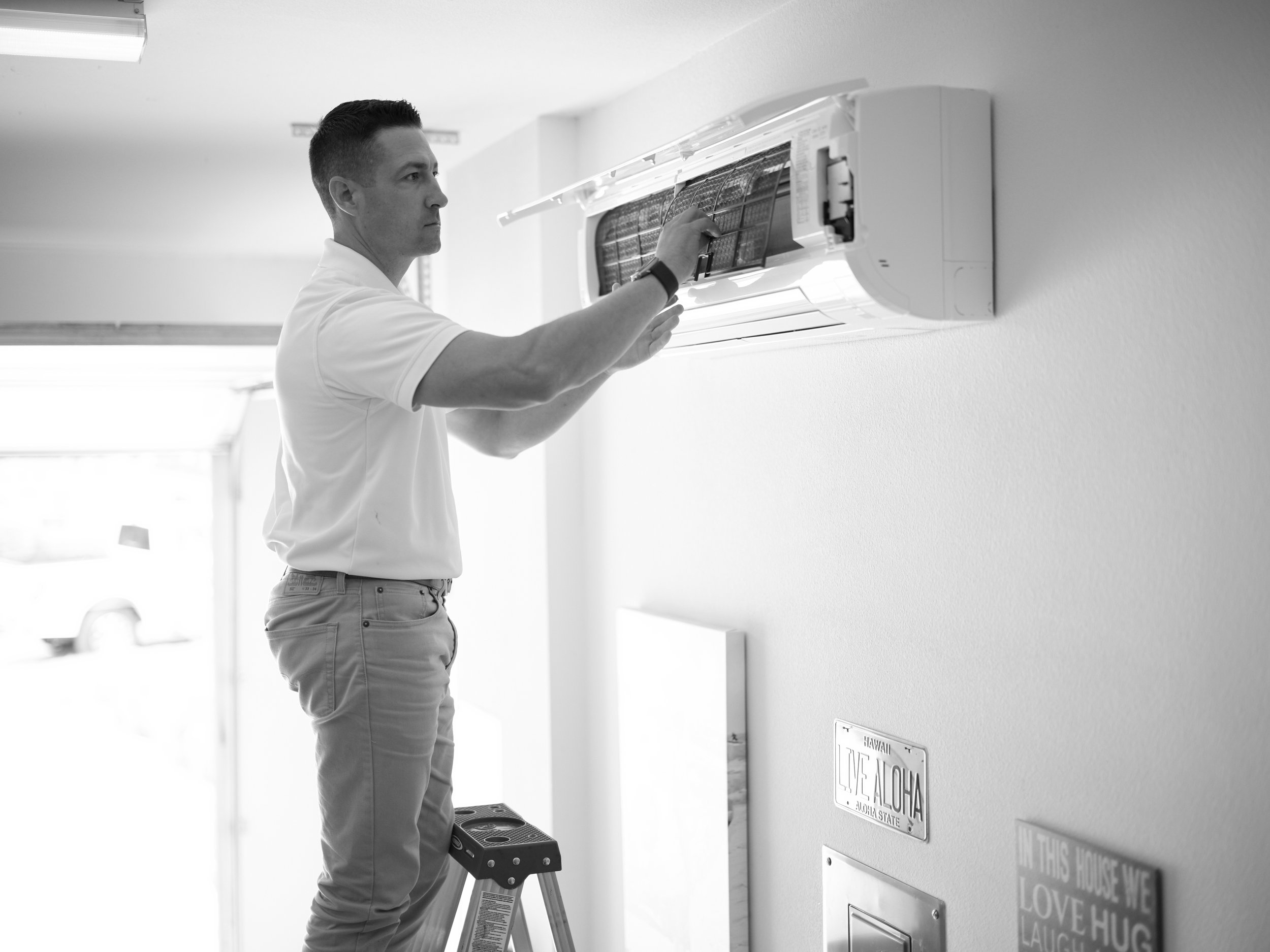
Professional mini split installation and maintenance makes the difference between a system that lasts 15 years and one that fails at year 8. J Martin's licensed technicians ensure your Orange County home gets proper refrigerant charging, electrical connections, and placement.
The Hybrid Approach: Mini Splits + Keep Your Central AC
This is the solution nobody talks about but makes sense for many Orange County homes.
How it works:
Keep your existing central AC system for the main floor and add mini splits only to problem areas:
Upstairs bedrooms that never cool properly
Master bedroom on the west side that gets afternoon sun
Home office or bonus room
Converted garage space
The math:
Single-zone mini split for master bedroom: $3,500-5,000 Keeps your existing central AC investment Solves the specific problem room Total energy savings: 15-20% (not cooling entire house as much)
Many Yorba Linda homeowners find this is the sweet spot. You're not replacing a working central AC system unnecessarily, but you're solving the temperature imbalance that makes your home uncomfortable.
What Actually Fails and When: Maintenance Reality
Central AC maintenance:
Annual service: $150-250
Check refrigerant levels
Clean outdoor coil
Replace filter (or DIY for $15-30)
Inspect electrical connections
Typical lifespan: 12-15 years in Orange County
Common repairs:
Capacitor failure ($250-400) - usually happens years 8-12
Compressor failure ($1,800-2,800) - usually happens after year 10, often not worth repairing
Refrigerant leak ($400-1,200 depending on location)
Plus duct cleaning every 5-7 years ($300-500) if you want to maintain efficiency.
Mini split maintenance:
Annual service: $150-250 per system (covers all indoor units)
Check refrigerant levels on all lines
Clean all indoor unit filters (or DIY monthly)
Clean outdoor coil
Inspect all electrical connections
Typical lifespan: 15-20 years
Common repairs:
Indoor unit circuit board failure ($300-600)
Outdoor unit compressor failure ($1,500-2,500)
Refrigerant leak ($500-1,000)
Mini split indoor units have filters you can wash yourself every 2-4 weeks. Takes 5 minutes per unit. Central AC filters need replacement every 1-3 months depending on type.
Reliability comparison:
Both systems are reliable when properly maintained. Mini splits have more components (multiple indoor units) so theoretically more things can fail. But each indoor unit is simpler than a central air handler.
In practice, we see similar failure rates. The difference: when one mini split indoor unit fails, the others keep working. When a central AC compressor fails, you lose cooling to your entire home.
The Yorba Linda Climate Factor
Orange County's moderate climate favors mini splits more than extreme climates.
Why this matters:
Mini splits excel in mild-to-moderate temperatures (40-95 degrees). They struggle in extreme heat (105-115 degrees) or extreme cold (below 10 degrees).
Yorba Linda weather (based on historical climate data):
Summer average highs: 79-87 degrees (rarely exceeds 97 degrees)
Winter average lows: 44-50 degrees (rarely below 36 degrees)
Occasional heat waves: 95-100 degrees during Santa Ana winds (happens several days per year)
You're in mini split's optimal performance range nearly year-round.
In Phoenix (regular 115-degree days) or Minnesota (regular sub-zero temps), mini splits face more limitations. In Yorba Linda, they thrive.
Santa Ana wind considerations:
During Santa Ana wind events when outdoor temps reach 95-100 degrees, both mini splits and central AC face challenges. The difference in performance is minimal. Both systems were sized for typical summer days (mid-80s), not the handful of extreme heat days we get annually.
The Honest ROI Calculation
Let's run the numbers for a typical scenario:
1,800 sq ft Yorba Linda home, 20-year-old central AC needs replacement
Option 1: New Central AC
Upfront cost: $8,500 installed (SEER2 16 system)
Monthly summer cooling cost: $130
Annual maintenance: $200
No significant rebates available
Option 2: Mini Split System
Upfront cost: $12,000 installed (4-zone system)
After rebates: $9,000 (assuming $2,000 federal credit, $1,000 TECH incentive)
Monthly summer cooling cost: $75 (assumes active zone control)
Annual maintenance: $200
Energy savings calculation:
Summer cooling season (5 months): $55/month x 5 = $275/year savings Winter heating conversion (eliminate gas furnace): $40/month x 4 = $160/year savings Total annual savings: $435
Payback calculation:
Extra cost for mini splits: $9,000 - $8,500 = $500 Payback period: $500 ÷ $435/year = 1.1 years
Over 15-year lifespan:
Total energy savings: $435 x 15 = $6,525 Net savings after paying back extra upfront cost: $6,025
But this assumes:
You actively use zone control
You qualify for rebates
You eliminate gas heating entirely
Energy prices stay relatively stable (SCE rates have increased 25% from 2022-2025)
If you don't use zone control strategically, actual savings might be $200-250/year, extending payback to 2-3 years and lifetime savings to $3,000-3,500.
Making the Decision for Your Yorba Linda Home
Start by answering these questions:
1. What's your ductwork condition?
Schedule a duct leakage test ($150-300). If leakage exceeds 20%, mini splits or duct repair + central AC are both worth considering.
2. How long are you staying in this home?
Less than 5 years: Central AC (lower upfront cost, universal appeal) 5-10 years: Either works, depends on other factors 10+ years: Mini splits offer better long-term value through energy savings
3. Do you have temperature problem areas?
Specific hot/cold rooms: Mini splits or hybrid approach Whole-house temperature imbalance: Mini splits Generally comfortable: Central AC is fine
4. Will you actually use zone control?
Yes, we actively manage our home: Mini splits maximize savings No, we want one thermostat: Central AC is simpler
5. What rebates do you qualify for?
Income-qualified with HEEHRA approval: Mini splits become much more affordable Non-income-qualified: Smaller rebates, but still beneficial No rebates: Central AC saves upfront cost
6. How do you feel about visible wall units?
Don't care/think they look modern: Mini splits are fine. Strongly prefer hidden HVAC: Central AC or expensive ceiling cassette mini splits
What We Recommend for Different Yorba Linda Home Situations
1970s-1980s tract home, original ductwork, upstairs always hot:
Add 1-2 mini splits to upstairs bedrooms, keep central AC for main floor. Cost: $7,000-10,000. Solves the problem without full replacement.
1990s-2000s home, ductwork in decent shape, no major comfort issues:
Replace with new high-efficiency central AC (SEER2 18+). Cost: $8,000-10,000. Simple, effective, familiar.
Home with no existing ductwork (older home, recent addition, converted space):
Mini splits all the way. Cost: $10,000-15,000 for whole home vs. $15,000-25,000 for central AC plus new ductwork.
Large home (2,500+ sq ft) with good ductwork:
New central AC unless you have specific problem zones. At this size, mini splits get expensive and complex.
Small home (under 1,500 sq ft) with old ductwork:
Mini splits make economic sense. Lower installation cost, better efficiency, eliminates duct issues.
Home office/work from home situation:
Hybrid: mini split in office, central AC for rest of house. Best of both worlds.
Get Your Yorba Linda Home Properly Assessed
The right answer depends on your specific home, usage patterns, and budget. Generic advice doesn't account for your ductwork condition, insulation levels, sun exposure, and how you actually live in your space.
For Professional Assessment:
If you want J Martin to evaluate your home and provide honest recommendations on whether central AC or mini splits make more sense for your situation, call (714) 462-4686.
We'll assess your existing ductwork condition, measure your home's cooling needs, explain rebate eligibility, and give you accurate cost estimates for both options.
We're not going to push mini splits just because they're trendy or central AC because it's easier. We'll tell you what actually makes financial sense for your home and how you use it.
For Emergency Service:
If your AC died and you need cooling restored immediately, we offer same-day emergency service throughout Yorba Linda, Anaheim Hills, and Orange County.
For Second Opinions:
If another company told you that you "must" replace your entire system or that one type is definitively better, get a second opinion. We'll give you facts, numbers, and options so you can make an informed decision.
J Martin Indoor Air Quality - CL#998956
15 years experience with ductless mini splits serving Orange County homeowners with honest HVAC advice.
Common Questions About Mini Splits vs. Central AC
Can I install mini splits myself to save money?
Legally, no. California requires licensed contractors (C-20 HVAC license) to install systems that handle refrigerant. DIY mini split kits exist, but they void warranties, may violate building codes, and can create refrigerant leaks that cost more to fix than you saved. Professional installation also ensures proper sizing, refrigerant charging, and electrical work. We put together this list of 5 HVAC tasks you can do yourself for reference.
Will mini splits heat my home in winter or do I still need a furnace?
Mini splits provide sufficient heating for Yorba Linda winters (rarely below 40 degrees). They work efficiently down to outdoor temperatures of 5-10 degrees. You can eliminate your gas furnace entirely. Many Orange County homeowners use mini splits for both heating and cooling year-round.
How much noise do mini splits make compared to central AC?
Indoor mini split units are quieter than central AC vents (19-25 decibels vs. 30-40 decibels). Outdoor units make similar noise levels (50-60 decibels for both). The difference: mini split noise is localized to rooms with units, while central AC noise comes from every vent. Some people find mini splits quieter overall; others find the visible/audible indoor unit more noticeable than a distant vent.
If one mini split indoor unit breaks, does the whole system stop working?
No. Each indoor unit operates independently. If one fails, the others continue working normally. With central AC, a compressor or air handler failure means no cooling anywhere. This is a reliability advantage for mini splits in multi-zone installations.
Can I add more mini split zones later after initial installation?
Yes, if your outdoor unit has capacity. Multi-zone systems are typically sized for 2-5 indoor units. If you install 3 units initially but the outdoor unit can handle 5, you can add 2 more later. Costs $1,500-2,500 per additional indoor unit. Confirm capacity with your installer when choosing the outdoor unit size.
Do mini splits filter air as well as central AC systems?
Mini splits have built-in filters in each indoor unit that capture dust and debris. They're effective for basic filtration but don't match whole-home air purification systems that integrate with central AC. If you have significant allergies or air quality concerns, central AC with a HEPA filter or air purifier typically offers better filtration. Mini split filters require monthly cleaning (simple rinse and dry) while central AC filters are replaced every 1-3 months.
What happens to mini splits during a power outage?
Same as central AC - they don't work without electricity. Both require similar power draw. Neither system offers an advantage during outages. If you install a backup generator, factor in starting watts for whichever system you choose (mini splits typically draw 1,500-3,000 watts per zone; central AC draws 3,500-5,000 watts).
Can mini splits work with solar panels?
Yes, both mini splits and central AC work with solar. Mini splits' higher efficiency (lower energy consumption) means you need fewer solar panels to cover their operation compared to central AC. If you have solar or plan to install it, mini splits maximize your solar investment through reduced electricity demand.
How long does mini split installation take compared to central AC?
Mini split installation typically takes 1-2 days for a whole-home system (3-4 zones). Central AC replacement takes 1 day if you're swapping equipment with existing ductwork in good shape. If ductwork needs repair or modification, add 1-2 more days. Single-zone mini split installations often complete in 4-6 hours.
J Martin Indoor Air Quality | (714) 462-4686 | Services