
Frozen AC Coil in Orange County? Here's What Causes It and How to Fix It
Updated on May 12, 2026
It's a strange thing to see ice on the inside of your air conditioner when it's 95 degrees outside. But if you've noticed frost creeping along the copper refrigerant lines, a layer of ice coating the indoor unit, or water pooling beneath your air handler, you're dealing with a frozen evaporator coil. And despite how it looks, a frozen coil doesn't mean your AC is working extra hard to keep you cool. It means the opposite. A frozen evaporator coil shuts down the cooling process entirely, turns your system into an expensive fan blowing lukewarm air, and if you keep running it, can cause serious damage to the compressor that costs thousands of dollars to replace.
This is one of the most common AC problems we see across Orange County, and it tends to spike at two specific times of year. The first is in early spring (March and April) when homeowners flip their AC on for the first time after months of sitting idle. The second is during peak summer heat waves (July and August) when systems run for extended periods and minor issues that were manageable under lighter loads become full-blown failures under sustained demand.
The good news is that a frozen coil is almost always a symptom of an identifiable, fixable underlying problem. And in many cases, the first steps you need to take are things you can do yourself before calling anyone. This guide walks you through exactly what causes an evaporator coil to freeze, how to safely thaw it, how to determine whether the underlying cause is a DIY fix or a professional repair, and what the whole thing typically costs.
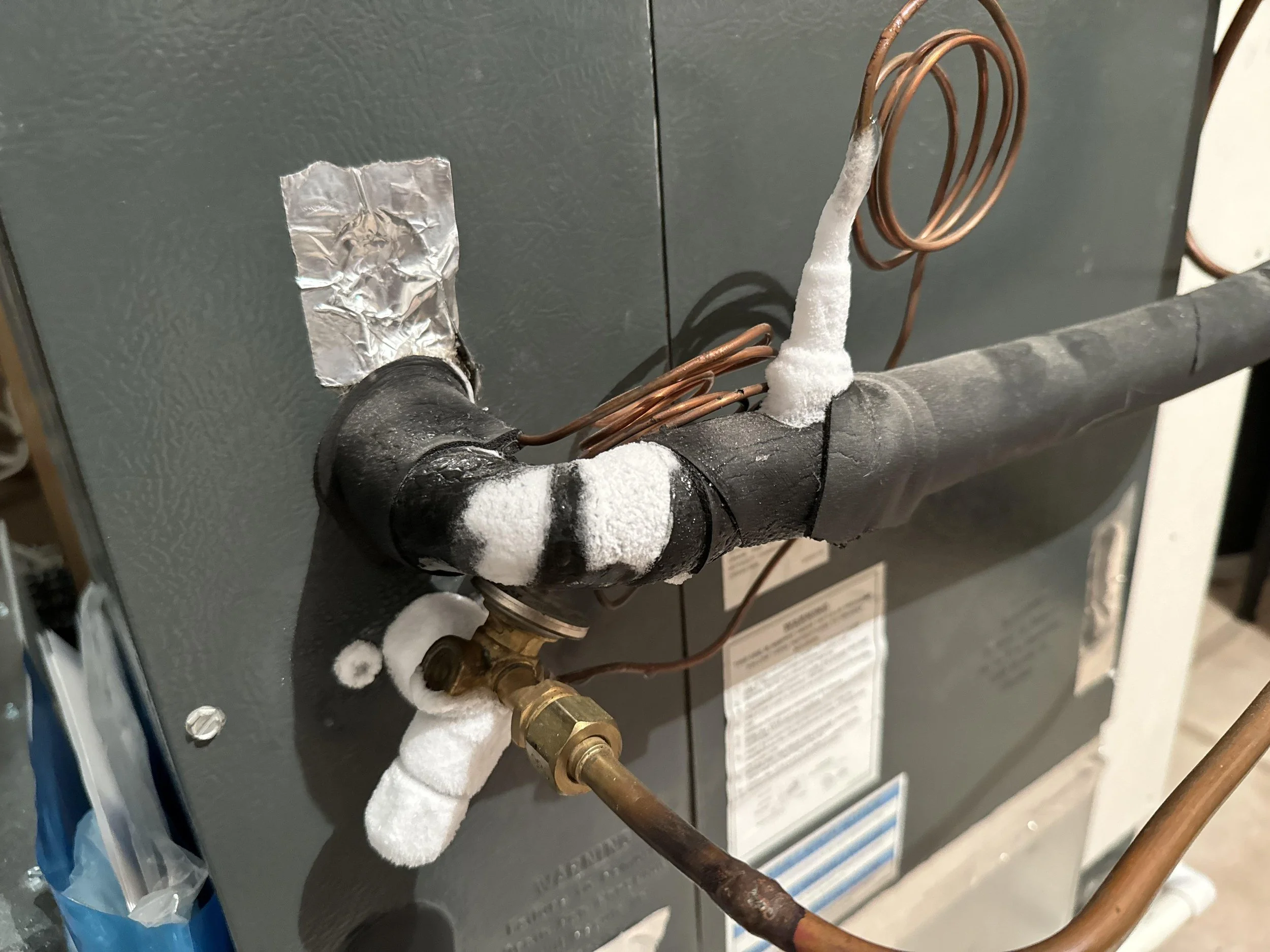
Seeing ice on your AC refrigerant lines like this? A frozen evaporator coil can shut down your cooling system fast. J Martin offers same-day AC diagnostics across Orange County. Call (714) 462-4686.
What Your Evaporator Coil Actually Does (and Why Freezing Breaks the Whole System)
To understand why a frozen coil is such a problem, it helps to know what the evaporator coil does when things are working correctly.
Your air conditioning system cools your home by absorbing heat from indoor air and moving it outside. The evaporator coil is the component responsible for that heat absorption. It's located inside your home, typically housed within the air handler or mounted on top of the furnace. The coil contains cold, low-pressure refrigerant that's been metered into the coil by an expansion valve. As your blower fan pushes warm household air across the coil, the refrigerant absorbs the heat from that air and evaporates from a liquid into a gas. The now-cooled air continues through your ductwork and into your rooms, and the heated refrigerant gas travels through copper lines to the outdoor condenser unit, where the heat is released outside.
Under normal operating conditions, the evaporator coil runs at approximately 40 degrees Fahrenheit. That's cold enough to efficiently absorb heat from the air passing over it, but warm enough that the moisture condensing on the coil remains liquid and drips into the drain pan below. When something disrupts this balance and the coil temperature drops below 32 degrees, that moisture freezes instead of dripping. The ice insulates the coil surface, which blocks even more airflow and causes the temperature to drop further, which creates more ice. It's a self-reinforcing cycle that accelerates quickly. Within hours, a thin layer of frost can become a solid block of ice encasing the entire coil.
Once the coil is frozen, the system physically cannot cool your home. The ice acts as a barrier between the refrigerant and the air, preventing heat exchange. The blower fan strains to push air through the obstruction. The compressor continues running and working against abnormal pressures. If the system keeps operating in this state, the compressor can overheat, lose lubrication, and suffer permanent damage. Compressor replacement is the single most expensive common AC repair, typically running $1,500 to $3,500. So the financial stakes of catching and addressing a frozen coil early are significant.
Cause 1: A Dirty or Clogged Air Filter (The Most Common Culprit by Far)
A clogged air filter is responsible for more frozen evaporator coils than any other single cause. The connection is straightforward: the filter restricts airflow, reduced airflow means less warm air passes over the coil, the coil gets too cold, and ice forms.
Your air filter sits between the return air duct and the evaporator coil, and its job is to trap dust, pet hair, pollen, and other airborne particles before they can coat the coil or get circulated through your home. Over time, those particles accumulate and the filter becomes increasingly restrictive. In Orange County, filters tend to clog faster than homeowners expect because of our dry climate, frequent Santa Ana wind events that stir up dust and particulates, and the pollen from the abundance of landscaping common in neighborhoods throughout Yorba Linda, Brea, Anaheim, and Fullerton.
When airflow drops below the minimum threshold the system needs to operate properly, the evaporator coil can't absorb enough heat to stay above freezing. The refrigerant inside the coil, which was designed to absorb heat from a steady stream of air, instead sits in a near-stagnant environment and overcools the coil surface.
This is also the easiest cause to check and fix. Turn off the system, locate the filter (it's typically behind a return air grille on a wall or ceiling, or in a slot on the air handler), pull it out, and hold it up to a light. If you can't see light through it, it's overdue for replacement. A new pleated filter costs $5 to $20 at any hardware store. During the cooling season in Orange County (roughly April through October), you should be replacing the filter every 30 to 60 days and checking it monthly. This single habit prevents more AC problems than any other maintenance task a homeowner can perform.
Cause 2: Low Refrigerant from a Leak
Refrigerant is the substance that flows through the evaporator coil and absorbs heat. If the refrigerant level drops below what the system was designed for, the pressure inside the coil decreases. Lower pressure means lower temperature, and when that temperature drops below 32 degrees, the coil freezes.
This is an important concept that many homeowners misunderstand: refrigerant does not get "used up" like gasoline in a car. It circulates in a sealed, closed-loop system. If your refrigerant is low, it means there's a leak somewhere, whether in the evaporator coil itself, a solder joint, a fitting, or a section of the copper line set that connects the indoor and outdoor units. Simply adding more refrigerant without finding and fixing the leak is a temporary measure that wastes money. The refrigerant will leak out again, the coil will freeze again, and you'll be in the same situation within weeks or months.
Signs that a refrigerant leak may be causing your frozen coil include a hissing or bubbling sound near the indoor unit, an oily residue around the coil or on the refrigerant lines, the system running constantly without reaching the set temperature, and of course, ice forming on the coil or the lines. This guide goes into more detail about what to check when your AC is running but not cooling.
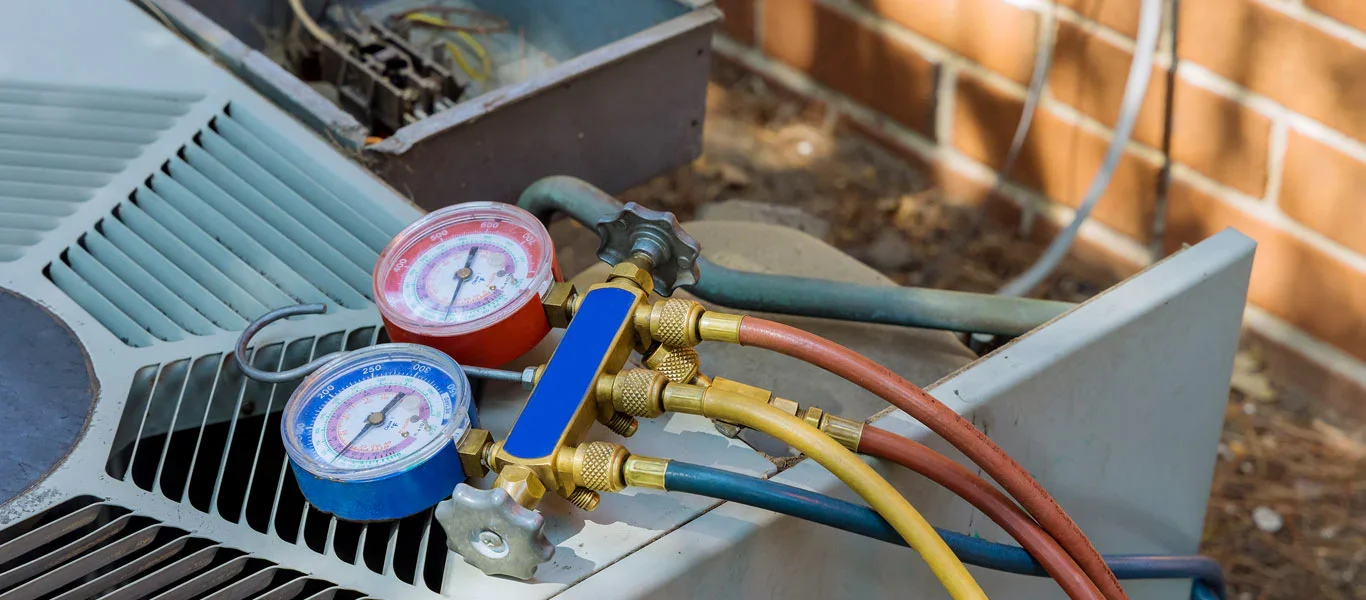
Refrigerant pressure testing like this helps our technicians pinpoint the exact cause of AC cooling problems. J Martin provides honest diagnostics for Orange County homeowners.
Refrigerant work is not a DIY repair. Federal EPA regulations under Section 608 require that only certified technicians handle refrigerant. A professional will use specialized equipment to locate the leak, repair it, and recharge the system to the manufacturer's specified level. For systems using R-410A (the standard in residential units manufactured between 2010 and 2024), a recharge typically costs $100 to $320 for a partial top-off, with the refrigerant priced at roughly $100 to $300 per pound installed. Leak detection and repair adds $200 to $1,500 depending on the location and severity of the leak. For a deeper breakdown of these costs, see our complete guide to AC repair costs in Orange County.
Cause 3: A Dirty Evaporator Coil
Even with regular filter changes, some dust and particulates eventually make it past the filter and settle on the evaporator coil surface over the years. When the coil becomes coated with enough dust and grime, it acts as an insulating layer that prevents the refrigerant inside from efficiently absorbing heat from the air passing over it. The coil temperature drops because the heat exchange is impaired, and freezing follows.
A dirty evaporator coil often develops gradually, which is why it tends to manifest as a frozen coil during the first heavy cooling demands of the season. The system may have been working adequately during mild spring days when cooling loads were light, but the moment temperatures climb into the 90s and the system needs to run continuously, the compromised coil can't keep up.
Professional evaporator coil cleaning typically costs $100 to $400 as part of a maintenance visit. This is not a job most homeowners should attempt themselves. The coil is delicate (the aluminum fins bend easily), it's located inside the air handler where access is limited, and improper cleaning techniques can damage the coil or push debris deeper into the fins. A professional technician uses specialized coil cleaner solutions and low-pressure rinsing techniques that clean effectively without causing damage.
This is one of the key reasons annual AC maintenance matters. During a spring tune-up, a technician will inspect and clean the evaporator coil, catching buildup before it reaches the point of causing operational problems. If you haven't had your system serviced in more than a year, coil fouling should be high on your list of suspects when dealing with a frozen coil. You can learn more about what's included in a professional tune-up on our maintenance page.
Cause 4: Blower Fan Problems
The blower fan (sometimes called the blower motor or air handler fan) is the component that pushes air across the evaporator coil. If the blower isn't moving enough air, whether because the motor is failing, the fan speed is set too low, the fan wheel is dirty and unbalanced, or the motor capacitor is weak, the result is the same as a clogged filter: insufficient airflow over the coil, dropping temperatures, and eventually ice.
Signs of blower trouble include noticeably weak airflow from your supply vents even when the system is running, the blower making unusual sounds (squealing, grinding, or humming), or the system cycling on and off repeatedly because the high-limit safety switch keeps tripping due to restricted airflow.
A blower motor that's simply dirty can sometimes be restored with a thorough cleaning. A motor with a weak capacitor may need only a $150 to $400 capacitor replacement. But a blower motor that's truly failing or burned out requires replacement, which runs $900 to $3,000 depending on whether you have a standard single-speed motor or a variable-speed ECM motor (the latter being more efficient but significantly more expensive to replace).
This is a professional repair. Blower motors involve electrical connections, capacitors that store dangerous charges, and calibration of fan speeds that affect the entire system's performance. Unless you have HVAC experience, leave this one to a technician.
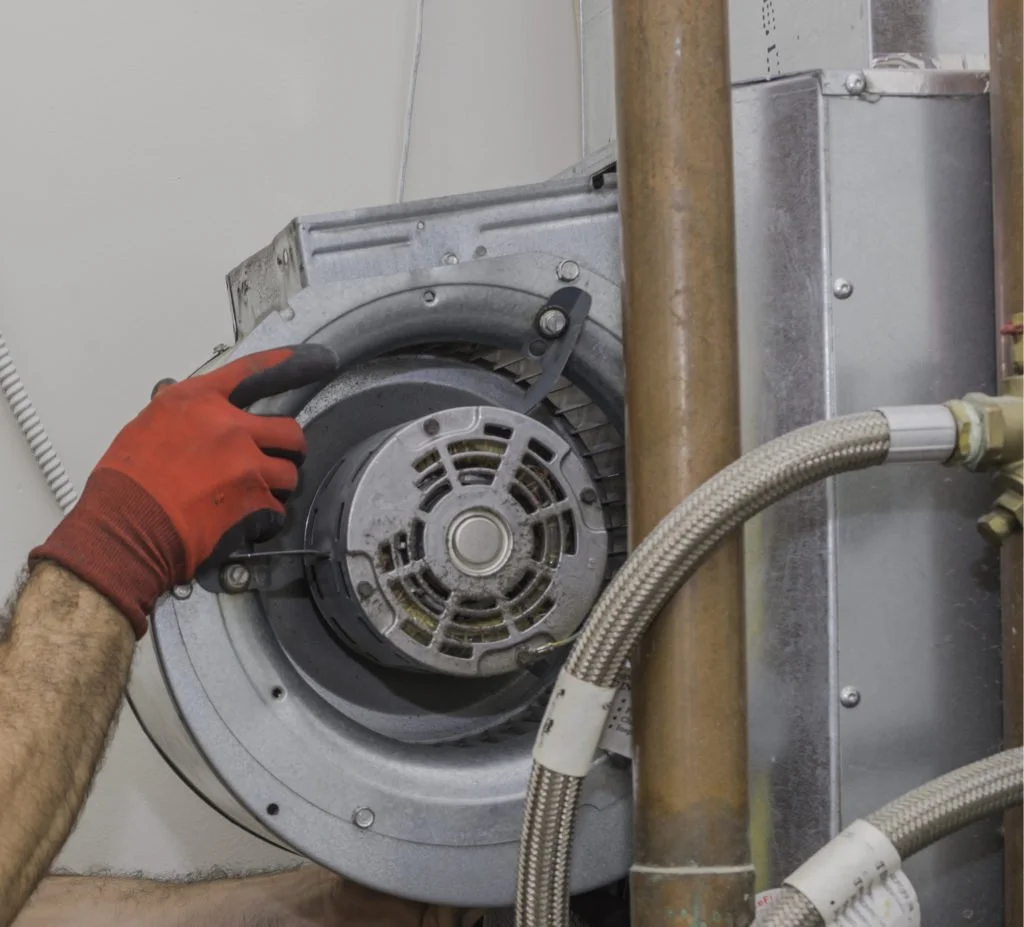
Experiencing weak airflow or warm air from your vents? A blower motor issue could be the cause. Call J Martin for fast AC diagnostics in Orange County: (714) 462-4686.
Cause 5: Running the AC When Outdoor Temperatures Are Too Low
This cause is particularly relevant to Orange County homeowners because of our unique climate pattern. During spring and fall, daytime temperatures in Yorba Linda, Brea, and the inland valleys often reach the 80s or even low 90s, while overnight lows drop into the upper 50s or low 60s. Many homeowners run their AC during the warm afternoon and leave it running into the evening without adjusting the thermostat.
When outdoor temperatures fall below roughly 60 to 62 degrees, the already-cool air being drawn into the return ducts combined with the refrigerant's natural cooling effect can push the evaporator coil below freezing. The system was designed to cool warm air, not air that's already at moderate temperatures. Without enough heat to absorb, the coil overcools and ice forms, often overnight. Homeowners then wake up to find a frozen system and warm air coming from their vents in the morning.
The fix is simple but requires a small habit change. If overnight temperatures are expected to drop below the mid-60s, either turn the AC off before bed and open windows (this is what whole house fans are designed for, and they're incredibly popular and effective in Orange County's dry climate), or set the thermostat to a temperature that won't call for cooling when outdoor conditions are already mild. Programmable and smart thermostats make this easy by allowing you to set different temperature profiles for daytime and nighttime.
If your coil freezes specifically in the morning but works fine during the afternoon, overnight low temperatures are very likely the cause.
Cause 6: Blocked or Closed Supply Vents and Return Grilles
This cause ties back to airflow, but it originates from the duct system rather than the filter or blower. If too many supply vents or return air grilles in your home are closed, blocked by furniture, or covered by rugs, the overall volume of air moving through the system drops. The evaporator coil receives less warm air than it needs, the coil temperature drops, and freezing begins.
Closing vents in unused rooms is a common practice that many homeowners believe saves energy, but it actually increases static pressure in the duct system, reduces airflow across the coil, and can contribute directly to frozen coil situations. For optimal performance, keep all vents and returns open and unobstructed throughout the house.
Walk through your home and verify that every supply register and return grille is open, unblocked, and has clear space around it. This takes five minutes and costs nothing, but it resolves the problem in a surprising number of cases.
How to Safely Thaw a Frozen Evaporator Coil (Step by Step)
Regardless of what caused the freeze, the immediate response is the same. Here's how to safely thaw a frozen evaporator coil without causing additional damage to your system.
First, turn off the air conditioner at the thermostat. Switch it from "Cool" to "Off." This stops the cooling cycle and prevents the compressor from continuing to run against the abnormal conditions created by the frozen coil. Running the compressor while the coil is frozen is the single fastest way to cause permanent, expensive compressor damage.
Second, switch the fan setting from "Auto" to "On." This keeps the blower running and pushes room-temperature air across the frozen coil, which significantly speeds up the thawing process. Warm air from your house flowing over the ice will melt it much faster than simply turning the system off and waiting.
Third, check the area around the air handler for water. As the ice melts, the water needs somewhere to go. Under normal conditions, it drips into the condensate drain pan beneath the evaporator coil and flows out through the drain line. But if the ice buildup is extensive, the volume of meltwater can exceed what the drain pan can handle, potentially causing water damage to floors, ceilings (if the air handler is in the attic, which is extremely common in Orange County homes), and surrounding materials. Place towels or a shallow container beneath the air handler to catch overflow, and check periodically as the ice melts.
Fourth, do not chip, scrape, or try to forcibly remove the ice. The evaporator coil's aluminum fins are extremely thin and delicate. Poking at the ice with a screwdriver, knife, or any hard object can easily bend the fins (reducing airflow permanently) or puncture a refrigerant tube, which turns a $0 thawing process into a $500 to $1,500 leak repair. You can use a hair dryer on a low or medium setting held about six inches from the coil to gently assist the thawing, but never apply high heat directly to the coil.
Fifth, while the coil is thawing (which typically takes two to four hours for moderate ice, potentially longer for severe buildup), check and replace the air filter. This is the single most likely cause of the freeze, and you want a clean filter in place before restarting the system.
Once the coil has fully thawed and you've confirmed the filter is clean and all vents are open, you can set the thermostat back to "Cool" and monitor the system. Give it 15 to 20 minutes to settle into a normal cooling cycle, then check the supply vents in a few rooms to confirm cold air is flowing. Also check the area around the air handler one more time for any residual dripping.
If the system starts cooling normally and the coil doesn't refreeze within 24 hours, the problem was likely airflow-related and your filter change resolved it. Going forward, set a recurring reminder to check your filter monthly so the situation doesn't repeat itself.
If the coil freezes again within a day or two despite a clean filter and open vents, the underlying cause is something beyond a simple airflow restriction, most likely a refrigerant leak, a dirty coil, or a blower motor issue. At that point, it's time for a professional diagnosis. Do not keep thawing and restarting the system repeatedly. Each freeze-and-thaw cycle stresses the compressor and increases the risk of permanent damage. One thaw-and-test cycle is reasonable troubleshooting. A second freeze means the problem needs a technician.
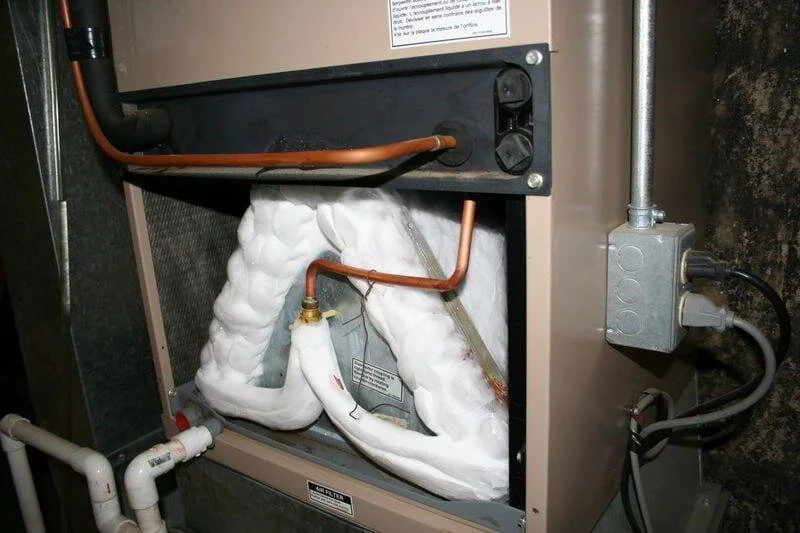
A frozen evaporator coil like this is usually caused by airflow problems, refrigerant leaks, or dirty components. J Martin provides honest AC diagnostics to help Orange County homeowners fix the root cause.
What It Costs to Fix a Frozen Evaporator Coil in 2026
The cost to resolve a frozen evaporator coil depends entirely on what caused the freeze. Here's a realistic breakdown of the most common scenarios.
If the cause is a clogged air filter, the fix costs $5 to $20 for a new filter. This is a DIY repair with zero labor cost, and it's the resolution in a significant percentage of frozen coil cases.
If the coil itself is dirty and needs professional cleaning, expect to pay $100 to $400. Many HVAC companies include coil cleaning as part of their annual maintenance service, which typically costs $100 to $200 for the full tune-up.
If the blower motor capacitor has failed (preventing the blower from running at proper speed), replacement typically costs $150 to $400 including parts and labor.
If the cause is low refrigerant from a leak, the cost involves both the recharge and the leak repair. An R-410A recharge runs $100 to $300 per lb, and leak detection plus repair adds $200 to $1,500 depending on the location and severity. Total cost for a refrigerant leak scenario: $300 to $1,800.
If the blower motor itself needs replacement, you're looking at $900 to $3,000 depending on motor type.
If the evaporator coil is damaged and leaking refrigerant (which can happen from corrosion, especially in coastal Orange County areas where salt air accelerates metal degradation), coil replacement costs $600 to $2,500 or more depending on the unit's size, brand, and warranty status. Evaporator coil replacement is a major repair, and for systems over 10 to 12 years old, it's worth discussing with your technician whether the repair cost justifies the investment versus replacing the system.
A diagnostic service call to have a technician evaluate the problem costs $75 to $200, and many companies apply that fee toward the repair if you proceed with the work.
Why This Problem Is Especially Common in Orange County
Orange County's climate creates a few conditions that make frozen evaporator coils more likely than in many other parts of the country.
The first is our extended cooling season. AC systems in this region can run from April through October (and sometimes year-round in warmer areas), which means more operating hours, more filter loading, and more cumulative wear on components like blower motors and capacitors compared to regions where AC runs for only three or four months.
The second is our dramatic temperature swings between day and night, particularly in the inland valleys. Yorba Linda, Brea, and Villa Park regularly see 30-degree temperature differentials between afternoon highs and overnight lows during spring and fall. This is the classic setup for overnight coil freezing when homeowners leave the AC running as temperatures drop.
The third factor is dust. Between Santa Ana wind events (which can deposit a fine layer of dust and particulates on everything in and around your home), construction activity in developing areas, and the generally arid conditions, air filters in Orange County homes clog faster than the national average. Homeowners who follow the generic "change your filter every 90 days" advice may find that their filters need attention every 30 to 45 days during active cooling season.
And fourth, many Orange County homes have their air handlers and ductwork located in the attic, where summer temperatures can exceed 140 degrees. When a frozen coil thaws in an attic-mounted unit, the resulting water can cause significant damage to ceilings, insulation, and drywall below if the drain pan overflows or the drain line is clogged. This is why addressing a frozen coil promptly (rather than just re-setting the system and hoping for the best) is particularly important in our region.
There's also a fifth factor that affects homes closer to the coast. Salt air accelerates corrosion on the evaporator coil's copper tubing and aluminum fins. Homes in Huntington Beach, Seal Beach, and even parts of Anaheim and Fullerton that are within a few miles of the ocean may see evaporator coil degradation happen faster than homes further inland. Corroded coils develop micro-leaks that slowly release refrigerant, which leads to the low-charge freezing cycle we described earlier. If your home is in a coastal area and your coil keeps freezing despite clean filters and adequate airflow, coil corrosion may be the underlying issue.
How to Prevent Frozen Coils Going Forward
Preventing a frozen evaporator coil comes down to maintaining the conditions the system needs to operate correctly: adequate airflow, proper refrigerant levels, clean components, and appropriate operating temperatures.
Change your air filter every 30 to 60 days during cooling season. Set a recurring reminder on your phone. This is the single most impactful thing you can do.
Keep all supply and return vents open and unblocked throughout your home. Don't close vents in unused rooms.
Schedule a professional AC tune-up every spring before the heavy cooling season begins. A technician will clean the evaporator coil, check refrigerant levels, inspect the blower motor and capacitor, test electrical connections, and verify proper airflow. This annual visit catches small problems before they become mid-summer emergencies. Learn more on our maintenance page.
Make sure your condensate drain line is clear. The drain line carries moisture away from the evaporator coil's drain pan, and if it becomes clogged with algae, mineral deposits, or debris (which is common in Orange County's hard water areas), the backed-up water can interfere with coil performance and contribute to freezing in some systems. You can help keep the line clear by pouring a cup of white vinegar down the drain opening every few months. If you notice water pooling around your air handler or the drain pan overflowing, have a technician clear the line before the issue worsens.
If you're running the AC during spring or fall when overnight temperatures drop below the mid-60s, either set the thermostat higher at night or switch to fan-only mode after the evening cools down. Better yet, consider using a whole house fan during those transitional months. They're incredibly effective in Orange County's dry climate and can cool your house for a fraction of the energy cost of AC.
Pay attention to your system's behavior. If you notice your AC running but not cooling the house, weak airflow from the vents, unusual sounds from the blower, ice on the refrigerant lines, or unexpectedly high electric bills, these are early warning signs that something is off. Catching these signs before the coil fully freezes saves you time, money, and the discomfort of losing cooling during a heat wave.
When to Call a Professional
You can handle the thawing process and a filter replacement on your own. Beyond that, the underlying causes of a frozen coil generally require professional diagnosis and repair.
Call a licensed HVAC technician if the coil refreezes after thawing and replacing the filter, if you suspect a refrigerant leak (hissing sounds, oily residue, ice that keeps returning), if the blower fan isn't spinning or sounds abnormal, if you see water damage from overflow during the thawing process, or if the system trips the circuit breaker when you try to restart it after thawing.
If you're in the middle of a summer heat wave and your frozen coil has left you without cooling, don't hesitate to call for same-day service. Indoor temperatures in Orange County can climb into dangerous territory quickly during extreme heat events, particularly in homes with limited shade, poor insulation, or upper-floor bedrooms that trap heat.
We're Here to Help Orange County Homeowners
At J Martin Indoor Air Quality, frozen evaporator coils are one of the most common AC repair calls we handle during cooling season. With 15 years of experience serving Yorba Linda, Anaheim, Brea, Fullerton, Villa Park, and surrounding Orange County communities, our team knows exactly how to diagnose the root cause, fix it properly, and make sure it doesn't happen again.
We're a family-owned company with a 4.97-star average rating across more than 5,000 customers, and our technicians never work on commission. That means you get an honest diagnosis and a repair recommendation based on what's actually wrong, not on what generates the biggest invoice.
If your AC has a frozen coil, or if you want to schedule a spring tune-up to prevent one, call us at (714) 462-4686. We offer same-day service for cooling emergencies and transparent pricing on every repair.
J Martin Indoor Air Quality | (714) 462-4686 | Services