
Air Duct Cleaning: What It Actually Costs and Whether You Really Need It in 2026
Posted on June 12, 2026
You're scrolling through Facebook and there it is again: "Whole House Air Duct Cleaning, $99! Limited Time Offer!" The ad has a stock photo of a sparkling clean duct, a too-good-to-be-true price, and a comment section full of people tagging their friends. You click through, schedule an appointment, and two days later a guy shows up with a shop vac and a camera. He spends 45 minutes in your house, shows you a blurry photo of dust inside a vent, and then tells you he found mold and your ducts are in terrible shape. The $99 cleaning is now a $1,500 "mold remediation and duct sanitization" package. He needs a decision today because the mold is a "health hazard."
This scenario plays out across Orange County every single week. And it's exactly the kind of thing that makes homeowners distrust the entire duct cleaning industry, which is unfortunate because there are legitimate situations where having your ducts cleaned is genuinely important. The challenge is knowing when you actually need it, what it should actually cost, and how to tell the difference between a company that's trying to help you and a company that's trying to take your money.
That's what this guide is for. We're going to walk through the real costs, the real science, and the real indicators that your home might benefit from a duct cleaning, all based on EPA guidance and 15 years of working in Orange County homes.
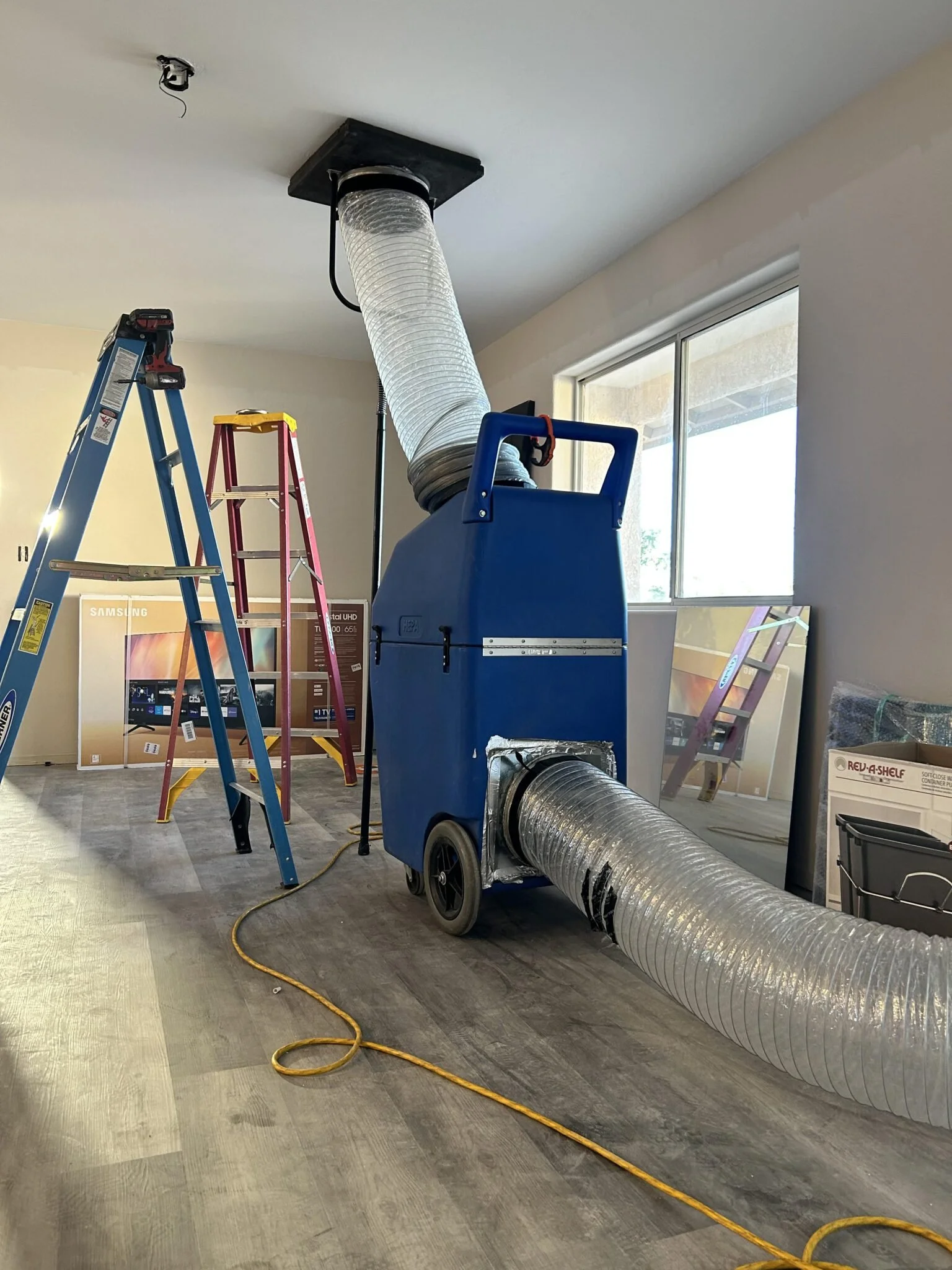
Seeing dust or debris around your vents? It could be a sign your ductwork needs attention. J Martin offers honest air duct inspections for Orange County homeowners.
What the EPA Actually Says (And Why It Matters)
Let's start with the most important thing most duct cleaning articles leave out. The EPA does not recommend routine air duct cleaning as a standard part of home maintenance. That's not our opinion. That's the EPA's official position, published in their guidance document titled "Should You Have the Air Ducts in Your Home Cleaned?"
The EPA's stance is nuanced, and it's worth understanding fully because it will save you from spending money unnecessarily while also helping you recognize when spending that money is genuinely warranted.
The EPA states that if nobody in your household suffers from allergies or unexplained symptoms, and if a visual inspection of the inside of your ducts shows no indication of contamination with large deposits of dust or mold, having your air ducts cleaned is probably unnecessary. They also note that indoor activities like cooking, cleaning, and general daily living can cause greater exposure to airborne contaminants than dirty air ducts. A light amount of household dust in your ductwork is normal and does not pose a health risk.
However, the EPA clearly identifies three situations where duct cleaning is recommended. First, if there is substantial visible mold growth inside hard surface ducts or on other components of your HVAC system. Second, if ducts are infested with vermin such as rodents or insects. Third, if ducts are clogged with excessive amounts of dust and debris, and particles are actually being released into the home through the supply registers.
The National Air Duct Cleaners Association (NADCA), the industry trade group, takes a slightly different position. NADCA recommends having your ducts cleaned every 3 to 5 years as preventive maintenance, with more frequent cleaning (every 2 to 3 years) for homes with pets, allergy sufferers, smokers, or recent renovations. This recommendation is more aggressive than the EPA's, which is understandable given that NADCA represents the companies that perform duct cleaning.
The honest answer, in our experience, falls somewhere between these two positions. Most homes don't need annual duct cleaning. Many homes don't need it every 3 years. But some homes absolutely do need it, and ignoring the warning signs can lead to real health consequences and measurably higher energy bills.
When You Genuinely Need Your Ducts Cleaned
Over the past 15 years, we've inspected thousands of duct systems in Orange County homes. Here are the situations where we consistently find that duct cleaning delivers real, measurable value.
After a home renovation or remodel. This is one of the clearest cases for duct cleaning. Construction generates enormous amounts of fine particulate matter: drywall dust, sawdust, paint chips, insulation fibers, and general debris. Even if the contractor sealed off the work area and changed your air filter, some of that material inevitably makes it into your duct system. In homes where we've inspected ductwork after a kitchen remodel or bathroom renovation, the interior surfaces of the ducts are often coated with a fine, gritty layer of construction dust that your standard air filter was never designed to catch. If you've had any kind of significant construction work done in the past year, cleaning your ducts is a smart investment.
When you move into a home you didn't build. You don't know what the previous owners did or didn't do. You don't know if they had pets, if they smoked, if they ever changed the air filter, or if they had construction work done without cleaning the ducts afterward. Starting with a clean system when you move in gives you a known baseline and eliminates whatever the previous occupants left behind.
Visible mold growth. If you can see mold on your vent registers, around your return grilles, or inside the ductwork when you remove a vent cover and look inside with a flashlight, that's a situation that requires professional attention. Mold in your duct system means mold spores are being circulated through every room in your house every time the system runs. This is particularly concerning in Orange County homes near the coast, where humidity from Newport Beach, Huntington Beach, and Dana Point can create conditions favorable to mold growth inside ductwork. It's also a concern in homes where the air conditioning system runs constantly during summer, as condensation on cold duct surfaces can create a moist environment if the ducts aren't properly insulated.
Pest infestation. If you've had rodents, insects, or other vermin in your ductwork, cleaning and sanitizing after the pest control company has addressed the infestation is essential. Rodent droppings, urine, nesting materials, and insect debris in your duct system create genuine health hazards that won't resolve on their own.
Unexplained allergy symptoms that worsen indoors. If family members are experiencing allergy-like symptoms (sneezing, congestion, itchy eyes, respiratory irritation) that are consistently worse when they're inside the house and improve when they leave, your duct system could be a contributing factor. This is especially true if you've already addressed the other common sources of poor indoor air quality like filter changes, humidity levels, and cleaning products. For households with allergy sufferers, duct cleaning combined with proper filtration can make a noticeable difference in symptom severity.
Visible dust being discharged from supply registers. If you can see puffs of dust or debris coming out of your vents when the system kicks on, your ducts are telling you something. A small amount of dust around the edges of a register is normal. Visible plumes of particles blowing out every time the blower starts is not.
Homes older than 15 to 20 years that have never had ductwork cleaned. If your home was built in the 1980s or 1990s and the ductwork has never been cleaned, two decades of accumulated dust, dead skin cells, pet dander (from previous owners or your own pets), pollen, and household debris has built up inside the system. Even if nobody is symptomatic, cleaning at that point addresses a significant accumulation that's reducing your system's efficiency and circulating decades of buildup through your living space.
What Duct Cleaning Should Cost in Orange County
This is where the conversation gets practical. A legitimate, professional duct cleaning for a standard single-family home in Orange County typically costs between $400 and $1,000, with most homes falling in the $400 to $600 range for a comprehensive cleaning of all supply and return ducts, registers, and the main trunk lines.
Here's how that pricing typically breaks down.
A standard cleaning for a home with 10 to 15 vents generally runs $370 to $550. This includes cleaning all supply and return registers, the main supply and return trunk lines, and basic cleaning of the blower compartment and air handler cabinet. A quality job on a home this size should take a two-person crew approximately 3 to 4 hours.
For larger homes with 16 to 25 vents, pricing increases to $500 to $800 due to the additional time and equipment access required. Homes with ductwork in difficult-to-reach locations, such as attics with limited clearance or multiple-story configurations with long duct runs, may be at the higher end of this range.
Additional services are where costs can climb further. Sanitizing and deodorizing treatments typically add $30 to $50 per application. Dryer vent cleaning (which is smart to bundle with duct cleaning) adds $100 to $200. If mold is discovered and requires remediation beyond basic cleaning, costs can increase significantly depending on the extent of contamination. And if the ductwork itself is damaged and needs sealing or partial replacement to actually function properly, that's a separate scope of work with its own pricing.
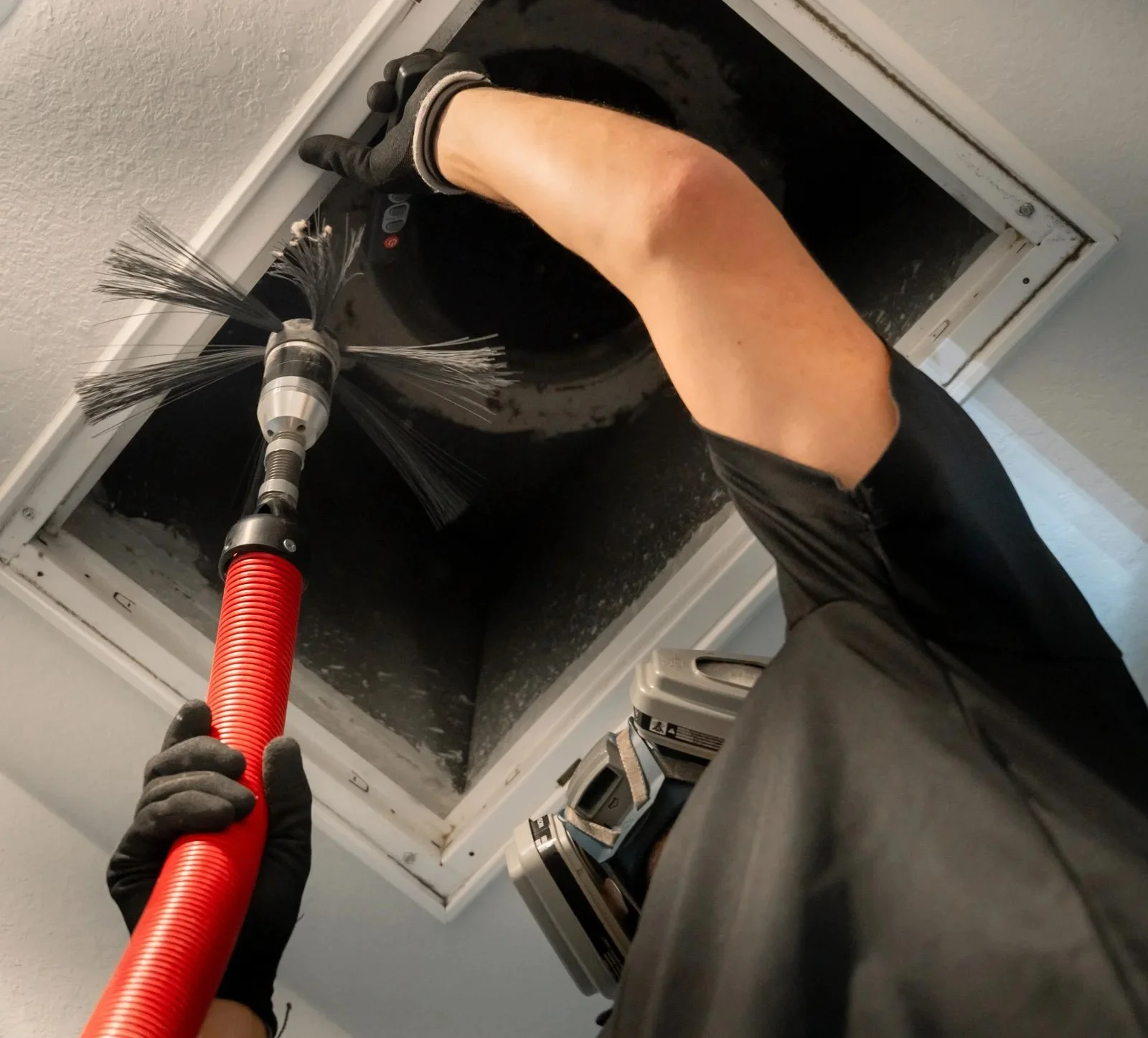
Seeing dust coming from your vents or noticing musty air when the system runs? J Martin offers honest air duct inspections for Orange County homeowners.
Per-vent pricing in Orange County generally ranges from $25 to $50 per vent, depending on the company and the scope of work included. Some companies quote a low per-vent price but charge extra for the main trunk lines, the blower compartment, or the return side of the system. Always ask what's included before comparing per-vent prices, because a $25-per-vent quote that doesn't include the trunk lines is not the same as a $40-per-vent quote that covers the entire system.
Seasonal pricing is also worth considering. Spring and early fall tend to be the best times to schedule duct cleaning in Orange County because demand is lower, crews are more available, and you're not competing with the emergency calls that dominate the summer months. During July and August, HVAC companies are overwhelmed with AC repair calls, and scheduling non-emergency services like duct cleaning often means longer wait times and less scheduling flexibility. If you're thinking about getting your ducts cleaned, booking it in March, April, or October gives you the best combination of availability and attention.
One more cost factor that's specific to Orange County: many homes in Yorba Linda, Brea, Fullerton, Anaheim Hills, and Villa Park were built between the 1970s and 1990s with flexible ductwork that runs through the attic. Attic access in these homes varies significantly. Some have walk-in attics with decent clearance. Others have low-clearance crawl spaces where technicians are working on their stomachs in 120-degree heat during summer months. Difficult attic access can add $100 to $200 to the total cost because of the additional time and physical difficulty involved. This is a legitimate added expense, not an upcharge, and any company that fails to mention it during the estimate and then adds it to the bill afterward is not operating transparently.
The $99 Scam and How It Works
If a company is offering whole-house duct cleaning for $99 or less, they are not going to clean your ducts for $99. That price exists for one reason: to get a technician inside your home. Once inside, one of two things will happen.
In the first scenario, the technician performs a minimal cleaning that involves running a basic vacuum attachment into each vent opening for 30 seconds to a minute, pulling out whatever loose debris is sitting at the register, and calling it done. No trunk lines are cleaned. No blower compartment is touched. No return side is addressed. The ducts look exactly the same 6 inches past the register as they did before the "cleaning." You paid $99 for something that accomplished nothing, and you'll be right back where you started.
In the second scenario (which is far more common and far more expensive), the technician inspects your system, shows you photos of contamination (which may or may not be accurately represented), and then presents you with a dramatically more expensive scope of work. Suddenly the $99 cleaning becomes $800 for "sanitization," $1,200 for "mold remediation," or $2,500 for "full system restoration." The technician creates urgency by telling you the contamination is a health hazard, that your family is breathing dangerous air, and that they can take care of it right now if you authorize the work. This is textbook bait-and-switch, and it's exactly the tactic the EPA warns homeowners about in their duct cleaning guidance. The EPA specifically advises homeowners not to hire duct cleaners who make sweeping claims about health benefits, because such claims are unsubstantiated.
Legitimate duct cleaning companies don't need $99 bait prices because their pricing reflects the actual cost of equipment, labor, and time required to do the job properly. A real duct cleaning requires specialized equipment including a truck-mounted or portable negative air machine (which costs $5,000 to $30,000), rotating brush systems designed for different duct types, and HEPA-filtered vacuum equipment. Operating this equipment properly takes trained technicians 3 to 4 hours for a standard home. The math simply doesn't work at $99.
What Legitimate Duct Cleaning Actually Involves
Understanding what a proper duct cleaning looks like helps you evaluate whether the company you're considering is doing real work or performing theater.
A professional duct cleaning starts with a system inspection. The technician should examine the ductwork at several access points, check the condition of the air handler and blower compartment, and assess the overall state of the system before starting any cleaning. This inspection determines the appropriate cleaning method and identifies any issues that need to be addressed.
Next, the crew sets up a negative air machine connected to the main trunk of the duct system. This creates negative pressure that pulls air (and the debris being dislodged) toward the vacuum source, preventing contaminants from being pushed into your living space during cleaning. This step is critical, and it's the step most cheap operators skip entirely. Without negative air containment, brushing and agitating the interior of the ducts just pushes contamination deeper into the system or blows it out through registers into your home. The EPA specifically warns that an inadequate vacuum collection system can release more dust and contaminants than leaving the ducts alone.
With negative air established, the technicians work through each supply and return run using rotating brush systems or compressed air tools designed to dislodge debris from the interior duct surfaces. Different duct types require different approaches. Rigid sheet metal ducts can handle aggressive mechanical brushing. Flexible ductwork (the corrugated plastic type common in many Orange County homes) requires softer tools and more careful technique to avoid tearing the duct material. A company that uses the same aggressive approach on flex duct that they'd use on sheet metal is going to damage your ductwork.
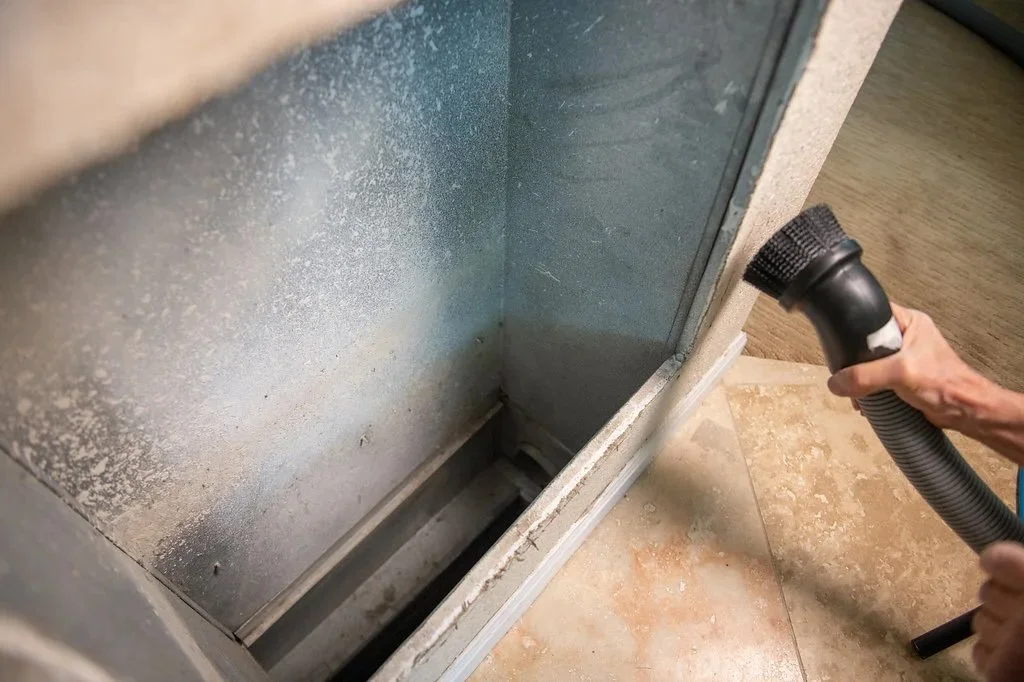
Dust buildup inside HVAC ductwork is one of the key factors that determines whether air duct cleaning is worth the cost in Orange County homes.
After the individual runs are cleaned, the crew addresses the main trunk lines, the return air plenum, and the blower compartment. The air handler cabinet and evaporator coil housing should also be cleaned or at minimum inspected. Registers and grilles are typically removed, cleaned, and reinstalled.
A thorough cleaning on a standard Orange County home with 10 to 15 vents takes 3 to 4 hours for a two-person crew. If someone tells you they can clean your entire system in 45 minutes, they are not cleaning your entire system.
What You Can Do Yourself (And What You Can't)
There are several things you can do to maintain decent air quality in your ducts without hiring anyone.
Remove your supply and return registers once or twice a year and wash them with soap and water. Dust and debris accumulate on these grilles, and every time the system cycles, air passes over that buildup. Clean registers are the easiest win for indoor air quality maintenance.
Vacuum around and into the visible portions of the duct opening behind each register. A standard household vacuum with a hose attachment can reach the first 12 to 18 inches of each duct run. This won't address what's deeper in the system, but it removes the most accessible accumulation.
Change your air filter on schedule. During the summer months in Orange County, when your system runs heavily, check the filter monthly and replace it when it looks gray or loaded. A clean filter is your ductwork's first line of defense against accumulation. Most filters should be replaced every 60 to 90 days during the cooling season, though homes with pets or high dust levels may need monthly changes. If you're not sure which filter rating to use, a MERV 8 to MERV 11 filter offers a good balance between particle capture and airflow for most residential systems. Going higher than MERV 13 without confirming your system can handle the added resistance can actually restrict airflow and cause the system to work harder, which defeats the purpose.
Keep the area around your return vents clear. Your return vents are where the system pulls air back in for recirculation, and anything on the floor near those vents (pet hair, dust bunnies, debris) gets pulled into the system and deposited in the ductwork.
Inspect the visible duct connections in your attic if you can safely access it. Look for obvious disconnections, torn flex duct, or sections where the duct has pulled away from the register boot or trunk line. You don't need to fix these yourself, but identifying them early means you can address the problem before it worsens. A disconnected duct run doesn't just waste energy; it dumps conditioned air into the attic while pulling hot, dusty attic air into the system and circulating it through your home.
Check the condensate drain near your indoor air handler unit. If you see standing water in the drain pan or moisture around the base of the unit, that's a mold risk that no amount of duct cleaning will resolve. The drain needs to be cleared and the underlying issue addressed before mold has a chance to develop and spread into the ductwork.
What you can't do yourself is clean the main trunk lines, reach deep into long duct runs, address the blower compartment and evaporator coil area, or set up the negative air containment that prevents contamination from spreading during cleaning. Those tasks require professional equipment and training.
How to Evaluate a Duct Cleaning Company
The duct cleaning industry has a reputation problem, and much of it is deserved. The barrier to entry is low, the equipment for a minimal operation is relatively inexpensive, and the average homeowner has no way to verify whether the work was done properly because the ducts are hidden from view. That combination attracts companies more interested in collecting fees than delivering results.
Here's how to separate the legitimate operators from the rest.
Ask whether they follow NADCA standards. NADCA (the National Air Duct Cleaners Association) publishes the ACR standard, which defines the minimum requirements for HVAC system cleaning. Companies that follow this standard are committed to a level of thoroughness and professionalism that goes well beyond running a vacuum hose into each vent for 30 seconds. You can verify NADCA membership and find certified professionals on the NADCA website.
Ask what equipment they use. A legitimate company will describe their negative air machine (truck-mounted or portable), their agitation tools (rotating brushes, air whips, or compressed air nozzles), and their HEPA filtration equipment. If the answer is vague, or if the equipment consists of a household vacuum and a shop vac, you're not getting a professional cleaning.
Ask for a written scope of work and a firm price before the work begins. A reputable company will tell you exactly what they're going to clean, how long it will take, and what it will cost. If they can't give you a firm price until "after they take a look," that's a setup for the upsell.
Ask how long the job will take. If the answer is under two hours for a standard home, the work will be insufficient. Three to four hours for a two-person crew on a standard 10-to-15-vent home is the baseline for a thorough job.
Check their license. In California, duct cleaning companies are required to hold a C-20 (Warm-Air Heating, Ventilating and Air Conditioning) license or a C-38 (Refrigeration) license. You can verify contractor licenses through the California Contractors State License Board. An unlicensed operator performing duct cleaning is both illegal and a sign that you're dealing with a company that doesn't meet basic professional standards.
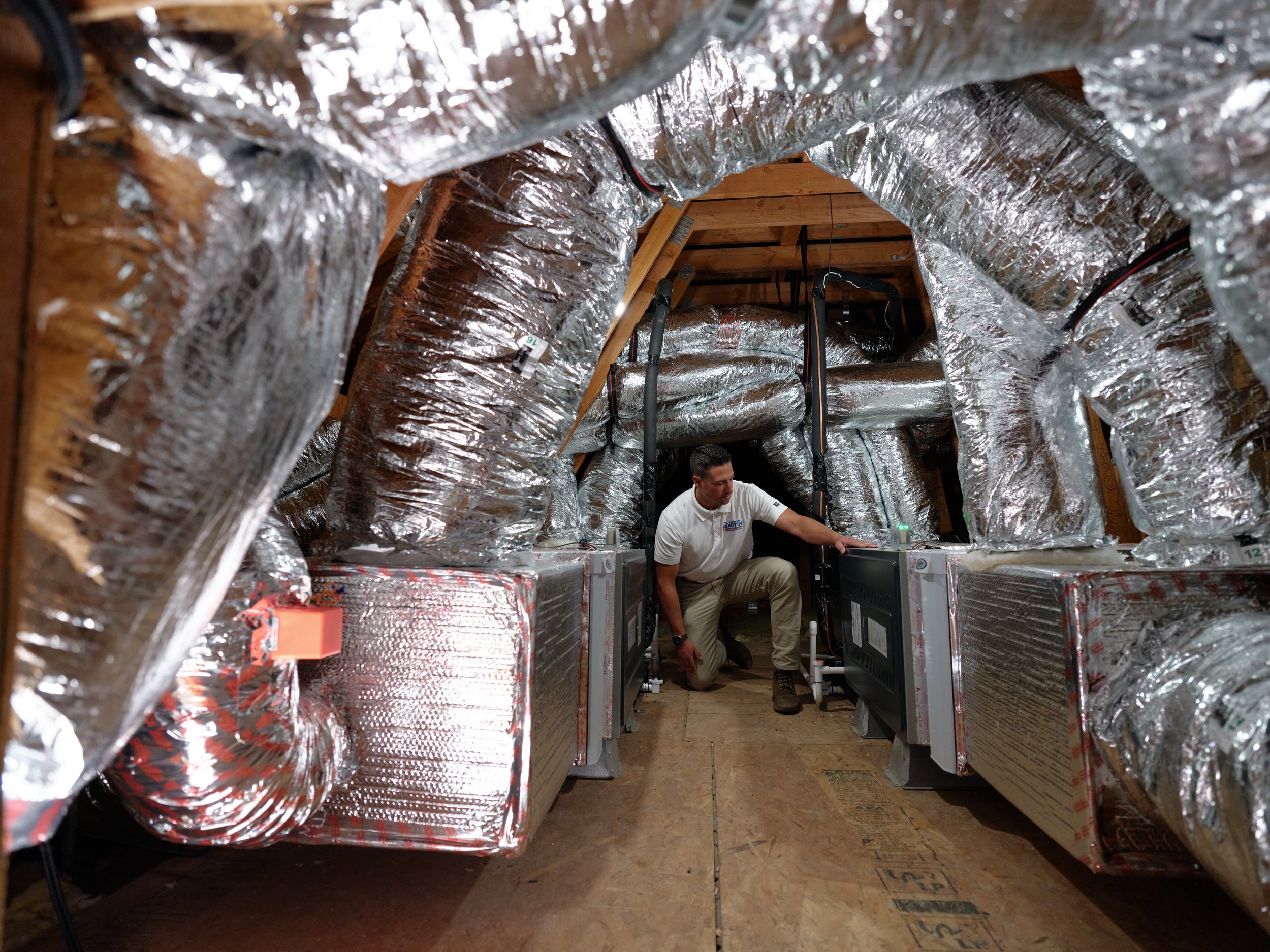
A proper air duct cleaning starts with a full system inspection. We check your attic ductwork to determine if cleaning is actually needed, not just recommended.
When Duct Cleaning Won't Solve Your Problem
Sometimes homeowners call for duct cleaning when the real issue is something else entirely, and an honest company will tell you that before taking your money.
If your ducts are old, deteriorated, disconnected, or severely damaged, cleaning them won't fix the problem. You can clean the interior of a flex duct that's torn, kinked, or separated at a joint, but you haven't addressed the fact that conditioned air is leaking into the attic instead of reaching your rooms. In many older Orange County homes, especially those built between the 1970s and 1990s, the ductwork itself has reached the end of its functional life. The connections have failed, the insulation has deteriorated, and the duct material has become brittle and inflexible. In these cases, duct replacement or professional sealing is the right solution, and spending $400 to $600 on cleaning ductwork that needs to be replaced is a waste of money.
We see this constantly in communities like Bryant Ranch, Travis Ranch, and East Lake Village in Yorba Linda, where homes from the late 1980s and early 1990s still have original flex duct that has been baking in attic temperatures exceeding 150 degrees for over 30 years. The outer vapor barrier has cracked, the fiberglass insulation has compressed and shifted, and the inner liner has become stiff and fragile. Cleaning this ductwork is like detailing a car with a cracked engine block. It might look better for a moment, but the fundamental problem hasn't changed. When we encounter ductwork in this condition during a cleaning assessment, we tell the homeowner directly: don't pay us to clean these ducts. Invest that money toward replacing them, because that's the solution that will actually improve your comfort and your energy efficiency.
If your air quality issues are caused by an undersized or missing return vent, duct cleaning won't help. If the problem is inadequate filtration, duct cleaning addresses the symptom but not the cause. If excess humidity is driving mold growth, cleaning the mold without addressing the moisture source means it will come back within months. And if the ductwork damage is severe enough that cleaning is pointless, the conversation shifts to duct replacement as part of a broader system upgrade. A company that diagnoses the actual problem rather than defaulting to "you need a duct cleaning" is a company worth trusting.
When to Call a Professional
The DIY steps above will help you maintain your system between professional services, but there are clear situations where you need someone with the right equipment and training.
Call a professional immediately if you see visible mold on or around your vent registers, if you smell a persistent musty or "dirty sock" odor when the system runs, if you've had a confirmed pest infestation in the walls or attic, or if family members are experiencing respiratory symptoms that worsen when they're home and the HVAC system is running. These are the situations the EPA specifically identifies as warranting professional duct cleaning, and waiting only allows the problem to get worse.
Schedule a professional assessment (not necessarily a full cleaning) if your home is more than 15 years old and the ducts have never been serviced, if you just moved into a previously owned home, if you recently completed a renovation, or if you've noticed a gradual increase in dust accumulation on surfaces despite regular cleaning. In these cases, a visual inspection of the duct interior can tell you whether a full cleaning is needed or whether your system is actually in fine shape. A good company will tell you honestly which category you fall into.
At J Martin, a duct inspection is part of our standard diagnostic process. We don't charge a separate fee for looking at your ducts and telling you what we see. If the inspection reveals that cleaning is warranted, we'll provide a firm, written price for the complete scope of work before we start. If it reveals that your ducts are clean and your air quality issue is coming from somewhere else, we'll tell you that and help you identify the actual source.
The J Martin Approach
Here's where we're going to be direct about something that might surprise you coming from a company that offers duct cleaning services.
We will tell you if you don't need your ducts cleaned. We do it regularly.
When a homeowner calls and asks about duct cleaning, our first step is always a visual inspection and an honest conversation about what's actually going on. If your ducts look fine, your air quality is good, and there's no specific trigger that warrants a cleaning, we'll tell you to save your money and we'll see you when there's actually a reason to do the work. That might cost us a sale today, but it earns us a customer for life, and that's always been a better trade.
When duct cleaning is warranted, we do it properly. Negative air containment, rotating brush systems appropriate for your duct type, complete cleaning of supply and return runs plus the main trunk lines, and a thorough inspection of the overall duct condition so we can identify any issues beyond cleanliness that might be affecting your system's performance or your home's air quality.
We also believe in showing you what we find. Before and after photos of the duct interior are standard with our service. We want you to see the condition of your ducts before we start and the condition after we finish, because that transparency is what separates legitimate duct cleaning from the companies that charge you $500 and leave you wondering whether anything actually happened. If we find issues beyond what a standard cleaning can address, whether that's damaged ductwork, mold that requires remediation, or a system design problem that's contributing to poor air quality, we'll explain it clearly and give you options rather than pressuring you into an immediate decision.
We've served over 5,000 families across Orange County since 2014, maintaining a 4.97-star rating across hundreds of verified reviews. We hold California Contractor's License #998956 and every one of our technicians is background-checked, trained, and paid a salary rather than a commission. When they tell you your ducts look fine, they're not losing money by being honest. That changes everything about the quality of the advice you receive.
If you're not sure whether your home would benefit from duct cleaning, or if you've been told by another company that you need an expensive cleaning and you want a second opinion before spending the money, call us at 714-462-4686. We'll take a look, tell you what we actually see, and help you decide whether it's worth the investment. And if it's not, we'll shake your hand and tell you to call us when it is.