
How to Read an HVAC Quote Without Getting Ripped Off
Updated on May 15, 2026
You've done the responsible thing. You called three HVAC companies for quotes on a new system, and now you're sitting at your kitchen table with three pieces of paper in front of you. One quote is $8,900. Another is $12,500. The third is $14,200. They're all for the same house, supposedly solving the same problem, and somehow the prices are thousands of dollars apart. If you're like most homeowners, you're staring at these numbers thinking, "I have no idea how to tell which one of these is actually a good deal."
You're not alone. HVAC quotes are one of the most confusing documents a homeowner will ever try to compare, and that confusion is exactly what less-than-honest companies rely on. A vague quote with a low bottom line can hide thousands in missing work, cheap equipment, or fees that magically appear after the install begins. A detailed quote with a higher total might actually be the better value because it includes everything you need and nothing you don't.
The difference between reading a quote correctly and reading it wrong can easily be $3,000 to $5,000. This guide is going to teach you how to read every line item, what each one should cost, and what the red flags look like so you never have to wonder whether you're getting a fair deal.

HVAC quotes can vary by thousands of dollars. Before you sign anything, make sure you understand every line item and what you're actually paying for.
Why HVAC Quotes Are So Confusing in the First Place
Before we get into the line items, it helps to understand why quotes vary so much. It's not just about companies charging different prices for the same thing. In most cases, they're not quoting the same thing at all.
HVAC companies use different pricing models. Some use flat-rate pricing where the total is bundled into one number. Others itemize every component separately so you can see exactly what you're paying for equipment, labor, materials, and permits individually. Neither approach is inherently dishonest, but a flat-rate quote makes it much harder to compare against an itemized one, and some companies know that.
Equipment choices drive massive price differences too. A basic single-stage 14 SEER2 air conditioner from a builder-grade brand costs significantly less than a variable-speed 20 SEER2 unit from a premium manufacturer. Both will cool your house, but they represent completely different levels of efficiency, noise, humidity control, and longevity. If one quote specifies a Goodman 14.5 SEER2 system and another specifies an American Standard variable-speed system, you're comparing a Toyota Corolla to a Lexus. Both are fine vehicles, but you'd never judge them by sticker price alone.
Then there's the scope of work. One company might include new refrigerant lines, a concrete pad, and a smart thermostat. Another might list those as optional add-ons or leave them out entirely, quoting only the bare minimum to get the system running. If you compare the bottom-line totals without accounting for these differences, you'll end up choosing the company that left the most out of their quote, and you'll pay for those missing items later.
The Seven Things Every Legitimate HVAC Quote Should Include
A professional HVAC quote is both a pricing document and a project roadmap. If any of the following elements are missing, that's your first warning sign.
Equipment identification with brand, model number, and efficiency rating. This is non-negotiable. Every legitimate quote should specify the exact brand name, full model numbers, and efficiency ratings for every major component being installed. That means the outdoor condensing unit (air conditioner or heat pump), the indoor unit (furnace or air handler), and the evaporator coil. If a quote just says "3-ton air conditioner" without listing the brand and model, you have no way to verify the equipment quality, compare it against other quotes, or confirm what warranty you're getting. A proper equipment listing looks something like "American Standard Silver 14, Model 4A7A4036L1000A, 14.3 SEER2" or "Carrier Comfort Series 24ACC636A003, 15.2 SEER2." The model numbers matter because they let you look up the exact specs, retail pricing, and warranty terms independently. When a company leaves them out, it's usually because they don't want you doing that research.
Labor as a separate line item. Labor typically accounts for 30 to 50 percent of the total cost of an HVAC installation. That's a huge portion of what you're paying for, and it should be clearly broken down. The labor section should describe the scope of work: removal and disposal of the old system, installation of all new components, system testing, calibration, refrigerant charging, and cleanup. In Orange County, labor for a standard residential HVAC replacement typically runs between $2,500 and $5,000 depending on the complexity of the job. Attic installations, rooftop units, and multi-story homes take more time and cost more. If labor and equipment are bundled into a single line item with no breakdown, you can't tell whether you're overpaying for labor, getting cheap equipment with inflated labor charges, or both.
Permits and inspections. In Orange County, a mechanical permit is required for HVAC system replacements. This isn't optional. A permit ensures the installation meets local building codes and will be inspected by the city or county after completion. Permit costs in the OC area typically range from $150 to $400 depending on the municipality. If a quote doesn't include permits, ask why. Contractors who offer unusually low bids sometimes achieve those prices by skipping the permit process entirely. This is illegal, it voids most manufacturer warranties, it creates problems when you try to sell your home, and it means nobody is verifying that your system was installed safely and correctly. The presence or absence of a permit line item is actually one of the most reliable indicators of whether a company is legitimate.
Warranty details for both equipment and labor. Most major HVAC manufacturers offer a 10-year parts warranty on their equipment, but that warranty is only valid if the system is installed by a licensed contractor and properly registered. Your quote should specify both the manufacturer's equipment warranty and the company's labor warranty. The labor warranty covers the installation work itself, and it varies widely between companies. Some offer one year, some offer five, and some offer ten. A company that stands behind its work with a strong labor warranty is telling you something important about the quality of their installation teams. Ask specifically what happens if something goes wrong within the first year, the first five years, and beyond. Get the answer in writing on the quote.
Materials and accessories. Beyond the major equipment, a proper installation requires a range of supporting materials: refrigerant lines (often called line sets), a new condensate drain line, a condenser pad, electrical wiring and disconnect, a new thermostat (or confirmation that your existing one is compatible), and potentially a new filter rack or transition fittings. These items might seem small individually, but they add up. New copper line sets alone can cost $200 to $500 depending on length and diameter. A smart thermostat adds $150 to $350. If these items aren't listed on the quote, either they're bundled into the equipment or labor line (acceptable if the total seems reasonable) or they've been left out entirely (a problem, because you'll be charged for them during installation).
Removal and disposal of old equipment. Someone has to disconnect, remove, and properly dispose of your old system. This includes recovering the refrigerant in accordance with EPA regulations, which requires specialized equipment and certification. Most reputable companies include this in their quote. If it's not mentioned, ask whether it's included or whether there's a separate charge. Old equipment disposal typically costs $100 to $300 if it's charged separately, though many companies fold it into the overall labor cost.
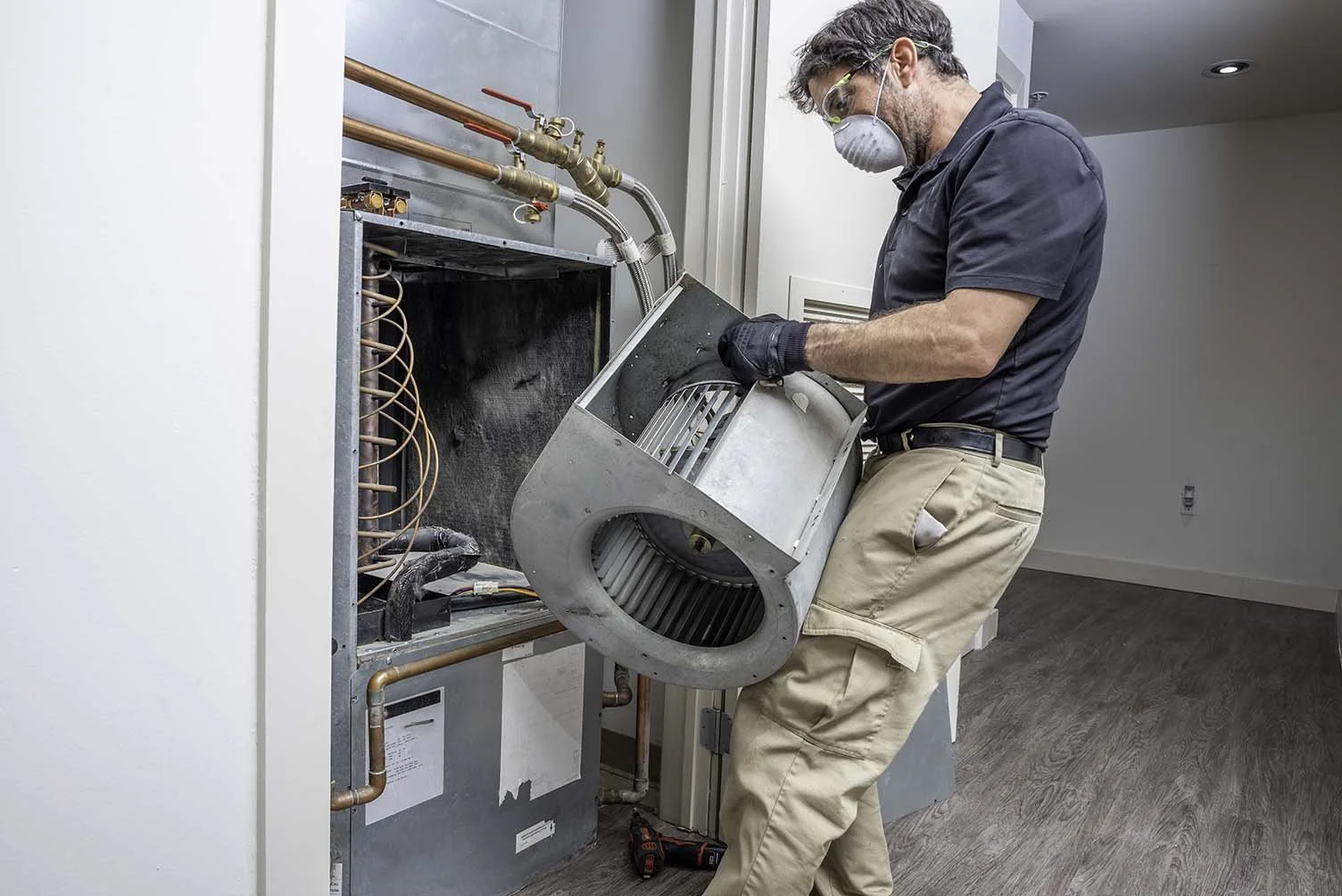
Repairs like blower motor replacement can significantly affect the cost of an HVAC quote, which is why understanding each line item matters.
Start date, estimated completion time, and payment terms. A professional quote should tell you when the work will begin, how long it will take (most residential replacements take one day, though complex installations can take two), and how payment is structured. Typical payment terms involve either full payment upon completion or a deposit (usually 10 to 30 percent) with the balance due at completion. Be cautious of any company that demands full payment before the work begins. That's an industry red flag for a reason.
What Fair Pricing Actually Looks Like in Orange County
One of the hardest parts of evaluating a quote is knowing whether the total is reasonable for your area. National averages don't tell the full story because labor rates, permit costs, and energy code requirements vary significantly by region. California in general, and Orange County specifically, sits at the higher end of the national range due to stricter building codes (including Title 24 energy compliance), higher labor costs, and longer cooling seasons that demand properly sized and installed equipment.
For a standard HVAC replacement in Orange County in 2025 and 2026, here's what the major categories should look like for a typical 3-ton system in a 1,200 to 1,800 square foot home.
Equipment for a standard efficiency AC and furnace combination (14 to 16 SEER2, single-stage) typically runs $3,500 to $5,500 at contractor pricing, which includes the outdoor condenser, indoor furnace or air handler, and evaporator coil. Mid-range systems (17 to 18 SEER2, two-stage) push equipment costs to $5,000 to $8,000. High-efficiency variable-speed systems can reach $7,000 to $12,000 or more for equipment alone.
Labor for a straightforward change-out where the existing ductwork is in good condition and no electrical upgrades are needed typically runs $2,500 to $4,500 in Orange County. If the installation involves attic work, rooftop access, or significant modifications, labor can climb to $4,000 to $6,000 or more.
Materials, accessories, permits, and disposal collectively add $500 to $1,500 to the total. This covers line sets, the condensate line, thermostat, pad, disconnect, permit fees, and old system removal.
When you add it all up, a standard efficiency full system replacement in Orange County should fall in the range of $9,500 to $13,500 installed. Mid-range systems land between $12,000 and $18,000. High-efficiency or premium systems can reach $16,000 to $25,000 or more, particularly for heat pump conversions or multi-zone setups.
If a quote comes in dramatically below these ranges, something is missing. If it comes in far above, something may be inflated. Either way, knowing the benchmarks gives you the leverage to ask the right questions.
It's also worth understanding how these numbers compare to what you'd spend on AC repairs. A major repair like a compressor replacement runs $1,200 to $2,500, and an evaporator coil replacement can cost $1,500 to $4,500 depending on warranty status. When you're looking at a repair that costs $2,000 or more on a system that's past the 10-year mark, and a full replacement quote comes in at $10,000 to $13,000, the math starts to change. The repair feels cheaper in the moment, but when you factor in the age of the equipment, the likelihood of additional failures, and the energy savings from modern equipment, the replacement often delivers better value over the next five to ten years. A good HVAC company will walk you through this comparison honestly and help you see the full picture, not just the number that makes their cash register ring.
Understanding What You're Really Paying For
Here's something most homeowners don't realize: you're not just paying for a metal box that sits outside your house. You're paying for engineering, expertise, and execution.
A properly installed HVAC system requires a Manual J load calculation to determine the right equipment size, proper refrigerant line sizing, correct electrical connections, code-compliant gas piping (if applicable), system commissioning with verified airflow and refrigerant charge, and a final inspection by the local building department. Every one of these steps requires training, tools, and time. Skipping any of them leads to problems that range from annoying (uneven temperatures, high energy bills) to dangerous (gas leaks, electrical fires, carbon monoxide exposure).
When you see a quote that's $3,000 less than everyone else's, ask yourself: where did that $3,000 go? Usually, it came out of the labor hours (the installation was rushed), the quality of materials (cheaper line sets, no new disconnect, reused drain line), the permitting process (skipped entirely), or the system design (no load calculation, just matched whatever tonnage was there before). Those shortcuts save the company money today but cost you money for the next 10 to 15 years through higher energy bills, more frequent repairs, and a system that never quite keeps your home comfortable.
This is why the cheapest quote is almost never the cheapest option in the long run. The companies that charge a fair price and do the job right the first time end up saving you more over the life of the system than the company that cut corners to get your signature. Think of it this way: the equipment you choose determines your energy costs for the next 15 years, and the quality of the installation determines whether that equipment performs the way it was designed to or falls short of its potential from day one.
The Red Flags That Should Make You Walk Away
Over the past 15 years serving Orange County, we've seen every questionable tactic in the book. Here are the ones that should concern you the most.
The quote is a single lump sum with no breakdown. A quote that says "HVAC System Installation: $11,000" and nothing else is not a quote. It's a guess dressed up as a number. Without line items, you can't verify the equipment quality, confirm the scope of work, or compare it meaningfully against other bids. A transparent company has nothing to hide, and their quote should reflect that. If a company resists providing an itemized breakdown when you ask for one, that tells you everything you need to know about how they do business.
No model numbers or brand names listed. If the quote says "3-ton, 16 SEER air conditioner" without naming the manufacturer and model, the company is reserving the right to install whatever equipment they choose on the day of installation. Sometimes that means you get a premium brand. More often, it means you get whatever they had left on the truck or whatever carried the highest margin for them that week. Insist on specific model numbers in writing.
The price is dramatically lower than every other quote. The cheapest quote is almost never the best value. HVAC scams frequently start with a lowball estimate designed to get you to say yes. Once the work begins, these companies "discover" additional problems that require more money. Your $7,500 quote becomes $11,000 by the time the job is finished, and you feel trapped because your old system has already been ripped out. A legitimate company that's quoting thousands less than its competitors is either cutting corners on equipment, skipping permits, using unlicensed labor, or planning to make up the difference with change orders. None of those scenarios end well for you.
No mention of permits. As we covered earlier, mechanical permits are required by law for HVAC replacements in every city in Orange County. A company that doesn't include permits on their quote is either planning to skip them (which is illegal and voids your warranty) or planning to charge you separately after the fact. Either way, it's a sign that the company is not operating at a professional level.

We see this all the time in Orange County: three HVAC quotes, thousands of dollars apart, and no clear explanation why. Understanding the details is the key to choosing the right system.
High-pressure sales tactics or "today only" pricing. If a salesperson tells you the quoted price is only good for 24 hours, or that they can only hold the discount if you sign right now, that's a textbook high-pressure tactic designed to prevent you from getting competing quotes. Legitimate companies understand that a $10,000 to $15,000 decision takes time. They'll hold their pricing for a reasonable period and encourage you to do your homework. At J Martin, we've never used artificial urgency because we don't need to. Our quotes stand on their own merit.
Commission-based technicians. This one isn't always visible on the quote itself, but it's worth asking about. When the person diagnosing your system and recommending solutions earns a commission on what they sell, their financial incentive and your financial interest are in direct conflict. They make more money when you spend more money, which creates an inherent motivation to recommend replacement over repair, to upsell premium equipment when standard would serve you fine, or to diagnose problems that may not exist. Non-commissioned companies eliminate this conflict entirely. Our technicians at J Martin earn the same wage regardless of whether they recommend a $200 repair or a $15,000 system replacement, and that changes everything about the quality of the advice you receive.
How to Compare Quotes Like a Pro
Once you have two or three detailed quotes in hand, comparing them properly requires a methodical approach. Here's how to do it.
First, make sure you're comparing equivalent equipment. Pull the model numbers from each quote and look them up. Verify that you're comparing the same tonnage, the same SEER2 rating, and the same type of system. A quote for a 14 SEER2 single-stage system should only be compared against other 14 SEER2 single-stage systems. If one company is quoting you a variable-speed 20 SEER2 heat pump and another is quoting a basic single-stage AC, you're comparing completely different products and the price difference is expected.
Second, compare the scope of work line by line. Does each quote include the same components? Does one include a new thermostat while the other doesn't? Does one include ductwork modifications that the other doesn't mention? Does one include the permit while the other leaves it out? Write down every item from the most detailed quote, then check whether the other quotes include those same items. The items that are missing from the cheaper quotes are the ones you'll end up paying for anyway, either as surprise charges during installation or as problems that show up after the job is done.
Third, evaluate the warranty coverage. A 10-year parts warranty from the manufacturer is standard across most major brands, but the labor warranty varies enormously between companies. A company offering a 1-year labor warranty is telling you they're not confident their installation will hold up beyond the first year. A company offering 5 to 10 years of labor coverage is making a real commitment to the quality of their work. When you factor the value of that extended protection into the price comparison, a higher-priced quote with a longer warranty may actually deliver better value over the life of the system.
Fourth, check the company's credentials. Before comparing prices, verify that every company on your list holds an active California CSLB contractor's license, carries proper insurance (general liability and workers' compensation), and has a track record of positive reviews from real customers. You can verify contractor licenses at the California Contractors State License Board website for free. If a company can't provide a license number or their license status shows issues, remove them from your comparison entirely. Price is irrelevant if the company isn't qualified to do the work.
Fifth, ask about the installation team. Will the company send its own W-2 employees, or will they subcontract the installation to a third party? This matters more than most homeowners realize. When a company uses its own trained installation crews, those technicians are accountable to the company's standards, covered by the company's insurance, and familiar with the company's quality expectations. Subcontracted installers may be perfectly competent, but the accountability chain is weaker, and if something goes wrong, you can find yourself caught between two companies pointing fingers at each other. At J Martin, every installation is performed by our own full-time, background-checked team members. We don't sub out our work because we don't want anyone else's standards in our customers' homes.
What to Do Before the Technician Arrives
You can set yourself up for a better quoting experience by doing a little homework before the first company shows up. Start by locating your existing equipment and writing down the brand, model number, and any information on the nameplate of both the indoor and outdoor units. This gives you a baseline so you know what you currently have and can evaluate whether the proposed replacement is a step up or a lateral move.
Next, measure the square footage of your home, note how many stories it has, and think about any comfort issues you've been experiencing. Are certain rooms always too hot? Is the upstairs significantly warmer than the downstairs? Does the system run constantly during heat waves without reaching the set temperature? These details help a good technician design the right system for your home, and they also help you evaluate whether the company is actually assessing your home's needs or just quoting a generic replacement.
If your home was built before 2000, pay attention to what the technician says about your ductwork. In many Orange County homes from the 1970s through 1990s, the original ductwork has deteriorated significantly after decades in attic temperatures that regularly exceed 150 degrees in summer. Leaky or damaged ductwork can reduce the efficiency of even a brand-new system by 20 to 30 percent. A company that inspects your ducts and discusses their condition is being thorough. A company that never mentions ductwork despite your home being 30 or 40 years old may be cutting corners on the assessment.
Finally, don't be afraid to ask questions during the visit. Ask the technician whether they performed a load calculation (also called a Manual J calculation) to determine the correct system size for your home. A load calculation considers your home's square footage, insulation levels, window placement, ceiling height, and local climate to determine exactly how much cooling capacity you need. A company that sizes your system based on a load calculation is doing the job right. A company that just matches your existing tonnage without any analysis is guessing, and guessing leads to oversized or undersized systems that cost you money for years.
When to Call a Professional (And Who to Call)
If you're in the market for a new HVAC system, the quoting process itself is your first interaction with the companies you're considering. Pay attention to how they treat you during this phase, because it's the best predictor of how they'll treat you during installation and for years afterward.
A trustworthy HVAC company will spend 60 to 90 minutes at your home for a replacement consultation. They'll inspect your existing equipment, check your ductwork, discuss your comfort concerns, and take measurements. They'll present options at different price points rather than pushing a single solution. They'll provide a written quote with full line-item detail, and they'll give you time to review it without pressure.

A clear HVAC quote should never feel confusing. A reputable contractor will explain equipment, labor, permits, and warranties so homeowners know exactly what they’re paying for.
If you're not sure whether you need a full replacement or just a repair, a good company will tell you honestly. At J Martin, our goal is always the most cost-effective solution first. Ninety-five percent of the time, a same-day fix is all that's needed. When replacement is genuinely the better path, we walk you through exactly why the numbers support that decision and let you make the call on your own timeline.
We've served over 5,000 families across Orange County since 2014, from Yorba Linda and Anaheim to Newport Beach and Mission Viejo. Our technicians are background-checked, licensed, and certified, and they're paid a salary, not a commission. That means when they tell you what your home needs, they're telling you what your home actually needs. Not what their paycheck needs.
Every quote we provide is written, detailed, and fully itemized. Equipment brand and model numbers are always specified. Permits are always included. Warranty terms are always spelled out. And if you want to take two weeks to compare us against other companies, we'll be here when you're ready. No pressure, no expiration date, no gimmicks.
If you're getting ready to replace your HVAC system and want a quote you can actually understand and trust, call us at 714-462-4686. We'll schedule a time to come out, assess your home properly, and give you a quote that tells you exactly what you're getting, what it costs, and why. That's how it should work. And at J Martin, that's how it always does.
J Martin Indoor Air Quality | (714) 462-4686 | Services