
Ductless Mini Splits in Orange County: Costs, Pros and Cons, and Best Uses for Your Home
Updated on May 23, 2026
You just finished converting your garage into a home gym, but there's a problem: it's 95°F in there during summer afternoons and you can't extend your home's ductwork without tearing apart walls and spending a fortune. Or maybe you've got a 1940s Yorba Linda home with beautiful original plaster walls and radiant heat but no air conditioning ductwork, and the thought of cutting into those walls makes you cringe. Or perhaps you built a beautiful room addition but connecting it to your existing HVAC system would require replacing the entire unit to handle the extra load.
These are exactly the situations where ductless mini split systems shine. Unlike traditional HVAC that requires extensive ductwork snaking through walls and ceilings, mini splits deliver powerful heating and cooling through a simple connection between an outdoor unit and wall-mounted indoor units. The installation requires nothing more than a three-inch hole through your wall for refrigerant lines, and you can have the system up and running in a day.
After installing mini split systems across Orange County for over 15 years in everything from historic Anaheim homes to modern Brea additions to converted Villa Park garages, I've seen firsthand when these systems are absolute game-changers and when traditional HVAC makes more sense. This guide breaks down everything you need to know about mini splits specifically for Orange County homeowners, including real local costs, how our climate affects performance, and whether they're the right solution for your specific situation.
What Are Ductless Mini Splits and How Do They Actually Work?
A ductless mini split system is exactly what it sounds like: a heating and cooling system that doesn't require ductwork. Instead of moving conditioned air through ducts like a traditional forced-air system, mini splits deliver temperature-controlled air directly into the room where the indoor unit is mounted. The system consists of two main components. The outdoor condenser unit sits outside your home just like a traditional AC condenser. It contains the compressor, a heat exchanger, a fan, and the refrigerant system. The indoor air handler units mount on your wall, ceiling, or floor inside the rooms you want to condition. Each indoor unit contains its own heat exchanger, blower fan, air filter, and thermostat controls.
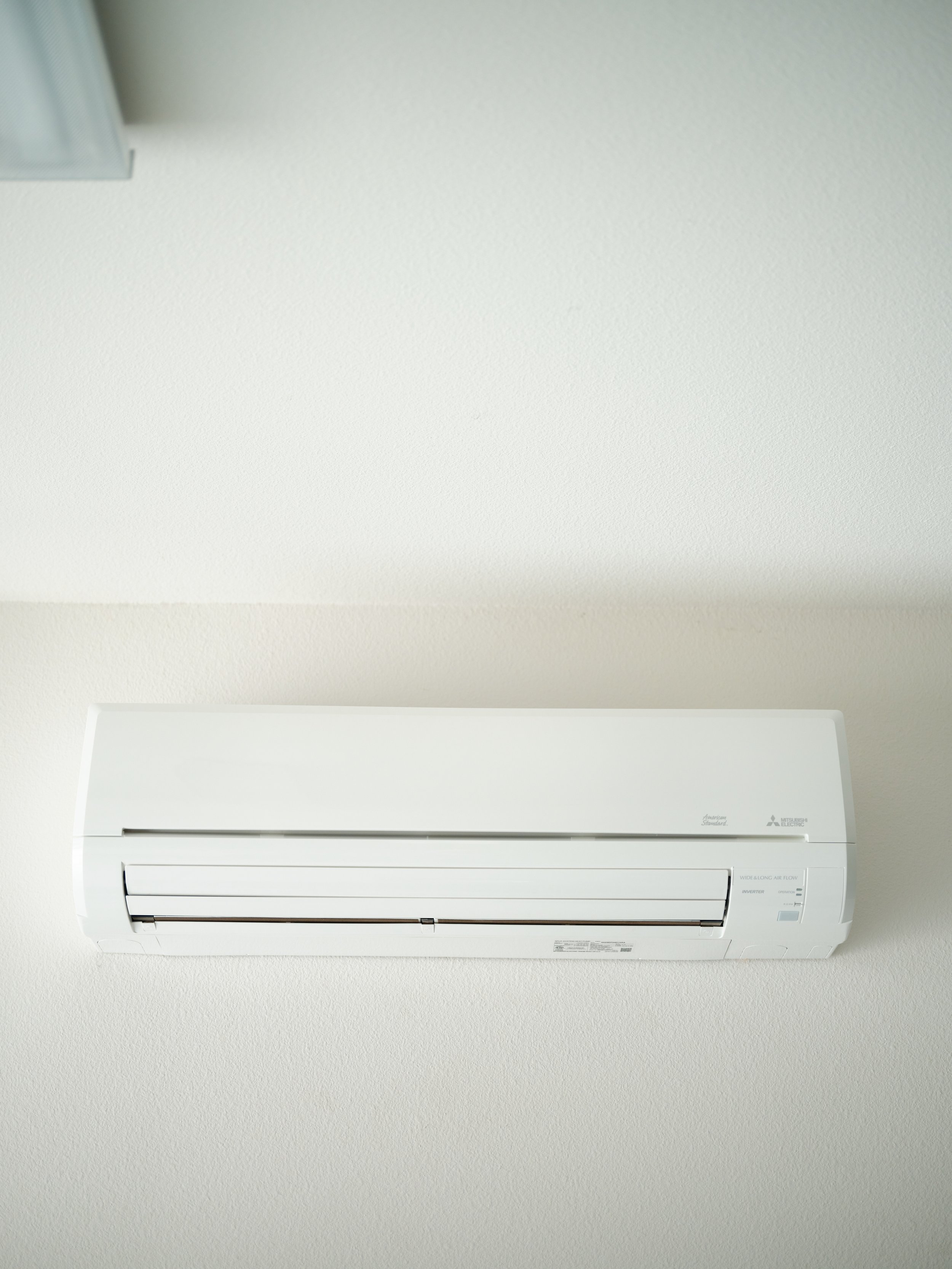
Thinking about adding AC to a room with no ductwork? A mini split like this one can be installed in a single day. Call J Martin at (714) 406-5001.
These components connect through a small bundle of refrigerant lines, power cables, and a condensate drain that runs through that three-inch hole in your wall. That's it. No cutting into ceilings for ductwork. No tearing apart walls. No running sheet metal through your attic. Just a slim conduit that's barely noticeable once installation is complete. The way mini splits work is fundamentally similar to any heat pump system. In cooling mode, the indoor unit pulls warm air from your room, passes it over cold refrigerant coils that absorb the heat, and blows the cooled air back into the space. The absorbed heat transfers to the outdoor unit where it's expelled outside. In heating mode, the process reverses. The outdoor unit extracts heat from outside air even when it's cold and transfers it inside to warm your space. This heat pump technology is incredibly efficient because you're moving heat rather than generating it through combustion or electric resistance.
What makes mini splits special is the zoned control they provide. In a traditional ducted system, your whole house is essentially one big zone controlled by a single thermostat. If you turn on the AC, every room gets cooled whether it needs it or not. With a mini split system, each indoor unit operates independently with its own temperature controls. You can keep your garage at 65°F for working out while the rest of your house is off. You can cool a sun-drenched bedroom without affecting other rooms. This independence creates both comfort benefits and significant energy savings because you're only conditioning the specific spaces you're actually using.
Modern mini splits use inverter-driven variable-speed compressors that continuously adjust their output to match heating and cooling demand rather than cycling on and off like traditional systems. When your room needs just a little cooling, the compressor runs at low speed using minimal energy. When demand increases, it ramps up smoothly. This variable operation is both more efficient and more comfortable because temperature stays steady instead of swinging up and down through on-off cycles.
Real Orange County Mini Split Installation Costs for 2025-2026
Let's talk about what you'll actually pay to have a mini split system installed in Orange County right now, because cost is probably your first big question. A single-zone mini split system serving one room or area typically costs between $4,000 and $9,000 installed in Orange County. This includes a 9,000 to 18,000 BTU wall-mounted indoor unit, the outdoor condenser, all refrigerant lines and electrical connections, professional installation with permits, and startup and testing. The wide range depends on the brand you choose, the efficiency rating, and any electrical work needed. A basic 12,000 BTU system from a value brand like Pioneer or Gree might land on the lower end around $2,800 to $3,500. A premium Mitsubishi or Daikin system with higher efficiency ratings runs $4,500 to $6,000 for the same cooling capacity.
For a dual-zone system with two indoor units serving two separate areas, expect to pay between $5,000 and $8,500 installed. This uses a single outdoor unit that can handle the combined cooling load of both indoor units. Multi-zone systems with three to five indoor units serving different areas of your home range from $8,000 to $15,000 or more depending on the total capacity needed and brand selection. These larger installations are essentially replacing or supplementing your whole-home HVAC and represent significant projects.
The cost breakdown helps you understand where the money goes. The equipment itself accounts for roughly 50% to 60% of the total. Indoor air handlers cost $400 to $1,800 each depending on capacity and features. The outdoor condenser runs $800 to $3,000 depending on how many zones it supports and the brand. Refrigerant lines, electrical components, mounting hardware, and other materials add another $200 to $500. Professional installation labor typically runs $800 to $2,500 depending on installation complexity, the number of zones, and how difficult it is to run refrigerant lines and make electrical connections. In Orange County's higher cost-of-living market, expect labor on the upper end of that range.

We walk you through every option, from costs to pros and cons, so you can make the right decision for your home. No pressure, just honest advice from the J Martin team.
Additional costs to factor in include electrical work if you need a new dedicated circuit or panel upgrade, which can add $300 to $1,500. Permits generally run $150 to $400 depending on your city. Some installations require a concrete pad for the outdoor unit costing $100 to $300 if one doesn't exist. If you want ceiling-mounted cassette units instead of standard wall-mounted units, that adds labor complexity and typically increases costs by $500 to $1,000 per indoor unit.
Brand choice significantly impacts cost, so it's worth understanding the landscape. Budget-friendly brands like Pioneer, Gree, and Senville offer single-zone systems starting around $2,000 to $3,500 installed. These are capable systems that do the job, though they may lack some premium features and their long-term reliability track record isn't as established. Mid-range brands like LG, Carrier, and Bryant fall in the $3,500 to $5,500 range for single zones. They offer good performance, decent warranties, and solid reliability. Premium brands including Mitsubishi, Daikin, and Fujitsu command $4,500 to $7,000 or more for single zones but they deliver exceptional efficiency, whisper-quiet operation, the most advanced features, and best-in-class reliability backed by strong warranties.
Operating costs are where mini splits often shine compared to traditional systems. Because they're so efficient and you can zone your cooling and heating, monthly energy costs can be 20% to 40% lower than running traditional ducted HVAC for the same spaces. The exact savings depend on how you use the system, your utility rates, and what you're comparing against. A single mini split serving a 400 square foot garage that you cool only when you're working out might cost $15 to $30 per month to run during summer. That same space connected to your whole-house AC would force you to run the entire system, likely costing $100+ monthly even for intermittent garage use.
Federal tax credits and local rebates can significantly reduce your out-of-pocket costs. In 2025 and 2026, high-efficiency mini split heat pumps qualify for federal tax credits up to $2,000 under the Inflation Reduction Act's 25C provision. Southern California Edison offers rebates ranging from $350 to $3,500 depending on the system efficiency and whether you qualify for income-based incentives. These incentives can reduce your actual cost by 15% to 30% or more, making a $5,000 system cost you $3,500 to $4,000 after rebates and credits.
The Pros: Why Mini Splits Work So Well in Orange County
Understanding the advantages of mini splits helps you recognize situations where they're the clear winner over traditional HVAC. Installation simplicity is perhaps the biggest practical advantage. We've completed single-zone garage installations in four to six hours from start to finish. Compare that to extending ductwork and upsizing a central HVAC system, which can take multiple days and requires cutting into walls, ceilings, and potentially moving electrical or plumbing that's in the way. The minimally invasive installation of a mini split means less disruption to your life and your home's structure.
This installation simplicity becomes particularly valuable in Orange County's older homes. Many houses built before the 1970s have no ductwork at all, relying on wall heaters, floor furnaces, or window AC units for climate control. Installing whole-home ductwork in these houses requires extensive demolition and reconstruction that can easily run $10,000 to $20,000 just for the ductwork before you even consider the HVAC equipment. Mini splits let you add modern, efficient heating and cooling without touching your walls.
Energy efficiency is where mini splits truly excel. The best systems achieve SEER2 ratings of 28 or higher for cooling and HSPF2 ratings above 12 for heating. Traditional ducted systems typically max out around 18 to 20 SEER2. That efficiency difference translates to real money on your monthly bills. Additionally, because mini splits deliver air directly into the room rather than through ductwork, you avoid the 25% to 30% energy loss that occurs in typical duct systems due to air leakage and heat transfer through duct walls. In Orange County where cooling loads dominate and systems run heavily from May through October, that efficiency compounds into significant annual savings.
Zoned temperature control gives you comfort and cost benefits that traditional systems simply can't match. Each indoor unit operates independently, so you can cool your home office to 72°F for focused work while leaving unused bedrooms at 78°F. You can heat a converted garage workshop to 68°F on a winter morning without heating your whole house. You're not forced into the all-or-nothing proposition of traditional HVAC where turning on the system means conditioning every room connected to the ductwork whether those rooms need it or not. This targeted conditioning saves energy and gives everyone in the household control over their personal comfort.
Quiet operation is a notable quality-of-life advantage. The indoor units in modern mini splits operate at noise levels around 19 to 30 decibels on low fan speeds, which is quieter than a whisper. Even on high fan, they typically max out around 40 to 45 decibels, quieter than normal conversation. Compare that to the whooshing sound of air through ductwork and the rattling of metal ducts expanding and contracting, and mini splits create a noticeably more peaceful indoor environment. This matters particularly in bedrooms, home offices, or any space where noise is a concern.
Indoor air quality benefits come from mini splits eliminating ductwork where dust, allergens, mold, and debris accumulate. Even well-maintained duct systems harbor contaminants that get blown through your house. Mini splits don't have this problem. Each indoor unit has its own multi-stage filtration system that you can clean or replace easily. The air in your conditioned space stays cleaner because you're not pulling it through dusty ductwork. For Orange County's allergy sufferers dealing with pollen from landscaping and dust from Santa Ana winds, this can make a real difference.
Heating and cooling versatility means a single system handles both functions. Most mini splits are heat pumps, so they cool in summer and heat in winter. In Orange County's mild climate where we rarely see temperatures below 40°F, heat pump technology works beautifully year-round. You eliminate the need for separate heating and cooling systems. This is particularly valuable in homes that currently have wall heaters or radiant floor heat but no cooling, or window AC units but inefficient heating. One mini split replaces both.
Design flexibility allows you to choose from wall-mounted, ceiling-mounted, floor-mounted, or ceiling cassette indoor units to fit your space and aesthetic preferences. Wall-mounted units are most common and cost-effective. Ceiling cassettes integrate into drop ceilings for a more discreet look. Floor units work well in rooms with lots of windows where wall mounting isn't practical. This flexibility means mini splits can work in virtually any room configuration.
The Cons: When Mini Splits Aren't the Best Solution
Being honest about mini split disadvantages helps you make a realistic decision. The higher upfront cost for whole-home applications is the biggest drawback. If you want to condition an entire 2,000 square foot house with mini splits, you're looking at $9,000 to $20,000 for a four to five zone system. A new traditional ducted heat pump system for the same house might cost $11,000 to $40,000. The mini split premium only makes financial sense if installing or replacing ductwork would add thousands more to the ducted system cost, or if the zoning and efficiency benefits justify the extra expense.
Visible indoor units bother some homeowners aesthetically. Unlike ducted systems where vents blend into ceilings or walls, mini split air handlers are prominent rectangular boxes mounted high on walls or visible ceiling cassettes. They're sleeker and more attractive than they used to be, with modern designs in white or other finishes, but they're definitely noticeable. Some people don't mind or even like the modern look. Others find them disruptive to their interior design. This is a personal preference issue, but it's real for some homeowners.
Regular filter maintenance is more hands-on than with ducted systems. Each indoor unit has a filter that needs cleaning every month to six weeks during heavy use. The process is simple—you pop off the front panel, remove the filter, wash it with water, let it dry, and reinstall it. It takes five minutes per unit. But with multiple indoor units, you need to stay on top of this more actively than you would changing a central air filter every three months. Neglecting filter maintenance hurts efficiency and indoor air quality, so you need to build it into your routine.
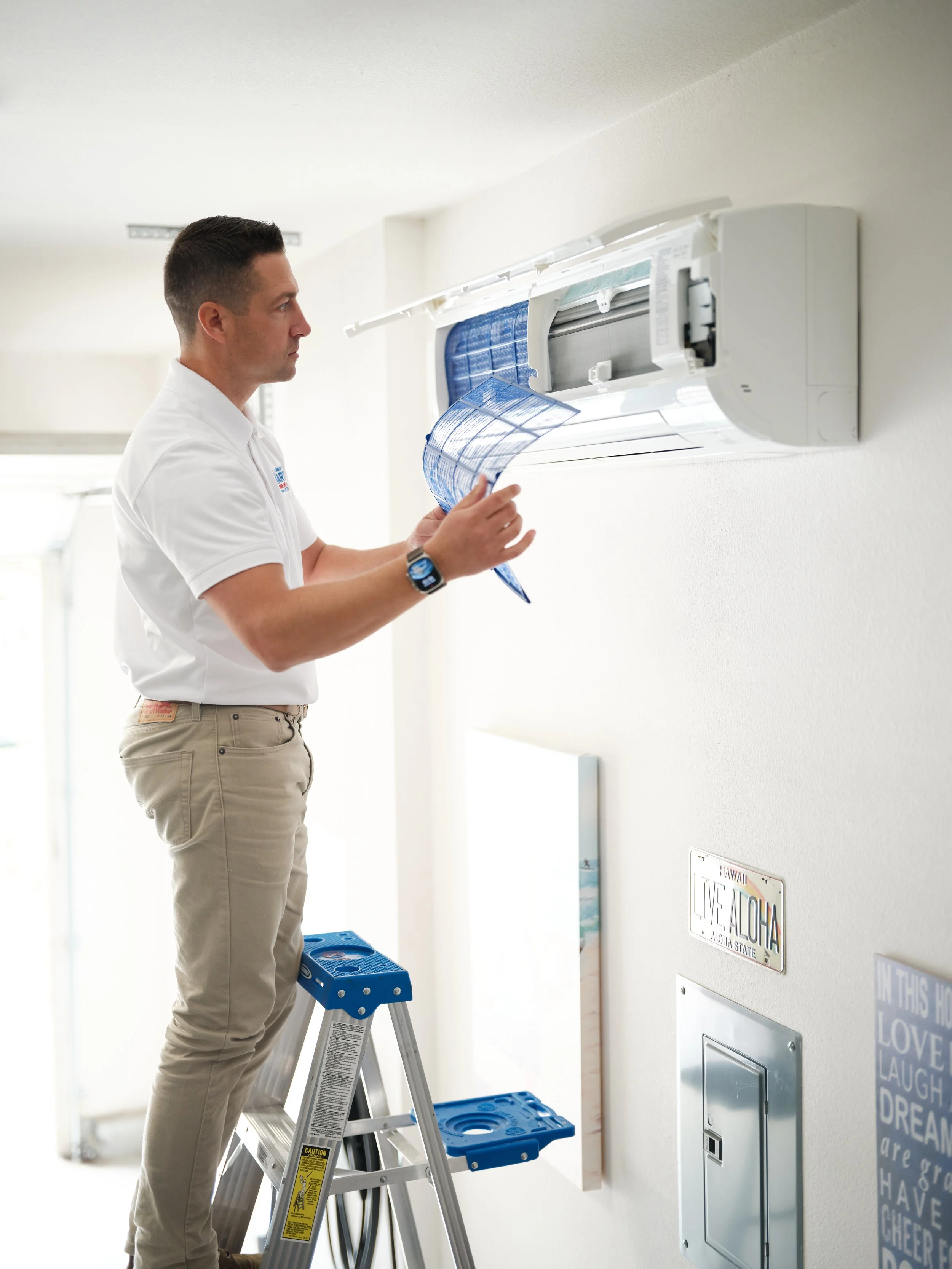
It takes about five minutes to clean a mini split filter, but you'd be surprised how many homeowners forget. That's one reason we include it in every maintenance visit.
Coverage limitations for very large open spaces can be an issue. A single indoor unit effectively conditions about 400 to 900 square feet depending on the BTU capacity, but that assumes a relatively normal room configuration. If you have a huge great room with 20-foot ceilings and an open floor plan spanning 1,200 square feet, a single mini split might struggle to evenly condition the entire space. You might need multiple units, which increases cost and potentially aesthetics concerns. Traditional ducted systems with multiple vents strategically placed sometimes handle very large open spaces more uniformly.
Performance in extreme cold can be a limitation for heating, though this is less relevant in Orange County. Mini split heat pumps lose heating capacity as outdoor temperatures drop. Premium systems maintain good heating output down to 5°F or even lower, but performance does decline. In Orange County where we rarely drop below 40°F even on the coldest winter nights, this isn't a practical concern. Our mild winters are perfect for heat pump operation. But it's worth mentioning for completeness.
Limited effectiveness for homes that truly need whole-house conditioning 24/7 is a consideration. If you have a family of five and everyone expects every room to stay at a consistent 72°F all day every day, you might end up running four or five mini split zones constantly, which diminishes the efficiency advantage and makes the higher upfront cost harder to justify compared to traditional ducted HVAC. Mini splits shine brightest when you're conditioning specific zones on an as-needed basis rather than treating your entire home as one uniform space.
Professional installation requirements mean you can't just buy a mini split and DIY the installation to save money unless you're an HVAC professional yourself. While some DIY-friendly models exist, proper installation requires EPA certification to handle refrigerants, specialized tools to evacuate and pressure-test the system, and electrical expertise to make safe connections. Poor DIY installation leads to refrigerant leaks, inadequate performance, and voided warranties. Plan on professional installation as part of your cost.
Perfect Use Cases: When Mini Splits Are the Obvious Answer in Orange County
Certain situations make mini splits the clear winner over alternatives. Room additions are the textbook mini split application. You've added a 300 square foot bedroom suite or a 500 square foot family room extension, and you need to heat and cool it. Extending your existing HVAC system would require running new ductwork, possibly upsizing your outdoor unit to handle the extra load, and potentially replacing your furnace or air handler. Total cost could easily hit $8,000 to $12,000. A single-zone mini split delivers dedicated heating and cooling to the addition for $3,000 to $5,000, gives you independent control, installs with minimal disruption, and doesn't stress your existing HVAC system. This is such a common application that we install mini splits in probably 70% of the room additions we service across Orange County.
Converted garages and workshops are another ideal scenario. Garages typically have no insulation on three of four walls, no ductwork, and severe temperature swings. Extending your home's HVAC to the garage forces your system to work overtime conditioning a poorly insulated space while you're trying to work out or run power tools, and it means running the whole house system even when you're only using the garage. A dedicated mini split for the garage lets you condition just that space only when you're using it. The installation is straightforward because garages usually have good wall space for mounting and clear paths to place the outdoor unit nearby. For the $3,000 to $4,500 investment, you transform an unusable space into comfortable year-round workspace. We've done hundreds of these installations in Orange County garages that became home gyms, woodworking shops, home offices, and art studios.
Older homes without ductwork are perhaps where mini splits provide the most value. Orange County has many beautiful 1920s through 1960s homes with original plaster walls, radiant heat, and no air conditioning. Homeowners love these houses but suffer through hot summers with window units or just open windows. Installing full ductwork would require tearing out ceilings and walls throughout the house, potentially damaging original architectural details, and costing $15,000 to $25,000 before equipment. A strategically planned mini split system with three or four zones can deliver modern whole-home cooling and heating for $8,000 to $13,000 while preserving the home's character. You mount sleek indoor units high on walls where they're not intrusive, run slim line sets through existing wall cavities or along the exterior, and maintain your home's original charm while adding contemporary comfort.
Finished basements and attics where extending ductwork is impractical or extremely expensive are another strong use case. If you've finished your attic into a bonus room or media room but it's not connected to your HVAC ductwork, a mini split provides an independent, efficient solution without the expense and difficulty of running ducts up to the attic or down to a basement through finished spaces.
Hot or cold spots in your home that your existing HVAC can't properly address sometimes point toward mini splits as a supplemental solution. Maybe you have a sun-room that's great in winter but brutal in summer, or a bedroom that never gets enough airflow from your central system. Rather than trying to rebalance your entire duct system or replace your HVAC, adding a single mini split to that problem area can solve the issue for $3,000 to $4,000 while leaving the rest of your system as-is.
Detached structures like pool houses, guest cottages, or backyard studios make perfect mini split candidates. Running ductwork from your main house to a detached building is somewhere between impractical and impossible. A mini split provides independent heating and cooling without the complexity of a separate traditional HVAC system.

Garages are one of the most popular spaces we add mini splits to across Orange County. Dedicated cooling without stressing your home's existing HVAC system.
Orange County Climate Considerations: How Local Conditions Affect Performance
Orange County's Mediterranean climate with hot, dry summers and mild winters creates an ideal environment for mini split heat pumps. Understanding how local conditions affect performance helps you set realistic expectations. Our summer heat is where mini splits shine brightest. From May through October, temperatures regularly hit the 80s and 90s, and heat waves push inland areas above 100°F. Mini splits handle this cooling load efficiently, and because they're heat pumps with high SEER2 ratings, they cost less to run than older traditional AC systems for the same cooling output. The ability to zone your cooling means you can keep frequently used spaces comfortable without overcooling the whole house, which matters during the long Orange County cooling season.
Our mild winters are perfect for heat pump operation. Traditional air-source heat pumps lose efficiency and capacity as temperatures drop, but Orange County's winter lows rarely drop below 40°F even on the coldest nights. Most winter evenings sit in the 45°F to 55°F range, which is the sweet spot for heat pump efficiency. A quality mini split can heat your home for a fraction of the cost of electric resistance heat or gas furnaces at these temperatures. This is why we're seeing so many Orange County homeowners replacing old wall heaters and gas furnaces with mini split heat pumps, the year-round efficiency just makes financial sense in our climate.
Coastal versus inland performance creates some variation across the county. Coastal areas like Newport Beach have more moderate temperatures year-round due to marine influence. A mini split in these areas will run less aggressively because temperature extremes are limited. Inland areas like Yorba Linda, Brea, and Villa Park experience hotter summers and slightly cooler winters with bigger temperature swings. Mini splits handle this fine, but the system will work harder during peak summer afternoons when it's 100°F outside compared to a coastal installation where it might peak at 85°F. This doesn't make inland installations a bad idea, it just means you should size appropriately and understand that peak summer cooling draws more power inland than at the coast.
Humidity is generally not a major concern in Orange County compared to more humid climates. Our summer humidity levels are moderate, and mini splits effectively dehumidify as they cool. Coastal areas can get some marine layer moisture, but it's not the oppressive humidity you'd find in the Southeast or Midwest where dehumidification becomes a primary concern. Mini splits handle our typical humidity levels without any issues.
Santa Ana wind events bring their own challenges. These hot, dry winds blow through Orange County primarily in fall and winter, creating dusty conditions and temperature spikes. The good news is that mini split filters are easily accessible and washable, so after a dusty Santa Ana event, you can clean the filters yourself in five minutes. The bad news is that you need to actually do it. Keep an eye on filters during wind season and clean them more frequently if needed. The outdoor unit should also be checked for debris accumulation after major wind events.
Air quality during wildfire season affects mini splits the same way it affects any HVAC system. When smoke from distant wildfires creates poor outdoor air quality, you want to minimize bringing outdoor air into your home. Mini splits with their standard filters will catch some smoke particles, but they're not designed for serious filtration. For wildfire season, consider adding standalone HEPA air purifiers to spaces conditioned by mini splits if air quality is a concern.
Mini Splits vs Traditional HVAC: Making the Right Choice for Your Home
Understanding when each system type makes sense helps you choose wisely. Mini splits win clearly when you don't have existing ductwork and would need to install it from scratch. The cost and disruption of adding full ductwork often makes traditional HVAC systems cost more and create more hassle than a multi-zone mini split system. Mini splits also win when you're conditioning a single room or small addition where extending existing ductwork would be expensive or impractical. For garage conversions, workshops, sunrooms, bonus rooms, and similar single-space applications, mini splits are usually the obvious choice.
Mini splits win when you want zoned control and are willing to pay for it. If you love the idea of independent temperature control in different areas of your home and you'll actually use that feature to save energy by not conditioning unused spaces, the mini split's zoning advantage justifies the cost. Mini splits also make sense when you value high efficiency and quiet operation above all else. The best mini splits are quieter and more efficient than the best traditional systems.
Traditional ducted HVAC wins when you have existing ductwork in good condition and need to replace your aging system. If your ducts are already in place and properly sized, installing a new high-efficiency ducted heat pump or AC system will cost less than installing an equivalent-capacity multi-zone mini split system to serve the same spaces. Traditional HVAC also wins for whole-house conditioning when you want every room at the same temperature all the time. While you can absolutely do whole-home mini splits, if your usage pattern is to keep the whole house at 72°F 24/7, a traditional system might be more cost-effective and simpler. If you're weighing the full financial picture on a like-for-like system replacement, our breakdown of mini split vs. central AC costs and savings for Yorba Linda homes in 2026 walks through real upfront numbers, monthly energy costs, and rebate scenarios side-by-side.
Traditional systems win when aesthetics are a top priority and you can't stand the look of wall-mounted indoor units. Ductwork hides in walls and ceilings with only small vents visible. Some people strongly prefer this over visible mini split heads. Traditional HVAC also wins when you value having one simple system controlled by one thermostat rather than managing multiple zones. Some homeowners find multiple zone controllers more complicated than they want to deal with.
The hybrid approach often makes the most sense. Many Orange County homes have traditional ducted HVAC for the main living spaces and mini splits for specific problem areas. You might have central AC for your main house and add a single mini split for a converted garage or new addition. Or you have traditional heating and cooling for most rooms and add mini splits to solve persistent hot/cold spot issues. This hybrid strategy lets you use each technology where it works best.
When making your decision, consider not just initial cost but total cost of ownership over the system's life. A mini split might cost $2,000 more upfront than extending ductwork, but if it saves you $400 per year on energy bills through zoning and higher efficiency, it pays for itself in five years and continues saving money for the next 15 years. Run these numbers for your specific situation with real usage patterns, not hypothetical ones.
Installation Timeline and What to Expect
Knowing what actually happens during mini split installation helps you prepare and understand why professional installation matters. The process starts with a site evaluation where an HVAC technician visits your home, assesses the space you want to condition, discusses your needs, and provides a detailed quote. They'll measure the space, evaluate insulation, identify the best locations for indoor and outdoor units, plan refrigerant line routing, and verify electrical capacity. This visit is free with most contractors and helps ensure accurate sizing and pricing.
Once you approve the quote, installation typically happens one to three weeks later depending on contractor availability and any needed permits. For a single-zone system, installation usually takes four to eight hours from start to finish. Multi-zone systems take longer, typically eight to sixteen hours depending on the number of zones and routing complexity. The actual installation process involves mounting the indoor unit bracket on your wall or ceiling in the location you've selected, cutting the three-inch hole through the wall for the refrigerant lines and electrical, and setting the outdoor unit on a concrete pad or mounting bracket outside.
The technician then runs the refrigerant lines from outdoor to indoor units through the wall penetration, connects electrical wiring from your electrical panel to both units, connects the condensate drain line, and vacuums and pressure-tests the refrigerant system to ensure there are no leaks. After verifying the system is sealed and leak-free, they charge it with the proper amount of refrigerant, power on the system, and run it through complete heating and cooling cycles to verify proper operation. Finally, they walk you through the remote control or wall controller operation and answer your questions.
Permits and inspections are required in most Orange County cities. Your installer should pull the necessary permits, which typically cost $150 to $400 and require an electrical inspection and sometimes an HVAC inspection. The inspector verifies that installation meets code for electrical connections, refrigerant handling, and equipment mounting. This adds a day or two to the overall timeline as you wait for inspection scheduling, but it ensures safe, compliant installation and protects you as the homeowner.
Maintenance Requirements and Long-Term Reliability
Understanding what mini splits need to stay healthy helps you budget time and money. Monthly filter cleaning is the main homeowner responsibility. Each indoor unit has a removable, washable filter that should be cleaned every four to six weeks during heavy use. The process takes five minutes: pop off the front panel, slide out the filter, rinse it under running water or vacuum it, let it dry completely, and reinstall it. This simple task maintains efficiency and air quality. Neglected filters restrict airflow and make the system work harder.
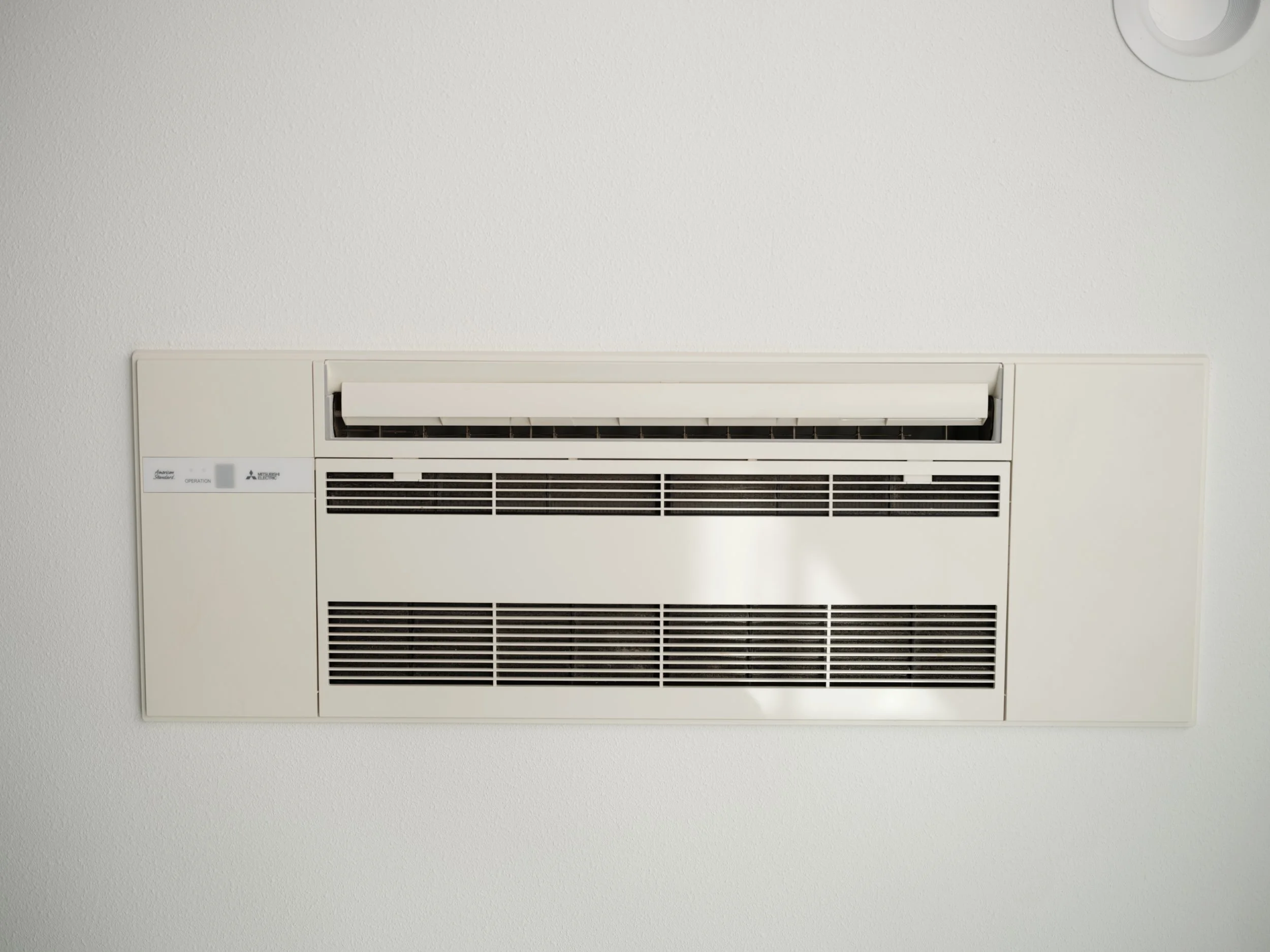
Want ductless cooling without a wall-mounted unit? Ceiling cassettes blend right into your space. Call J Martin at (714) 406-5001 to see if one is right for your home.
Annual professional maintenance keeps the system running optimally. Schedule a technician visit each year before cooling season starts, typically in March or April. During the maintenance visit, the technician will clean the outdoor coil, inspect and clean the indoor coil, check refrigerant levels and pressures, test electrical components and connections, verify proper airflow and temperature differential, clean the condensate drain, and identify any developing issues before they become problems. This service typically costs $120 to $180 per year and is cheap insurance against major repairs.
Long-term reliability with proper maintenance is excellent. Quality mini split systems from reputable manufacturers typically last 15 to 20 years or longer, matching or exceeding the lifespan of traditional HVAC systems. Mitsubishi, Daikin, and Fujitsu systems in particular have proven track records of lasting 20-plus years with good maintenance. The inverter-driven compressors that run continuously at variable speeds actually experience less wear than traditional compressors that cycle on and off repeatedly. This contributes to longevity.
Common issues to watch for include refrigerant leaks which create hissing sounds and diminishing cooling capacity, drainage problems where condensate doesn't drain properly and causes water leakage, dirty coils from neglected maintenance reducing efficiency and capacity, and failing circuit boards or sensors in the indoor or outdoor units, though these are relatively rare in quality systems. Most issues beyond filter cleaning require professional diagnosis and repair.
Warranty coverage varies by manufacturer but typically includes 5 to 12 years on the compressor, 5 to 10 years on other parts, and 1 to 5 years on labor if you use an authorized installer. Premium brands like Mitsubishi offer some of the longest warranties. Always register your equipment with the manufacturer within 60 to 90 days of installation to activate the full warranty. Unregistered systems often have limited warranty coverage.
The Bottom Line: Are Mini Splits Right for Your Orange County Home?
The decision comes down to your specific situation and priorities. Mini splits make tremendous sense for specific applications including room additions, converted garages and workshops, older homes without ductwork, finished basements or attics, hot and cold spots in your home, and detached structures like guest houses or studios. For these applications, mini splits usually cost less than alternatives, install with minimal disruption, deliver superior efficiency and comfort, and provide independent zone control that adds real value.
Mini splits make less sense when you have good existing ductwork and need straightforward replacement of a traditional system, when you want simple whole-house conditioning at one temperature and don't value zoning, when aesthetics are paramount and you can't tolerate visible wall units, or when budget is extremely tight and you need the absolute lowest upfront cost. In these situations, traditional ducted systems often make more practical and financial sense.
For Orange County homeowners specifically, our climate creates an ideal environment for mini split operation. Mild winters mean heat pump heating works beautifully year-round without the performance degradation that colder climates experience. Hot summers mean cooling efficiency matters, and mini splits deliver excellent SEER2 ratings. Moderate humidity means these systems handle our moisture levels without needing dedicated dehumidification. The long cooling season from May through October means energy savings from efficient mini splits compound over many months each year.
The hybrid approach using both traditional HVAC for main spaces and strategic mini splits for specific areas often delivers the best of both worlds. Your existing central system handles your primary living areas efficiently through established ductwork, while mini splits solve specific challenges like a garage conversion, a home addition, or a problem room without requiring ductwork expansion. This pragmatic strategy avoids forcing one technology to do everything and instead uses each where it excels.
If you're considering mini splits, start with a clear understanding of what problem you're trying to solve. Are you adding cooling to a space that has none? Replacing an inefficient system? Solving a hot spot? Creating independent zones? The clearer you are about your goal, the easier it becomes to evaluate whether mini splits or alternative solutions make more sense. Get quotes from multiple reputable contractors who specialize in mini split installation. Installation quality matters tremendously with these systems because improper refrigerant handling, incorrect sizing, or poor electrical work creates performance problems and shortens lifespan.
Don't let initial cost shock deter you from considering mini splits if they solve your specific problem well. Yes, they can cost more upfront than some alternatives, but factor in federal tax credits, utility rebates, and long-term energy savings. Also consider the value of not tearing apart your home to install ductwork or the comfort improvement from solving a persistent problem area. Sometimes the right solution costs more initially but delivers vastly better results.
Considering a mini split for your Yorba Linda, Anaheim, Brea, Fullerton, or Villa Park home? J Martin Indoor Air Quality specializes in ductless mini split installation with proper sizing, quality equipment, and professional installation that maximizes performance and longevity. We'll evaluate your specific situation and recommend whether a mini split makes sense or if alternative solutions serve you better. Call (714) 462-4686 for an honest assessment with no pressure sales.
J Martin Indoor Air Quality | (714) 462-4686 | Services
Related Articles: