
QuietCool Whole House Fan: Is It Worth It for Orange County Homes?
Posted on April 30, 2026
A couple in Anaheim Hills had been spending $380 to $420 per month on electricity every summer. Their 2,200-square-foot home had a 15-year-old 4-ton AC system, original ductwork from the early 1990s, and R-19 insulation in the attic. Their AC ran from about 2 PM until 10 PM most summer days, sometimes kicking back on in the middle of the night when the upstairs bedrooms held heat long after the sun went down. We installed a QuietCool Stealth Pro 3.0 during a spring tune-up visit. That first summer, their routine changed. By 6 or 7 PM most evenings, when the outdoor temperature dropped below what was inside the house, they'd open a few windows, flip on the QuietCool, and shut the AC off for the night. The fan pulled cool evening air through the house and flushed the accumulated heat out through the attic. Their summer electric bills dropped to $220 to $260 per month, a reduction of roughly $140 to $160 per month during the peak cooling season. The fan cost them about $1,800 installed. It paid for itself before the end of that first summer.
That's the pitch you'll hear from every QuietCool dealer in California, and it's not exaggerated for most Orange County homes. But "most" isn't "all." Whether a whole house fan is worth the investment for your specific home depends on where in Orange County you live, how your home is built, what your evening temperatures actually look like, and whether you're willing to open windows instead of running the AC. This post is going to give you the real numbers, the honest limitations, and a clear picture of who should absolutely get one and who might be better off spending that money elsewhere.
At J Martin Indoor Air Quality, we're a certified QuietCool installer serving Orange County. We've put these fans in hundreds of homes across Yorba Linda, Anaheim, Anaheim Hills, Fullerton, Brea, Villa Park, Placentia, and surrounding communities. We know which homes see dramatic savings and which situations call for a different approach.
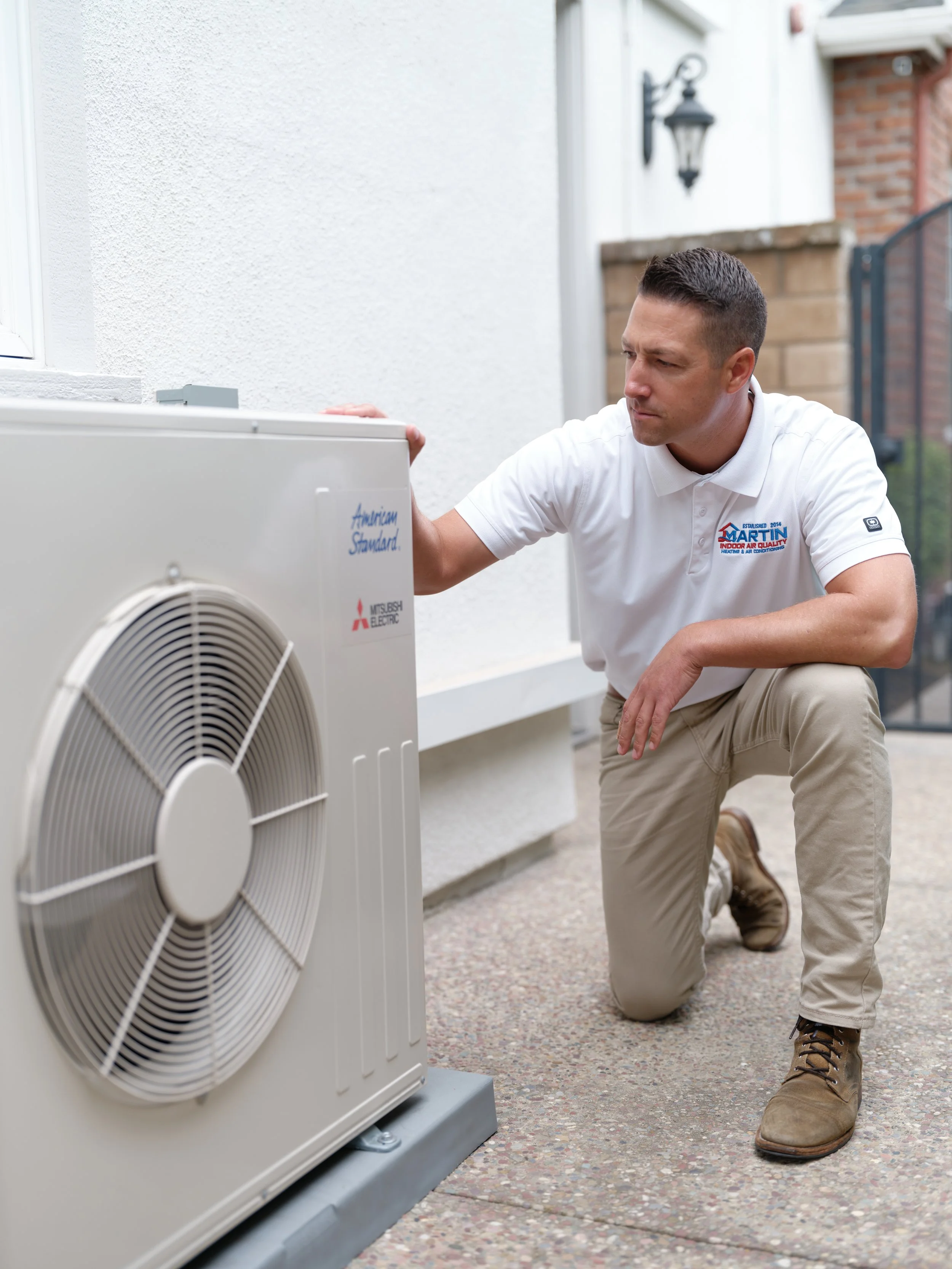
Still running your AC all evening? A QuietCool whole house fan can cool your Orange County home for a fraction of the cost. Call J Martin Indoor Air Quality at (714) 462-4686.
How a QuietCool Whole House Fan Actually Works
A whole house fan is not an attic fan, and it's not a ceiling fan. Understanding this distinction matters because they do completely different things.
A QuietCool whole house fan is installed in your attic floor (your ceiling), typically in a central hallway on the highest floor of the home. When you turn it on, it pulls air from inside your living space up through a ducted connection, through the fan motor in the attic, and exhausts it out through your existing attic vents (ridge vents, gable vents, soffit vents). As the fan pulls indoor air up and out, replacement air is drawn in through open windows, creating a continuous flow of fresh outdoor air through every room in the house.
The result is two-fold. First, the moving air creates a breeze throughout the home that makes the actual air temperature feel 5 to 10 degrees cooler, the same wind-chill effect you feel from a desk fan but applied to your entire house. Second, and this is the part most people underestimate, the sustained airflow cools the thermal mass of the home itself: the walls, the floors, the furniture, the countertops, every physical surface that absorbed and stored heat during the day. An air conditioner cools the air but leaves all of that stored heat radiating back into the room. A whole house fan cools the structure, which means the home stays cooler longer the following day and the AC doesn't have to work as hard, or at all, until the afternoon heat builds back up.
QuietCool's design is what separates it from the old-school whole house fans your parents might remember. Those older belt-driven fans mounted directly in the ceiling, were loud enough to drown out a conversation, and had no insulation between the attic and the living space when not running. QuietCool uses a ducted design: a ceiling grille connects to an insulated flexible duct (typically 8 to 10 feet long) that runs to the fan motor positioned away from the living space. The distance and insulation dramatically reduce noise. The fan also has an insulated damper that seals shut when the unit is off, preventing attic heat (which reaches 150 degrees or more in Orange County summers) from radiating down into your home through the opening.
This matters for Orange County specifically because our attic temperatures are among the most extreme in the country during summer. An unsealed opening between your attic and your living space is essentially a heat vent. QuietCool's insulated damper eliminates that problem.
The Energy Math at SCE Rates
This is where the numbers get compelling for Orange County homeowners, because Southern California Edison's rates make the whole house fan vs. AC comparison dramatically one-sided.
A typical central air conditioner for a 2,000 to 2,500-square-foot Orange County home draws between 3,000 and 5,000 watts per hour of operation. At SCE's current average residential rate of approximately 34.5 cents per kWh, running a 3,500-watt AC system costs roughly $1.21 per hour. Over a typical 8-hour cooling day, that's $9.66 per day or about $290 per month during the peak summer period. If you're on an SCE time-of-use plan and running the AC during peak hours (4 PM to 9 PM), the per-kWh rate can reach 74 cents, pushing the hourly cost of AC operation above $2.50 per hour during those windows.
A QuietCool whole house fan, by contrast, uses between 55 and 1,147 watts depending on the model and speed setting. Most homeowners run the fan on low or medium speed for extended evening cooling, which typically draws 100 to 500 watts. At 300 watts on medium speed and SCE's average rate of 34.5 cents per kWh, operating cost is approximately 10 cents per hour. Running the fan for 8 hours costs about 83 cents. That's roughly $25 per month compared to $290 per month for the AC over the same hours.
Even on high speed, the most powerful QuietCool model (the Trident Pro 7.0X at 7,000 CFM) pulls only about 1,147 watts, which costs roughly 40 cents per hour at SCE's average rate. That's still less than a third of what the AC costs at its lowest operating setting.
The savings math gets even better when you factor in SCE's time-of-use rate structure. The most expensive electricity hours are 4 PM to 9 PM on weekdays. A whole house fan is most effective during evening hours when outdoor temperatures drop, which aligns directly with the tail end of the peak pricing window and the entire off-peak period. Every hour you can shift from AC to fan during or after the peak window saves the maximum possible amount per kWh.
QuietCool estimates that whole house fans can save homeowners 50% to 90% on AC-related electricity costs. PG&E (Northern California's utility) has published similar figures. The range is wide because it depends on how aggressively you use the fan as a replacement for AC versus a supplement. In Orange County's climate, where evening temperatures drop into the 60s and low 70s for roughly 8 to 9 months of the year, the realistic savings for most homeowners fall in the 50% to 75% range during the months the fan is usable. During the absolute peak of summer heat waves, when nighttime temperatures stay above 80 degrees, the fan is less effective and you'll rely more heavily on AC, which is why the annual savings figure accounts for a mix of fan-heavy and AC-heavy months.
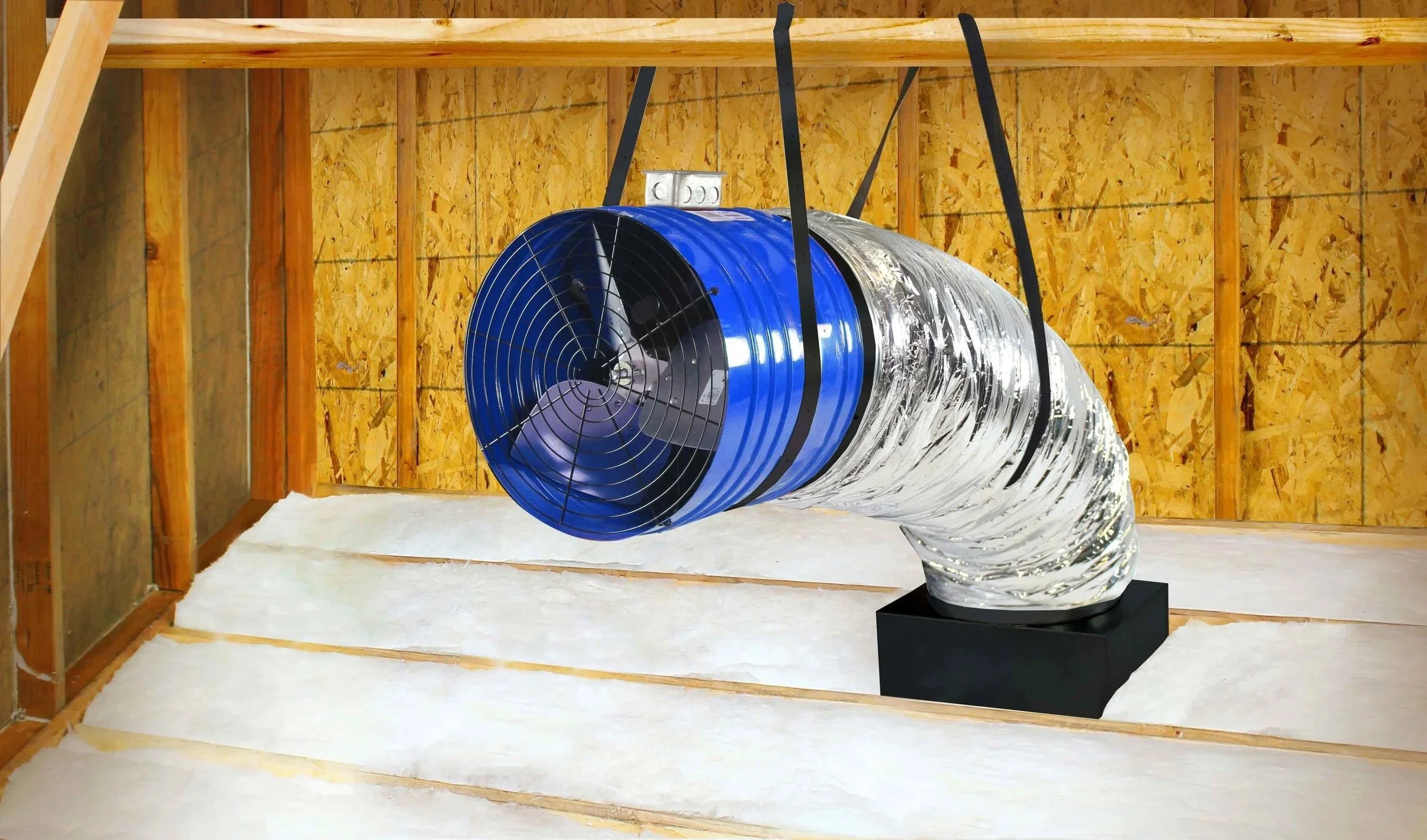
A properly installed QuietCool whole house fan can dramatically reduce AC runtime in Orange County homes. J Martin Indoor Air Quality installs systems designed for real energy savings and long-term reliability.
Why Orange County's Climate Is Ideal for Whole House Fans
Orange County's Mediterranean climate is among the best in the country for whole house fan effectiveness, and the inland cities where J Martin does most of our work are particularly well suited.
The key factor is the diurnal temperature swing, the difference between the daytime high and the evening low. In Yorba Linda, Anaheim Hills, Brea, and Fullerton, summer daytime highs typically reach the upper 80s to low 90s, but evening temperatures consistently drop into the mid-60s to low 70s by 8 or 9 PM. That 15 to 25-degree swing is exactly what a whole house fan needs to work effectively. When the outdoor air is 68 degrees and the inside of your home is 82 degrees from a day of accumulated heat, flipping on the fan creates an immediate, dramatic cooling effect.
Even during heat waves, when daytime temperatures push into the upper 90s and triple digits in the inland valleys, evening temperatures in most of northern Orange County still drop into the low to mid-70s. There are typically only two to four weeks per year when nighttime temperatures stay warm enough (above 78 to 80 degrees) that a whole house fan provides minimal benefit. The rest of the year, including spring and fall when evenings are in the 55 to 65-degree range, the fan eliminates the need for AC entirely during evening and nighttime hours.
Coastal Orange County cities like Huntington Beach, Newport Beach, and Laguna Beach have even more favorable conditions because evening temperatures are cooler and more consistent, but those homes also tend to use less AC overall, so the dollar savings may be lower simply because the baseline AC costs are lower.
Orange County's low humidity is another advantage. In humid climates like Florida or the Gulf states, pulling in outdoor air can actually increase indoor humidity and make the house feel clammy even when the temperature drops. Orange County's typical summer humidity levels are low enough that this is rarely a concern. The air coming in through the windows is dry, comfortable, and exactly what you want flowing through your home.
The one climate-related consideration for Orange County homeowners is Santa Ana wind events. During Santa Ana conditions, the air is hot, dry, and often carrying fine dust and particulate. Running a whole house fan during an active Santa Ana event pulls that air directly into your home. Most homeowners simply use the AC during Santa Ana events (which typically last two to five days) and resume fan use once conditions normalize. If indoor air quality is a priority in your home, especially during wildfire season when smoke particulate is a concern, you can read more about comprehensive air quality solutions that work alongside your HVAC system year-round.
QuietCool Models: Which One Fits Your Home
QuietCool offers several product lines with different features and price points. The right model depends on your home's square footage, ceiling height, and how you plan to use the fan.
The sizing rule is straightforward: you need 2 to 3 CFM (cubic feet per minute) of airflow per square foot of living space. A 2,000-square-foot home needs a fan rated for 4,000 to 6,000 CFM. A 1,500-square-foot home needs 3,000 to 4,500 CFM. Homes with vaulted or high ceilings should size toward the higher end of the range because there's more air volume to move.
The Stealth Pro Series is QuietCool's premium line and the one we install most frequently. It uses electronically commutated motors (ECM) that are exceptionally efficient, consuming as little as 55 watts on low speed. The Stealth Pro comes in multiple sizes from approximately 1,500 CFM to over 5,000 CFM. It operates quietly enough that most homeowners run it overnight while sleeping without any disturbance. The Stealth Pro carries a 15-year motor warranty, which is the best in the industry. Installed cost for a Stealth Pro typically runs $1,200 to $2,500 depending on the model size and installation complexity.
The Trident Pro Series is QuietCool's highest-capacity line, designed for larger homes that need maximum airflow. The Trident Pro 7.0X moves 7,000 CFM and is designed for homes above 2,500 square feet or homes with high ceilings and large open floor plans. It also uses ECM motors, carries the 15-year warranty, and offers three-speed operation. Installed cost ranges from $2,000 to $3,000 for the larger Trident Pro models.
The Classic and Energy Saver Series are QuietCool's value-oriented lines, available through retail channels and DIY installation. They use the same fundamental ducted design but with slightly less efficient motors and a 10-year warranty instead of 15. These are a solid option for homeowners on a tighter budget or those comfortable with self-installation. Fan-only pricing (without installation) ranges from $450 to $900 depending on the model and CFM rating.
For most Orange County homes in the 1,500 to 2,500-square-foot range, a single Stealth Pro unit in the 3,000 to 5,000 CFM range provides excellent whole-home cooling. Larger homes or homes with layouts that don't allow good airflow from one central location may benefit from two smaller units positioned in different areas.
One important sizing note: the fan is only as effective as your attic ventilation allows. QuietCool recommends one square foot of net free attic vent area for every 500 to 750 CFM of fan capacity. If your attic doesn't have adequate venting, the fan can't exhaust air efficiently and its performance suffers. A qualified installer will evaluate your attic ventilation as part of the installation process and recommend additional venting if needed.
Installation: What's Involved and What It Costs
Professional installation of a QuietCool whole house fan is typically a half-day job. The process involves selecting the optimal ceiling location (usually a central hallway on the top floor), cutting an opening in the ceiling, mounting the ceiling grille and damper assembly, running the insulated duct to the fan motor position in the attic, mounting the fan motor to the roof framing, running electrical wiring from an existing circuit or new dedicated circuit to the fan, and installing the wall switch or wireless control.
The ideal installation location is centrally positioned so that air is drawn relatively evenly from all parts of the home when windows are opened in different rooms. In a two-story home, the fan should be installed on the second floor, typically in the upstairs hallway, because heat rises and the hottest air in the home accumulates at the highest point.
Not every home benefits from the same cooling solution. J Martin Indoor Air Quality evaluates your attic ventilation and home layout to determine if a QuietCool whole house fan is the right fit for your Orange County home.
Installed costs for QuietCool whole house fans in Orange County typically range from $1,500 to $3,000 for a complete professional installation, which includes the fan, all materials, electrical work, and labor. The exact price depends on the model chosen, the complexity of the attic access, whether additional attic ventilation is needed, and whether a new electrical circuit is required. Some installations in homes with easy attic access and existing nearby circuits come in toward the lower end. Multi-story homes with limited attic access or homes requiring additional attic vents tend toward the higher end.
At J Martin, QuietCool installation is one of our specialties. We evaluate your home's layout, attic configuration, existing ventilation, and electrical setup before recommending a specific model and providing a fixed-price quote. No surprises. You can learn more about how we approach every job and why the person doing the work in your home matters.
What a Whole House Fan Does for Your AC System's Lifespan
This is the benefit that doesn't show up on your electric bill but saves you thousands over time.
Your air conditioner's lifespan is directly related to how hard and how often it runs. Every hour of compressor operation puts wear on the motor, the refrigerant system, the electrical contacts, and the capacitors. A system that runs 8 to 10 hours per day during summer will wear out significantly faster than one that runs 4 to 6 hours per day.
QuietCool estimates that using a whole house fan to reduce AC runtime can extend AC system life from a typical 15 years to as long as 25 to 30 years. Even a conservative estimate of extending your system's life by 3 to 5 years represents significant savings when you consider that replacing an HVAC system in Orange County costs $8,000 to $15,000 depending on the system type and efficiency level. Delaying that replacement by even a few years while your current system runs efficiently is a substantial financial benefit on top of the monthly energy savings.
Reduced runtime also means fewer repair calls during the system's life. The components that fail most often in Orange County AC systems, capacitors, contactors, and fan motors, fail primarily due to accumulated heat stress and cycling. Running the AC fewer hours per day directly reduces the probability of these failures.
Who Should Get a QuietCool Fan (And Who Shouldn't)
A QuietCool whole house fan is an excellent investment for Orange County homeowners in the following situations: you live in an inland city (Yorba Linda, Anaheim Hills, Brea, Fullerton, Villa Park, Placentia, Orange) where summer AC bills regularly exceed $200 per month; your home has a standard attic with adequate or upgradeable ventilation; you're comfortable opening windows in the evening and overnight; you have a functional AC system that you want to preserve and reduce the runtime on; or you're looking for the single highest-return energy efficiency upgrade available.
A whole house fan may not be the best first investment if your ductwork is severely deteriorated and losing 25% to 30% of conditioned air (fix the ducts first for the biggest immediate impact; our Complete Guide to Air Duct Cleaning covers the full range of duct services). It's also not ideal for homes with flat roofs or minimal attic space (though QuietCool does make a roof-mount model for these situations), homes in gated communities or HOA-restricted areas where leaving windows open overnight isn't practical for security or noise reasons, or households where someone has severe allergies or respiratory conditions that require filtered, sealed indoor air at all times.
For homes with significant temperature differences between floors, where the upstairs traps heat while the downstairs stays comfortable, a whole house fan can be transformative because it directly addresses the heat stratification that causes the problem. The fan pulls the hottest air from the highest point of the home and replaces it with cooler outdoor air. We've covered why this problem exists and other approaches to solving it in our post on the truth about closing vents in unused rooms.
Whole House Fan vs. Attic Fan: They're Not the Same Thing
This is one of the most common points of confusion we encounter. A whole house fan and an attic fan serve completely different purposes, and understanding the distinction prevents you from buying the wrong product.
A whole house fan cools your living space by pulling indoor air through the house and exhausting it through the attic. It cools you.
An attic fan cools only the attic by pulling hot attic air out and replacing it with outdoor air. It cools the attic, which indirectly reduces the heat load on your ceiling and can help your AC run slightly more efficiently, but it does not create airflow through your living space and does not provide the direct cooling effect you feel from a whole house fan.
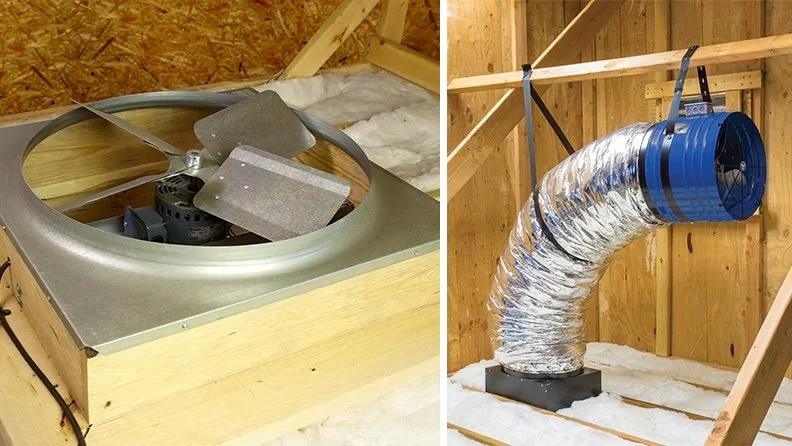
Attic fans and whole house fans solve different problems. J Martin Indoor Air Quality helps Orange County homeowners understand the difference before recommending a QuietCool installation.
The ideal setup, and what we often recommend for Orange County homes, is both: an attic fan running during the day to keep attic temperatures from reaching 150+ degrees (which reduces the heat radiating down into your living space and protects your ductwork), and a whole house fan running in the evening and overnight to directly cool the home and its thermal mass. QuietCool manufactures both products, including solar-powered attic fans that run during daylight hours with zero electricity cost.
How to Use Your QuietCool Fan for Maximum Savings
Getting the most out of your whole house fan involves a few simple habits that become second nature within a week or two.
Start by checking the outdoor temperature. When it drops below the indoor temperature (typically by 5 PM to 7 PM in spring and fall, 7 PM to 8 PM in summer), open three to four windows throughout the house, each about 4 to 6 inches. You want windows in the rooms you're occupying so the cool air flows directly through the spaces where you'll feel it. Turn the fan on high speed initially to flush the accumulated hot air out of the home quickly. Most homeowners notice a dramatic temperature drop within the first 10 to 15 minutes.
Once the home has cooled to a comfortable level, reduce the fan to medium or low speed for sustained cooling. Running on low speed overnight while you sleep creates a gentle, continuous breeze through the bedroom that many homeowners describe as one of the best sleeping experiences they've ever had, better than AC because the air is fresh rather than recirculated.
In the morning, close the windows and turn off the fan before the outdoor temperature starts climbing. The thermal mass of your home (walls, floors, furniture) has been cooled overnight and will hold that lower temperature well into the afternoon, which means the AC either doesn't need to kick on until much later in the day or doesn't need to work as hard when it does.
On the hottest days of summer, when temperatures exceed 100 degrees, you'll likely need to run the AC during the afternoon hours. But even on those days, switching from AC to the whole house fan by 7 or 8 PM when the outdoor temperature drops into the 70s saves you 3 to 5 hours of AC runtime per day. At $1.21 per hour at SCE rates, that's $3.60 to $6.05 in daily savings during the hottest month of the year, while the fan costs roughly 80 cents for those same hours.
The Bottom Line
A QuietCool whole house fan is one of the best energy efficiency investments available to Orange County homeowners. The combination of our high electricity rates (34.5 cents per kWh average, up to 74 cents during peak hours), our climate's reliable evening temperature drops, and the dramatic difference in operating cost between AC and a whole house fan creates a payback period of one to two years for most installations, with ongoing savings of $500 to $1,500 per year depending on home size, usage patterns, and AC costs.
Beyond the energy savings, the fan improves indoor air quality by continuously exchanging stale indoor air with fresh outdoor air, equalizes temperatures between floors, cools the home's thermal mass so it stays comfortable longer the next day, and reduces wear on your AC system, extending its lifespan by years.
If you're interested in a QuietCool whole house fan for your Orange County home, give us a call at (714) 462-4686. J Martin Indoor Air Quality is a certified QuietCool installer with years of experience putting these systems in homes across Yorba Linda, Fullerton, Anaheim, Anaheim Hills, Brea, Villa Park, Placentia, and Orange. We'll evaluate your home's layout, attic ventilation, and electrical setup, recommend the right model for your square footage, and give you a fixed-price quote with no surprises. It's one of the fastest-returning investments we help homeowners make, and we've seen the results on hundreds of electric bills to prove it. You can read more about why Orange County homeowners trust us with every aspect of their home comfort.
J Martin Indoor Air Quality proudly serves Yorba Linda, Fullerton, Anaheim, Anaheim Hills, Brea, Villa Park, Placentia, Orange, and communities throughout Orange County. California License #998956. Call (714) 462-4686 or visit jmartiniaq.com to schedule service.