
How Much Does It Cost to Run AC All Day in Orange County? (SCE Rate Breakdown)
Posted on April 28, 2026
It's July in Anaheim. The forecast says 98 degrees. You set the thermostat to 74 before you leave for work, and when you come home nine hours later, the house feels perfect, the kids are comfortable, and nobody's complaining. Then the SCE bill arrives three weeks later, and suddenly everyone has complaints.
Running your air conditioner all day in Orange County is not cheap. But the actual cost depends on a surprisingly specific set of variables: what SCE rate plan you're on, what time of day your system runs hardest, how efficient your equipment is, what condition your ducts are in, and how well your home holds onto conditioned air. Change any one of those variables and your daily cost can swing by $5 to $15 or more.
Most of the "cost to run AC" articles you'll find online use national average electricity rates, which are completely useless if you live in Southern California. SCE's rates are roughly double the national average, and their time-of-use pricing structure means the same kilowatt-hour of electricity can cost you anywhere from 24 cents to 74 cents depending on when your compressor kicks on. That's a threefold difference in price for the exact same amount of cooling.
So let's do the real math. No national averages. No generic estimates. Just current SCE rates applied to actual AC systems running in actual Orange County homes.

Summer heat in Orange County means your AC works harder than you think. J Martin helps Anaheim homeowners understand exactly why their cooling costs rise and what actually lowers their SCE bill.
How Much Electricity Does Your AC Actually Use?
Before we can calculate cost, we need to know consumption. The amount of electricity your air conditioner uses depends primarily on its size (measured in tons), its efficiency rating (measured in SEER or SEER2), and how many hours per day the compressor actually runs.
A central air conditioning system doesn't run continuously even when you leave it on all day. It cycles on and off based on the thermostat's demand. When the indoor temperature rises above your set point, the compressor kicks on and runs until it brings the temperature back down, then shuts off until the temperature rises again. On a mild 85-degree day, your system might only run 40 to 50 percent of the time. On a brutal 105-degree day, it might run 80 to 90 percent of the time. HVAC professionals call this the "duty cycle," and it's the single biggest factor in your daily electricity consumption.
Here's a straightforward way to estimate your system's hourly electricity draw. A standard central AC system uses approximately 1 kWh per ton per hour of compressor runtime. So a 3-ton system uses roughly 3 kWh per hour when the compressor is running, and a 4-ton system uses roughly 4 kWh per hour. This is a reasonable baseline for systems rated between 13 and 16 SEER. Higher-efficiency systems (18 to 22 SEER2) use less, sometimes 20 to 40 percent less, because they extract more cooling from every kilowatt-hour of electricity consumed.
For a typical Orange County home of 1,500 to 2,000 square feet with a 3-ton system rated at 14 SEER, here's what a full day of cooling looks like at different outdoor temperatures.
On a mild day (85 degrees outside, thermostat set to 76), the system runs about 8 to 10 hours out of 24, consuming roughly 24 to 30 kWh for the day.
On a hot day (95 degrees, thermostat at 76), runtime climbs to 12 to 16 hours, consuming approximately 36 to 48 kWh.
On an extreme heat day (105 degrees or higher, thermostat at 76), the system may run 18 to 22 hours, consuming 54 to 66 kWh or more. On days like this, especially during Orange County's inland heat waves that regularly hit Yorba Linda, Brea, and Anaheim Hills, some systems run nearly nonstop.
Those kWh numbers are where the math gets expensive, because the cost of each kWh depends entirely on your SCE rate plan and the time of day.
The SCE Rate Plans That Determine Your AC Bill
Most residential SCE customers in Orange County are on one of three rate structures: the tiered plan, the TOU-D-4-9PM plan, or the TOU-D-5-8PM plan. There's also TOU-D-PRIME, which is available to customers with solar panels, battery storage, electric vehicles, or heat pump systems. Each plan prices electricity differently, and the differences are dramatic.
Here's what you're looking at as of early 2026, based on the most recent SCE rate advisories. SCE's average residential rate sits around 34.5 cents per kWh, but that average hides enormous variation depending on your plan, your usage tier, and the time of day.
On the tiered plan (also called the domestic rate), you pay roughly 31 cents per kWh for usage up to your baseline allocation, then approximately 42 cents per kWh for everything above baseline. There's no time-of-day variation, so it doesn't matter whether your AC runs at 2 PM or 2 AM. The rate is the same. This plan works well for households with consistent, moderate usage, but it penalizes heavy users because every kWh above baseline costs 35 percent more.
On the TOU-D-4-9PM plan, electricity costs vary based on when you use it. Off-peak hours (before 4 PM and after 9 PM on weekdays, and all day on weekends) are priced lower, while on-peak hours (4 PM to 9 PM on weekdays) carry a premium. As of January 2026, on-peak rates on this plan are approximately 58 cents per kWh, while off-peak rates drop to around 29 cents per kWh. Summer rates (June through September) are even higher, with peak rates climbing further. This plan also includes a baseline credit of about 10 cents per kWh for usage within your baseline allocation, which helps offset costs for moderate users.
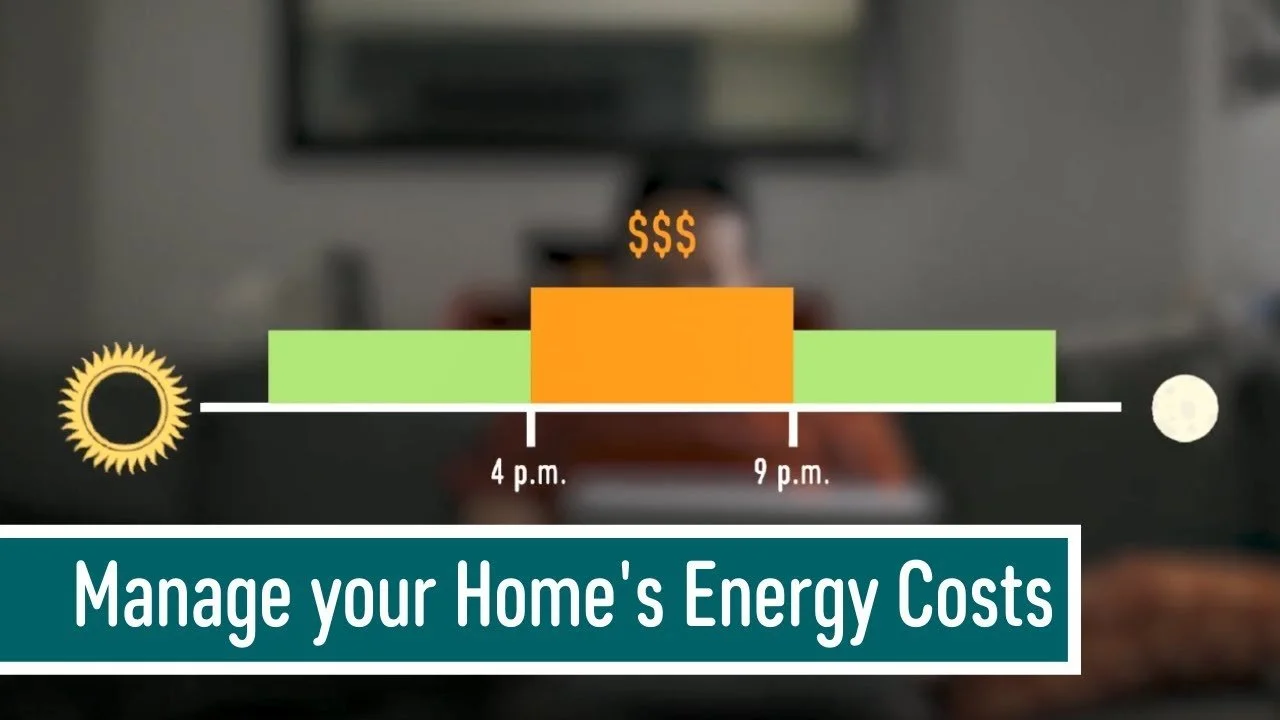
Electricity prices jump during SCE peak hours from 4–9 PM. If your AC runs hardest during that window, your Orange County cooling costs can spike fast. J Martin helps homeowners reduce AC energy bills. Call (714) 462-4686.
The TOU-D-5-8PM plan has a shorter peak window (5 PM to 8 PM) but higher peak rates during that window, with summer peak rates reaching as high as 74 cents per kWh. Off-peak rates are lower than the 4-9PM plan, making this plan attractive if you can truly avoid using electricity during those three evening hours. But here's the problem: 5 to 8 PM is exactly when most families come home, turn on the AC, start cooking dinner, and run the dishwasher. If you can't avoid that window, this plan will cost you more, not less.
Understanding which plan you're on is essential, because it determines whether running your AC at 3 PM costs you 29 cents per kWh or whether running it at 6 PM costs you 58 to 74 cents per kWh. That's the difference between a $10 day and a $25 day for the exact same amount of cooling.
The Real Daily Cost: Four Scenarios
Let's put actual dollars to these numbers using the most common rate plan in Orange County, the TOU-D-4-9PM schedule. We'll calculate for a typical 3-ton, 14 SEER system in a 1,700 square foot home.
Scenario One: Mild Summer Day (88 degrees)
The system runs approximately 10 hours total. Of those 10 hours, about 5 fall during off-peak time (morning and early afternoon) and 5 overlap with the on-peak window (4 PM to 9 PM). That's 15 kWh at roughly $0.29 (off-peak) plus 15 kWh at roughly $0.58 (on-peak).
Off-peak cost: 15 kWh x $0.29 = $4.35 On-peak cost: 15 kWh x $0.58 = $8.70 Daily total: approximately $13.05
Scenario Two: Hot Summer Day (97 degrees)
Runtime jumps to about 15 hours. Roughly 8 hours fall off-peak and 5 hours fall on-peak (the system runs hard from 4 PM to 9 PM), with 2 additional hours in late evening after the peak window closes.
Off-peak cost: 30 kWh x $0.29 = $8.70 On-peak cost: 15 kWh x $0.58 = $8.70 Daily total: approximately $17.40
Scenario Three: Extreme Heat Day (105+ degrees)
The system runs nearly all day, roughly 20 hours. About 13 hours are off-peak and the full 5-hour peak window is running at capacity.
Off-peak cost: 39 kWh x $0.29 = $11.31 On-peak cost: 15 kWh x $0.58 = $8.70 Additional high-tier usage above baseline: approximately $3 to $6 depending on your allocation. Daily total: approximately $23 to $26
Scenario Four: Week-Long Heat Wave
This is the scenario that produces the electric bills that make homeowners physically ill. Seven consecutive days at 100+ degrees means roughly $20 to $26 per day just for air conditioning. That's $140 to $182 for the week in AC costs alone, on top of your normal household electricity usage. Over a full billing cycle that includes a heat wave, it's not unusual for SCE bills to hit $400 to $600 or more in Orange County during July and August.
Now here's the number that really matters: over an entire summer season (June through September), a typical Orange County household running AC daily on a 14 SEER system will spend somewhere between $800 and $1,800 on air conditioning alone, depending on how hot the summer is, how well-insulated the home is, and how efficient the equipment is. That's a wide range, and it's exactly why efficiency matters so much in our climate.
Why Your Neighbor Pays Half What You Do
You know that neighbor who seems to have the same size house, the same number of people, and somehow their electric bill is $200 less than yours every summer? It's not magic. It's almost always one or more of the following factors.
System efficiency makes a massive difference. The SEER rating of your air conditioner directly determines how many kWh it consumes per hour, and the math is worth understanding because it directly translates to dollars on your SCE bill.
SEER stands for Seasonal Energy Efficiency Ratio, and it measures how many BTUs of cooling your system produces per watt-hour of electricity consumed. A higher SEER number means the system produces more cooling per kilowatt-hour, which means shorter runtime and lower electricity consumption for the same amount of comfort. Here's what that looks like in real numbers for a 3-ton system running on a 97-degree day in Yorba Linda.
A 10 SEER system (common in homes built before 2006) uses approximately 3.6 kWh per hour of runtime. On a hot day with 15 hours of runtime, that's 54 kWh. At a blended SCE rate of $0.38 per kWh (mixing off-peak and on-peak hours), that's $20.52 for the day.
A 14 SEER system (the minimum standard from 2006 to 2022) uses approximately 2.6 kWh per hour. Same 15 hours of runtime yields 39 kWh, costing $14.82. That's $5.70 less per day than the 10 SEER system.
The efficiency of your air conditioner plays a huge role in how much it costs to run all day. J Martin helps Orange County homeowners understand whether their AC system is costing them more than it should.
A 16 SEER2 system (a common mid-range choice for new installations in 2025 and 2026) uses approximately 2.25 kWh per hour. Fifteen hours of runtime comes to 33.75 kWh, costing $12.83. That's $7.69 less per day than the 10 SEER unit.
A 20 SEER2 variable-speed system uses approximately 1.8 kWh per hour, and because variable-speed compressors run at lower capacity for longer periods rather than cycling on and off, they often achieve even better real-world efficiency than the SEER2 number suggests. Fifteen equivalent hours of cooling might only consume 27 kWh, costing $10.26.
The gap between the old 10 SEER system and a new 20 SEER2 system is over $10 per day on a hot day. Multiply that by 90 to 120 hot days per summer, and you're looking at $900 to $1,200 in annual savings. Over the 15-year life of the new system, that's $13,500 to $18,000 in reduced electricity costs. If your energy bills have been climbing year over year and your system is past the 12-year mark, the efficiency gap is almost certainly a major contributor.
Duct condition is the silent bill killer. This is the factor that most homeowners never think about, and it's often the biggest one. In older Orange County tract homes built in the 1970s through 1990s, the original ductwork has been sitting in attic temperatures that regularly exceed 150 degrees for 30 to 50 years. The insulation has deteriorated, the joints have separated, and the duct tape (which was never meant for HVAC ducts despite its name) has long since dried out and fallen off. The result is that 20 to 40 percent of the conditioned air your system produces never reaches your living space. It leaks into the attic, where it does absolutely nothing for your comfort but costs you the same amount of electricity. Getting your ducts sealed or replaced is one of the highest-return investments you can make in your home's energy performance.
Thermostat programming saves real money. A smart thermostat that understands SCE's TOU rate schedule can pre-cool your home during off-peak hours (when electricity costs 29 cents per kWh) and then coast through the expensive on-peak window (when rates jump to 58 cents or higher) with minimal compressor runtime. This strategy alone can reduce your peak-hour AC consumption by 30 to 50 percent, which translates to $3 to $5 in savings every hot day. Over a 120-day cooling season, that's $360 to $600 in real savings from a device that costs $150 to $300.
Insulation and air sealing reduce how hard your system works. If your attic insulation has compressed or deteriorated over the decades, your home absorbs more heat from the roof, and your AC has to work harder and longer to compensate. Adding attic insulation from R-19 (common in older OC homes) to R-38 (current code minimum) can reduce cooling costs by 10 to 15 percent. Air sealing around recessed lights, attic hatches, and plumbing penetrations can reduce it further.
The Pre-Cooling Strategy That Cuts Your Peak Bill in Half
This is the single most effective trick for reducing your AC costs on an SCE time-of-use plan, and it's surprisingly simple.
Between 12 PM and 4 PM on weekdays, you're paying off-peak rates (roughly 29 cents per kWh). Starting at 4 PM, you jump to on-peak rates (58 cents or more). The goal is to use those cheaper afternoon hours to overcool your home by 2 to 3 degrees below your normal set point, then raise the thermostat by 2 to 3 degrees right at 4 PM.
Here's how it works in practice. If your normal set point is 76 degrees, program your thermostat to cool the house down to 73 degrees between 1 PM and 4 PM. Your system works harder during those three hours, but every kWh it consumes is at the cheaper off-peak rate. Then at 4 PM, raise the set point to 78 degrees. Because your house is already at 73, the thermal mass of your walls, floors, and furniture holds that coolness for a while. The compressor barely runs during the first hour or two of the peak window, and when it does kick on later in the evening, it's running less aggressively because you've already banked that cold air.
The math works out strongly in your favor. You might use an extra 3 to 4 kWh during the off-peak pre-cooling phase at $0.29 per kWh (about $1 extra), but you avoid 5 to 8 kWh of on-peak usage at $0.58 per kWh (saving $3 to $5). Net savings: $2 to $4 per day, every weekday, all summer. Over a four-month cooling season with roughly 85 weekdays, that's $170 to $340 in savings from nothing more than adjusting your thermostat schedule.
A smart thermostat can automate this entirely. Ecobee and Google Nest both have features that allow scheduling by time of day, and some can integrate directly with your utility's TOU schedule. Set it up once and forget about it for the entire season.
DIY Steps to Lower Your Cooling Bill Right Now
Before you call anyone or spend a dollar, there are several things you can do today that will lower your AC costs measurably.
Start with your air filter. A dirty filter restricts airflow, which forces your system to run longer to achieve the same cooling. Check it monthly during summer and replace it when it looks gray or clogged. A clean filter costs $5 to $15 and can reduce your system's energy consumption by 5 to 15 percent.
Close your blinds and curtains during the day, especially on south- and west-facing windows. Solar heat gain through windows is one of the largest contributors to your home's cooling load. Blocking direct sunlight with curtains or blinds can reduce the heat entering a room by 30 to 45 percent, which translates directly to less runtime for your air conditioner.
Blocking direct sunlight with blinds can reduce indoor heat and lower AC runtime during Orange County summers.
Check your vents. Make sure all supply and return vents are open and unobstructed by furniture, rugs, or curtains. A blocked vent in one room forces your system to work harder to cool the rest of the house, increasing runtime and energy consumption.
Seal obvious air leaks. Walk through your home and check for gaps around windows, doors, electrical outlets on exterior walls, and attic access panels. A $5 tube of caulk and a $15 pack of weatherstripping can seal the most common leak points in under an hour.
Use ceiling fans. A ceiling fan uses about 30 to 75 watts of electricity (compared to 3,000 to 4,000 watts for your AC compressor), and it creates a wind-chill effect that makes a room feel 3 to 4 degrees cooler than the thermostat reading. This means you can raise your thermostat by 2 to 3 degrees while maintaining the same comfort level, reducing your AC runtime without sacrificing how the house feels.
If you have a two-story home with uneven temperatures, keep the thermostat set to the temperature you want upstairs. Heat rises, so the downstairs will naturally be cooler. If the temperature difference between floors is more than 3 to 4 degrees, that's a sign of ductwork issues or insufficient return air, and it's worth having a professional take a look.
When Your Bill Tells You Something Is Wrong
There's a difference between a high electric bill because it was hot outside and a high electric bill because something is wrong with your system. Here's how to tell the difference.
If your bill is consistently 20 to 30 percent higher than the previous summer despite similar temperatures, your system is losing efficiency. This could be a refrigerant leak, dirty coils, a failing compressor, or ductwork that has deteriorated further. Any of these issues causes your system to run longer to produce the same amount of cooling, which drives up consumption and costs.
If your system runs constantly without reaching the set temperature, it's either undersized for your home, low on refrigerant, or struggling with restricted airflow from dirty coils or collapsed ductwork. A system that runs 24 hours a day on a 100-degree day might be normal. A system that runs 24 hours a day on a 90-degree day is telling you something needs attention.
If you notice a sudden spike in one billing period that doesn't correlate with a heat wave, check whether someone accidentally changed the thermostat setting, whether a window was left open, or whether a vent got blocked. If none of those explain it, the spike likely indicates a mechanical issue that's causing your system to draw more electricity than normal.
In any of these situations, having a licensed HVAC technician diagnose the issue before the peak of summer can save you hundreds of dollars over the season. A $150 to $250 maintenance visit that catches a refrigerant leak or cleans dirty coils can easily pay for itself within the first month of summer through reduced electricity consumption.
SCE Rates Are Not Going Down
Everything we've calculated above uses current 2026 rates, but here's the uncomfortable reality: SCE rates have been climbing steadily for years, and the trend shows no signs of reversing. According to public data, SCE's residential rates have increased roughly 83 percent over the past decade. Between January 2022 and early 2025 alone, residential rates climbed approximately 25 percent. In October 2025, SCE implemented a rate increase that added roughly $22 per month to the average residential bill, and projections suggest continued increases through 2028 as the utility recovers costs for wildfire mitigation, grid hardening, infrastructure replacement, and undergrounding power lines.
What this means for your AC costs is straightforward: every year you wait to address efficiency problems, the cost of those problems grows. A leaky duct system that wastes 30 percent of your conditioned air cost you an extra $300 last summer. With rates climbing, that same duct leak will cost you $350 this summer and $400 or more the summer after. The underlying waste stays the same, but the price tag keeps increasing.
This is also why equipment efficiency has become more important than it was even five years ago. When electricity cost $0.22 per kWh, the difference between a 14 SEER and a 20 SEER system was meaningful but modest. At $0.35 per kWh and climbing, that same efficiency gap translates to hundreds more dollars per year, and the payback period on a high-efficiency system gets shorter with every rate increase.
The homeowners who will feel this the least are the ones who invested in efficient equipment, sealed ductwork, proper insulation, and smart thermostat programming. The homeowners who will feel it the most are the ones running 15-year-old systems through deteriorated ductwork in poorly insulated homes with no strategy for managing TOU rates. The gap between those two groups will only widen as SCE's rates continue their upward trajectory.
When to Call a Professional
There's a clear line between what you can handle yourself and what requires professional equipment and expertise. The DIY steps we covered earlier (filters, blinds, vent checks, air sealing, ceiling fans) are all worth doing and can make a meaningful dent in your bill. But if you've done all of those things and your bills are still unreasonably high, or if your system is exhibiting any of the warning signs we described, it's time to bring in someone who can diagnose the root cause.
A professional energy assessment of your AC system typically includes checking refrigerant levels (low refrigerant forces the compressor to work harder and longer), measuring airflow across the evaporator coil (restricted airflow from dirty coils or a failing blower motor reduces efficiency dramatically), inspecting ductwork for leaks and damage (especially in attic runs), verifying that the system is properly sized for your home, and testing electrical connections and capacitors that can degrade over time and increase energy draw.
At J Martin, this kind of assessment is what we do before recommending anything. We don't walk into a home and immediately suggest a new system. We figure out what's actually driving the problem, because sometimes a $200 repair or a $1,500 duct sealing job accomplishes more than a $12,000 system replacement. Our technicians aren't paid on commission, which means their recommendation is based on what your home actually needs, not what generates the biggest invoice.
Rising cooling costs often come down to system efficiency, duct condition, or thermostat strategy. J Martin helps Orange County homeowners understand exactly what's driving their AC bills.
The Bottom Line on Running AC All Day in Orange County
On a typical SCE time-of-use plan in 2026, running your air conditioning all day during an Orange County summer costs roughly $13 to $26 per day depending on how hot it is outside, with extreme heat days pushing higher. Over a full summer, most households spend between $800 and $1,800 on cooling costs, with the wide range determined by equipment efficiency, home insulation, duct condition, and thermostat habits.
The most effective ways to reduce that number, in order of impact, are upgrading to a higher-efficiency system if yours is more than 12 to 15 years old, sealing or replacing deteriorated ductwork, using a smart thermostat with a pre-cooling strategy aligned to SCE's TOU schedule, improving attic insulation, and maintaining your system with annual tune-ups and clean filters.
If your summer electric bills have been climbing steadily and you're not sure whether the problem is your rates, your equipment, or your home, we can help you figure it out. At J Martin, we've been helping Orange County families lower their energy bills for over 15 years through honest assessments, efficient equipment, and installation quality that ensures your system runs the way the manufacturer designed it to. No one should dread opening their electric bill every August. Call us at 714-462-4686 and let's talk about what it would take to make your next summer a lot less expensive.