
Your Thermostat Says One Temperature But Your House Feels Different. Here's Why.
Posted on May 19, 2026
It's a Tuesday evening in June. You walk through the front door after work, glance at the thermostat on the hallway wall, and it says 74 degrees. That's exactly where you set it this morning. But the living room feels warm. The upstairs hallway feels oppressive. The master bedroom is somehow hotter than the rest of the house, and when you walk into the kitchen, the tile floor feels cool on your feet but the air near the ceiling feels like a completely different climate. The thermostat insists everything is fine. Your body insists it's not.
This is one of the most common complaints we hear from homeowners across Orange County, and it's also one of the most misunderstood. Most people assume the thermostat is broken. They replace the batteries, buy a new thermostat, or call an HVAC company and say "my thermostat isn't reading the right temperature." But here's the thing that surprises almost everyone: in the vast majority of cases, the thermostat is reading the correct temperature. It's just reading the temperature of the air immediately surrounding the thermostat, which may be very different from the temperature in the rooms where you're actually trying to be comfortable.
Understanding why that gap exists, and what to do about it, is the difference between spending $200 on a new thermostat that doesn't fix the problem and spending that same $200 on the thing that actually will.
The Most Common Reason: Your Thermostat Is in the Wrong Place
Your thermostat can only measure the temperature of the air within a few inches of its sensor. If the air at that location happens to be 74 degrees, the thermostat will read 74 degrees and tell your AC system that everything is fine, even if your living room is 78 and your upstairs bedroom is 82. The thermostat isn't lying. It's just not measuring what you think it's measuring.
Thermostat placement problems are the number one cause of the "it says 74 but feels like 80" complaint, and they're remarkably common. Here are the placement mistakes we see most often in Orange County homes.
Thermostats installed in hallways. This is the default location in most production-built homes, and it's often the worst one. Hallways tend to be the coolest, most sheltered part of the house. They're interior spaces with no exterior walls, no windows, and no direct solar heat gain. Conditioned air from multiple rooms flows through them, keeping them cooler than the rooms people actually occupy. Your thermostat reads 74 in the hallway while the family room with its south-facing windows sits at 78 and the west-facing bedroom is at 80 during afternoon sun.
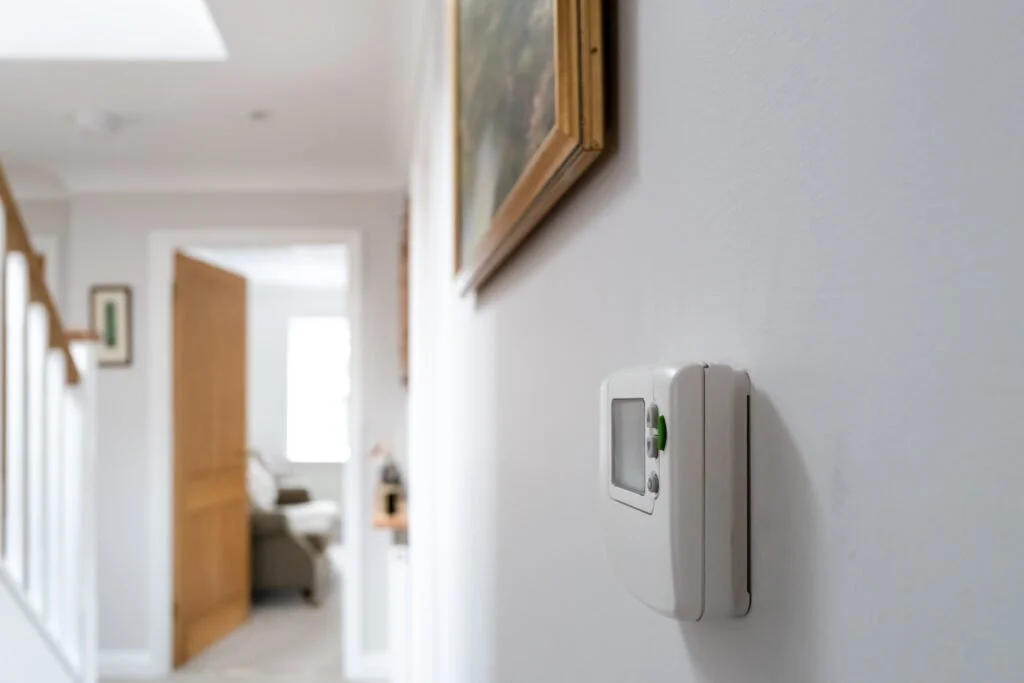
Thermostat says 74 but your house feels hotter? A poorly placed hallway thermostat could be the reason. J Martin offers fast diagnostics across Orange County. Call (714) 462-4686.
Thermostats near supply vents. If your thermostat is mounted on a wall near a supply register, the cool air blowing out of that vent hits the thermostat sensor and tells it the room is colder than it actually is. The system satisfies the thermostat setting and shuts off, but the rest of the room never reached the target temperature. This is especially problematic in homes where the thermostat was installed on the same wall as a ceiling vent, which is common in Orange County tract homes where the builder's electrician put the thermostat in whatever location was most convenient for wiring.
Thermostats on exterior walls. During summer, an exterior wall absorbs heat from outside and radiates it inward. A thermostat mounted on that wall reads warmer than the actual room temperature because the wall behind it is warm. The system runs longer than it needs to, overcooling the house in some areas while the thermostat itself never seems satisfied. In winter, the opposite happens: the cold exterior wall makes the thermostat think the house is cooler than it is, causing the heater to overrun.
Thermostats in direct sunlight. Even indirect afternoon sun through a nearby window can raise the temperature at the thermostat by 3 to 5 degrees compared to the rest of the room. Direct sunlight hitting the thermostat can skew the reading by 10 degrees or more. The system responds to that false reading by running the AC aggressively, overcooling the house while the thermostat's sun-warmed sensor keeps demanding more.
Thermostats near heat sources. Lamps, televisions, gaming consoles, kitchen appliances, and even recessed lighting in the ceiling above the thermostat can warm the surrounding air enough to throw off the reading. A television mounted on the same wall as the thermostat can raise the local air temperature by 2 to 4 degrees, which is enough to trigger a cooling cycle that the rest of the house doesn't need.
The ideal thermostat location is on an interior wall in a central, commonly used room, approximately 52 to 60 inches from the floor, away from any supply registers, windows, exterior doors, direct sunlight, and heat-producing appliances. If your thermostat isn't in that kind of location, relocating it may be the single most effective thing you can do to improve the accuracy of your system's temperature control. Relocating a thermostat typically costs $150 to $350 when done by an HVAC professional, depending on the wiring involved, and the improvement in comfort and efficiency often pays for itself within a single cooling season.
Air Stratification: The Physics You Can Feel But Can't See
Even if your thermostat is perfectly placed, there's a fundamental physics problem that affects every home: warm air rises and cool air sinks. This natural process, called thermal stratification, means the air temperature in any room varies by elevation. The air near the floor is cooler than the air at head height, which is cooler than the air near the ceiling. In a room with standard 8-foot ceilings, the temperature difference between floor level and ceiling level can be 3 to 5 degrees. In rooms with vaulted or two-story ceilings, that difference can reach 8 to 15 degrees.
Your thermostat is mounted on the wall at roughly 5 feet. It measures the air temperature at that specific elevation. But you experience temperature at multiple elevations simultaneously: your feet on the floor, your body in the middle of the room, and your head and face in the warmest layer of air. If the thermostat reads 74 at its mounted height, the air at your feet might be 71 and the air at the ceiling might be 78. You perceive the average of what your body encounters, which feels warmer than what the thermostat reports.
This effect gets dramatically worse in two-story homes where the upstairs is significantly hotter than the downstairs. In a typical Orange County two-story home with a single HVAC system and the thermostat on the first floor, the temperature difference between the ground floor and the upper floor can be 5 to 10 degrees during summer. The thermostat on the first floor reads 74 and says everything is fine, while the bedrooms upstairs are sitting at 80 or higher. The thermostat is accurate for its location. It's just not measuring where you need to sleep.
Why is the gap so large? Several factors compound the problem. Hot air from the first floor naturally rises through the stairwell to the second floor. The attic above the second-floor ceiling, which can exceed 150 degrees in an Orange County summer, radiates heat downward through the ceiling. The ductwork running through that superheated attic loses cooled air through leaks and absorbs heat through inadequate insulation, so the air that arrives at the upstairs registers is warmer than the air that left the AC unit. And in most two-story homes built with a single thermostat on the first floor, the system has no way to know that the second floor is 8 degrees warmer because it's only measuring the first floor.
This is also why certain rooms always feel hotter or colder than the rest of the house. A bedroom at the end of a long duct run gets less airflow than a room near the air handler. A room with large west-facing windows absorbs massive solar heat gain during afternoon hours. A room over the garage has less insulation below it. None of these rooms will match the thermostat reading because the thermostat is somewhere else entirely, measuring conditions that don't represent those spaces.
The Dirty Sensor Problem
Sometimes the thermostat itself is genuinely reading the wrong temperature. This is less common than placement issues, but it does happen, and it's worth checking before you spend money on other solutions.
Modern digital thermostats use a thermistor (a small electronic temperature sensor) to measure air temperature. Over time, dust can accumulate on or around this sensor, insulating it slightly from the ambient air and causing it to read a degree or two off. In most cases, this drift is minor (1 to 2 degrees) and doesn't dramatically affect comfort. But combined with other factors like poor placement or stratification, even a small sensor error can compound the perceived gap between what the thermostat says and what you feel.
To check whether your thermostat's reading is accurate, tape a reliable standalone thermometer to the wall right next to the thermostat and leave it there for 15 minutes. Compare the readings. If they match within 1 to 2 degrees, your thermostat sensor is fine and the problem is almost certainly related to placement, airflow, or stratification rather than the sensor itself. If the readings differ by 3 degrees or more, the sensor may need cleaning or the thermostat may need recalibration.
Cleaning a thermostat sensor is straightforward on most models. Remove the thermostat's faceplate (it usually snaps off or unscrews from the wall plate), then use a can of compressed air to gently blow out any dust that has accumulated inside the housing, particularly around the sensor area. Avoid touching the sensor with your fingers, as the oils from your skin can affect its accuracy. Snap the faceplate back on and give it 15 minutes to stabilize before checking the reading again.
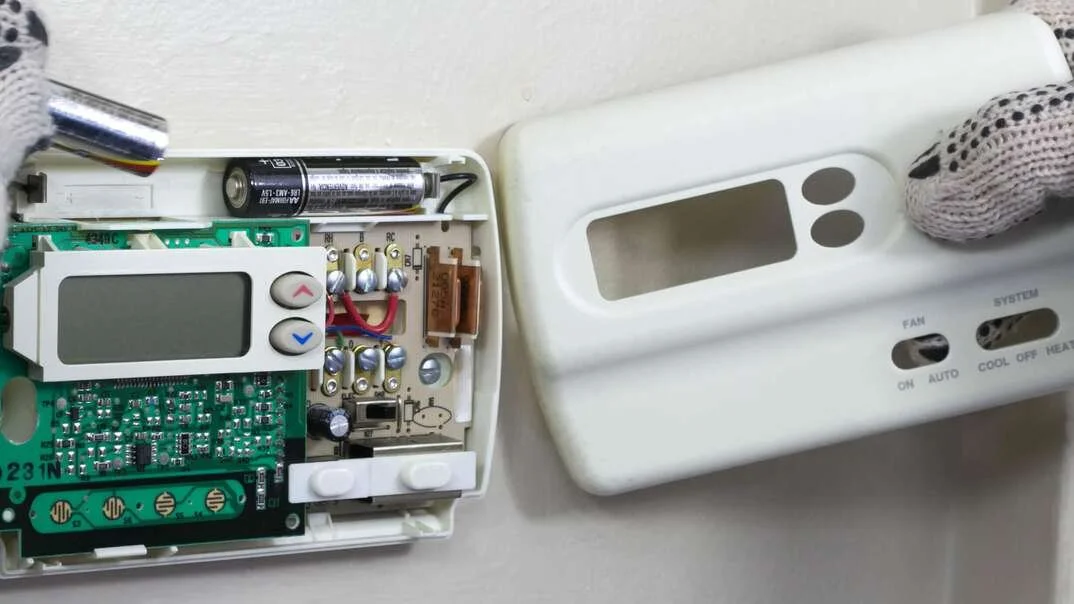
Not every thermostat problem means replacement. Sometimes a dirty sensor or internal issue is causing inaccurate temperature readings. J Martin helps homeowners find the real fix.
If cleaning doesn't resolve a significant discrepancy, the thermostat may need to be recalibrated. Some digital and smart thermostats have a calibration offset setting that allows you to adjust the displayed temperature by a degree or two to match a known accurate reference. Check your thermostat's manual or settings menu for a "temperature correction" or "calibration" option. If your thermostat doesn't offer this feature and the reading is consistently off by more than 2 degrees after cleaning, replacement is usually the most practical solution. A quality programmable thermostat costs $30 to $75, and a smart thermostat that can help manage TOU rates and multi-room comfort runs $150 to $350.
When the Problem Isn't the Thermostat at All
Here's what most "thermostat not accurate" articles won't tell you: in many cases, the thermostat is perfectly accurate, properly placed, and functioning exactly as designed. The real problem is with the HVAC system itself.
Restricted airflow from a dirty filter or dirty coils. When your air filter is clogged or your evaporator coil is coated in dust and debris, the system can't move enough air to effectively cool the house. The thermostat detects that the air near it hasn't reached the set temperature, so it keeps the system running. But the system is struggling to push conditioned air through the restriction, so rooms far from the air handler receive barely any cooling while the area near the thermostat (which is often near a supply vent) gets cooled first. The thermostat eventually satisfies, but the rest of the house never catches up. Check your filter first. It's the cheapest, easiest fix and solves this problem more often than you'd expect.
Duct leaks. If your ductwork has leaks, disconnections, or deteriorated insulation, a significant portion of the cooled air your system produces never reaches the rooms it's intended for. It leaks into the attic, the crawlspace, or the wall cavities. The system works hard, the thermostat eventually satisfies because the area around it receives adequate cooling, but the rooms at the ends of long duct runs or upstairs bedrooms fed by leaky attic ductwork stay warm. In older Orange County homes from the 1970s through 1990s, duct losses of 20 to 40 percent are common because the original flex ductwork has deteriorated after decades of exposure to extreme attic temperatures. Duct sealing or replacement addresses this problem at the source.
An undersized system. If your AC system is too small for your home's cooling load, it will run continuously on hot days without ever reaching the set temperature in every room. The thermostat may show 74 near its location, but the system simply can't produce enough cooling to overcome the heat gain from sun-exposed walls, inadequately insulated attic spaces, and heat-generating appliances. This is especially common in homes that have been expanded with room additions or converted garages without upgrading the HVAC system to handle the increased square footage.
Low refrigerant. When your system is low on refrigerant due to a leak, it loses cooling capacity. The air coming out of the vents is warmer than it should be, so the system runs longer to achieve the same result. The thermostat may eventually satisfy, but the cooling is uneven, slow, and inefficient. If your system used to keep the house comfortable and now struggles to maintain the set temperature on moderately hot days, low refrigerant is a likely culprit.
Single-zone system in a multi-zone house. Most Orange County homes built before 2010 have a single HVAC system with a single thermostat controlling the entire house. This works reasonably well in single-story homes with moderate square footage. In two-story homes, homes with open floor plans and vaulted ceilings, or homes with room additions, a single thermostat simply cannot represent the temperature conditions throughout the entire structure. The solution is either a zoned system with dampers that direct airflow to different areas independently, or a supplemental system (like a ductless mini split) for the areas that consistently run too warm or too cool.
Orange County Factors That Make This Problem Worse
Certain conditions specific to our area amplify the gap between what your thermostat reads and what you feel, and they're worth understanding because they explain why your neighbor in a different part of town might not experience the same issue you do.
West-facing windows in afternoon sun. Orange County's geographic orientation means west-facing rooms take a direct hit from afternoon sun between roughly 2 PM and 7 PM during summer. In communities like Anaheim Hills, Yorba Linda, and Brea, where many homes are built on hillsides with large west-facing windows for views, the solar heat gain through those windows during afternoon hours can raise the room temperature by 5 to 10 degrees above the thermostat reading in the hallway. Your thermostat is happily reporting 74 while the family room with the canyon view is baking at 82. Blackout curtains or solar shades on west-facing windows can reduce this heat gain by 30 to 45 percent, which is one of the cheapest and most effective ways to reduce the gap.

Sunlight through large windows can raise room temperatures far above what your thermostat reads. J Martin helps Orange County homeowners fix uneven cooling at the source.
Attic duct deterioration. We've mentioned this in other contexts, but it deserves emphasis here because it's so directly connected to the thermostat discrepancy problem. When your ductwork is leaking or poorly insulated, the conditioned air that reaches distant rooms is significantly warmer than the air that reaches rooms close to the air handler. The thermostat, which is typically located near the air handler on the first floor, gets cooled efficiently and satisfies quickly. Meanwhile, the upstairs bedrooms fed by 30-year-old flex duct running through a 150-degree attic receive air that's been warmed by 5 to 10 degrees during its journey through the ductwork. The thermostat reads 74. The bedroom feels like 80. The thermostat isn't wrong. The duct system is failing.
Santa Ana wind events. During Santa Ana wind conditions, which occur multiple times per year in Orange County, hot, dry air pushes temperatures well above normal, sometimes reaching 100 to 110 degrees in inland areas while coastal communities stay 15 to 20 degrees cooler. These events create extreme demand on AC systems and can widen the gap between thermostat readings and room temperatures because the system simply can't overcome the heat load fast enough. If your thermostat discrepancy only appears during extreme heat events, it may indicate that your system is operating at its design limit rather than indicating a malfunction. However, if the gap persists on moderate days (85 to 90 degrees), the system has an underlying issue that needs professional diagnosis.
DIY Steps to Diagnose and Fix the Gap
Before you call anyone, run through these checks systematically. Many thermostat discrepancy issues can be identified or resolved without professional help.
Start by verifying your thermostat's accuracy using the standalone thermometer test described earlier. Tape a reliable digital thermometer next to the thermostat, wait 15 minutes, and compare. This tells you immediately whether the thermostat itself is the problem or whether the issue is elsewhere.
Check your air filter next. Pull it out and hold it up to a light source. If you can't see light through it, it's restricting airflow and needs to be replaced. A $5 to $15 filter swap resolves a surprising number of "my house won't cool evenly" complaints.
Walk through each room with a portable thermometer and note the temperature in every space. This gives you a temperature map of your home and immediately reveals whether the problem is isolated to specific rooms or widespread. Pay particular attention to the difference between the first and second floors, rooms with large windows (especially west-facing ones in Orange County, where afternoon sun is brutal), rooms over the garage, and rooms at the end of long hallway runs.
Check all your supply registers to make sure they're open and unblocked. A vent that's been closed, covered by furniture, or blocked by curtains can't deliver conditioned air to that room, and the thermostat has no way to know that room is warming up.
Feel the air coming out of each supply register with your hand. The air should feel distinctly cool (about 15 to 20 degrees cooler than the room temperature). If the air from some registers feels barely cool or lukewarm, there's likely a duct issue between the air handler and that register: a leak, a kink, a disconnection, or insulation that has fallen away from the duct.
If you have a two-story home with a single thermostat on the first floor, try an experiment: set the thermostat 2 to 3 degrees lower than your desired upstairs temperature. Yes, the downstairs will be a bit cooler than ideal, but the upstairs will be closer to comfortable. If this makes a significant difference in upstairs comfort, it confirms that stratification and duct distribution are the root issues, not the thermostat itself.
Use your ceiling fans. Ceiling fans don't lower the actual air temperature, but they create air movement that disrupts the stratification layers and makes the room feel 3 to 4 degrees cooler than the thermometer reads. Running ceiling fans allows you to set the thermostat 2 to 3 degrees higher while maintaining the same perceived comfort level, which also saves on your electricity bill.
If your thermostat is in a problematic location (hallway, exterior wall, near a vent, in direct sunlight), consider whether you can temporarily test a different location. Some smart thermostats like the Ecobee come with remote room sensors that measure temperature in multiple rooms and average them together, effectively solving the single-location limitation without relocating the thermostat itself. This is one of the most practical upgrades for Orange County homes with uneven temperatures, and it costs $250 to $350 installed.
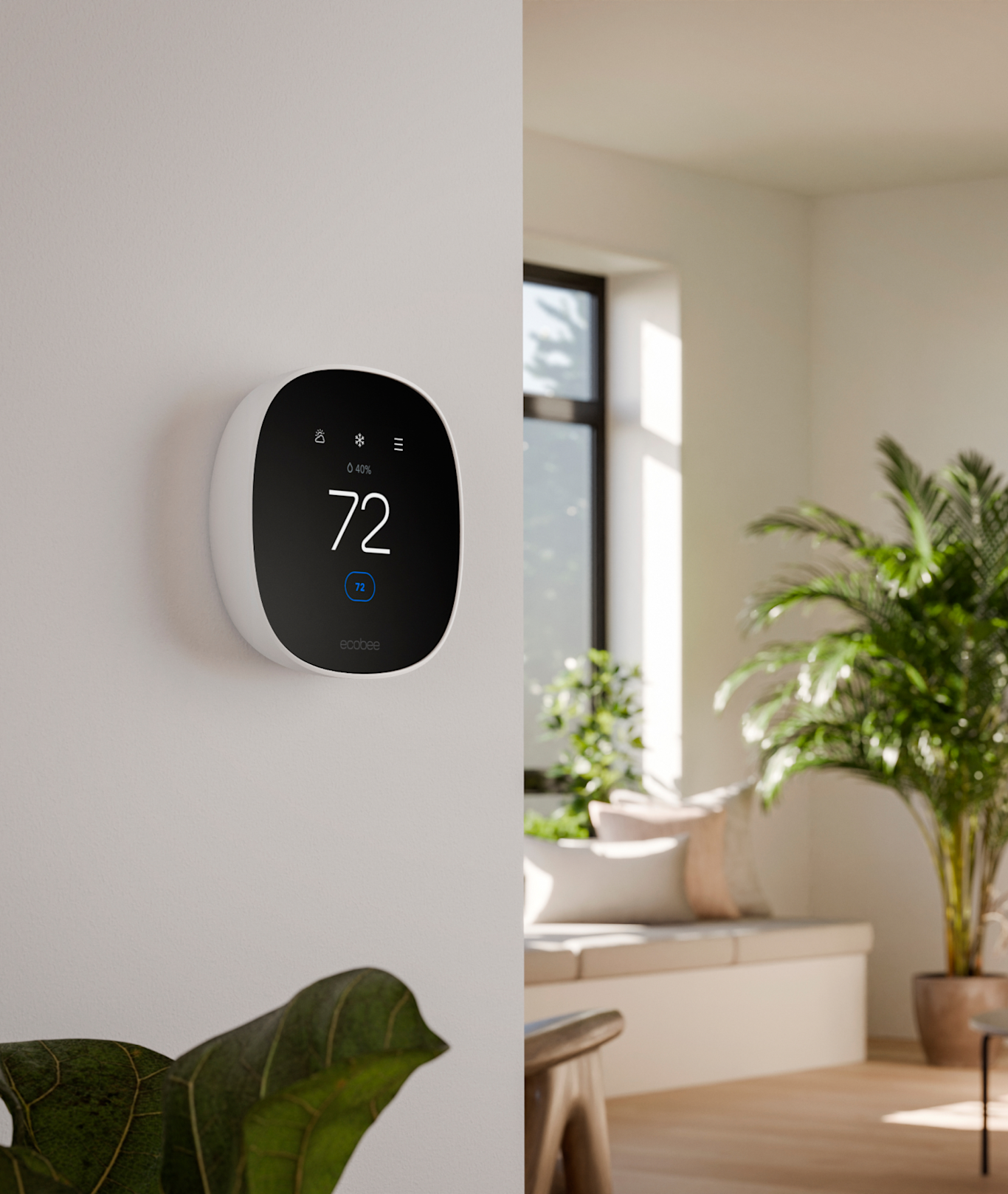
A thermostat should reflect how your home actually feels. Smart thermostats with advanced sensors help eliminate inaccurate readings and improve comfort throughout your home.
When to Call a Professional
The DIY steps above will either resolve your issue or narrow down the cause. But certain problems require professional diagnosis and equipment to fix properly.
Call a professional if the air from your supply registers feels warm or barely cool, because this indicates a refrigerant issue, a failing compressor, or a severely restricted evaporator coil, all of which require specialized tools and training to diagnose and repair.
Call a professional if you've confirmed a significant temperature gap between floors (more than 5 degrees) that persists regardless of thermostat settings and fan usage. This typically indicates a duct design problem, inadequate return air on the upper floor, or attic ductwork that has deteriorated to the point where it needs sealing or replacement. A qualified HVAC technician can measure airflow at each register, inspect the ductwork, and determine whether the issue is fixable with duct repairs or whether the home needs a zoned system to properly condition both floors.
Call a professional if you want to relocate your thermostat. Moving a thermostat involves running new low-voltage wiring through the wall to the new location, which requires knowledge of your system's wiring configuration and proper wall patching. It's a straightforward job for an HVAC technician ($150 to $350) and makes a dramatic difference when placement is the root cause.
Call a professional if your system runs constantly on moderately hot days (90 to 95 degrees) without maintaining the set temperature. This suggests an undersized system, low refrigerant, or a major duct leak that's robbing the system of capacity. A technician can measure the system's output, check refrigerant levels, and perform a load calculation to determine whether the equipment is matched to the home's actual cooling needs.
And call a professional if you're considering adding a smart thermostat with remote sensors, a zoned system with dampers, or a supplemental mini split for a consistently uncomfortable room. These solutions address the underlying physics of why your house feels different from the thermostat reading, and proper sizing and installation are critical to getting the results you're paying for.
At J Martin, diagnosing thermostat and comfort issues is one of the most common calls we take during the cooling season. Our approach is always to find the simplest, most cost-effective solution first. Sometimes that's a $15 filter change. Sometimes it's a $300 thermostat relocation. Sometimes it's identifying duct damage that's been costing you money for years without you knowing it. Our technicians are paid a salary, not a commission, which means their recommendation is always based on what your home actually needs rather than what generates the biggest invoice. We hold California Contractor's License #998956, maintain a 4.97-star rating across over 5,000 customers, and have been serving families in Yorba Linda, Anaheim, Brea, Fullerton, and Villa Park since 2014.
If your thermostat says one thing and your house says another, call us at 714-462-4686. We'll figure out why, fix what needs fixing, and leave you with a home where the thermostat reading and the way it feels actually match.