
Best HVAC Air Filters for Orange County Homes: MERV 8 vs. 11 vs. 13 Compared
Posted on May 21, 2026
A Yorba Linda homeowner called us for a routine tune-up last spring and mentioned that her allergies had been brutal since February. She'd been running the same MERV 8 filters she'd always bought from the hardware store, changing them every 90 days like the package said. When our technician pulled the filter out, it was black. Not dark gray, which you'd expect at 90 days. Solid black, packed with dust and pollen so thick that the pleats were bowed inward from the restricted airflow. The system's static pressure was nearly double what it should have been, and the evaporator coil behind the filter had a visible layer of dust coating it because the overloaded filter had started letting particles bypass around the edges.
The filter she was using wasn't bad. MERV 8 is a perfectly reasonable choice for many homes. But for her home, with two dogs, seasonal allergies, and a location that catches Santa Ana wind dust from the surrounding hillsides, MERV 8 wasn't capturing the smaller particles making her miserable, and she wasn't changing it often enough for her conditions. We switched her to a MERV 11 filter on a 60-day replacement schedule, and when she called back for her fall tune-up, she said it was the first spring in years where she hadn't needed to increase her allergy medication.
That's the real story behind the MERV rating conversation. It's not about buying the highest number on the shelf. It's about matching the filter to your household, your health needs, and your HVAC system's capabilities, then changing it on a schedule that actually makes sense for how your home generates and collects airborne particles. This guide breaks down what each MERV rating captures, what it costs, how it affects your system, and which one is the right fit for the specific conditions Orange County homeowners face.
What MERV Ratings Actually Measure
MERV stands for Minimum Efficiency Reporting Value. It's a standardized rating system developed by the American Society of Heating, Refrigerating and Air-Conditioning Engineers (ASHRAE) that measures how effectively an air filter captures airborne particles based on their size. The scale runs from 1 to 20, with higher numbers indicating finer filtration. For residential HVAC systems, the relevant range is MERV 8 through MERV 13. Anything below MERV 8 is essentially protecting only the equipment, not the people breathing the air. Anything above MERV 13 is hospital and laboratory-grade filtration that most residential systems aren't designed to handle without modification.
The rating is determined by testing the filter's performance across three particle size ranges. The largest range, 3.0 to 10.0 microns, includes common household dust, pollen, mold spores, and pet dander. The medium range, 1.0 to 3.0 microns, includes finer dust, auto emissions, and some bacteria. The smallest range, 0.3 to 1.0 microns, includes smoke particles, some viruses carried on respiratory droplets, and the finest particulate matter.
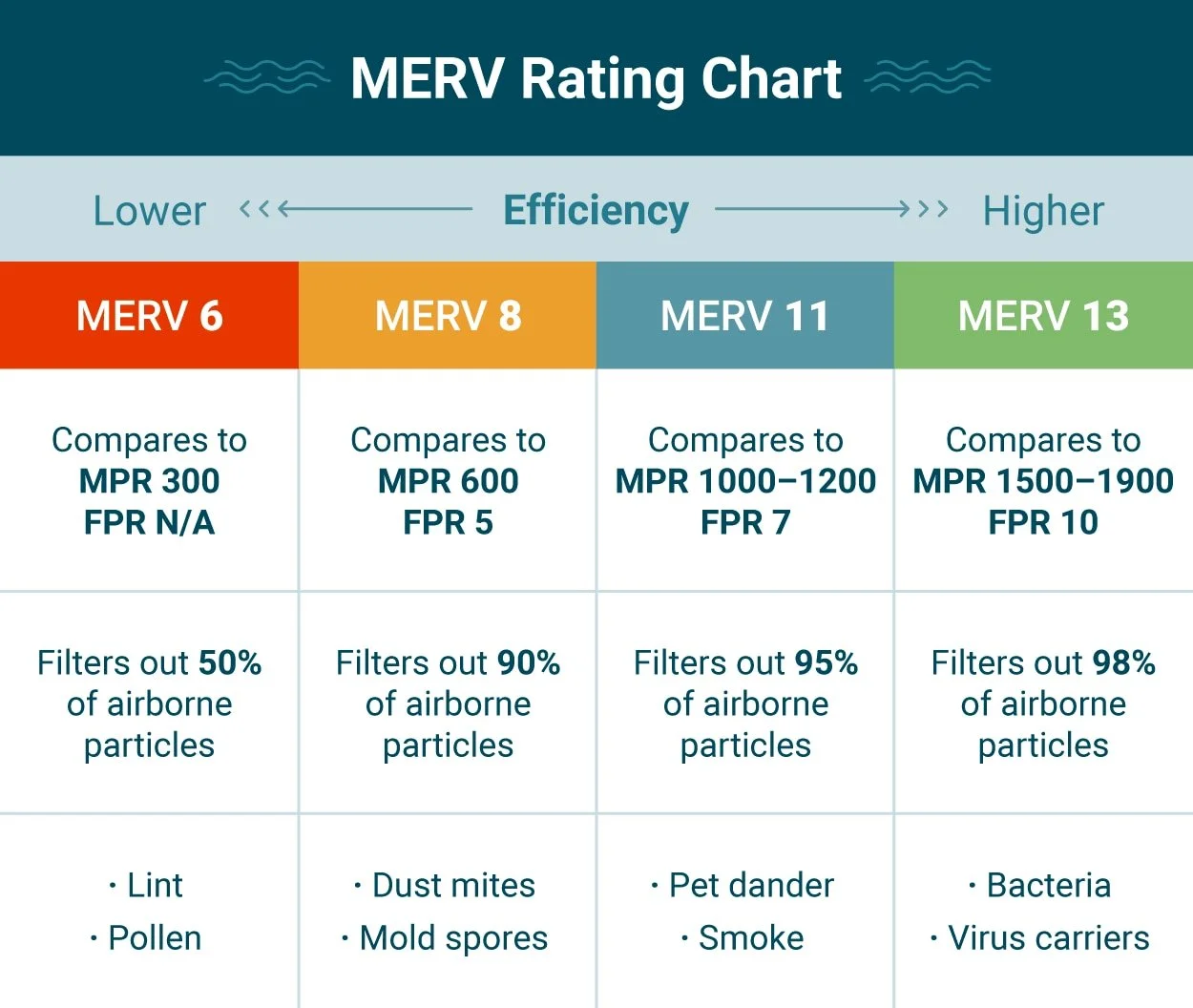
Not all air filters are the same. Understanding MERV 8 vs 11 vs 13 helps you balance air quality, airflow, and system performance the right way.
To put particle sizes in perspective, a human hair is roughly 70 microns in diameter. Pollen grains from common Orange County trees like oak, sycamore, and eucalyptus range from 15 to 50 microns. Pet dander particles are typically 2.5 to 10 microns. Mold spores run 2 to 20 microns. Wildfire smoke particulate (PM2.5) is, as the name suggests, 2.5 microns and smaller. The particles that cause the most respiratory irritation tend to be the smallest ones, because they penetrate deepest into the lungs. That's why the difference between filter ratings matters, and why the jump from MERV 8 to MERV 11 or MERV 13 is more significant than the numbers might suggest.
MERV 8: The Baseline That Works for Many Homes
A MERV 8 filter captures at least 70% of particles in the 3.0 to 10.0 micron range and at least 20% of particles in the 1.0 to 3.0 micron range. In practical terms, it catches most household dust, lint, larger pollen grains, dust mite debris, and mold spores. It does a reasonable job of keeping visible dust off your furniture and preventing the coarser airborne material from circulating through your home. It does relatively little against the finer particles that cause the most trouble for allergy sufferers, asthma patients, and anyone sensitive to smoke or automotive exhaust.
The advantages of MERV 8 are cost and airflow. These filters are the most affordable option, typically running $5 to $15 per filter for standard 1-inch sizes in a multi-pack. They create the least restriction to airflow, with an initial pressure drop of approximately 0.10 to 0.14 inches of water column (the industry standard measurement for airflow resistance). This makes them universally compatible with virtually every residential HVAC system regardless of age or blower motor type. And because they load up with particles more slowly than denser filters, they last longer between replacements, typically 90 days under standard conditions.
MERV 8 is the right choice for households where nobody has allergies, asthma, or respiratory sensitivities, where there are no pets generating dander, where the home isn't located in a particularly dusty area or near heavy traffic, and where the primary goal is equipment protection and basic dust control. For a newer, well-sealed home in a lower-dust coastal area of Orange County with no pets and no health concerns, MERV 8 gets the job done without overcomplicating things.
Where MERV 8 falls short is in the conditions that define life for much of Orange County. If you have pets (and roughly 67% of American households do), if anyone in the home has allergies or asthma, if you live in an inland area that gets Santa Ana wind dust, or if wildfire smoke is a seasonal concern, MERV 8 is leaving a significant amount of the harmful and irritating material in your air.
MERV 11: The Sweet Spot for Most Orange County Homes
A MERV 11 filter captures at least 85% of particles in the 3.0 to 10.0 micron range and at least 65% of particles in the 1.0 to 3.0 micron range. That jump from 20% to 65% in the medium particle range is where the meaningful health difference lies. MERV 11 catches the finer dust, most pet dander particles, legionella bacteria, auto emissions residue, mold spore fragments, and the larger end of the smoke particle spectrum.
The cost increase is modest. MERV 11 filters typically run $10 to $25 per filter for standard 1-inch sizes, representing a $3 to $10 premium per filter over MERV 8. Over a year with four filter changes, the annual cost difference is roughly $12 to $40. For a filter that captures substantially more of the particles causing allergic reactions and respiratory irritation, that's a remarkably cost-effective upgrade.
The airflow impact is noticeable but manageable for most systems. A MERV 11 filter has an initial pressure drop of approximately 0.15 to 0.18 inches of water column, representing about a 15% to 30% increase in resistance over MERV 8. For HVAC systems built in the last 20 years (which covers the vast majority of residential systems in Orange County), this level of restriction is well within the blower motor's operating range. Older systems or systems that are already operating near their maximum static pressure limit may need a professional evaluation before upgrading, but this affects a relatively small percentage of homes.
MERV 11 is the right choice for the majority of Orange County households, and here's why. Orange County's inland communities, including Anaheim Hills, Yorba Linda, Brea, Fullerton, Villa Park, and Placentia, experience conditions that generate more airborne particulate than the average American home. The Santa Ana winds, which blow from the inland deserts through the canyons between October and May, carry fine dust, pollen, and debris that infiltrates homes even when windows and doors are closed. Homes near equestrian trails, open hillsides, and construction zones accumulate airborne material faster than homes in fully developed areas. Trees common throughout Orange County neighborhoods, including oak, sycamore, eucalyptus, mulberry, olive, and ash, produce significant pollen loads from roughly January through June, with the worst months typically being March through May.
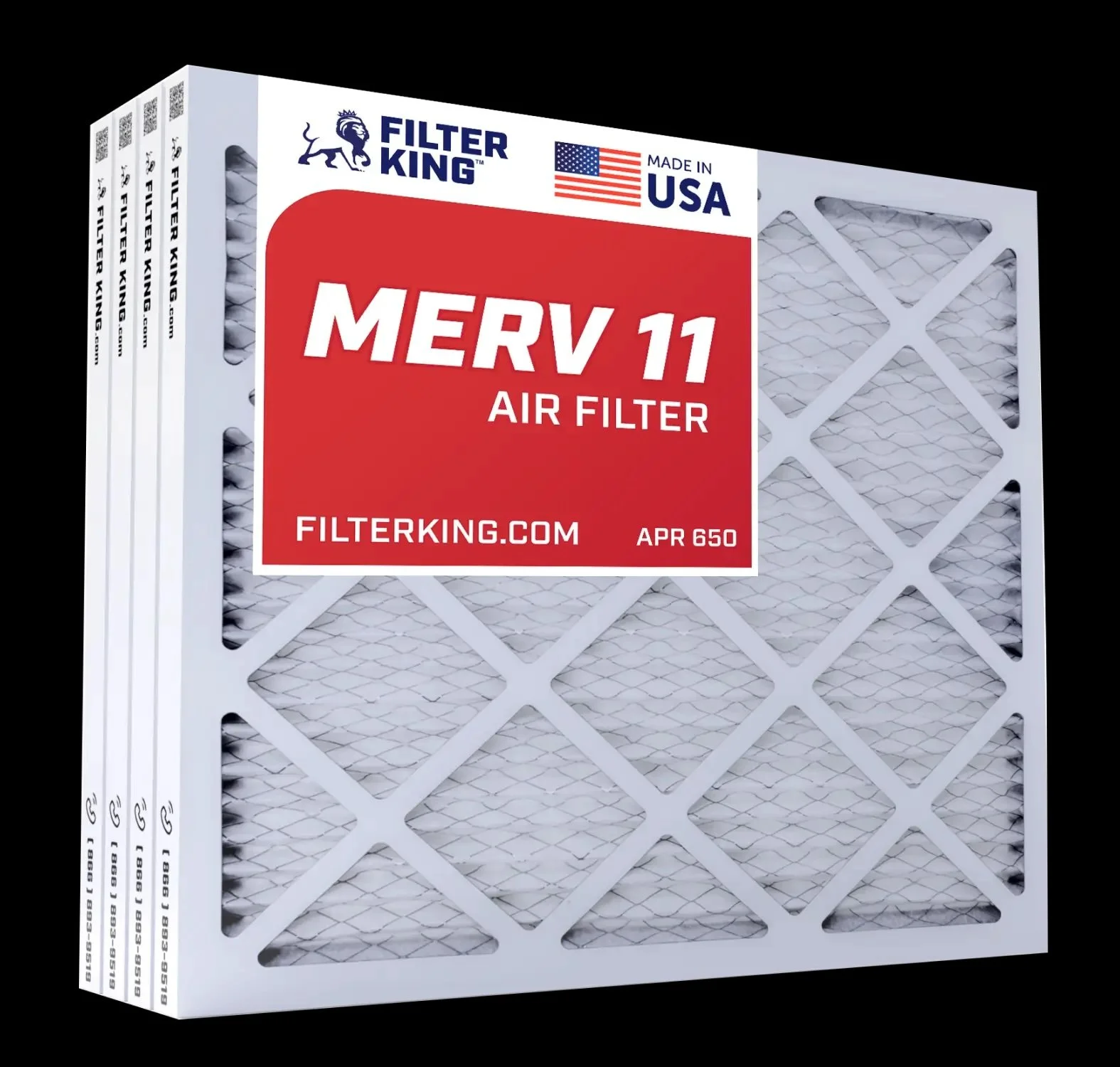
MERV 11 air filters offer the best balance of filtration and airflow for most homes. J Martin helps Orange County homeowners choose the right HVAC filter without guesswork.
If you have pets, seasonal allergies, live in any of the inland Orange County communities, or simply want meaningfully cleaner air than a MERV 8 provides, MERV 11 delivers the most improvement per dollar of any filter upgrade. We covered how these same airborne particles accumulate inside ductwork over time, and why periodic duct cleaning matters alongside proper filtration, in our complete guide.
The tradeoff with MERV 11 is that the denser filter media loads up with captured particles faster than MERV 8, which means shorter replacement intervals. In an average Orange County home, a MERV 11 filter should be replaced every 60 to 75 days rather than the 90 days typical for MERV 8. In homes with pets, heavy pollen exposure, or proximity to dusty open space, you may need to check and potentially replace the filter every 45 to 60 days. A loaded filter that hasn't been changed on time is worse than a lower-rated clean filter, because the restricted airflow reduces system efficiency, increases energy consumption, and can allow particles to bypass around the filter edges.
MERV 13: Maximum Residential Filtration (With Important Caveats)
A MERV 13 filter captures at least 90% of particles in the 3.0 to 10.0 micron range and at least 85% of particles in the 1.0 to 3.0 micron range. It also captures approximately 50% or more of particles in the smallest 0.3 to 1.0 micron range. This is where wildfire smoke particulate (PM2.5), tobacco and cooking smoke, bacteria, and virus-carrying respiratory droplets live. MERV 13 is the highest filtration rating that's practical for residential HVAC without specialized equipment, and ASHRAE has recommended it as the minimum for improved protection against airborne pathogens.
The cost is higher. MERV 13 filters typically run $15 to $35 per filter for standard 1-inch sizes, and $25 to $50 for 4-inch media filters. Over a year, the difference between MERV 13 and MERV 8 might be $40 to $100 depending on filter size and replacement frequency. That's not a significant cost in the context of HVAC ownership, but the replacement frequency is the real budget factor: MERV 13 filters in a standard 1-inch housing need replacing every 45 to 60 days, and in homes with heavy particulate loads (multiple pets, construction nearby, Santa Ana wind season), as often as every 30 to 45 days.
Here's where the important caveat comes in. MERV 13 filters have an initial pressure drop of approximately 0.22 to 0.28 inches of water column for a standard 1-inch pleated filter. That's roughly double the resistance of a MERV 8 filter. For most residential HVAC systems, which have a maximum rated external static pressure of around 0.50 inches, that filter alone is consuming close to half the system's total available pressure budget. Add in the resistance from the ductwork, the evaporator coil, and the return grille, and some systems genuinely cannot handle a MERV 13 filter, especially in a standard 1-inch slot.
This doesn't mean MERV 13 is off the table. It means the installation needs to be done correctly. Systems with variable-speed ECM blower motors (common in equipment manufactured after 2010) can compensate for the increased resistance by automatically adjusting motor speed. Systems with standard single-speed PSC blower motors have less flexibility and are more susceptible to airflow reduction. And the single most effective way to use MERV 13 filtration without straining your system is to use a deeper filter: a 4-inch or 5-inch media cabinet filter at MERV 13 provides the same filtration with significantly less airflow restriction than a 1-inch filter at the same rating, because the larger surface area allows air to pass through more easily. A 4-inch MERV 13 filter typically has 40% to 50% less pressure drop than a 1-inch MERV 13 filter. Installing a media cabinet (a professional-grade filter housing that mounts between the return duct and the furnace) costs $200 to $500 for the hardware plus installation labor, and the replacement filters last 6 to 12 months rather than 30 to 60 days.
MERV 13 is the right choice for households where someone has severe allergies, asthma, chronic respiratory conditions, or a compromised immune system. It's the right choice for homes where wildfire smoke infiltration is a priority concern (which includes every hillside and canyon-adjacent community in Orange County, particularly neighborhoods in Anaheim Hills, Weir Canyon, and eastern Yorba Linda that have experienced direct fire impact). And it's the right choice for households where anyone smokes indoors or where cooking smoke is a persistent issue.
If you're not sure whether your system can handle MERV 13 in a standard 1-inch slot, the safest approach is to have a technician measure your system's static pressure with your current filter installed. If there's adequate headroom (meaning the total system static pressure with the new filter would remain below 0.50 inches), the upgrade is safe. If not, a 4-inch media cabinet installation solves the problem permanently and is a better long-term investment than fighting airflow restrictions with a filter that's too dense for the housing.
What Orange County's Air Does to Your Filters
Understanding why Orange County homes are harder on filters than homes in many other parts of the country helps explain why the generic replacement schedules printed on filter packages don't always apply here.
Southern California has a well-earned reputation for air quality challenges. Orange County's location between the coast and the inland basins means it gets the best and worst of both worlds. Coastal breezes bring relatively clean marine air, but the basin effect traps ozone and particulate matter during stagnant weather patterns. The South Coast Air Quality Management District regularly issues advisories for elevated PM2.5 and ozone levels affecting Orange County, particularly during summer months and Santa Ana wind events.

When outdoor air quality drops, the right HVAC air filter makes a difference. J Martin helps Orange County homeowners choose the best MERV rating for cleaner indoor air.
The Santa Ana winds are the biggest single factor affecting indoor air quality and filter life in Orange County. These hot, dry winds blow from the desert through the mountain passes and canyons, carrying fine dust, pollen, ash, and debris. They strip moisture from vegetation, creating conditions that are both fire-prone and heavily particulate-laden. During Santa Ana events, outdoor PM10 and PM2.5 concentrations spike, and that airborne material infiltrates homes through every available pathway. HVAC systems operating during Santa Ana winds are pulling that dust-laden air through the return ducts and directly into the filter. Homeowners near hillsides, canyons, and open space are especially affected.
Pollen season in Southern California doesn't get the same attention as it does in the Southeast or Northeast, but it's a significant factor for allergy sufferers. Unlike regions with a distinct "allergy season" followed by relief, Orange County's Mediterranean climate means something is always pollinating. Trees like oak, sycamore, eucalyptus, mulberry, and olive produce heavy pollen from January through May. Grasses pollinate through summer. Weeds like sagebrush and ragweed continue into fall. The only months with consistently lower pollen counts are November and December, and even then, juniper and some ornamental species keep going.
For Anaheim Hills homeowners specifically, the combination of hillside elevation, proximity to equestrian trails and open space, canyon wind channels, and wildfire history creates filter conditions that are among the most demanding in the county. We covered the full range of air quality challenges unique to that community in our Anaheim Hills HVAC guide, including why homes near Deer Canyon, Weir Canyon, and the eastern neighborhoods facing Cleveland National Forest need more aggressive filtration and maintenance schedules.
The Annual Cost Comparison (Real Numbers)
Looking at the total annual cost of each MERV rating, including purchase price and replacement frequency, puts the comparison in practical terms.
For a home using standard 1-inch filters in a common size like 16x25x1 or 20x25x1, the math works out roughly as follows. A MERV 8 filter costs approximately $5 to $12 per filter. At a 90-day replacement interval, that's 4 filters per year, totaling $20 to $48 annually. A MERV 11 filter costs approximately $10 to $20 per filter. At a 60 to 75-day replacement interval, that's 5 to 6 filters per year, totaling $50 to $120 annually. A MERV 13 filter in a 1-inch housing costs approximately $15 to $30 per filter. At a 45 to 60-day replacement interval, that's 6 to 8 filters per year, totaling $90 to $240 annually.
The cost picture changes significantly if you install a 4-inch media cabinet. A 4-inch MERV 13 filter costs $25 to $50 per filter but lasts 6 to 12 months, meaning 1 to 2 replacements per year at a total of $25 to $100 annually, plus the one-time cabinet installation cost of $200 to $500. Over a 5-year period, the media cabinet route is often cheaper than running 1-inch MERV 13 filters, and it provides better airflow and more consistent filtration between changes.
The cost difference between MERV 8 and MERV 11 for a typical household is roughly $30 to $70 per year. That's less than a single dinner out. For the meaningful improvement in filtration and air quality that MERV 11 provides, particularly in a pollen-heavy, dust-exposed, pet-friendly Orange County home, the value proposition is straightforward.
If you're also running a smart thermostat optimized for SCE's time-of-use rates, the minor increase in fan energy from a higher-MERV filter is more than offset by the scheduling efficiency gains. We covered whether a smart thermostat is worth it including the real savings math at current SCE electricity rates.
How to Choose the Right Filter for Your Home
Rather than defaulting to whatever's on sale at the hardware store, work through these considerations in order.
Start with your household health profile. If anyone in the home has diagnosed allergies, asthma, COPD, or another respiratory condition, MERV 11 is the minimum you should consider, with MERV 13 preferred if your system can handle it. If someone is immunocompromised due to age, illness, or medical treatment, MERV 13 with a media cabinet is worth the investment. If nobody has specific health sensitivities, you have more flexibility.
Next, assess your home's particulate exposure. Do you have pets? One large dog can generate as much dander and hair as a small family generates dust. Multiple pets multiply the problem. Do you live near open hillsides, equestrian trails, construction zones, or heavily trafficked roads? Do you keep windows open regularly? Are you in an area with significant pollen-producing trees? Every "yes" pushes you toward MERV 11 at minimum. If you checked multiple boxes, consider MERV 13.
Then verify your system's compatibility. Check your HVAC system's documentation for the maximum recommended MERV rating. If you can't find it, look at the data plate on your air handler or furnace for the model number and search the manufacturer's specifications online. As a general guideline, systems manufactured after 2005 with ECM variable-speed blower motors can handle MERV 13 in most configurations. Systems with standard PSC blower motors should be evaluated by a professional before going above MERV 11 in a 1-inch filter slot. If you want MERV 13 filtration on an older system, the 4-inch media cabinet route avoids airflow concerns entirely.
Finally, commit to a replacement schedule that matches the filter you've chosen and actually follow it. The single most important thing about HVAC filtration isn't the MERV rating you buy. It's whether you change the filter on time. A MERV 11 filter changed every 60 days will outperform a MERV 13 filter that's been sitting in the system for 120 days every single time. A neglected filter doesn't just stop filtering effectively; it becomes an airflow restriction that increases your energy bills, stresses your blower motor, and can lead to frozen evaporator coils and compressor damage.
How to Change Your Filter (And Common Mistakes to Avoid)
Changing an HVAC filter is one of the few maintenance tasks that every homeowner should do themselves. It requires no tools, no technical knowledge, and less than five minutes.
Locate your filter. In most Orange County homes, the filter is in one of three places: a slot in the return air grille (usually on a wall or ceiling), a slot in the side of the furnace or air handler (usually in the garage or a utility closet), or in a media cabinet between the return duct and the furnace. If you're not sure where yours is, look for the large grille on your wall or ceiling where air gets pulled into the system (as opposed to the smaller supply registers where conditioned air comes out). The return grille is typically larger, located in a central area, and you can feel air being sucked in when the system is running.
Check the filter size. The dimensions are printed on the cardboard frame of your current filter, typically expressed as length by width by depth (for example, 16x25x1 or 20x20x1). Write down the exact dimensions and buy that exact size. A filter that doesn't fit snugly in the slot allows air to bypass around the edges, which defeats the purpose of filtration regardless of the MERV rating. The printed dimensions are the "nominal" size, which is how filters are sold. The actual dimensions are slightly smaller (usually half an inch less in each direction) to allow the filter to slide into the housing.
Note the airflow direction. Every pleated filter has an arrow printed on the frame indicating the direction of airflow. The arrow should point toward the blower, which means toward the furnace or air handler and away from the return grille. If you install the filter backwards, the structural support of the frame faces the wrong direction and the filter can collapse under the air pressure, severely restricting airflow and potentially damaging the system.
The most common mistake homeowners make beyond forgetting to change the filter entirely is buying the cheapest fiberglass filter available. Flat fiberglass filters (the thin, see-through ones that cost $1 to $3) are rated MERV 1 to 4. They protect the equipment from large debris but capture virtually none of the particles that affect air quality or your health. They are not a substitute for a pleated MERV 8 or higher filter. The second most common mistake is upgrading to a high-MERV filter and then keeping the same 90-day replacement schedule they used with MERV 8. The higher-rated filter captures more material, which means it fills up faster, which means it needs to be changed more frequently.
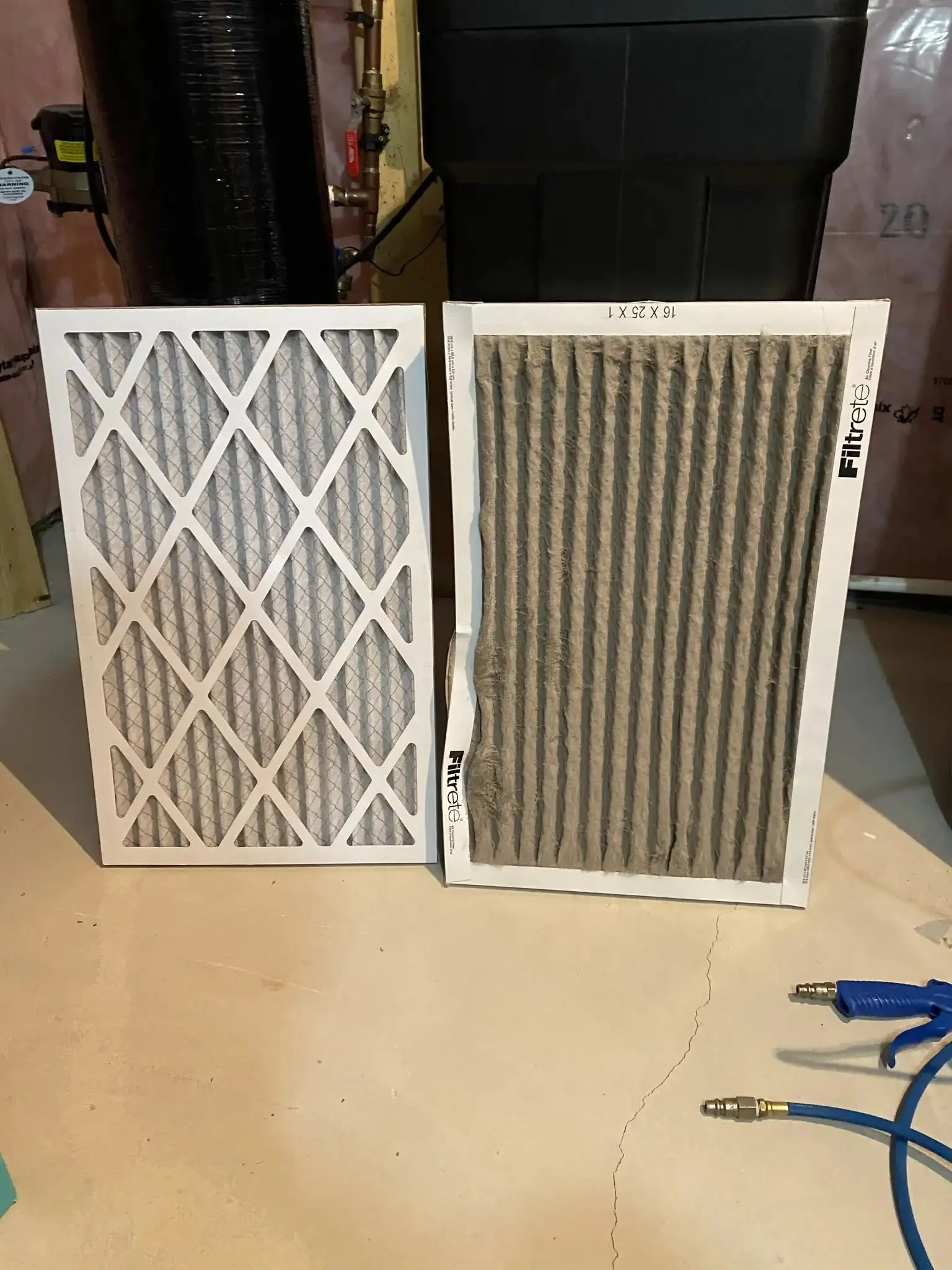
Not all air filter problems are obvious until you see the difference. J Martin helps Orange County homeowners stay ahead of clogged HVAC filters and poor airflow.
When Your Filter Isn't Enough
Filters are the first line of defense for indoor air quality, but they have inherent limitations. A filter only works on air that passes through it, and it only captures particles while the HVAC system is running. During the hours when the system cycles off, airborne particles continue to circulate and settle throughout the home. A filter also cannot address gaseous pollutants like volatile organic compounds (VOCs), cooking odors, or chemical off-gassing from building materials and furnishings.
For households with serious air quality needs, including severe allergy or asthma sufferers, immunocompromised family members, or homes in wildfire-prone areas where smoke infiltration is a recurring concern, a whole-home air purification system integrated with the HVAC provides continuous, active air cleaning that goes beyond what any filter alone can achieve. These systems use technologies like UV germicidal irradiation, photocatalytic oxidation, or electronic air cleaning to neutralize airborne pathogens and break down gaseous pollutants in addition to the particle filtration provided by the MERV-rated filter.
Our post on improving your indoor air quality covers the full range of options, from upgraded filtration to whole-home purification systems, and how they integrate with your existing HVAC equipment. For many Orange County homeowners, the combination of a MERV 11 or MERV 13 filter plus a properly sized air purification system provides the best balance of particle removal, pathogen reduction, and odor control.
If you're replacing your HVAC system entirely and want to build air quality protection into the new installation from the start, that's the ideal time to spec a media cabinet for deeper filters and consider add-on purification. The cost is lower when done as part of a new installation versus retrofitting later. Our HVAC replacement cost guide includes the full range of equipment options and accessories.
When to Call a Professional About Filtration
Most filter selection and replacement is straightforward enough to handle yourself. But there are situations where professional guidance is the right call.
If you've upgraded your filter to MERV 13 and noticed reduced airflow from your supply vents, increased noise from the blower, the system cycling on and off more frequently, or the system struggling to maintain temperature, the filter may be too restrictive for your system. A technician can measure the static pressure and determine whether the system can accommodate the higher-rated filter or whether a media cabinet upgrade is needed.
If you're consistently going through filters faster than the manufacturer's recommended schedule, with filters becoming visibly clogged in 30 days or less, there may be an underlying issue beyond normal particulate accumulation. Excessive filter loading can indicate ductwork leaks that are pulling unfiltered attic air into the system, a return duct that's undersized for the system's airflow requirements, or an unusual source of airborne material in the home.
If you've been diligent about filtration but your home still has persistent dust accumulation, musty odors, or occupants with unexplained respiratory symptoms, the issue may be in the ductwork rather than the filter. Deteriorated duct connections, microbial growth inside duct runs, or gaps in the duct system that allow unfiltered and unconditioned air to bypass the filter entirely are problems that no filter upgrade can solve. A professional duct inspection and cleaning addresses the source rather than the symptom.
And if your system is more than 15 years old and still running the original equipment, a conversation about the system's overall condition and remaining lifespan is more valuable than optimizing the filter alone. A $20 filter upgrade on a system that's two years from compressor failure is putting a bandage on a broken arm. You can read about what we look for when evaluating your system and why having the right technician matters.
Our Honest Recommendation
For most Orange County homes, MERV 11 is the right filter. It captures the particles that matter most for health and comfort, it costs roughly $30 to $70 more per year than MERV 8, it's compatible with nearly every residential HVAC system built in the last two decades, and it provides a meaningful upgrade over baseline filtration without creating airflow risks. Change it every 60 days, set a calendar reminder, and you're covered.
If anyone in your household has significant respiratory sensitivities, if you're in a wildfire-adjacent area, or if you want the maximum filtration available for residential HVAC, MERV 13 in a 4-inch media cabinet is the gold standard. The cabinet and filter combined cost less per year than running through 1-inch MERV 13 filters every 45 days, and it provides better airflow and more consistent performance.
MERV 8 remains appropriate for homes without pets, allergies, or elevated particulate exposure, particularly newer homes with tight building envelopes in lower-dust areas. There's no shame in running MERV 8 if it matches your needs. Spending more on filtration you don't benefit from is money that could go toward duct cleaning, insulation improvements, or system maintenance that produces a better return on investment.
Whatever MERV rating you choose, the filter only works if you change it. Set the reminder. Buy in bulk so you always have replacements on hand. And if you're not sure what your system can handle or what MERV rating makes sense for your specific situation, give us a call at (714) 462-4686. At J Martin Indoor Air Quality, we'll measure your system, evaluate your home's conditions, and give you a recommendation based on what your household actually needs, not on what generates the highest upsell. That's how we've earned the trust of over 5,000 Orange County families and a 4.97-star average rating. It's also why we've been doing this for over 15 years.
J Martin Indoor Air Quality proudly serves Yorba Linda, Anaheim Hills, Fullerton, Anaheim, Brea, Villa Park, Placentia, Orange, and communities throughout Orange County. California License #998956. Call (714) 462-4686 or visit jmartiniaq.com to schedule service.